Category: Hope in dark times

  • Blossoming Hope in Eco-dystopian times: Deniz Gezgin’s Eyes Wings Flowers Tails

    by Merve Günday

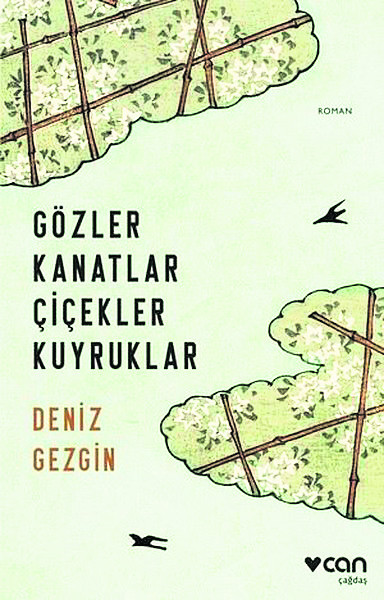
    Deniz Gezgin’s1 poetic novel Eyes Wings Flowers Tails (2023)2 welcomes its readers to a magical realist universe where weird and fantastic characters become the everyday victims of environmental degradation. Though plunged into the darkness of the exploitation of nature, its “[w]orld is more sudden than we fancy it/…crazier and more of it than we think/ incorrigibly plural” (MacNeice 24).

    The novel is set in a dystopian space where ecological balance is shattered and an inexplicable sense of fear looms around. In this setting, winters witness trees with budding branches, new seasons are lived every day, and winds continuously change their direction; everything is in the constant threat of rising water. What is more threatening, plants start to fly, seeds become lighter than ever, birds’ wings get shorter, seas turn into smoke holes while mine workers get poisoned, and following the death of trees even weeds and insects disappear. Moreover, the number of artificial species increases, and natural human-animal-insect subjects are replaced with talking puppets, toy animals, and artificial bees.

    Amidst the chaos of this shattered ecology reverberating with a dystopian sense of fear and anxiety, surprisingly “[a]ll the living beings are on the move, everything is in constant transposition” (Gezgin 13). I suggest that this movement implies in a way that there are still some glitters of hope blossoming despite all the death, sickness, or distress caused by the Anthropocene. 

    Only what Gezgin calls the Randoms (Gelişigüzeller) can cross the boundaries of rationality by slipping into the constant flow of waters and passing through closed roads. Unlike the Anthropos, notoriously intoxicated with the dream of gaining mastery over the nonhuman, the Randoms are not poisoned by this greed. They are not compelled by the linearity of time and they sense time only through light, similar to the way plants do. In the absence of linearity, “the corridors of the wind, water mouths, and gaps” become their homes (Gezgin 14)3. Gezgin doesn’t give a clear depiction of what she means by the Randoms. They address, I would argue, whatever resists the codes of binarism or mathematical formulation.                 
    Inspired by the Randoms, Luçe and Kara, two peripheral characters whose paths cross at the beginning of the novel, resist in this dystopian world.

    Echoing the spirit of the Randoms for regeneration, Luçe, the son of a mine worker named Siti, emerges from the magma of a volcano: sleeping in a cradle made of black ashes, he holds on to life. Similarly to Luçe, Kara is also depicted as a victim of ecological devastation: he is found in the middle of a burnt forest surrounded by ashes. Put in a mental institution together with other marginalized children, Kara is not allowed to get in touch with the outside world. However, unlike the others, he does not bend to the will of those who attempt to silence and tame him but rather confronts what lies beyond the cold walls of the institution. 

    In the midst of the unsettling Gezgin’s scenery where life and death and natural and artificial are difficult to distinguish, it is shown that the world is surrounded by infinite possibilities of liberation. To put it in the words of the narrator,

    “[a]lthough there were no flowers anymore, bees would see petals in the globules and find the nectar in this way…Aren’t globules opened on their own?…Nothing gets lost without leaving a trace…While the Randoms walk around all these traces, they are neither in the past nor in the future. Tails stars bones, lights waters volcanoes, everything is in a constant motion” (Gezgin 39)4.

    Despite the loss of bees and their replacement with artificial ones, there are still some natural bees that can find “eucalyptuses, downy oaks, and cedars in grains” (Gezgin 43)5. Motivated by the constant move of the Randoms, as mentioned earlier, Kara finds in the heavy rain that turns everything into mud an opportunity to create a new narrative: following the deep arcs opened by waters, he finds a road, but he does not falter. Rather, in a state of drowsiness, he finds a breach opened by the constant drops of water and follows Bohemian waxwings into the darkness. 

    Then, at the end of the tunnel, he meets wooden-legged Çilaba and the rock goat Patina who collect seeds from the few spaces remaining still uninvaded by the Anthropos and plant them in sandbags for their preservation. He also meets a puppet named Avel, who comforts Çilaba and Patina away from the harsh reality of the world by singing and playing. With his help, Kara discovers the world of poetry: “Poetry was a seed of transposition and growth sprouting infinite possibilities” (Gezgin 68)6.

    Having encountered such magical characters, Kara reaches the volcano presented at the very beginning of the novel and meets Luçe there. The novel ends with this encounter, implying the beginning of a new phase for both of them: they jump into the volcano crater hand-in-hand and as they pass through, they die into life. 

    In conclusion, despite all the exploitative practices of the Anthropos that erase nature’s blissful melodies, nature is always pregnant with multiple possibilities connecting everything like a rhizome and resisting immobility. As the author puts it in the last lines of the novel: “Wouldn’t the world turn upside down if the living always gathered on the same slope of the same hill?” (Gezgin 95). That’s what the Randoms represent in the novel. Given that the Randoms always find a way to freedom from the tyranny of ecological degradation, I argue that Eyes Wings Flowers Tails make our hopes blossom amidst the darkness of the Anthropocene. What is more important, the human-nonhuman hierarchy is overturned in the novel, as what unlocks the chains of stillness for Kara and Luçe is in fact the nonhuman.

    About the author

    Merve Günday completed her PhD in English Literature at Middle East Technical University (2022) with a thesis entitled “Alternative Subject Positions and Subject-Object Relations in Keats’s Poetry.”

    References

    • Gezgin, Deniz. Eyes Wings Flowers Tails (Gözler Kanatlar Çiçekler Kuyruklar). İstanbul: Can Publishing, 2023.  
    • MacNeice, Louis. “Snow” in Peter McDonald (ed), CollectedPoems: p. 24. London: Faber and Faber, 2007.   

    Footnotes

    1. Gezgin is a graduate of Protohistory and Asia Minor Archeology Departments at Ege University. She made her first entrance into literature with her novel Ahraz, followed by YerKuşAğı and Eyes Wings Flowers Tails.   ↩︎
    2. Gezgin’s novel hasn’t been translated into English yet. The translated sections of the work from Turkish to English belong to me. ↩︎
    3. “Gelişigüzellerin konağı rüzgâr koridorları, su ağızları ve boşluklar” (Gezgin 14).
      ↩︎
    4. “Orada artık hiç çiçek olmadığı halde arılar yuvalarda taç yapraklar görür, nektarları böyle bulurdu…Yuvarlar açılmıyor mu kendiliğinden? …Hiçbir şey iz bırakmadan sönüp gitmiyor…Gelişigüzeller bütün bu izlerin üstünde gezinirken ne geçmişte ne gelecekte. Kuyruklar yıldızlar kemikler, ışıklar sular volkanlar her şey kendi boşluğunda sonsuz hareketli” (Gezgin 39).  
      ↩︎
    5. “(…)zerrelerde okaliptüsleri, tüylü meşeleri ve sedirleri” (Gezgin 43). ↩︎
    6.  “Bir yer değiştirme ve büyüme kozasıydı şiir, sesle örülmüş deriyi soyunurken sonsuzca hareketin uç vermesi” (Gezgin 68). ↩︎
  • Rivers as Emblems of Hope and Resilience: Drowning and Resurfacing in the Ganga

    by Saloni Shokeen

    I still remember the extreme experience of drowning in the Ganga. A few years back, I went up the river with the intention of acquainting myself with rafting. As we got on our rafts, the river appeared to be calm and serene, except for a few rapids that shook the raft with great intensity. We were now moving closer to the end of our route and I was brimming with a sense of achievement and thrill.

    This was our last and most difficult rapid to cross. The waves hit our raft with unimaginable force, which made me lose all control. Within the next few seconds, I was one with the river, and the waves were carrying me from one end to the other. My fate was completely up to the river water now, since I could not anticipate where the waves would eventually take me. Although I was wearing a life jacket, I could have hit large rocks in the river while I was flowing like a leaf on its surface. It was becoming more and more difficult to not let the water suffocate me, I was struggling to keep my face above the surface. During these brief minutes of resistance, I witnessed the evening sun right in the middle of the valleys that surrounded the Ganga. With its low light, the sun was about to disappear into nothingness, and so was I. 

    All I could think of was getting just one more chance to live, and how I would lead a different life from hereon. The life that I had experienced so far flashed before my eyes, and I was filled with remorse for the precious moments wasted. I was not able to accept that this could possibly be the end of my life and this led my body to revolt more strongly. Exhausted, I almost surrendered to the nothingness that lay beneath the river, until a hand pulled me back up on the raft. Gasping for breath, rubbing my eyes in disbelief, I sat in deep quietude watching the river. 

    Over the years, people asked me what changed in my life after this accident, but it is impossible to translate such experiences into words. However, some changes did indeed happen, and they were majorly internal; I became more reflective, hopeful and humble. Moreover, I became grateful for each day of life and I formed a special connection with the Ganga. Instead of getting forever scared by its waters, they started representing immense hope, the place where a new and more conscious life began for me. 

    Meditating upon this incident, I wonder:” What is it about rivers that makes us calm and reflective?”. Standing on the banks of a river, an individual witnesses the unstoppable flow moving. An inevitable parallel that comes to our minds is that of the trajectory of life itself: similar to rivers, human life has to constantly overcome obstacles. The river, like life’s flow, does not stop, irrespective of the magnitude of challenges. In order to reach their destination, streams never stop. The breeze that swiftly moves above the water surface only symbolizes temporary disturbances. The patterns created by the wind are mirages. The human eyes see them appear and disappear every second. Whatever enters into the river surrenders itself to its waters and here it finds the place to express freely. The river water, as it symbolizes fluidity and transitionality, provides a special place for hope in our times. 

    The metaphor of transitoriness associated with rivers goes back to the rhetoric current of Ancient Greek philosophy of the 6th century BC. The following lines from Heraclitus’ works are the most famous today:

    A man cannot step into the same river twice, because it is not the same river, and he is not the same man.

    The two main ideas in Heraclitus’s philosophy are the doctrine of flux and the unity of opposites.  It is difficult to locate the complete body of work where Heraclitus said this sentence, or point to what he exactly meant by those words. Nonetheless, this line greatly influenced thinkers that succeeded Heraclitus, and most of all Plato and Aristotle. Although Heraclitus is considered as a pessimistic philosopher, in my opinion the river could be an emblem of choices and alternatives: by emphasizing the natural flow of the river, Heraclitus describes the succession of momentary situations. If nothing is permanent, the possibility of positive change will always persist. After a steam leaves the river, a new one enters and fills the heart with hope. 

    One could argue that Heraclitus is mourning the instant gone forever and that will never return. That is to say, we can never turn time backwards just as a stream cannot reverse its route. But in the context of human life, it also signifies that opportunities continually arise in our present world. The river, similar to life, unendingly rejuvenates and revitalizes itself. Rather than being remorseful about what is lost forever (if anything really is), can we imagine a scenario where re-entering into the river flow is better than before? In other words, perhaps a new moment was worth the wait and the hope? Especially in a planet that is increasingly threatened by anthropogenic activities, can rivers become embodiments of respite? 

    Across the globe, rivers hold distinct cultural and social value. By virtue of belonging to particular geographies for centuries, rivers greatly influence the language and knowledge systems. Rivers have intricate relationships with human beings, especially those who live in close proximity to them. This is a difficult thing to trace and map out. W.H Herendeen’s essay The Rhetoric of Rivers, analyzes history of river representations in literature and philosophy. Herendeen’s argument is that rivers are the central repository of wisdom for mankind. Rivers evoke a feeling of reflectiveness that leads to meditating upon life. This is intimately tied, Heredeen states, with the geographical and social existence of a river. It embodies the voice(s) of a specific region and informs its people’s identity. A prime example of this is the significance of the Ganga river in Hinduism. The first words that come to one’s mind when the name Ganga is mentioned are purity and liveliness. Apart from the religious associations, the river has an ecologically rich life that we cant see from the surface. Over the years, the Ganga has been represented across Indian literature and films. In the national award winning movie Massan (2015), the Ganga becomes the epitome of hope, depicted through the metaphor of confluence. Ironically, the title Massan, literally translates into “crematorium”, yet the story ends on a hopeful note for the two main characters of the movie Devi and Deepak. 

    Deepak, an engineer in the making, works with his family as they cremate bodies on the banks of the Ganga. In the Hindu tradition, the Ganga is considered to be the ultimate pious place for the rebirth of human life. When cremated on the banks of the Ganga, a soul never ‘dies’. The river waters symbolizes immortality and rejuvenation of the soul. One day, without any prior warning, Deepak receives his girlfriend’s body, which he must cremate. In the same period of time Devi loses her beloved boyfriend, while also being shamed for having an intimate relationship with him outside of marriage. Her entourage, even her father, begins to question her ‘purity’, and the movie portrays the hardships she encounters facing a patriarchal society. The Ganga is a constant part of both their lives. Despite the tragic screenplay, Massan ends on an optimistic note where the audience is left full of hopefulness. In the final scene, Devi and Deepak’s stories come naturally together as two streams flowing in the same direction: they accidentally meet on a boat, as if the river were bringing them together. 

    They will never swim in the same river again, yet the tragic past they have already lived through has come to an end. Nothing could take away their hope, because life’s flow never stops. It might just change its course temporarily. Heraclitus’ lines encapsulate the transitoriness central to human life and have strong echoes in this situation: Deepak, after cremating his past, has to eventually overcome his grief, and so does Devi, for if they had lost all hope they could not meet each other. Massan’s ending, along with Heraclitus’ thinking, could offer us a generative method to think about rivers. 

    Hope is perhaps the rarest emotion to find in our times. Everyday, our anxiety escalates after reading shocking news about climate change and increasing instances of violence worldwide. This pessimism does not let us appreciate the beauty of the present moment, and makes us feel hopeless and lost.

    I would leave you with these questions: is it still possible to feel a glimmer of hope for our future? Moreover, is it possible to gather the courage to welcome change, and believe it doesn’t have to always be negative? Despite the unfortunate scenery, can we really afford to miss the present beauty that surrounds us? 

    About the author: 

    I am Saloni Shokeen, instructor and PhD scholar at SUNY Binghamton. Here at Binghamton I have so far undertaken specialization courses in environmental literature. This is in fact my primary area of research, as I am interested in how different forms of storytelling can enlighten our minds on the subject of climate change. Within the broad field of environment, I am curious about water bodies, and especially in how rivers prefigure literary narratives: along with being a significant resource to any civilization, rivers shape our cultural and personal horizon in various ways. Belonging to specific regional geographies, rivers represent multiple voices at once, enriching our knowledge. While this is one of my major interests, through my research I also look at interspecies, planetary and animal studies. My goal is to find generative and sustainable methods of research that expand our understanding of nature.

    References

    • Herendeen, W. H. “The Rhetoric of Rivers: The River and the Pursuit of Knowledge.” Studies in Philology, vol. 78, no. 2, 1981, pp. 107–27. JSTOR, http://www.jstor.org/stable/4174068. Accessed 10 April 2024.
    • Kirk, G. S. “Natural Change in Heraclitus.” Mind, vol. 60, no. 237, 1951, pp. 35–42. JSTOR, http://www.jstor.org/stable/2251397. Accessed 10 April 2024.
    • Stern, David G. “HERACLITUS’ AND WITTGENSTEIN’S RIVER IMAGES: STEPPING TWICE INTO THE SAME RIVER.” The Monist, vol. 74, no. 4, 1991, pp. 579–604. JSTOR, http://www.jstor.org/stable/27903264. Accessed 10 April 2024.
    • Colvin, Matthew. “Heraclitean Flux and Unity of Opposites in Plato’s ‘Theaetetus’ and ‘Cratylus.’” The Classical Quarterly, vol. 57, no. 2, 2007, pp. 759–69. JSTOR, http://www.jstor.org/stable/27564109. Accessed 10 April 2024.