Tag: narrative

  • Waterwork: The Clash Between Social Rights and Fossil Capitalism in Norwegian Fiction

    by Karl Emil Rosenbæk Reetz

    Norway – a nation where oil production was born at sea – is by far the largest producer of fossil fuels in Europe. The second largest, the UK, is distanced by a factor of 2.3 according to the EIA (disregarding the Eurasian fossil mastodon of Russia).[1] To zoom in on Norway is therefore an obvious way to grab the question of the so-called green transition championed by Western and especially European nations by its horns and scrutinize the black, extractivist foundation on which it often stands. In this sense, the political discourse of sustainability can be boiled down to an unrealisable fantasy of a green transition without real transformation of any sorts. Here, I will show how ‘roustabout narratives’ from Norway – stories depicting the absurdly profitable offshore oil enterprise of this nation – display how the green paradox is closely related to a long socialist history of class struggle and worker rights.

              Focussing on two recent novels, I urent farvann (2020; In Muddy Waters) by Sidsel Mørck and Puslingar (2019; Mannikins) by Atle Berge, I showcase how they register aspects of offshore austerity related to a corporate trend of cutting expenses in a globalised economy. Cutbacks, untrained personnel working at a lower salary, postponements of regular safety reviews, and use of expired equipment as well as other sorts of measures to ‘trim the fat’ and push the limit, constitute what I term a North Sea peripheralisation of safety. In that sense, these Norwegian offshore petrofictions are best understood as additions to a long tradition of fossil fuel working-class literature from the Global North where issues of safety have surfaced repeatedly as a signifier of class struggle.

    “WE RUN A BUSINESS, NOT POLITICS”

    First, let us look at Sidsel Mørck’s novel I urent farvann. In this bildungsroman about social mobility and national oil development, we follow the protagonist Ole Viktor. Ole Viktor is the only child of a working-class family with firm connections to the labour union. In the beginning of the novel, his father works at a steel nail factory and often goes to after-hour meetings in the local trade union. Later, the father works as a roustabout on a drilling rig at the Ekofisk field in the North Sea, and the father’s background as a factory worker hired under collective agreement comes forth again. When he is onshore, he often talks about the ‘wild west’ security issues offshore and about how he and his fellow roustabout Lars are working on unionising the workforce. But before this ambition of oil labour organisation is ever materialised, he is involved in an accident that crushes his right shoulder. Following the accident, he receives some insurance money and then lives the rest of his life on cash benefits provided by the Norwegian state.

              The timespan of the novel – from the late-1960s onwards – corresponds to the development of Norwegian oil, and further, Ole Viktor’s adulthood, growing up to be an oil engineer, is organised as a tour de force through real Norwegian oil developments, incidents, and scandals both domestic and international. Following Ole Victor’s white-collar employments, I urent farvann, however, focusses on the management level rather than that of roustabouts employed on oil platforms. In this way, the novel registers a socioeconomic and cultural move away from a locally oriented working-class perspective to a globalist middle-class stance. In the novel, this shift is furthermore connected to a decreased social-democratic collectivist position replaced by a liberalistic individualised concern about career and self-fulfillment. “We [run] a business, not politics,” Ole Viktor says, whenever there are problems. Societal concerns and moral conundrums are simply outside the scope of multinational oil enterprises in the neoliberal zeitgeist, the novel asserts.

              Furthermore, as Ole Viktor grows up and gets involved in the oil industry as an engineer, his father functions as an idealistic figure calling him up whenever there is an oil-related accident urging Ole Viktor to do something. Invalidated, the father cannot live out his own ambition of unionising the offshore workforce and consequently the burden is put on his son to reform the oil business. Yet, Ole Viktor quickly begins to pivot towards another stance altogether. The father’s class struggle orthodoxy begins to feel burdensome to Ole Viktor and an instance of cultural patricide can be observed in his life choices. Slowly he turns away from the collectivist ideal and towards becoming what he himself terms “a company man” with a conservative, unapologetic slogan of capitalist reality: “That’s how the world is, take it or leave it.”

              The novel is driven forward by exactly this blue-collar/white-collar dichotomy. Central to the plot is the clash within the family constellation of two distinctive perspectives. On the one side; collectivism and social politics, and on the other side; individualism and capitalist necessity. As such, the novel takes shape as a small chamber play between father and son reflecting larger societal alterations in both the labour market and the national debate over the Norwegian offshore oil enterprise.

              I urent farvann is saturated by a defeatist ethos when it comes to believing in changing the oil enterprise substantially. However, this overall tone of capitalist surrender is suddenly upended on the very last pages of the novel. Throughout the novel, Ole Viktor’s daughter Vera has disarmingly been called “Vesla” (meaning ‘the little one’) by both father and grandfather. But now, instigating her own much more outspoken generational rebellion, Vera tells Ole Viktor that she will study “green economics.” With this rebellious choice and some harsh words against her father’s complicity in the emission of greenhouse gasses, Vera seems to personify the environmentalist aura of Greta Thunberg and the green youth movements more generally as she argues for an alternative study of economy. The ideology that has guided Ole Viktor’s life is confronted and his ‘apolitical’ self-image is being revealed as a highly political stance. Still very much in its infancy, then, the novel ends up suggesting that a new world order could be on the rise driven by the next generation. Just as Ole Viktor himself was part of a massive social, economic, cultural, and political transformation in his time.

    RURAL OIL

    Puslingar by Atle Berge is also structured as a bildungsroman following the child Marita from 1980 till 1991. Marita lives with her parents in a rural neighborhood adjacent to the port city of Bergen where the area’s oil-industry is centred. Throughout the novel an identity-conflict between the urban city and the rural surroundings emerges, but the main story of the book concerns the real Norwegian event of the offshore capsizing of the oil platform Alexander L. Kielland (March 27, 1980) and its traumatic influence on Marita’s teenage life. Her father, Jonny, is one of the victims of the accident leaving Marita alone with her mother Astrid. Some years after the accident she is suddenly approached by one of Jonny’s old friends, Trygve, who was with Jonny at Kielland. And with the help of Trygve as well as her bookish classmate called Settembrini, Marita slowly becomes more and more interested in the accident.

              As Marita and Trygve begins to dig deeper into the possible causes of the accident, the novel makes use of the still-existing distrust towards the official inquiries and reports that were made after the accident. The novel is filled with gestures towards these reports’ explanations as well as references to other mysterious circumstances omitted from the inquiries.

               With this general tone of distrust in the activities of the government, the novel registers a dialectic between rural workers and a seemingly clandestine ruling class. There is a visible animosity towards urbanity and all the connotations that go along with it – power, influence, higher education, capital. This dialectic is one of the defining features of fossil fuel working-class literature. Us, the authentic, down-to-earth working-class, versus them, the capitalist vultures who live withdrawn in their mansions and club houses. Consequently, the general tone of the novel is that the ‘strong forces in the society’ are less occupied with figuring out exactly what happened at Kielland then they are with ensuring that the North Sea region’s contribution to the world-systemic business of oil production carries on.

              As Marita continues to question the reports, we also see how she is finally reproached by her mother and her stepfather Einar in this somewhat timid fashion: “Sometimes you just have to let things go. People who don’t manage to forget and move on eventually becomes unbearable to be around” (223). It is okay, it seems, – even expected – to be critical and almost conspiratorial against the urbanites in the abstract, but it is best not to become too concrete in one’s criticism and skepticism. The emphatic conviction of elitist malpractice must not turn into real political agency. The very last page of the novel describes how Marita also draws this conclusion herself as she thinks: “People who can’t manage to forget are unbearable. People want to forget, need to forget, just as the nation needs to forget in order to live with itself” (247). Subtle, Atle Berge is not. The reader is firmly guided to draw a particular conclusion about the sincerity of the official inquiries on Kielland.

              And yet, it is rarely the oil and therefore also the oil-work itself that is being criticised in these roustabout narratives. An affinity towards the oil enterprise seems to linger on in the cultural unconscious as the energy workers can be said to forego their body to keep the nation both powered and proud: Ole Viktor’s father literally sacrifices his arm in the nation’s service. So, while the author of Puslingar has some critical comments on oil production as well as the comprehensive oil culture, it is interesting to note how adamantly the protagonist Marita defends the wonders of oil. Fittingly, the novel ends with her lifelong dream of enrolling as an oil engineer student being realised. For Marita, the problem is not the extraction of oil from the seabed, but the loose regulations and the corporate inclination to cut costs on behalf of the safety protocols.

              Marita is obviously haunted by the tragic loss of her father, yet, growing up in the rural outskirts of Bergen oil still constitutes the best and often only way to realise a prosperous (and aspiring) future. For these rural working-class families, the oil rig is tragic in a double sense then. It is the haunting accident of the past and still the only possible future.

    CONCLUSION

    To conclude, a clear tension is registered in these recent Norwegian roustabout narratives. On the one hand, they expose a neoliberal ideal about cost-efficient fossil fuel enterprises driven without organisationally imposed measures or governmental restrictions. On the other hand, they argue for worker-oriented oversight based on a moral sense of righteousness. Another way to frame this is to say that these working-class oil fictions illustrate an imperfect match between world-systemic fossil capitalism and the Nordic welfare state model.

              When thinking of the historical legacy of Norwegian oil revenue, this internal conflict is perhaps not that surprising. In Norway, a discussion of ownership and control has always been in the foreground. At the beginning of the Norwegian North Sea endeavour, environmental and industrial concerns went hand in hand at the governmental level. In 1971, the Government of Norway decided on ‘ten oil commands’ revolving around the management and control of this burgeoning industrial sector. In the mid-1970s, to avoid what is called the ‘Dutch Disease’ where rapid growth in one sector of the economy causes decline in other sectors and to prevent ecological depletion, the Government furthermore decreed a principle of ‘moderate extraction tempo.’ However, this principle was eventually overhauled by grand expansions to the Norwegian North Sea territory in the late 1980s. And then, the culminating success of developing the oil sector while preventing a sudden decline in other parts of the economy came in 1990 with the construction of a sovereign wealth fund – Statens pensjonsfond utland – internationally known as the Norwegian Oil Fund.

              The unique construction of the Oil Fund works to ensure that the revenue from offshore oil and gas extraction benefits the Norwegian public, but it has not entirely eliminated the tension between oil workers and managers. Thus, core class related questions of who benefits from who, how to secure right and proper distribution of wealth, and how the local and national history of offshore oil is to be told still saturates Norway.

              These contemporary Norwegian roustabout narratives, I argue, invoke a nostalgic longing for a strong welfare system of social security and worker rights – a thus another world possible – while showcasing how the reality of fossil capitalism’s neoliberal search for cost-cuts has played out in recent decades. As such, they extend to the waterscape the tradition of working-class fiction as they register and critically comment upon the offshore perspective of the continuing, deregulated fossil world economy in an era of havocking climate changes.

    Reworked paper presented at the EASCLE Symposium: Sea More Blue: Interdisciplinary Approaches to Blue Ecopoetics, June 17-20, 2024.

    About the author:
    Karl Emil Rosenbæk Reetz, PhD, is a postdoctoral researcher in the Department of Culture and Language at the University of Southern Denmark.


    [1] Visit https://www.eia.gov/international/rankings/world?pa=288&u=2&f=A&v=none&y=01%2F01%2F2022

  • Organic Farming: A Spirit of Ecofeminism in India

    Organic Farming: A Spirit of Ecofeminism in India

    According to the Food and Agriculture Organization (FAO), organic farming is a production management system that is unique and promotes biological cycles, biodiversity, and biological activity in the soil [4]. This is accomplished by using biological, mechanical, and farm-based agronomic approaches while reducing the amount of synthetic farm input from outside sources.

    The primary goal of organic farming is to enhance the interdependent communities of flora, animals, soil, and humans as well as their ability to produce food and maintain their health (Scialabba and Hattam, 2002) [6].

    Origin of Organic Farming in India

    The main historical examples of organic agriculture in India revolve around the following:

    Period/Literature  Description of organic farming
    Ancient periodNeolithic civilizations used this 10,000-year-old tradition, which was also embraced by Mesopotamian and other civilizations like the Hwang-Ho.
    RamayanaDead matter that returns to the earth, such as trash or rotting corpses, is transformed into nutrient-rich material. According to C. Rajagopalachari, it is Mother Earth’s power.
    Mahabharata (5500 BC)There have been references to the celestial cow, Kamadhenu. Its contribution to human existence and function in ensuring soil fertility has been described.
    Arthashastra by Kautilya (300 BC)Refers to various kinds of manure, including oil cakes and animal excrement.
    Brihad-Sanhita by VarahmihirExplains the numerous ways to collect manure and how to choose the right manure for different types of crops.
    Rig-Veda (2500–1500 BC)The Rig Veda 1,161,10 (written between 2500 and 1500 BC) and the Atharva Veda II 8.3 (written around 1000 BC) both provide descriptions of organic farming. In Vrksayurveda, Surpala also makes reference to manure. According to the Sukra, a plant needs water, meat, excrement from cows, goats, and sheep, among other things, to develop healthily (IV, V, 94, 107-112).
    Holy Quran (590 AD)An indication of harvest and recycling is the return of one-third of the portion removed from the soil.

    Source: Bhattacharya and Chakraborty, 2005

    Organic Farming and Indian Women

    In the arena of Indian culture, a woman is particularly called “Prakriti” which in its literal sense means “Nature”[8]. Prakriti is the feminine essence for conservation, development, and being purely ecological. She is also referred to as “Shakti”, who furnishes energy to steer the living system.

    In present times, the organic farming movement has taken the form of a social movement. India, the holder of the oldest agricultural fields in the entire world where agriculture has been practiced for around 10,000 years, has women as the leaders in organic farming [2]. Indian female farmers devote a significant amount of their work hours on farmlands, which is much above than those invested by male farmers. During the sowing and harvesting seasons, women spend 3300 hours on the fields while men do it for 1860 hours [3]. Women’s contribution to nature supports sustainable development and agricultural systems. This hypothesis develops a stronger bond between women and organic farming.

    In the Odagaon region of Nayagarh district, Odisha, an area of 90 acres of degraded forest has been transformed into a forest that provides food for the nearby population. The idea of change was first sown in Sabarmatee’s mind in the 1980s, when she began experimenting with her father on the land for cultivating organic food [5]. Later, when the efforts started to bear fruit, a non-governmental organization called Sambhav was founded. Today, this organization is aimed at promoting ecological conversation, women capacity, and organic farming. Sabarmatee has done a brilliant job of collecting and preserving 800 varieties of seeds of indigenous origin, which have a strong relationship in combating climate change. Greater than 30 varieties of seeds withstood the cyclonic storms between the time periods 2013-2014.

    Rohibai Popre has the face of a leader of the organic farming movement in Maharashtra [9]. Without any formal education, Rohibai has been successful in leading a women-oriented agro-biodiversity initiative. She has cultivated 17 crop varieties on 50 acres of farmland and shares her knowledge with 3,500 farmers. Her seed bank is meant for the conservation of 122 landraces of 32 crop varieties.

    Bibi Kamaljit Kaur made her endeavor in the field of organic products and farming. Around 39% of the soil in Punjab is absolutely degraded owing to over irrigation. In 2019–20 and 2020–21, the use of pesticides was 4995 MT (technical grade) and 5193 MT (technical grade), respectively, in the state of Punjab [1]. With keeping in mind the paramount damage caused to the environment from the aforementioned factor, organic farming being done by Bibi Kamaljit Kaur in Punjab has assisted in breaking the toxic web of inorganic farming based on pesticide and chemical use. After participating in a seminar by the Agriculture Heritage Mission, Bibi Kaur learned about the negative impacts of pesticides on the environment and human health. Soon she got trained and well-informed about organic farming and started to practice the same in her kitchen garden. She had reached farmers from over 20 neighboring villages and imparted knowledge about the deadly consequences of using harmful chemical fertilizers. Inspired by her, the villages of Bhotna, Malliya, and Chughan have undergone a shift towards organic farming. Presently, she has received overwhelming support from 2000 women farmers and runs 2000 organic kitchen gardens.

    Two villages named Damodarpur and Murakhati in the Jhargram district of West Bengal narrate the revolutionary stories of two women organic cultivators.Panchabati BaskeandNirmala Mahato have seeded organic indigenous rice varieties in their individual villages. These women organic farmers are leading movements at the grassroots level. 55 male and 21 female farmers are each associated with them in Damodarpur and Murakhati villages, helping and making each other realize the power of organic agriculture and womanhood [7]. Rice varieties, namely Kalabhat, Sathia, Kerala Sundari, and Mallifullo, are being grown in the district. With time, the number of women organic cultivators has increased to over 4500 in all 5 gram panchayats of Block Nayagram in the district Jhargram. As per Panchabati, they are saving Rs 4000-Rs 5000 per bigha[1] in relation to fertilizers, and there is hardly any difference witnessed in the crop yield. For additional income plates made up of sal leaves are sold by the women supported by the women enterprise Aamon.

    Conclusion

    Organic farming has done the work of improving women’s role in Indian agriculture. The above-listed real-life examples are a clear indication of the same. This process of women’s involvement in organic farming needs to be constantly ameliorated. Active entrepreneurship opportunities, education, social and environmental justice, equity, farming rights, training, and skill development are some of the ways that can assure their vital contribution to organic farming. This must continue.

    References

    1. CONSUMPTION OF CHEMICAL PESTICIDES IN VARIOUS STATES/UTs DURING 2017-18 TO 2021-22. (2022, July 22). Directorate of Plant Protection, Quarantine, and Storage, Ministry of Agriculture and Farmers Welfare, Government of India. https://ppqs.gov.in/statistical-database
    2. Fernandes, S. (2017, June 17). Farming took root in India only 10,000 years ago, study finds. Hindustan Times. https://www.hindustantimes.com/mumbai-news/farming-took-root-in-india-only-10-000-years-ago-study-finds/story znhMgOYjQOWWtgX49PkUsJ.html
    3. Kamdar, B. (n.d.). Women grow as much as 80% of India’s food – but its new farm laws overlook their struggles. The Conversation. https://theconversation.com/women-grow-as-much-as-80-of-indias-food-but-its-new-farm-laws-overlook-their-struggles-155083
    4. Organic Agriculture: What is organic agriculture? (n.d.). https://www.fao.org/organicag/oa-faq/oa-faq1/en/
    5. Padma Shri For Father-Daughter Who Transformed Wasteland Into A Forest. (n.d.). NDTV.com. https://www.ndtv.com/offbeat/padma-shri-for-father-daughter-radha-mohan-and-sabarmatee-who-transformed-wasteland-into-a-forest-2175441
    6. Scialabba, N. & C. Hattam, Eds. (2002). Organic agriculture, environment and food security. Environment and Natural Resources Series. Rome, Food and Agriculture Organization of the United Nations (FAO). (n.d.-b). http://www.sciepub.com/reference/90645
    7. Singh, S. S. (2022, August 21). Women farmers of Bengal’s Jhargram reap fortunes with organic rice. The Hindu. https://www.thehindu.com/news/national/other-states/women-farmers-reap-fortunes-with-organic-indigenous-rice-varieties-in-bengals-jhargram/article65790956.ece
    8. The Incarnate Word. (n.d.). https://incarnateword.in/dict/sans/prakriti-1
    9. Wikipedia contributors. (2022, July 25). Rahibai Soma Popere. Wikipedia. https://en.wikipedia.org/wiki/Rahibai_Soma_Popere

    [1] Bigha is a unit for land measurement in northern India.


    Sonali Sharma is the author of this post.

  • The Eco-Gender Gap: When Sustainability Became a Women’s Issue

    The Eco-Gender Gap: When Sustainability Became a Women’s Issue

    When looking at the faces of the sustainability movement, what do you see? A campaign for environmental justice that is synonymous with names like Jane Goodall, Alexandria Ocasio-Cortez, Greta Thunberg, Autumn Petlier, Vanessa Nakate, and Sylvia Earle. Companies dedicated to sustainability, such as Blueland, Stasher, and Bite are led by Sarah Paiji Yoo, Kat Nouri, and Lindsay McCormick, respectively. Women are the advocates, voices of change, and the ones paving the future.

    This trend is called the eco-gender gap, a term created by British marketing company Mintel to describe the “difference in environmental awareness and eco-friendly behavior between men and women, with men being much less likely to feel connected to these issues than women” (Liddell, 2021). Sustainability has become a women’s issue, and in turn, their responsibility. Much of this plays into gender roles, gender-based personality differences, and marketing, as corporations provide gendered messages about sustainability.

    The authors of “Is Eco-Friendly Unmanly? The Green-Feminine Stereotype and Its Effect on Sustainable Consumption,” published in Journal of Consumer Research in 2016, examined this systemic issue, delving deep into working to find the root cause of why the majority of men will not purchase sustainable products. Their studies asked men and women to designate products as either “green” or “non-green”, “feminine” or “masculine”, to choose a product as “better for the environment” or “better at performing ___”, and to gauge affinity for eco-conscious wording and imagery. Across all metrics, green products almost always equated to femininity and were therefore avoided by men. Associating greenness with femininity may also explain why “women display greater concern and willingness to take action to help the environment… across age groups and countries… in contrast, men litter more, recycle less, have a larger overall carbon footprint, and feel less guilty about living a non-green lifestyle” (Brough et al., 2016). There are larger repercussions of this association, as it “may discourage men from engaging in green behaviors, particularly if they are motivated to maintain a macho image and wish to avoid being stereotyped as feminine” (Brough et al., 2016).

    Men feeling turned away from sustainable products parallels women feeling drawn in. Though women might in part feel inclined to make sustainable choices to enhance their femininity, they also face more “eco-anxiety,” a chronic fear of environmental doom (American Psychological Association). Globally, women are more susceptible to the effects of climate change, despite men causing more environmental damage, from avoiding sustainable practices like recycling or using less electricity where possible to engaging in “petro-masculinity,” a denial-rooted, climate-destructive reaction – from mostly white, politically conservative men –  to the fear of environmental crisis where they choose to consume the most pollutant energy in response to being told to reduce (Nelson, 2020).  Natural disasters disproportionately affect people in poverty, which is often communities of women, children, elderly, and disabled people. Studies have even shown that “gender-based violence, including physical, psychological, and reproductive violence against women, becomes more prevalent after natural disasters, with complex… consequences on health and well-being” (Gloor et al., 2022). Researchers have also seen an uptick in hormonal imbalance disorders such as polycystic ovary syndrome linked to the consumption of endocrine-disrupting microplastics. Microplastics were also just discovered in breast milk (Ragusa et al., 2022). On the consumer side, women are told their bodies are hurting the earth, from cosmetics to menstrual products, and told to make better – often more expensive – choices before it is too late. Perhaps most importantly, women are typically the main caregivers to their children, who will grow up in a polluted world. Creating a better future for their well-being is the most influential drive of them all.

    The first step in closing the eco-gender gap is to normalize men caring about the climate. In the consumer product industry, companies themselves create much of the issue. Women predominantly assume responsibility for purchasing goods for the household, and thus the items are tailored to them. Some of the most prominent sustainable products are for cleaning, cosmetics, clothing, storage, and office supplies, categories falling within a woman’s stereotypical responsibilities. Men can feel uncatered to and simply avoid sustainability for fear of being seen as feminine. This pattern appears repeatedly and ranges from choosing vegan or vegetarian diets to bringing a reusable shopping bag to a store. These trends have been helpful in spreading awareness, but it is crucial that all genders climb aboard.

    The authors of “Is Eco-Friendly Unmanly?…” designed a solution to address the eco-gender gap: explicitly catering eco-conscious services and products to men. In an experiment with two hypothetical conservation nonprofits, one called Friends of Nature with a tree logo (feminine directed) and one called Wilderness Rangers with a wolf logo (masculine directed), it was found that though both nonprofits carried the same values, Wilderness Rangers attracted more men (Brough et al., 2016). Additionally, they found that while Friends of Nature attracted women yet turned men away, men and women were similarly likely to donate to Wilderness Rangers (Brough et al., 2016). If women are not deterred by clear masculine branding, perhaps this is a solution in catering to everyone.

    As we look at sustainability, we must remember that its core value is caring for the earth. In our patriarchal society, women are assigned the role of caregivers, and the idea of sustainability being a “women’s issue” is “already insidious due to the persistent portrayal of women as caregivers – even of the planet” (Abbiss & Hunt, 2020). Men often hold the most power, especially leading companies responsible for pollution. Watching nineteen-year-old Greta Thunberg in a room of older men encapsulates the gender-based power dynamic embedded in environmental dicussion, demostrating “for climate skeptics, it was not [only] the environment that was threatened; it was a certain kind of modern industrial society built and dominated by their form of masculinity” (Abbiss & Hunt, 2020). Women will continue to lead the way and make change, and thankfully, younger generations of men seem more open to sustainable practices as our livelihoods are eminently threatened. While we have many advocates, women are still outnumbered in many spaces where it counts most. Women make up 27% of STEM roles, 29% of corporate senior management roles, and 25% of US congressional roles. It is especially crucial to open more opportunities for women to bring sustainability issues to the forefront and provide the necessary support to create change.

    As the need to live sustainably grows omnipresent, it is important to remember that everyone – regardless of gender – is responsible for working towards a solution. Society needs to move closer to making sustainability a movement everyone feels welcomed, affirmed, and empowered.

    Bibliography

    Ballew, M., Marlon, J., Leiserowitz, A., & Maibach, E. (2018, December 12). Gender

    Differences in Public Understanding of Climate Change. Yale Program on Climate Change Communication. Retrieved October 4, 2022, from https://climatecommunication.yale.edu/publications/gender-differences-in-public-und erstanding-of-climate-change/

    Brough, A. R., Wilkie, J. E., Ma, J., Isaac, M. S., & Gal, D. (2016). Is Eco-Friendly Unmanly? The Green-Feminine Stereotype and its Effect on Sustainable Consumption. Journal of Consumer Research, 43(4), 567–582. https://doi.org/10.1093/jcr/ucw044

    Gloor, J. L., Mestre, E. B., Post, C., & Ruigrok, W. (2022, July 26). We Can’t Fight Climate Change Without Fighting for Gender Equity. Harvard Business Review. Retrieved October 4, 2022, from https://hbr.org/2022/07/we-cant-fight-climate-change-without-fighting-for-gender-eq uity

    Hunt, E., & Abbiss, R. (2020, February 6). The Eco Gender Gap: Why is Saving the Planet Seen as Women’s Work? The Guardian. Retrieved October 4, 2022, from https://www.theguardian.com/environment/2020/feb/06/eco-gender-gap-why-savingplanet-seen-womens-work

    Liddell, A. (2021, May 7). The Eco-Gender Gap. Cherwell. Retrieved October 4, 2022, from https://cherwell.org/2021/05/07/the-eco-gender-gap/

    Mintel Press Team. (2018, July 27). UK Women Try to Live More Ethically Than Men. Mintel. Retrieved October 4, 2022, from https://www.mintel.com/press-centre/social-and-lifestyle/the-eco-gender-gap-71-of-w omen-try-to-live-more-ethically-compared-to-59-of-men

    Nelson, J. (2020). Petro‐Masculinity and Climate Change Denial Among White, Politically Conservative American Males. International Journal of Applied Psychoanalytic Studies, 17(4), 282–295. https://doi.org/10.1002/aps.1638

    Piyatissa, Y. (2021, May 22). What Is The Eco Gender Gap and How Can We Bridge It? IVolunteer International. Retrieved October 4, 2022, from

    Ragusa, A., Notarstefano, V., Svelato, A., Belloni, A., Gioacchini, G., Blondeel, C.,

    Zucchelli, E., De Luca, C., D’Avino, S., Gulotta, A., Carnevali, O., & Giorgini, E.

    (2022, June 30). Raman Microspectroscopy Detection and Characterisation of

    Microplastics in Human Breastmilk. Polymers (Basel). 2022 Jun 30;14(13):2700. doi:

    10.3390/polym14132700. PMID: 35808745; PMCID: PMC9269371. Retrieved

    October 29, 2022, from https://www.ncbi.nlm.nih.gov/pmc/articles/PMC9269371/

    Wallis, J. (2021, July 26). Why Do Women Experience More Eco-Anxiety Than Men? Is There A Sustainability Gender Gap? Retrieved October 4, 2022, from https://www.refinery29.com/en-au/sustainability-gender-gap


    Sophie Bravo is the author of this post.

  • A Case for Denise Levertov as an Ecofeminist

    A Case for Denise Levertov as an Ecofeminist

    Ecofeminism was not refined in its usage until the 1980’s when Levertov was losing popularity as a poet, so it is unlikely she ever would have used this term in her life (ignoring the fact that she did not want to be labelled as a feminist in the first place), however, her work and personal ideologies closely aligns with the general theories of ecofeminism established and refined throughout her lifetime. Most ecofeminist work written during the ’70s centres around “dualisms such as woman-nature that worked in opposition to that of men-culture” (Estévez-Saá and Lorenzo-Modia 126). These dualisms are the subject of many of Levertov’s early poems such as “Losing Track” and “Stepping Westward,” making her one of the trailblazers of this movement.

    Many of Levertov’s poems use the moon or tides as a metaphor for celebrating her innate femininity, which follows one of Gretchen Legler’s, an ecofeminist literary critic, “emancipatory strategies” of ecofeminist criticism. In Levertov’s “Stepping Westward,” she says, “If woman is inconstant, /good, I am faithful to/ ebb and flow” (lines 3–5). The “ebb and flow” suggests images of tides, oceans, and water. Tides are controlled by the moon, which is a common motif for femininity. This image, coupled with her statement that it is good if a woman is “inconstant,” ever-changing, and unfaithful, shows a devotion to nature and its reflection of her inner femininity. In this poem, Levertov expresses the joy she finds in being a woman, the sense of self-sufficiency she feels, and the stability of her innate femininity in her life.

    The forces of water are powerful and are always tied to femininity in Levertov’s work. Water is controlled by the moon in many of her poems, suggesting a devotion to this feminine power. Water often exposes dreams and acts as a source of creativity, while removing men and patriarchal forces in Levertov’s work. These images of water are important because they blur the “boundaries between inner (emotional, psychological, personal) and outer (geographic landscapes),” which is one of Legler’s emancipatory strategies, an ecofeminist way to think about the relationships between women and nature (Estévez-Saá and Lorenzo-Modia 140).

    Not many of Levertov’s poems take a direct, feminist approach. Many of her poems, like “Losing Track,” encode ecofeminist values through the description of personal experience. In “Losing Track,” the speaker describes the tide as a force that takes a lover (presumably a man) away from her and exposes her dreams. Levertov puts her readers in a surreal experience in “The Room,” relying on the senses to make a feminine experience. Levertov adheres to Leger’s strategy of blurring boundaries between woman and nature in “Losing Track” as well. The poem ends with the image of “mud sucking at gray and black/ timbers of me,/ a light growth of green dreams drying” (Levertov lines 16–18). In this poem, the speaker is a pier, and the “green dreams” are moss on her piles (line 18). This moss is only exposed when her feminine force, the tide, takes her presumably male lover away. From this imagery, we infer that she is only able to see her dreams clearly when the presence of a man is removed. She is only free to explore her “green dreams” when the influence of the patriarchy is gone from her life and the tide has taken her love away (line 18). Levertov uses Leger’s strategies by blurring the lines between women’s inner desire and nature in both “Losing Track” and “Stepping Westward.”

    In both “Stepping Westward” and “Losing Track” Levertov associates the colour green with feminine dreams. “Stepping Westward” opens with the lines “What is green in me/ darkens, muscadine” (Levertov lines 1–2). Muscadine is a plant, a grapevine that produces grapes used to make wine. These grapes are green when unripe and turn a dark purple as they ripen. The colour green is often associated with fertility and growing, while the colour purple is often associated with power and wealth. As the speaker in this poem is “Stepping Westward,” an idea long associated with the American dream, her dreams ripen or begin to come to fruition. The idea that the speaker is stepping into her power and passing through the stage of growth or fertility in her life into a place where she can “hold steady” is conveyed completely through images of the natural world (Levertov line 11). Levertov’s images work as a metaphor for a woman’s ambitions and dreams, blurring the boundaries between nature and human, because the woman is the plant in this metaphor.

    Most early ecofeminist writers operated with “dualisms” as mentioned earlier. These dualisms are consistent in Levertov’s work. In her “Stepping Westward,” Levertov contrasts the bliss of being a woman with the “burdens” being “gifts, goods, a basket/ of bread that hurts.” These images are items to be bought, sold, and consumed; products of a capitalist society that tie the speaker to a system that she is “inconstant” to (lines 3, 26, 28, and 29). Similarly, in “Losing Track,” the speaker aligns herself as a manmade structure, a pier, to symbolize that she is a product of the patriarchy. She, a pier, is “half-in half-out of the water,” suggesting that she is partly feminine, partly masculine. The speaker also compares her lover to a boat, a manmade symbol of technology, the opposite of nature. When this lover comes to her, she loses track of the moon, her femininity, and the tide takes her lover away, exposing her “green dreams.” The presence of masculine, capitalistic forces in the speaker’s life made her forget her femininity and dreams. These images and metaphors reiterate Levertov’s dislike for the patriarchy and distaste for its degradation of women.

    Levertov’s work demonstrates a deep awareness of the effects the patriarchy can have on women through dualism and exposes a dislike for those effects. While she disliked the label of feminist and preferred her work to be thought of holistically, the values expressed in her poetry are that of an ecofeminist. Her subtle connection of woman to nature and reverent tone when describing the natural world indicate her as a pioneer in ecofeminism.

    Works Cited

    Estévez-Saá, Margarita, and María Jesús Lorenzo-Modia. “The Ethics and Aesthetics of Eco-Caring: Contemporary Debates on Ecofeminism(S).” Women’s Studies, vol. 47, no. 2, Mar. 2018, pp. 123–46. doi.org/10.1080/00497878.2018.1425509.

    Jarman, Mark. “Lives of a Poet: Denise Levertov.” The Hudson Review, www.hudsonreview.com/2014/02/lives-of-a-poet-denise-levertov/#.YuxJU3bMK3C. Accessed July 15, 2022.

    Levertov, Denise. “Hypocritical Women.” Poetry Foundation, www.poetryfoundation.org/poems/42524/hypocrite-women. Accessed July 15, 2022.

    —. “Losing Track.” Poetry Foundation, www.poetryfoundation.org/poetrymagazine/browse?contentId=29543. Accessed July 15, 2022.

    —.  “The Room.” Poetry Foundation, www.poetryfoundation.org/poetrymagazine/browse?contentId=27828. Accessed July 15, 2022.

    —. “Stepping Westward.” All Poetry, www.allpoetry.com/poem/8503363-Stepping-Westward-by-Denise-Levertov. Accessed July 15, 2022.

    —.  “The Well.” Poetry Foundation, www.poetryfoundation.org/poetrymagazine/browse?contentId=28573. Accessed July 15, 2022.

    Siwatch, Pooja. “Ecofeminism and Value Based Social Economy in Feminine Literature: Allied Resistance to the Age of Anthropocene.” Research Horizons, vol. 7, July 2017, pp. 57–63. Academic Search Complete, https://search.ebscohost.com/login.aspx?direct=true&AuthType=sso&db=a9h&AN=138606072&site=ehost-live&scope=site.


    Abigail Zajac is the author of this post.

  • “Survival is insufficient”: The cautionary power of speculative fiction

    “Survival is insufficient”: The cautionary power of speculative fiction

    Image by Daniel Lincoln on Unsplash

    Current headlines abound with apocalyptic references to the global climate emergency. The 2021 Intergovernmental Panel on Climate Change (IPCC) report released in August 2021 brought into the mainstream what climate scientists already knew – dramatic and life-altering changes to the climate are much closer than many of us expected. The ambiguous language is gone. Where before there were qualifiers about the likelihood of impacts and degrees of certainty regarding human responsibility, now we are told that the situation is unequivocal, unprecedented, indisputable and immediate. The proximity of potentially disastrous and irreversible climate impacts has come as a complete shock for many people. We thought we had more time. Given this accelerated schedule, we wonder how to respond, how to stay hopeful. What can we do when it feels like the precipice is closer than we imagined?

    Speculative fiction can provide insights into how people might respond to impending crises at different timescales, and what the consequences of those responses could potentially be. With the shortened timelines expressed in the IPCC report, it appears useful to consider three novels where the characters are confronted with crises that unfold over an extended period and which leave various amounts of time remaining before their version of the end of the world. The novels I have selected to do this are Station Eleven by Emily St. John Mandel, Seveneves by Neil Stephensen, and The Three-Body Problem by Cixin Liu. None of these novels have happy endings. In many ways, the authors seem to be warning against certain attitudes and types of responses rather than suggesting solutions.

    The characters in Station Eleven, for instance, are the survivors of a highly contagious virus which wiped out ninety-five percent of people. The novel looks back on how individuals processed and responded to the immediate threat posed by the Georgian Flu. Many of them managed to escape infection and the rapid loss of life by barricading themselves in places cut off from the rest of society. Outside their safe havens there was widespread panic, looting and hoarding of supplies, and quarantine of entire cities and countries. One man survived the initial crisis inside an airport terminal, haunted for years by his last phone call. Instead of calling his wife and child, he chose to talk to his business partners. The shallow, empty, professional terminology (circle back, put a pin in that) plays and replays in his memory.

    There are clear parallels between these responses and those currently manifesting to climate change. Populist governments across Europe and the United States are already threatening to turn against climate migrants and isolate themselves rather than committing to painful cuts in emissions and consumption that could potentially improve future conditions for vulnerable people. Climate denial persists in some arenas, and even those who believe in climate change may continue their lives as usual. If we trust the lessons of Station Eleven, in hindsight we will be haunted by our failure to act now to cherish and preserve what is important to us.

    The novel Seveneves explores humanity’s response to the destruction of the moon and the knowledge that within two years all life on Earth will be extinct. Governments of the world come together to expand the International Space Station and try to preserve humanity in the form of 1,500 randomly selected representatives. Throughout the novel, there are widespread concerns that the governments of the world do not actually believe in their own desperate projects. They simply want to pacify their citizens by being seen doing something. In the meantime, many people continue commuting to work and school and paying their bills on time, although Stephensen does make a point of noting that the home improvement industry has collapsed.

    The performative actions of world governments in Seveneves are paralleled by some responses to climate change. Despite growing awareness of threats, the temptation to continue business as usual looms large. Many countries take steps that are just enough to be seen to be doing something, even if they are fully aware that it will not be enough. In addition, a phenomenon called greenwashing has emerged, where any kind of product or activity is claimed to be “green” or “climate friendly”, regardless of its real impacts.

    Finally, in The Three-Body Problem a human-instigated crisis likely to lead to the eradication of humanity looms four hundred years in the future. The crisis was caused by people who decided that human civilisation was beyond redemption and invited the destruction of all human life by broadcasting our location to a hostile alien world. The extended timeframe of this novel means that humanity moves through several stages of denial, preparation and hopelessness. At the beginning of the crisis so many resources are poured into defending the Earth that rationing and shortages of basic necessities lead to a period called the “great ravine” where the global population plummets. Later, people decide that technology has advanced enough to save them and become complacent. At the international level, rich governments refuse to share technology and try to manoeuvre so that if anyone survives beyond the crisis they will emerge with more power and control. Low-income countries feel excluded and increasingly desperate, with sometimes violent consequences.

    Again these responses are frighteningly similar to what we see unfolding today. The refusal of rich countries to share their technologies or prioritise global concerns over their own reflects responses to climate change (and COVID-19, another urgent problem but beyond the scope of this post). Debates between proponents of degrowth and technological optimists expose a fundamental divide over how much our lifestyles and economies need to shift. Even further, Cixin Liu describes in detail the dangers of pouring resources into saving the future at the expense of the present. The Three-Body Problem poses a stark warning about the loss of democracy and the risk of losing our humanity in a moment of desperation. He causes us to wonder, what if we manage to stop climate change but, in the meantime, a real “great ravine” happens and millions or billions of people lose their lives? Will it have been worth it? What is the alternative?

    Even though Station Eleven, Seveneves and The Three-Body Problem present fatalistic doomsday scenarios, these novels seem to suggest that we have some agency in deciding between multiple pathways through catastrophe, not just in technical terms but in terms of what kind of future we want on the other side. In the aftermath of the Georgian Flu in Station Eleven, the remaining people decide that “survival is insufficient”. Survivors prioritize keeping art, music, creativity and beauty alive. The question in Seveneves after the decimation of life on Earth similarly is not just how to stay alive, but what kind of life preserves our humanity and is worth living.

    These novels are not optimistic or uplifting stories of how we can prevent climate change or survive the emergency we are already in. Instead, they hold a mirror to our modern society which highlights certain potential flaws in our current tendencies. The authors have each taken an intensified hypothetical scenario and followed it through to its logical conclusion. Such stories provide a source of caution and critique by centring the undesirable consequences of acting in certain ways which parallel responses we are currently seeing to climate change. By making these possibilities visible they give us an opportunity to rethink our own behaviour and perhaps even try to change it.


    Author:

    Elizabeth MacAfee is a PhD candidate in Society, Development and Planning at the Norwegian University of Life Sciences (NMBU). Elizabeth has a master’s degree in International Environmental Studies from NMBU and a bachelor’s degree in Exercise Science from the University of Puget Sound. The topic of Elizabeth’s dissertation is drinking water quality governance and planning in Kaolack, Senegal. She is interested in the ethical aspects of drinking water quality governance and frames her thesis using concepts from Deleuze and Guattari’s assemblage theory. Elizabeth is also a member of a speculative fiction book club in her free time. She read all three books referenced in this post with the book club and the ideas presented here grew out of those discussions.

  • Teaching Information Literacy in a Class on Global Environmental Justice

    Teaching Information Literacy in a Class on Global Environmental Justice

    Image by Lukas Blazek on Unsplash

    My class on Literatures of Global Environmental Justice was envisioned in the context of a global pandemic and a lockdown when misinformation about COVID-19 was being spread by the then US president with disastrous consequences for public health and safety. It was a moment that reminded me that teaching students the importance of information literacy was more urgent than ever, if we were to think of an environmentally just society. This was coupled with the fact that in my experience of teaching two semesters of research writing at the University of Pittsburgh, one of the common assumptions that I found among first-year students just out of high school was about data (especially numerical data) being neutral. There was a firm belief in numerical data as evidence, without questioning how the data was created, who conducted the survey, how the survey was conducted and who was interviewed for the survey.

    I had three goals as I was designing this assignment. Students should be able to understand how information is constructed and that it is not free of ‘biases’; to narrativize information; and to apply information literacy in their daily-life, social and professional contexts. For this project, students had to choose an already available set of statistics for an environmental justice issue of their choice. Once they had chosen the statistics, their responsibility was two-fold: a) to find out what problem is foregrounded through the data and what remains untold and b) to present the story behind the data either as a visual narrative (building on their practice from a previous visual assignment on comics/photo essays) or through a written account that contextualizes the statistics and demonstrates how the statistics came out in their current shape and what they gloss over. My philosophy of developing this assignment was not necessarily dismissing the power of numerical data for the Environmental Humanities as a field. Instead, as a researcher trained in Literary Studies and committed to the discipline, I was more invested in thinking together with my students about what narratives emerged from the data of their choice.

    When I started conceptualizing the assignment, I realized that information literacy as a field has seen substantial engagement from librarians, who often teach courses on this subject. Although I was conceiving the information literacy project as only one of the major projects for this class, I still felt the need to listen to my colleagues in Library and Information Sciences and to learn from them how they go about scaffolding major projects in Information Literacy for their students. It was at this moment that I came to know about the course on Information Literacy offered by Dr. Karen Sobel as part of the virtual Digital Pedagogy Lab at the University of Colorado, Boulder. I enrolled in the course, supported by a research grant from the University of Pittsburgh, and benefitted from the inputs of my colleagues ranging from librarians at community colleges and high schools to faculty at the Digital Pedagogy Lab who were my interlocutors as I was developing the assignment. As I was drafting the assignment, one of the things that I was struggling with was how I would evaluate my students on this assignment because I needed a clearer sense of what I was looking for. Kodi Saylor, who was one of the co-instructors, drew my attention to the part of the assignment sheet where I used a local example to show my students the questions that they could possibly ask of the data. Therefore, she pointed out that since one of the key components of this assignment is to ask effective questions, I might want to have a section of the class dedicated to teaching students how to ask good questions. I took this suggestion and communicated to my students that I was looking for the kind of questions that they were asking more than the answers that they were coming up with. I shared with my students an article by Kyla Wazana Tompkins on how to ask good questions and workshopped their questions in the asynchronous discussion board. The way I had designed the course, although the final research(ed) essay for this class followed the information literacy assignment, the students could use the information literacy project to dig deeper into their topic of research for the final essay, which they had already decided on by then, though they were not required to.

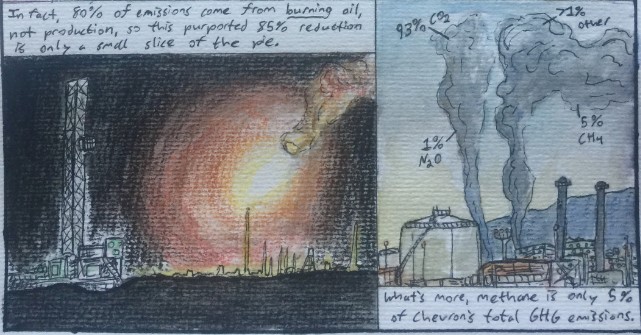
    A text that we read together in class for reflecting on the philosophy of the information literacy project was the introduction to Heather Houser’s book Infowhelm: Environmental Art and Literature in an Age of Data. One of the primary arguments of the book that inspired me to design this assignment and also my students in their work was its focus on how artists and writers utilize scientific data in their environmental art and literature to “speak back to forms of epistemological mastery” and positivism that data could end up reifying (2). The work that students came up with was thoughtful and wide-ranging. For instance, Lauren Posey, who is a first-year student at the University of Pittsburgh focused on greenwashing by corporate companies such as Chevron. She looked at Chevron’s 2019 Sustainability Report, specifically interrogating the truth behind Chevron’s statistics which claimed that “We have reduced methane emissions from Chevron’s US onshore production operations by 85 percent since 2013”. Posey pointed out, through a panel in her visual narrative, the part that remains untold: Methane is only five percent of Chevron’s emissions of greenhouse gases.

    Mary Guildin, another student, focused on the decreasing rate of bee populations in North America and Europe to dig deeper into the possible causes that might be responsible for the alarming decrease of the bee population. Besides the climate emergency, one of the reasons that she pointed out was the fact that the desire for perfectly manicured lawns was responsible for destroying bee habitats. Nate Madden drew the interconnections between the lack of healthcare in several counties of West Virginia, USA, and the high percentage of deaths due to lung cancer with the widespread practice of Mountain Top Removal coal mining in the state, thereby gesturing to the problem that environmental injustice disadvantages the low-income counties disproportionately. What is significant about the narratives that they crafted was the way they utilized information to show how issues about environmental justice at a local level translate to global problems. Their projects demonstrated that approaching justice as a multidimensional issue going beyond legal mechanisms can be generative for the Environmental Humanities as a discipline. 

    The idea behind this assignment was to carefully think through in what ways information is an aesthetic category in itself and in what ways information could be mobilized to tell stories about environmental injustice while being attentive to the nuanced, textured and grounded narratives that emerge from this information. It was an attempt on my part to foreground that the core contribution of literary studies towards environmental justice is to embrace how narratives can make a difference in how we utilize the humanities for social change and action.

  • The Chernobyl TV Series and the Impossibility of (Narrative) Closure

    The Chernobyl TV Series and the Impossibility of (Narrative) Closure

    Image by Mick De Paola on Unsplash

    The 2019 HBO mini-series Chernobyl has been praised as the best series of all times. Its account of the 1986 nuclear disaster in Ukraine and the fates of those dealing with its aftermath touched millions of viewers – but something about the appraising reviews of the series rubbed me the wrong way. It is true that the series is “as stunning as it is gripping”, as a Guardian review by Rebecca Nicholson revels (2019). Watching the series, I was touched by the terrible suffering and moral conflicts of the protagonists following the worst nuclear accident in history, and I recognized the echoes of Svetlana Alexievich’s 1995 Voices from Chernobyl, from which some of the most heart-wrenching storylines were taken.[1] I followed the critical debates about historical accuracy. How indebted is a TV series to its historical sources? And how American is Chernobyl’s view on the inner workings of the Soviet system? After some pondering and reading, I understood that my concern lies elsewhere, with the question of “narratability” and narrative form – and more precisely with the (im)possibility of narrative closure when talking about nuclear accidents.

    In one of the few critical reviews of the series, Mike Hale observes how resistant the Chernobyl nuclear disaster seems to be to narrativization: “[…] as a story, it’s hard to get your arms around – sprawling and repetitious, dependent on arcane particulars of physics and engineering, marked by failures to act and by large-scale action that accomplishes nothing” (2019). Forcing it into the “cheap theatrics” of a “creaky and conventional, if longer than usual, disaster movie”, Hale argues, does injustice to the complexity of the events and the multitude of actors attempting to live up to the moment. Indeed, the genre of the mini-series comes with clear requirements in terms of storyline and character constellations. It tells the story of only a few protagonists,[2] and it has a clear narrative arc. In many regards, contemporary mainstream storytelling still goes back to the Aristotelean poetics in which a tragedy requires a clear beginning, a middle, and an end, accompanied by suspense and finally catharsis, the sense of relief as all conflict is solved and equilibrium is restored. But how can such a storyline be adequate for a sprawling and unruly nuclear disaster?

    In an essay on “Narrative Closure”, Noël Carroll defines closure as a “phenomenological feeling of finality” (2007) as all questions posed by the narrative are answered satisfactorily for the audience. In the Chernobyl series, the (mostly fictional) showdown trial in which protagonist Valery Legasov recounts in detail how the accident happened, serves exactly this purpose. Loaded with suspense, and then relief, the occasion is used to inform the viewer of the intricacies of the social and technological failures which have led to the explosion of the reactor core, and to install Legasov as the hero that the audience needs him to be. All questions are answered satisfactorily, and the catharsis can resolve any doubts we might have about where the responsibility lies. Chernobyl has an ending in the Aristotelean and in Carroll’s sense. But, as the sociologist Kai Erikson observes in A New Species of Trouble (1995):

    Toxic disasters […] violate all the rules of plot. Some of them have clearly defined beginnings, such as the explosion that signalled the emergency at Chernobyl or the sudden moment of realization that opened the drama of Bhopal; others begin long years before anyone senses something as wrong [….]. But they never end. Invisible contaminants remain a part of the surroundings, absorbed into the grain of the landscape, the tissues of the body, and, worst of all, the genetic material of the survivors. (emphasis mine)

    The Chernobyl nuclear disaster has left 2,600 km2 of marshes, fields and forests uninhabitable for the unforeseeable future both in Ukraine and Belarus. Recent studies hint that reports about undisturbed and flourishing wildlife in the so-called ‘exclusion zone’ might be exaggerated, and that the density of mammals is actually lower than in comparable areas with lower levels of ionizing radiation (cf. Beaugelin-Seiller et al.).[3] And while a WHO report from 2005 sets the number of deaths attributed to radiation exposure at less than 50 (plus around 4000 eventual deaths due to long-term health consequences), recent publications have fuelled discussions about the validity of those earlier accounts (cf. Brown 2019). Irrespective of the exact numbers, anthropological research has shown that the accident still influences and overshadows the lives of thousands of people, and that for them, no sense of closure or ending is in sight (cf. Petryna 2013). The events surrounding the Chernobyl nuclear disaster were not only “sprawling and repetitious” in the 1980s, they continue to reach into the lives of uncountable humans and non-humans, and into the deep and almost unimaginably far future.

    Chernobyl makes an attempt to shine a light on the destiny of victims and survivors with an unusually long 5-minute coda, accompanied by a choir performing the Vichnaya Pamyat (or “Memory Eternal”), a hymn usually sung at eastern orthodox funeral services. The coda shows the fate of some of the protagonists of the series, speculates about its political legacy and also includes some drone footage of the abandoned town of Pripyat and the exclusion zone today. The final frame is of the New Safe Confinement completed in 2017, a large arched structure that covers both the damaged reactor and the make-shift concrete sarcophagus constructed directly after the accident. Hidden in this coda, and in the telling title of the final song, is the uncomfortably open ending of the story of the Chernobyl nuclear disaster. However, this openness remains an afterthought, attached to a carefully constructed and contained narrative arc.

    This is not to say that the series is bad, or that it shouldn’t exits. However, it will hopefully not remain the only way that viewers are confronted with what it means to live in a nuclear world. As frustrated climate scientists will attest to, we need to be aware of the limits of certain types of stories to grapple with the complexity of environmental (and technological) disaster. There are currently 440 nuclear power plants in operation worldwide, and while most of them are unlikely to spill ionized radiation through an accident, they produce highly radioactive waste for which most countries have no feasible storage solution right now. To confront the “everyday nuclearity” of our planet, we don’t need fearmongering and finger-pointing, no sharp distinction between heroes and villains. Most importantly, we should not embrace the “phenomenological feeling of finality” offered by Chernobyl (2019) but accept the impossibility of narrative closure. What we need is a nuanced knowledge and understanding of both the history and the present of nuclear power, nuclear waste and other nuclear infrastructures (such as mines or weapons). For such an endeavor, Chernobyl might even provide a good start.

    Do you want to learn more about the scientific, political and cultural history of ionizing radiation? You might want to have a look at this beautiful website by the Bombshelltoe Collective: https://illuminating-radioactivity.com/

    For in-depth discussions of all things nuclear, visit the website of the Bulletin of the Atomic Scientists: https://thebulletin.org/nuclear-risk/


    [1] The production team had the permission of the Nobel prize-winning author to weave the oral histories of her book into the series, and thus we now have filmed versions of the stories of young lovers Lyudmila and Vasily Ignatenko, who was a first responder and died from acute radiation sickness weeks after the accident, and the soldiers sent in to kill the pets left behind during evacuation of the zone around the exploded reactor.

    [2] This has, for example, led to the creation of the compound character of Ulana Khomyuk standing in for the many Soviet scientists who fought for better access to information and healthcare after the accident.

    [3] This is not to say that a purer, undamaged Nature existed around the reactor. The land was heavily cultivated and many of the marshes drained. Nonetheless, these lands have been taken from humans and non-humans alike and will remain contaminated for up to 20.000 years.


    Author: Hannah Klaubert is a doctoral student based at Stockholm University and the Graduate Center for the Study of Culture (GCSC) at Justus-Liebig-University Giessen, Germany. Hannah holds a BA in Comparative Literature and Philosophy from Freie Universität Berlin and an MA in Cultural Analysis from the University of Amsterdam. Her research focuses on fiction from the last three decades dealing with nuclear accidents and disasters. Through an (eco)narratological analysis of the aesthetic forms and strategies employed in literature and film, she aims to understand how the imperceptible threat of radiation and its impact on the human and non-human world are negotiated.