
In this writerly contemplation of queer relation with animals and landscapes, Clare Patterson draws connections between sheep trapped in snow drifts, Clarice Lispector’s cockroach, Leslie Feinberg’s crow, and various “significant othernesses” that shape our lives and queer literature.
🏵
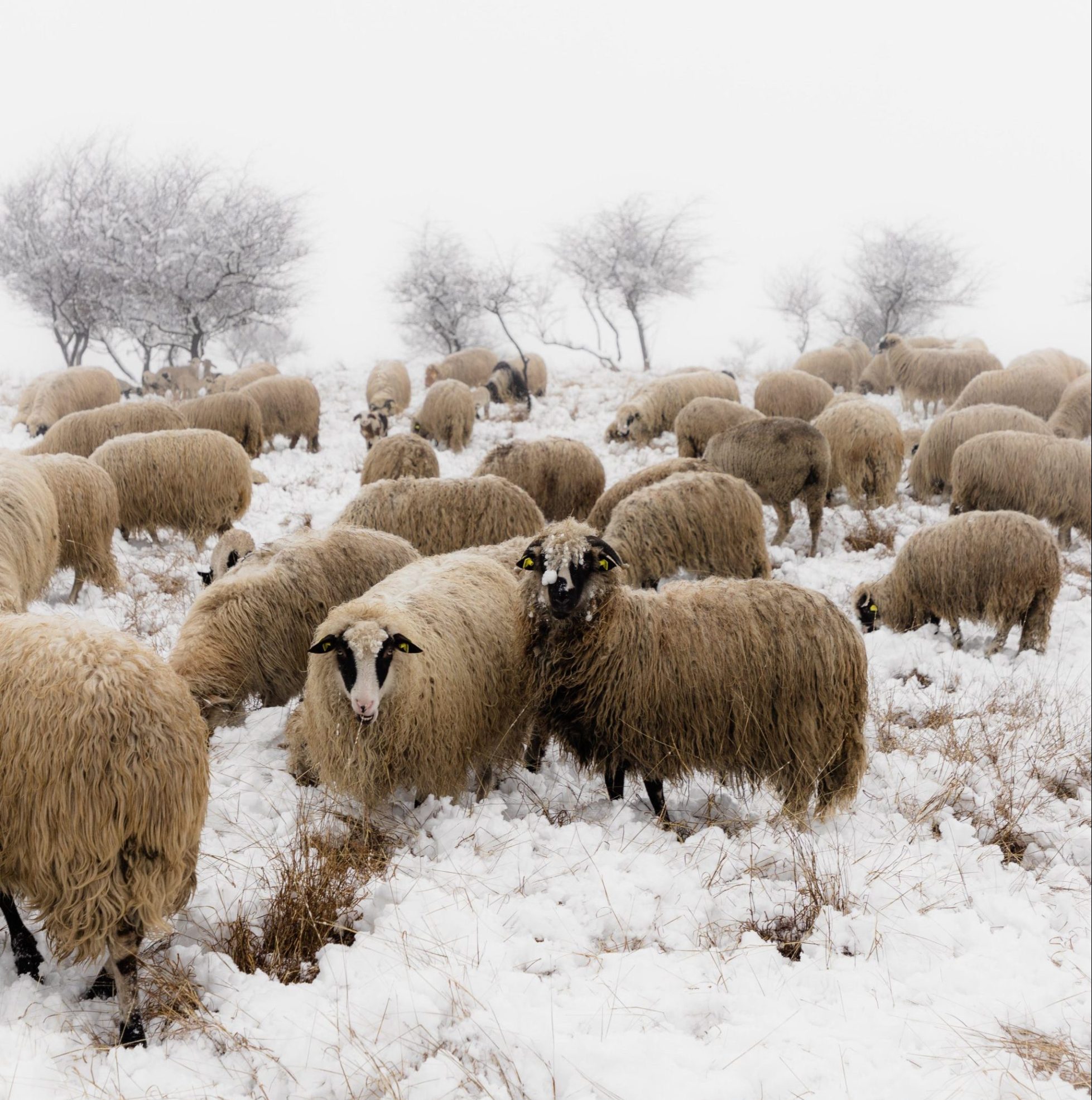
At my grandmother’s house, I slept in a small back bedroom, with one window that looked out onto the fell behind. In the winter, I would wake up to a changed landscape of white fields, the absolute white rendering the sheep the murky pale yellow of teeth. Sometimes my uncle or grandad had to dig out sheep that had been buried under snowdrifts – huddled together in flocks and protected by their thick wool, they could survive for multiple days buried completely.
This image stuck in my mind as a child – the flock of sheep crowded together in some deep, blue hole, wool coats pressed together for warmth, hot breath clouding the air. In my head, it was like an image I’d seen in a children’s book, one in which mice, squirrels, and other small animals lived in trees hollowed out into human houses. In the winter they dug tunnels between them to travel to each other’s homes, lit them with Victorian gas lamps and candles. In reality, the sheep probably huddled and shivered, terrified, until human hands came along and dragged them out.
Many of the children’s books I read involved these anthropomorphised animals, cute little animal societies whose denizens wore non-specific “old fashioned” clothing and lived in cosy cottages with roaring log fires. There was an ecological bent to these stories, which made children engage with the natural world and the changing of the seasons, but also a deeply anthropocentric one, making animals agents of storytelling relatable, empathy-worthy creatures through human narratives.
I held both ideas in tandem in my mind – saw mice as both the subjects of sweet children’s stories, who lived nearly-human lives in churches or hedgerows, but also as creatures that needed to be caught in traps when they came into the house. They were the reason why farms have barn cats, why cats were domesticated in the first place. When my mum grew up on the farm it was filled with cats, both feral ones in the barn and tame and semi-tame ones in the house. Some were only seen in glimpses carrying mice in their jaws, some let my mum dress them up in doll clothes and slept in her toy cot. By the time I was there they had far fewer cats on the farm, only feral ones we hardly saw, but my mum always had pet ones at home who, despite their pampered indoor lives, retained their own instincts and strangenesses.
The cats would often bring dead birds into the house. They would also bring them in alive, sending them flapping around the living room in a wild panic. My mum found the birds frightening, but I was one of those children who loved animals, so catching and rereleasing them was always my job. I would do this by first backing them into a high corner of the room, and would then gently close my hands around them, the weight of them between my palms like a smooth stone. If I could, I would grasp them with their head poking out between my thumbs, hoping this would prevent them from being frightened, but sometimes they cowered in my hands in a little ball.
There was always a soft thrill in holding them for a moment – the tickle of their wings against my palms as they panicked, the release of tension as they realised they were trapped and froze completely still. I carried all kinds of birds this way – wrens, sparrows, blue tits, robins, even a woodpecker. Once, just before I let the bird go, he pecked me sharply on the hand, drew blood. In my child’s mind I was deeply offended that a creature I had rescued could be so ungrateful. Another time, the bird flew out of my hands before circling back to me once more, as if to say thank you. My cats once brought in a half-dead bird – I don’t remember what kind, but his chest was white, and a blossom of bright red blood had flowered there. I took him and carried him gently to our front garden, shut the cats in the house, and placed him on a large, cool leaf. I knew he was still living because his red chest moved up and down heavily, as if with effort. I checked back on him hourly or so, hoping he might recover but knowing deep down that he wouldn’t. As it was getting dark, my mum stepped out to look at him, and came back to tell me she was very sorry, but he was dead. I was furious at my cats and their claws and teeth, even though I understood they couldn’t help their nature.
Their nature – an idea we apply to animals, an idea of what separates us from animals. Something inherent to them that they have no control over, no consciousness of. Animals are unmoral, thinking only in terms of instincts, prey drives, motivations that live only within the body. There is no love in nature, only maternal instinct and hunger. Clarice Lispector, in her novel The Passion According to G.H., calls this unmorality “the neutral” – life that doesn’t think about law or morality, life that doesn’t think, life as life itself only.
In the novel, a middle-class Brazilian sculptress known only as G.H., the initials embossed on her luggage, crushes a cockroach with a cupboard door and, looking upon its dying, oozing body, experiences something between a psychic break, a transcendence of physical form, and a return to this animal, “neutral” state of being. In G.H.’s loss of self, Lispector describes a “link of mutual ferocity” connecting all life, all things human and nonhuman. This phrase containsg both comradely connection and uncontrollable violence. It is a phrase that makes me think of the food chain diagrams we filled in in biology class, drawing big, red arrows connecting soil to an earthworm to a robin to a hawk then looping the hawk and its postmortem decay back around to the soil to represent transference of energy. Animals eat each other forever – they know no better; they know nothing else.
Lispector’s protagonist begins this text as a specifically gendered subject – she is a “pretty replica,” someone who men read as “a woman of generosity and grace, and one who isn’t a bother, and one who doesn’t eat away at a man.” Her class position and her role as an artist gives her some freedom – she is seen to inhabit a social role “between man and woman”, able to move with conviviality across both male and female spaces, but within this is still limited to a extent by her gender – her sculptures “would be good if they weren’t so amateurish”. Her fear of “being a bother” exemplifies how her welcome in these spaces, her treatment as an equal, are conditional to the extent that they exist at all. This idea of (not) “eating away” at a man is notable when, at the climax of the novel, G.H. feels compelled to consume the innards of the dead cockroach, giving herself over to the “mutual ferocity” of nonhuman life. She begins from the female urge to fold herself up, to repress desire. Indeed, Andrea Long Chu has described femaleness as “any psychic operation in which the self is sacrificed to make room for the desires of another”. The “neutral” she eventually embraces, this unmoral form of life, no longer makes room for the desires of another, and in fact barely contains the “desires” of the self, beyond the need to eat, to sleep, to procreate. The novel ends with an unselfconscious, in the most literal sense, consummation of the pure desire-driven actions of animal instinct. G. H.’s loss of self, her surrender to the neutral, is not only an act of un-humanisation but an act of ungendering.
🏵
In winter evening half-consciousness, I watch something on the news about glaciers receding. Later, in an episode of a David Attenborough documentary, an arctic fox is shown crossing the open tundra, all white under a blue-purple winter night. These documentaries often wring so much pathos out of animals lives, projecting human emotions that are as unknowable to them as their minds are to us – assuming they experience love like we do, grief like we do, envy like we do. Here, though, we seem to be seeing a creature only as it is – for a moment it is just the fox, beautiful and white, crossing the tundra alone. I would quite like to be a creature of snow, I think absentmindedly, something with thick wool or fur and hardened paws. Generating my own warmth and sleeping in an ice hole in cold, blue safety.
I would like to have the relationship to my body that an animal has, I think – difficult to gender by sight, just living with little thought of it. Of course, many creatures have sex characteristics that can be easily read by humans, but not all. For those that can’t, most people don’t try too hard to read them. People sometimes seem irritated when I inadvertently misgender their dogs, as if it is something that should be immediately obvious. In Leslie Feinberg’s novel, Stone Butch Blues, the protagonist Jess Goldberg has a similar feeling about animals. Jess is a young adult still comprehending her gender identity, and doing so within a nuclear family that punishes her for the gender transgressions of wearing jeans or having short hair. Upset by her family’s conditional love and their attempts to feminise her, Jess finds some solace in nature:
‘I hurried out to the pond to catch polywogs in a jar. I leaned on my elbow and looked up close at the little frogs that climbed up on the sun-baked rocks.
“Caw, caw!” A huge black crow circled above me in the air and landed on a rock nearby. We looked at each other in silence.
“Crow, are you a boy or a girl?”
“Caw, caw!”
I laughed and rolled over on my back. The sky was crayon blue. I pretended I was lying on the white cotton clouds. The earth was damp against my back. The sun was hot, the breeze was cool. I felt happy. Nature held me close and seemed to find no fault with me.’
The unintelligible response (for Jess) to an unintelligible question (for the crow) shows our ability to look at animals and their ability to look back – but also the vast gulf of communication between us, and our desire to make and project meaning onto that unknowability. Animals do not have gender, at least not as far as we know, and at least not in the way we do. In our mutual unknowing is an acceptance of the limits of our understanding. Donna Haraway calls this “relating in significant otherness”, the act of living with something we cannot know. Writing about her relationship with her dogs, she compares it to the love the worshipper has for God – the act of loving something too big or strange or far away to know its nature, the act of loving something that can only be understood by what it is not, and by knowing what one cannot understand.
“Nature” is often used in appeals to conservatism, especially around queerness – queer relationships aren’t “natural,” transition isn’t “natural,” in nature we only see reproductive sex and so only reproductive sex is “natural”. I could make appeals here to scientific evidence to the contrary – that many animals engage in same-sex relationships, that male seahorses carry pregnancies. I could cite numerous examples of reproduction in flora and fauna that are different and alien to ours – but that isn’t really the point I’m making. My appeal is more to a meeting with something unknowable without finding fault – to queer relation as a meeting with the limits of our understanding of another creature, or another being, without the desire to mould it into our own shape. Queerness opens up the idea that not everyone’s desires are the same, and in that are endless possibilities. Nature has never seemed to find any fault with me.