Tag: review

  • Eco-Aesthetics: A Framework of Watery Bodies and Fog-Scapes in Art

    Eco-Aesthetics: A Framework of Watery Bodies and Fog-Scapes in Art

    Water, Bodies, and Environment Aesthetics

    Water, besides being a central element of the environmental crisis, plays a profoundly symbolic and political role within contemporary societies. It is at the heart of numerous social struggles, embodying the demands of environmentalists, trade unions, and workers who oppose its privatization. The defense of water as a common and public good serves as a bulwark against the risk of amplifying social inequalities, especially in times of environmental crisis, when equitable access to water becomes a matter of justice and collective survival. In this context, water takes on the value of a symbol of resistance and solidarity, evoking movements fighting for environmental and social justice, for vital resources, and for the protection of the most vulnerable communities.

    However, the importance of water as a political and philosophical element is not limited to its social and political value; it is also a necessary presence within our bodies, permeating them, nourishing them, and defining their very essence. According to hydrofeminist perspectives and recent eco-aesthetic reflections, water is the original fluid matter from which we are composed, a substance that connects us to the natural world and at the same time reminds us of our vulnerability and our capacity to be part of a larger, more boundless whole. In this sense, water is not merely a physical substance, or corporeal “substance”, but becomes an element of identity, capable of shaping the way we perceive ourselves and our relationships with the environment. Its presence, both in the social and biological dimensions, pushes us to rethink artistic, curatorial, and philosophical practices, inviting us to recognize its transformative power in the construction of new, more inclusive and fluid imaginaries, capable of embracing the plurality of identities and experiences. The possibility of being “bodies made of water” allows the bodies themselves to assume a non-fixed, but continually changing, status. It is precisely this fluidity that the performing arts, land art, and philosophical aesthetics in general should also refer to, in order to cast our gaze toward new theoretical and practical horizons.

    A fundamental reference for creating a new horizon for environmental philosophy (especially for the aesthetics of landscape and environment) can be found in the words of the scholar Bronwyn Bailey-Charteris, when—in the book The Hydrocene: Eco-Aesthetics in the Age of Water (2024)—she writes about the importance of water as an element and the new Hydrocene paradigm:

    Water is a central figure of the current climate crisis: through sea-level risings, acidified oceans, extreme droughts and floods, polluted waterways and a lack of drinking water, the planet faces more and more extreme climate chaos dominated by water-related problems. Simultaneously a new wave of artistic water work has begun reconfiguring imagination where nature and culture inescapably meet and mingle; art is going into the blue. These works offer a model that considers the contemporary context of the climate crisis in ecoaesthetics. With the curatorial theory of the Hydrocene, this tide of artistic practices is shared and celebrated, and by thinking through the curatorial, recognised as a potential means of planetary caretaking.1

    The scholar repeatedly describes, for the first time, an aesthetic paradigm (comprising artworks, curatorial techniques, performing arts, and eco-aesthetics) linked to the climate crisis and environmental issues, with a focus on water. Once again, in her book The Hydrocene: Eco-Aesthetics in the Age of Water, she writes:

    The Hydrocene is a wet ontological shift in eco-aesthetics which redefines our approach to water, transcending anthropocentric, neo-colonial and environmentally destructive ways of relating to water. By engaging hydrofeminist, care-based and planetary thinking, The Hydrocene learns from the knowledge and agency of water itself within the tide of art going into the blue. The Hydrocene articulates and embodies the distinctive ways contemporary artists relate and engage with water, offering valuable lessons towards climate action.2

    The concept of the “Hydrocene” introduces new ways of making art, curating art, and decolonizing certain forms and narratives of art. In fact, it’s not the first time in the history of art and aesthetics that the question of how to address the climate crisis and how to represent socio-environmental concerns through art has been raised. One such approach is so-called land art, an artistic practice that centers on the nature-human dichotomy, seeking to artistically represent ecological and environmental challenges. There are even critical scholars like Crawford and Baker who affirm other intentions of doing environmental and land art. For example, Donald Crawford maintains that many environmental artworks are aesthetic affronts to nature by “forcibly assert[ing] their artifactuality over against nature” (Crawford 1983, 57)3, and Elisabeth Baker maintains that earthworks, as stages of an artistic pilgrimage, indirectly exercise a “preservational effect” on the territory even though they are not forms of “ecological art” (Baker 1983, 83).4 The fact remains that land art can be considered as a first effort, even theorized in the aesthetics of landscape and the environment, to conceive of art concerns that could be considered more ethical than aesthetic. Land art and environmental art focus the “aesthetic attention” on the climate, but in which ways? Through what theoretical paradigms and philosophical categories?

    I think art can be a valid medium through which to discuss current issues, including climate, environmental, and gender. To do so, however, it’s not enough to philosophically position oneself within the Anthropocene paradigm and argue that humanity’s impact on the environment is devastating, attempting to challenge the nature/culture dichotomy. This is insufficient for an aesthetic theory of the environment that seeks to address environmental discourse in all its facets. Indeed, placing oneself within the neologism of the Anthropocene means reiterating a series of problems and cultural biases that are believed to be overcome but are in reality ever-present. The concept of the Anthropocene doesn’t help us move beyond the nature/culture category, it doesn’t encourage us to listen to different, alternative theories, it doesn’t create dialogues with different cultures, it doesn’t consider other types of relationships that the environment creates and that are created with the environment itself. For these reasons, we will analyze public works of art such as the fog-scapes of Fujiko Nakaya and Janet Laurence, which express aesthetic and environmental issues through the fog. Therefore, to validate aesthetic discourse, we need to broaden the conceptual field and observe other ways of experiencing the environment, the identities that form within it, and the possibility of perceiving it in its multiplicity, contamination, and fluidity.

    The Hydrocene and the Reshaping of Eco-aesthetics

    One way to do justice both to aesthetics as an artistic practice and as a philosophical field that deals with art, the environment, and landscape, and to the plurality of identities, ways of being, and ways of being in the world, is provided by the concept of the Hydrocene. The book The Hydrocene: Eco-Aesthetics in the Age of Water, written by scholar Bronwyn Bailey-Charteris, is an initial introduction to environmental aesthetic discourse that breaks with anthropocentric and exceptionalist narratives and instead engages with the philosophical paradigm of hydrofeminism, ecology, and alternatives. Through the concept of the Hydrocene—which does not concern the geographical era as such but describes a conceptual path alternative to dominant narratives—we can investigate the performing arts, a new “environmental art”, and philosophical aesthetics starting from porous and fluid, aqueous bodies.

    Constable’s Cloud Studies

    If land art has always been based on a terrestrial matrix, probably now is the time to change and create a type of art that also works with other elements of the planet, such as air, water, fog, and everything that remains outside the exclusive aesthetic intervention on landscape. We could first begin by rethinking the term land art, which at this point no longer seems to be an appropriate term to express aesthetic practices involving all the atmospheric elements of the environment. To describe this kind of art that takes into consideration other elements than the land, we can use the term “environmental art”. If we think of the natural environment, we quickly understand that it is made up of “land”, but the environment we observe and perceive is not only made up of this terrestrial element.

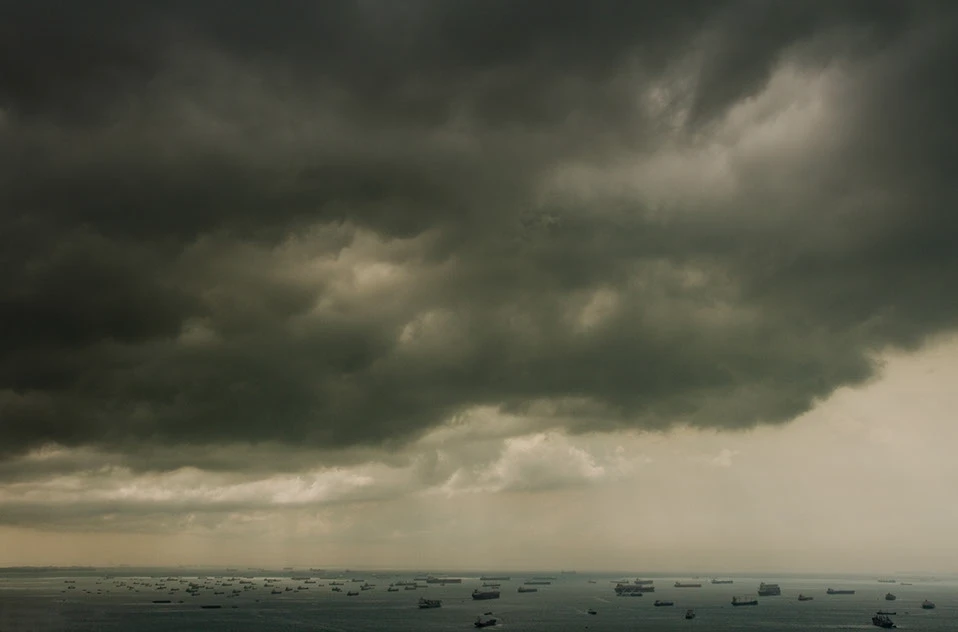
    Already in the 19th century, John Constable, a landscape artist, claimed that the sky and atmospheric phenomena were also an important part of nature, which needed to be studied scientifically and represented. On these premises, he created a cycle of works of art called Cloud Studies (1821-1822) that focused on the scientific recording of meteorological phenomena. He painted the clouds, and on the back of his canvas, he wrote down the date, the day, and data regarding the wind and the temperature.

    From that 19th-century artistic experience, we can already understand the desire to broaden the horizons of the concept of environment, starting from the various natural elements that are often overlooked. In that case, the air takes on an important aesthetic status, and with it the rain and various atmospheric events. Today, we have various artistic practices that use water in all its forms: fog, ice, and liquid—elements of the environment (natural and urban) that require a new connotation, gathered under the name of eco-aesthetic practices.5

    These are important experiments concerning fog and clouds. Both are aquatic environments that prompt deeper reflection on both nature and our embodied experience within it. This is represented by some recent installations by artists who seek to use fog and clouds as part of a broader aquatic paradigm that highlights not only the corporeal experience of them but also a climatic perspective on the toxicity of fog. The artist Fujiko Nakaya herself fostered an aesthetic experience of fog through the first exhibition of fog sculptures (or cloud sculptures) at the Osaka Expo (Japan) in 1970.

    Fujiko Nakaya’s Fog Sculptures
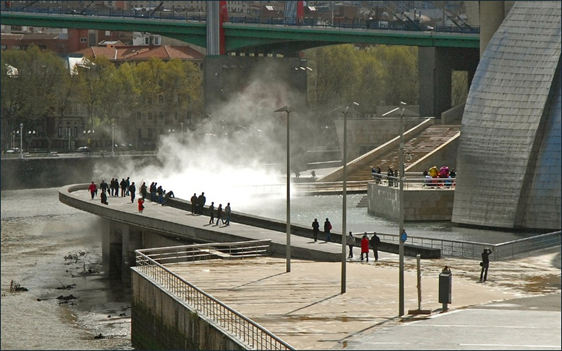
    By manipulating shapeless materials like water or smoke, and various vaporous elements like clouds, the artist suggests the possibility of transforming these hyperobjects6(that is, realities like clouds that, by their very nature, surpass the capacity for rational knowledge and require a different approach). In this way, through the manipulation of these shapeless objects (fog, water, etc.), the artist manages to create an altered and unconventional experience of the environment. Representing fog and clouds means representing, through art, pollution, toxicity, and their inequalities, reinforced through the hydrological cycle, and highlights a reading of the urgency of the natural-cultural water crisis through completely transformed microclimates. Thinking and immersing oneself in fog and clouds means focusing on the various ways of transformation of water.

    There are many artists (e.g., Emily Parsons-Lord, Olafur Eliasson, and Janet Laurence) who interact and dialogue with water: they interact with vaporous bodies of water in order to create embodied aesthetic experiences. In their artistic expressions, the fog reorients ideas and perceptions. A possible review of the artists is provided by the book Weather as Medium: Toward a Meteorological Art, written by Janine Randerson, in which the author explores a series of meteorological art projects from the 1960s to the present, drawing on sources ranging from dynamical, technological, and physical systems to indigenous cosmology.

    Janet Laurence: Fog-Scapes as a Way to Care for the Environment

    Another environmental artist who uses fog as an artistic material and as a means to create certain aesthetic experiences is the Australian artist Janet Laurence. Within the Australian art context, Laurence has contributed significantly to the development of eco-aesthetics. An example of this is her famous installation called In The Shadow (2000). This work was commissioned by the Olympic Park, part of Homebush Bay in Sydney, and installed along a stretch of stream crossed by three bridges. In the Shadow responds to the transformation of the site from a contaminated industrial area to a new “green” area.
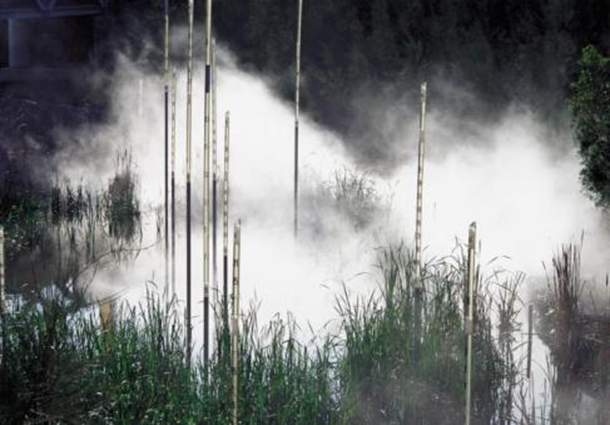
    The following public artwork aimed to restore natural vegetation to Sydney’s Olympic Park, on Homebush Bay. In addition to extensive planting of native plants, the work included the installation of twenty-one vertical sensors to monitor the chemical composition of the river water. By encouraging the growth of native plants in a suburban area of Sydney, “In the Shadow, oxygenates an otherwise rather sterile area” (Felicity Fenner, Art & Australia, p. 64). According to the scholar Bronwyn Bailey-Charteris:

    Laurence’s work is configured as a nebulous “anti-monument” in that it does not limit itself to satisfying an anthropocentric experience or gaze: the work, on the contrary, regulates and develops a microclimate within the Homebush stream, integrating itself with the local ecology.7

    Through the hydro-artistic method of nebulization, the artist not only conveys a fundamental message—that is, the possibility of going beyond the boundaries of the Anthropocene—but this work also reveals its power to regenerate the environment itself. The artist cares for the damaged environment of Homebush. Her installation is located inside the stream, and precisely because of this positioning, the artwork takes shape and embodies the fog. In this regard, Bronwyn wrote:

    Over time, as the trees grew, the stream became a place of aquatic regeneration. Through the hydro-artistic method of misting, Laurence directs the audience toward the possibility that art can act as a healing and regenerative force in damaged ecosystems.8

    This is an example of what I think of eco-aesthetics: working with art and the environment to care for the environment itself, both from a practical and theoretical point of view. Working with art and the environment to heal the environment itself, both practically and theoretically. The theoretical importance of this curatorial hydro-artistic practice lies in its ability to rewrite concepts of philosophy and aesthetics in terms of a broad, inclusive, and undisciplined theory, dismantling old oppositions (nature/culture, inside/outside, etc.) and providing the possibility of acting by resisting categorizations.

    Head in the Clouds: Conclusion

    “Having head in the clouds” is an everyday expression not to be underestimated. It suggests the possibility of being elsewhere, of being other, of thinking with the clouds. Being in the clouds is a state of dialogue between the elements and the body itself; it also means incarnating oneself in the clouds, surrounded by water in all its forms. Water represents the element through which we manifest ourselves as dynamic and interconnected entities, and constitutes the vital substance of our composition. «Water as body; water as communicator between bodies; water as facilitating bodies into being. Entity, medium, transformative and gestational milieu. All of this enfolded in, seeping from, sustaining and saturating, our bodies of water. “There are tides in the body,” writes Virginia Woolf.9

    It is precisely on this entity that we can begin to construct an aesthetic paradigm with a completely alternative development: a conception of art and the environment that is neither anthropocentric nor phallocentric, but rather watery, destructive, and disorienting. In conclusion, accepting water as fluid and vaporous, that is, not rigidly defined, both in form and meaning, means going beyond the existing categories on which Western thought and culture are built. Breaking with these consolidated paradigms means opening up to new possibilities; for example, we can build alternative methods of doing art by taking care of the environment and its problems.

    References

    [1] Bailey-Charteris, Bronwyn, The Hydrocene: Eco-Aesthetics in the Age of Water, Routledge Environmental Humanities (eds), 2024, p. 78.

    [2] Bailey-Charteris, p. 8.

    [3] Crawford, Donald W., “Nature and Art: Some Dialectical Relationships,” The Journal of Aesthetics and Art Criticism 42, no. 1 (1983): 57.

    [4] Baker, Elizabeth C., “Artworks on the Land,” in Art in the Land: A Critical Anthology of Environmental Art, ed. Alan Sonfist (New York: Dutton, 1983), 83.

    [5] I refer to what scholar Bronwyn Bailey-Charteris writes in the aforementioned book The Hydrocene: Eco-Aesthetics in the Age of Water about aesthetics and its combination with ecology… pp. 6-7.

    [6] Morton, T., Hyperobjects: Philosophy and Ecology after the End of the World, University of Minnesota Press, 2013.

    [7] Bailey-Charteris, The Hydrocene: Eco-Aesthetics in the Age of Water, p. 242.

    [8] Bailey-Charteris, p. 242.

    [9] A. Neimanis, Hydrofeminism: Or, On Becoming a Body of Water, in Undutiful Daughters… Palgrave Macmillan, New York, 2012, p. 87.

  • “Survival is insufficient”: The cautionary power of speculative fiction

    “Survival is insufficient”: The cautionary power of speculative fiction

    Image by Daniel Lincoln on Unsplash

    Current headlines abound with apocalyptic references to the global climate emergency. The 2021 Intergovernmental Panel on Climate Change (IPCC) report released in August 2021 brought into the mainstream what climate scientists already knew – dramatic and life-altering changes to the climate are much closer than many of us expected. The ambiguous language is gone. Where before there were qualifiers about the likelihood of impacts and degrees of certainty regarding human responsibility, now we are told that the situation is unequivocal, unprecedented, indisputable and immediate. The proximity of potentially disastrous and irreversible climate impacts has come as a complete shock for many people. We thought we had more time. Given this accelerated schedule, we wonder how to respond, how to stay hopeful. What can we do when it feels like the precipice is closer than we imagined?

    Speculative fiction can provide insights into how people might respond to impending crises at different timescales, and what the consequences of those responses could potentially be. With the shortened timelines expressed in the IPCC report, it appears useful to consider three novels where the characters are confronted with crises that unfold over an extended period and which leave various amounts of time remaining before their version of the end of the world. The novels I have selected to do this are Station Eleven by Emily St. John Mandel, Seveneves by Neil Stephensen, and The Three-Body Problem by Cixin Liu. None of these novels have happy endings. In many ways, the authors seem to be warning against certain attitudes and types of responses rather than suggesting solutions.

    The characters in Station Eleven, for instance, are the survivors of a highly contagious virus which wiped out ninety-five percent of people. The novel looks back on how individuals processed and responded to the immediate threat posed by the Georgian Flu. Many of them managed to escape infection and the rapid loss of life by barricading themselves in places cut off from the rest of society. Outside their safe havens there was widespread panic, looting and hoarding of supplies, and quarantine of entire cities and countries. One man survived the initial crisis inside an airport terminal, haunted for years by his last phone call. Instead of calling his wife and child, he chose to talk to his business partners. The shallow, empty, professional terminology (circle back, put a pin in that) plays and replays in his memory.

    There are clear parallels between these responses and those currently manifesting to climate change. Populist governments across Europe and the United States are already threatening to turn against climate migrants and isolate themselves rather than committing to painful cuts in emissions and consumption that could potentially improve future conditions for vulnerable people. Climate denial persists in some arenas, and even those who believe in climate change may continue their lives as usual. If we trust the lessons of Station Eleven, in hindsight we will be haunted by our failure to act now to cherish and preserve what is important to us.

    The novel Seveneves explores humanity’s response to the destruction of the moon and the knowledge that within two years all life on Earth will be extinct. Governments of the world come together to expand the International Space Station and try to preserve humanity in the form of 1,500 randomly selected representatives. Throughout the novel, there are widespread concerns that the governments of the world do not actually believe in their own desperate projects. They simply want to pacify their citizens by being seen doing something. In the meantime, many people continue commuting to work and school and paying their bills on time, although Stephensen does make a point of noting that the home improvement industry has collapsed.

    The performative actions of world governments in Seveneves are paralleled by some responses to climate change. Despite growing awareness of threats, the temptation to continue business as usual looms large. Many countries take steps that are just enough to be seen to be doing something, even if they are fully aware that it will not be enough. In addition, a phenomenon called greenwashing has emerged, where any kind of product or activity is claimed to be “green” or “climate friendly”, regardless of its real impacts.

    Finally, in The Three-Body Problem a human-instigated crisis likely to lead to the eradication of humanity looms four hundred years in the future. The crisis was caused by people who decided that human civilisation was beyond redemption and invited the destruction of all human life by broadcasting our location to a hostile alien world. The extended timeframe of this novel means that humanity moves through several stages of denial, preparation and hopelessness. At the beginning of the crisis so many resources are poured into defending the Earth that rationing and shortages of basic necessities lead to a period called the “great ravine” where the global population plummets. Later, people decide that technology has advanced enough to save them and become complacent. At the international level, rich governments refuse to share technology and try to manoeuvre so that if anyone survives beyond the crisis they will emerge with more power and control. Low-income countries feel excluded and increasingly desperate, with sometimes violent consequences.

    Again these responses are frighteningly similar to what we see unfolding today. The refusal of rich countries to share their technologies or prioritise global concerns over their own reflects responses to climate change (and COVID-19, another urgent problem but beyond the scope of this post). Debates between proponents of degrowth and technological optimists expose a fundamental divide over how much our lifestyles and economies need to shift. Even further, Cixin Liu describes in detail the dangers of pouring resources into saving the future at the expense of the present. The Three-Body Problem poses a stark warning about the loss of democracy and the risk of losing our humanity in a moment of desperation. He causes us to wonder, what if we manage to stop climate change but, in the meantime, a real “great ravine” happens and millions or billions of people lose their lives? Will it have been worth it? What is the alternative?

    Even though Station Eleven, Seveneves and The Three-Body Problem present fatalistic doomsday scenarios, these novels seem to suggest that we have some agency in deciding between multiple pathways through catastrophe, not just in technical terms but in terms of what kind of future we want on the other side. In the aftermath of the Georgian Flu in Station Eleven, the remaining people decide that “survival is insufficient”. Survivors prioritize keeping art, music, creativity and beauty alive. The question in Seveneves after the decimation of life on Earth similarly is not just how to stay alive, but what kind of life preserves our humanity and is worth living.

    These novels are not optimistic or uplifting stories of how we can prevent climate change or survive the emergency we are already in. Instead, they hold a mirror to our modern society which highlights certain potential flaws in our current tendencies. The authors have each taken an intensified hypothetical scenario and followed it through to its logical conclusion. Such stories provide a source of caution and critique by centring the undesirable consequences of acting in certain ways which parallel responses we are currently seeing to climate change. By making these possibilities visible they give us an opportunity to rethink our own behaviour and perhaps even try to change it.


    Author:

    Elizabeth MacAfee is a PhD candidate in Society, Development and Planning at the Norwegian University of Life Sciences (NMBU). Elizabeth has a master’s degree in International Environmental Studies from NMBU and a bachelor’s degree in Exercise Science from the University of Puget Sound. The topic of Elizabeth’s dissertation is drinking water quality governance and planning in Kaolack, Senegal. She is interested in the ethical aspects of drinking water quality governance and frames her thesis using concepts from Deleuze and Guattari’s assemblage theory. Elizabeth is also a member of a speculative fiction book club in her free time. She read all three books referenced in this post with the book club and the ideas presented here grew out of those discussions.

  • Birches like Barcodes

    Birches like Barcodes

    Art by Nick Hayes / Poem by Robert Macfarlane

    Writing Nature in the Anthropocene: Responses to Robert Macfarlane’s Masterclass, in Conversation with Joanna Dobson (Creative Writing Masterclass Series at Sheffield Hallam University, 18 November 2020)

    Response by Katharina Maria Kalinowski

    How do “we” respond to the many Anthropocenes in times of accelerated ecological crisis? Is it possible to write the legible strata of the earth? Do we need new forms of writing to register invisible and incomprehensible layers of a world that exceeds the limits of our understanding (hasn’t it always)? At the borders of language, how can writing and activism intersect? Are “we”, humankind, “good ancestors” for generations to come?

    Given the current state of the ecosphere, I’d be inclined to answer the last question with “no”. However, viewing humankind from a species point of view is problematic if we consider how explosive disparities shape the living conditions of the current generation on a daily basis. Following the argument that climate change is not so much anthropogenic as “sociogenic”,[1] the question concerning our heritage pushes against a homogenous humankind and opens up to a microcosm of stories with more-than-humankind/ness.

    The entanglement of these stories in a larger system is encapsulated in the last line of Macfarlane’s intricate poem “Heartwood”: “Have you heartwood, cutter? / Have those who sent you?” Dedicated to trees facing “unjust felling”, the poem, part charm, part song, part wood, can be seen as a piece of lyrical activism that enchants without euphemising and interrogates without scapegoating.

    One of the dangers of the (geochronologic) Anthropocene is its tendency to naturalise violent social and economic divisions and present the state of the world as inevitable. Here’s where writing can complicate, diversify, and wager on alternative scenarios; here’s where poetry can make something happen: what stuck with me most is Macfarlane’s cautious, yet unfalteringly urgent belief in the spell-binding potential of writing to re-invent form and to observe, to question, to touch, to affect, to change. Investigating what may be framed as the “golden spike” of the Environmental Humanities, namely the ever-present question whether poetry, or literature in general, can “save the earth”,[2] he offered an insightful response, unsurprisingly starting with “no” (again).

    For Macfarlane, the “golden spike”-question needs revising; it should really be asking: can literature join forces with other movements and creative arts to contribute to political changes? The answer to this is, finally: yes, of course! Macfarlane’s “Heartwood”, which became part of the Sheffield tree felling protests, is only one of many examples of how writing can challenge the status quo and create a shared space to imagine other voices and other worlds. Generating sets of new, unexpected relations, his texts make me wonder about the connection between (natural?) birches and (artificial?) bar codes, and how we poetically embody nature as more than a consumable good changing ownership through a red-light beep.

    In this sense, Macfarlane’s suggestion to “wearily embrace” anthropomorphic modes reminds me of Jane Bennett’s notion of vital materialism, in which “a touch of anthropomorphism” can “catalyse a sensibility” to a re-enchanted world filled with variously composed animate materialities vibrantly alive.[3] It further prompts critical reflection on anthropocentric assumptions determining what counts as human – and therefore as anthropomorphic – in the first place: it is arguably easier to categorise something as human-like than to categorise the human as something-like, as one among many unique beings that share their vulnerable lives in the Anthropocene.

    Literature cannot afford to choose the easier way. Embedded in a socio-cultural, political continuum, writing is one among many active and expressive forms that can make the world not only more comprehensible but also more liveable. It is neither separate from other forms of activism, nor does it exclude them – literature is shaped by its ability to both amplify and make silence for other voices. Nothing sums this up better than the following comment posted in the Zoom chat, one of many words that stayed with me long after clicking on “leave meeting”:

    Sometimes you have to tie yourself in knots about anthropomorphism and sometimes you have to spend your weekend dressed as a frog at the nature reserve open day to engage people and there’s space for both I think!

    By Rachel Dowse, sent in the Zoom chat


    [1] Andreas Malm and Alf Hornborg, “The Geology of Mankind? A Critique of the Anthropocene Narrative”, The Anthropocene Review, vol. 1, no. 1, 2014, pp. 62-69 (66).

    [2] The phrase is borrowed from John Felstiner’s book Can Poetry Save the Earth? A Field Guide to Nature Poems, Yale UP, 2010. Question to the reader: What would poetry have to be exchanged with in this phrase to prompt a “yes” response?

    [3] Jane Bennett, Vibrant Matter: A Political Ecology of Things, Duke UP, 2010, p. 99.

    Response by Melina Lieb

    I no longer remember why, but I had felt a bit down on the day of the masterclass, and logged into Zoom hoping it would cheer me up. Instead, it left me even more pensive, though in a strangely reassuring way. I know that the world is in a precarious state, but often I don’t know how to cope with the anxiety caused by this knowledge. I suppose others feel the same, but I usually cannot hear them in the echo chamber of my own head. Talking or listening to people talk about the subject helps a lot. It might not immediately solve problems, but hearing your own thoughts and feelings reflected by others makes them more endurable. You are not alone. And as the saying goes: Every dripping wears the stone.[1]

    Macfarlane found very fitting words for the feeling I’ve described: “The world has begun to make nonsense of realism”. The times we’re living in just are eerie and gothic. And this distortion is being recognised by literature. In Underland, Macfarlane pursues the question: “Are we being good ancestors?”. As Katharina highlights above, the answer too often is “no”. Driving through birch forests like barcodes, Macfarlane arrives at the only place where he would say that people have done a good – or at least, the best possible – job of being good ancestors. This place is Onkalo, the world’s first permanent repository for nuclear waste, on the Finnish island of Olkiluoto.[2] On hearing the name, I remembered watching a film about this place, years ago. It was called Into Eternity: A Film for the Future. I remember a match being lit in a dark cave, illuminating a man with a yellow helmet, talking in a solemn voice. I don’t remember his exact words, but he might have said what is stated on one of the movie posters: “We need you to know that this place should not be disturbed. You should stay away from this place. Then you will be safe”.

    When the people who built and filled the storage are no longer there, the place will speak for itself. Will it seem as eerie to our descendants as it already seems to me now?

    Speaking about speaking places, Macfarlane describes another potentially eerie site, though despite its “chilling” atmosphere, it has a fascinating charm to him. Orford Ness, a shingle spit on England’s Suffolk coast was a nuclear testing site but has now been given back to the wild and is protected by the National Trust. Inspired by this landscape, Macfarlane published Ness, his attempt at a different version of a medieval play on nature lashing back against the military-industrial complex. “Superheroes” of different genders, composed partly of organic matter, partly of the detritus of capitalism and consumerism – “speaking in swifts”, with “bones of plastic” – rush to the peninsula. Macfarlane recites, ending each verse with a warning: “Look, here he comes. – Look, here she comes. – Look, here they come. – Look, here as comes”.

    The power of these words still remains with me. It is one of Macfarlane’s great strengths to send powerful words out into the world, spells, songs, charms, chants. They are simultaneously an ushering and inspiration, intended to be spoken and extended by as many voices as possible – especially young voices, children and teenagers, our descendants. May they find a new way of speaking, of getting over the eeriness of our times, together.


    [1] This is a translation of the common German idiom “Jeder Tropfen höhlt den Stein.” A more common phrasing in English might be “Constant dripping wears the stone.” In this case, though, I wanted to place the emphasis on “every” drop.

    [2] See also: https://www.theatlantic.com/magazine/archive/2017/10/what-lies-beneath/537894/


    Authors:

    Katharina Maria Kalinowski is a bilingual poet and EUmanities fellow at the Universities of Cologne and Kent. Her creative-critical PhD project focuses on ecopoetics, the Anthropocene, and expanded forms of translation. Her publications include Magma, Epizootics, and the Journal of British and Irish Innovative Poetry.

    Melina Lieb is a PhD candidate and lecturer at the Faculty of Translation Studies, Linguistics and Cultural Studies at the Johannes Gutenberg-Universität Mainz/Germersheim, Germany. Her research focus is on 21st-century British Nature Writing, ecocriticism and ecopoetry. In her dissertation she considers the role of the “common” in this field of literature, including aspects such as the everyday, the ordinary and the familiar as well as the shared and the political. Melina also writes her own prose and poetry inspired by the natural world, both in English and German.

  • Review: Virtual Opening and Streaming Festival ‘Critical Zones’ (May 2020)

    Review: Virtual Opening and Streaming Festival ‘Critical Zones’ (May 2020)

    Image by USGS on Unsplash

    Virtual Opening and Streaming Festival ‘Critical Zones’, 22 – 24 May 2020, ZKM Karlsruhe (Online)

    The 22nd of May saw the launch of Critical Zones: Observatories for an Earthly Politics, a ‘thought exhibition’ at ZKM Karlsruhe. The exhibition – opening physically on the 24th of July, but currently available online – began with a streaming festival: three days of films, lectures, and panel discussions, mediated and moderated by Bruno Latour, Peter Weibel, Barbara Zoé Kiolbassa, Dominika Szope, and Annett Holzheid. The territory, literally and conceptually, was the Critical Zone – the “thin biofilm” of the earth’s near-surface, “from the tops of the trees to the bottom of the groundwater” – but the festival also raised relevant questions about critical practice, offering insights into academic and intellectual collaboration.

    Most of the festival is still available to watch: particularly provoking, for me, were Jennifer Gabrys’s discussion of the politics and pragmatics of sensory technologies; Eyal Weizman’s thinking around breath, and his proposal of clouds as the limit condition of forensics; Dipesh Chakrabarty’s remarkable reflection on colonial and post-colonial world-making; and the conversation between Donna Haraway, Weibel and Latour that followed the screening of Haraway and Fabrizio Terranova’s Storytelling for Earthly Survival. Those who work around the intersection of ecology and theatre, as I do, would also have been interested by the tensions, similarities and distinctions between Latour’s 2018 Anthropocene Lecture at HKW, and his collaboration with Frédérique Aït-Touati on Moving Earths (recorded at the Théâtre Nanterre-Amandiers in December 2019). The festival’s juxtaposition of the two – very similar in content, but clearly distinct in their performance practices and contexts – offers a sense of what Aït-Touati and Latour believe the theatre makes possible, or some of the things the medium can do.

    During a panel discussion on Saturday the 23rd of May, Latour and Jérôme Gaillardet characterised the Critical Zone as a way of bringing together different disciplines within a common conceptual space, rather than as a unified concept in itself. The festival’s speakers’ approaches were, therefore, heterogeneous, but constellated around a number of preoccupations – most notably assembly, subjectivity, and entanglement. Latour’s desire to re-understand the political subject, for example, was picked up by Haraway in her proposals for intimacy, connectedness, and “response-ability”; Jennifer Gabrys, meanwhile, invoked Alfred North Whitehead, Lyn Margulis and Isabelle Stengers in arguing that the task now is less to sensitise the subject than it is to rethink it as “already entangled with so many other entities and entanglements”.[1] This position – familiar to those working in the field, although perhaps rather less so to those outside it – is at the heart of Latour’s concept of terrestrial subjectivity, as I understand it: an interspecies, multiscalar self-description that addresses the question of ‘where we are’ not in spatial terms, but in relation to the other entities that are making us subsist. It is this sense of terrestrial entanglement that Latour and Haraway argue must be practically enacted in new strategies and technologies of political assembly. To this end, Latour has urged Weibel to republish the catalogue of Making Things Public, a previous collaboration at ZKM.

    It is a different approach to interdependence, however, that is perhaps the festival’s most relevant contribution to a blog that connects graduate students across the environmental humanities. As well as thematising entanglement, the weekend also bore witness to it as a practice: Dipesh Chakrabarty, in particular, offered valuable insight into the long-term mutualism of his intellectual engagement with Latour. As well as admiring Chakrabarty’s exemplary patience, curiosity, and thoughtfulness, I must confess that I found his description of this relationship acutely moving. It spoke to me of a critical practice characterised by sustained and simultaneous challenge and support: research not as a cantilever, but an arch.

    Since I was quite young, I have studied and worked in the kind of context that gets described as ‘competitive’: St Paul’s School (a prominent private school in the UK), the University of Cambridge, the Royal College of Music, and a career as a freelance baritone. I have always nodded along with that description, and repeated it to others – and I have found myself doing so again in recent discussions around job cuts, hiring freezes, and precarious employment.

    In the light of Chakrabarty’s comments, however, I can’t help feeling that this characterisation is inadequate, even ideological. It presents itself as a description of a situation – lots of people, all of them capable, not many jobs – but smuggles with it a prescription of how those people should frame, understand, and feel their response. Even without considering the unfairness of any such competition – particularly in and after a crisis that looks set to sharpen existent inequalities of race, class, and gender – the use of competitiveness as a descriptor naturalises a self-interested, zero-sum idea of academic work as a reaction to the scarcity and precarity of the jobs available. Within this model, co-operation and collaboration are framed as generous, instead of fundamental: an attitude completely at odds with what Chakrabarty is describing, as well as the actual practice of most academics – and the best academics – that I know.

    This is fraught and difficult territory, especially for someone writing from a position of considerable privilege. It is one thing to point out the etymological polyvalence of ‘competition’ – competere, “striving after (something) in company or together” – and the subsequently pluralised sense of what it might mean to compete with someone; it is quite another to begin to address the precarity and inaccessibility of academic employment, and the complex politics implicit in credit and collaboration. But in a profession so committed to radical redescription and lexical precision, and in a field that tends towards a robust suspicion of individualism, there has to be a better way to name our experience; a better word to describe the worlds in which we are proposing to work, that might more thoughtfully represent a process of productive solidarity within structures that are beyond our control.

    With this in mind, it is worth noting in closing that the festival’s speakers were accompanied, questioned, and challenged by a lively and engaging discussion group on Telegram. This group continues as an ongoing space for dialogue, running alongside ZKM’s programme of events (including their excellent Terrestrial University lecture series). It would be wishfully naïve to propose this discussion, and the exhibition more broadly, as a model for academic practice: they are obviously subject to different imperatives and exposed to different pressures. Critical Zones: Observatories for an Earthly Politics remains, however, not just a valuable resource and a fascinating body of work, but also a provocation to reflect on the nature and framing of contemporary professional research.


    [1] Haraway and Latour, of course, are discussing questions raised throughout their work – notably in Down to Earth: Politics in the New Climatic Regime (Cambridge: Polity, 2017), and Staying With the Trouble: Making Kin in the Chthulucene (Durham, NC: Duke UP, 2016).


    Author: Milo Harries is a PhD candidate at the University of Cambridge, writing on theatre and participation in the context of the climate crisis. Current research interests include: community theatre with/after Covid-19; local theatres, terrestriality and the Critical Zone; theatre ethics and aesthetics; theatre as denial; theatre for change; games and play. Milo is also an opera singer, holding an MPerf from the Royal College of Music, and most recently appearing in the role of Domenico in Silent City, part of Matera 2019.