
Water, Bodies, and Environment Aesthetics
Water, besides being a central element of the environmental crisis, plays a profoundly symbolic and political role within contemporary societies. It is at the heart of numerous social struggles, embodying the demands of environmentalists, trade unions, and workers who oppose its privatization. The defense of water as a common and public good serves as a bulwark against the risk of amplifying social inequalities, especially in times of environmental crisis, when equitable access to water becomes a matter of justice and collective survival. In this context, water takes on the value of a symbol of resistance and solidarity, evoking movements fighting for environmental and social justice, for vital resources, and for the protection of the most vulnerable communities.
However, the importance of water as a political and philosophical element is not limited to its social and political value; it is also a necessary presence within our bodies, permeating them, nourishing them, and defining their very essence. According to hydrofeminist perspectives and recent eco-aesthetic reflections, water is the original fluid matter from which we are composed, a substance that connects us to the natural world and at the same time reminds us of our vulnerability and our capacity to be part of a larger, more boundless whole. In this sense, water is not merely a physical substance, or corporeal “substance”, but becomes an element of identity, capable of shaping the way we perceive ourselves and our relationships with the environment. Its presence, both in the social and biological dimensions, pushes us to rethink artistic, curatorial, and philosophical practices, inviting us to recognize its transformative power in the construction of new, more inclusive and fluid imaginaries, capable of embracing the plurality of identities and experiences. The possibility of being “bodies made of water” allows the bodies themselves to assume a non-fixed, but continually changing, status. It is precisely this fluidity that the performing arts, land art, and philosophical aesthetics in general should also refer to, in order to cast our gaze toward new theoretical and practical horizons.
A fundamental reference for creating a new horizon for environmental philosophy (especially for the aesthetics of landscape and environment) can be found in the words of the scholar Bronwyn Bailey-Charteris, when—in the book The Hydrocene: Eco-Aesthetics in the Age of Water (2024)—she writes about the importance of water as an element and the new Hydrocene paradigm:
Water is a central figure of the current climate crisis: through sea-level risings, acidified oceans, extreme droughts and floods, polluted waterways and a lack of drinking water, the planet faces more and more extreme climate chaos dominated by water-related problems. Simultaneously a new wave of artistic water work has begun reconfiguring imagination where nature and culture inescapably meet and mingle; art is going into the blue. These works offer a model that considers the contemporary context of the climate crisis in ecoaesthetics. With the curatorial theory of the Hydrocene, this tide of artistic practices is shared and celebrated, and by thinking through the curatorial, recognised as a potential means of planetary caretaking.1
The scholar repeatedly describes, for the first time, an aesthetic paradigm (comprising artworks, curatorial techniques, performing arts, and eco-aesthetics) linked to the climate crisis and environmental issues, with a focus on water. Once again, in her book The Hydrocene: Eco-Aesthetics in the Age of Water, she writes:
The Hydrocene is a wet ontological shift in eco-aesthetics which redefines our approach to water, transcending anthropocentric, neo-colonial and environmentally destructive ways of relating to water. By engaging hydrofeminist, care-based and planetary thinking, The Hydrocene learns from the knowledge and agency of water itself within the tide of art going into the blue. The Hydrocene articulates and embodies the distinctive ways contemporary artists relate and engage with water, offering valuable lessons towards climate action.2
The concept of the “Hydrocene” introduces new ways of making art, curating art, and decolonizing certain forms and narratives of art. In fact, it’s not the first time in the history of art and aesthetics that the question of how to address the climate crisis and how to represent socio-environmental concerns through art has been raised. One such approach is so-called land art, an artistic practice that centers on the nature-human dichotomy, seeking to artistically represent ecological and environmental challenges. There are even critical scholars like Crawford and Baker who affirm other intentions of doing environmental and land art. For example, Donald Crawford maintains that many environmental artworks are aesthetic affronts to nature by “forcibly assert[ing] their artifactuality over against nature” (Crawford 1983, 57)3, and Elisabeth Baker maintains that earthworks, as stages of an artistic pilgrimage, indirectly exercise a “preservational effect” on the territory even though they are not forms of “ecological art” (Baker 1983, 83).4 The fact remains that land art can be considered as a first effort, even theorized in the aesthetics of landscape and the environment, to conceive of art concerns that could be considered more ethical than aesthetic. Land art and environmental art focus the “aesthetic attention” on the climate, but in which ways? Through what theoretical paradigms and philosophical categories?
I think art can be a valid medium through which to discuss current issues, including climate, environmental, and gender. To do so, however, it’s not enough to philosophically position oneself within the Anthropocene paradigm and argue that humanity’s impact on the environment is devastating, attempting to challenge the nature/culture dichotomy. This is insufficient for an aesthetic theory of the environment that seeks to address environmental discourse in all its facets. Indeed, placing oneself within the neologism of the Anthropocene means reiterating a series of problems and cultural biases that are believed to be overcome but are in reality ever-present. The concept of the Anthropocene doesn’t help us move beyond the nature/culture category, it doesn’t encourage us to listen to different, alternative theories, it doesn’t create dialogues with different cultures, it doesn’t consider other types of relationships that the environment creates and that are created with the environment itself. For these reasons, we will analyze public works of art such as the fog-scapes of Fujiko Nakaya and Janet Laurence, which express aesthetic and environmental issues through the fog. Therefore, to validate aesthetic discourse, we need to broaden the conceptual field and observe other ways of experiencing the environment, the identities that form within it, and the possibility of perceiving it in its multiplicity, contamination, and fluidity.
The Hydrocene and the Reshaping of Eco-aesthetics
One way to do justice both to aesthetics as an artistic practice and as a philosophical field that deals with art, the environment, and landscape, and to the plurality of identities, ways of being, and ways of being in the world, is provided by the concept of the Hydrocene. The book The Hydrocene: Eco-Aesthetics in the Age of Water, written by scholar Bronwyn Bailey-Charteris, is an initial introduction to environmental aesthetic discourse that breaks with anthropocentric and exceptionalist narratives and instead engages with the philosophical paradigm of hydrofeminism, ecology, and alternatives. Through the concept of the Hydrocene—which does not concern the geographical era as such but describes a conceptual path alternative to dominant narratives—we can investigate the performing arts, a new “environmental art”, and philosophical aesthetics starting from porous and fluid, aqueous bodies.
Constable’s Cloud Studies
If land art has always been based on a terrestrial matrix, probably now is the time to change and create a type of art that also works with other elements of the planet, such as air, water, fog, and everything that remains outside the exclusive aesthetic intervention on landscape. We could first begin by rethinking the term land art, which at this point no longer seems to be an appropriate term to express aesthetic practices involving all the atmospheric elements of the environment. To describe this kind of art that takes into consideration other elements than the land, we can use the term “environmental art”. If we think of the natural environment, we quickly understand that it is made up of “land”, but the environment we observe and perceive is not only made up of this terrestrial element.
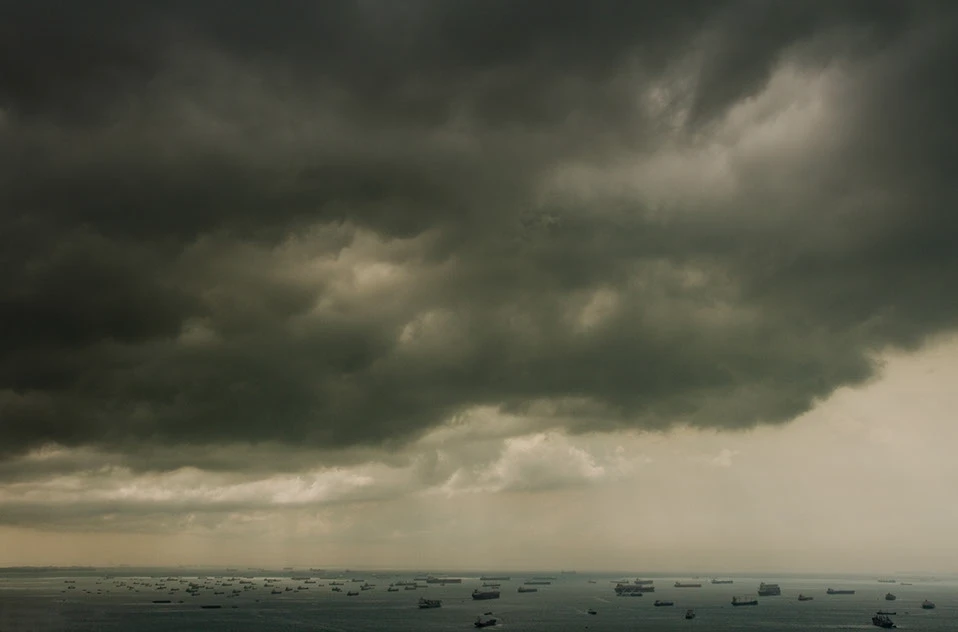
Already in the 19th century, John Constable, a landscape artist, claimed that the sky and atmospheric phenomena were also an important part of nature, which needed to be studied scientifically and represented. On these premises, he created a cycle of works of art called Cloud Studies (1821-1822) that focused on the scientific recording of meteorological phenomena. He painted the clouds, and on the back of his canvas, he wrote down the date, the day, and data regarding the wind and the temperature.

From that 19th-century artistic experience, we can already understand the desire to broaden the horizons of the concept of environment, starting from the various natural elements that are often overlooked. In that case, the air takes on an important aesthetic status, and with it the rain and various atmospheric events. Today, we have various artistic practices that use water in all its forms: fog, ice, and liquid—elements of the environment (natural and urban) that require a new connotation, gathered under the name of eco-aesthetic practices.5
These are important experiments concerning fog and clouds. Both are aquatic environments that prompt deeper reflection on both nature and our embodied experience within it. This is represented by some recent installations by artists who seek to use fog and clouds as part of a broader aquatic paradigm that highlights not only the corporeal experience of them but also a climatic perspective on the toxicity of fog. The artist Fujiko Nakaya herself fostered an aesthetic experience of fog through the first exhibition of fog sculptures (or cloud sculptures) at the Osaka Expo (Japan) in 1970.
Fujiko Nakaya’s Fog Sculptures
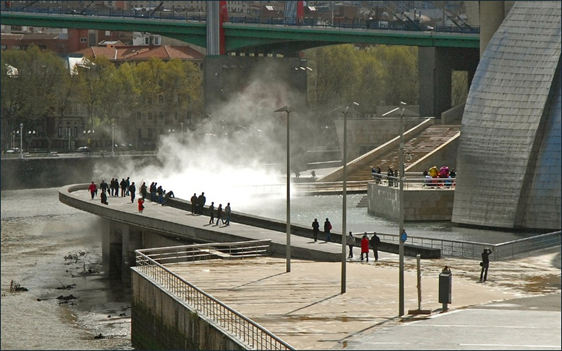
By manipulating shapeless materials like water or smoke, and various vaporous elements like clouds, the artist suggests the possibility of transforming these hyperobjects6(that is, realities like clouds that, by their very nature, surpass the capacity for rational knowledge and require a different approach). In this way, through the manipulation of these shapeless objects (fog, water, etc.), the artist manages to create an altered and unconventional experience of the environment. Representing fog and clouds means representing, through art, pollution, toxicity, and their inequalities, reinforced through the hydrological cycle, and highlights a reading of the urgency of the natural-cultural water crisis through completely transformed microclimates. Thinking and immersing oneself in fog and clouds means focusing on the various ways of transformation of water.
There are many artists (e.g., Emily Parsons-Lord, Olafur Eliasson, and Janet Laurence) who interact and dialogue with water: they interact with vaporous bodies of water in order to create embodied aesthetic experiences. In their artistic expressions, the fog reorients ideas and perceptions. A possible review of the artists is provided by the book Weather as Medium: Toward a Meteorological Art, written by Janine Randerson, in which the author explores a series of meteorological art projects from the 1960s to the present, drawing on sources ranging from dynamical, technological, and physical systems to indigenous cosmology.
Janet Laurence: Fog-Scapes as a Way to Care for the Environment
Another environmental artist who uses fog as an artistic material and as a means to create certain aesthetic experiences is the Australian artist Janet Laurence. Within the Australian art context, Laurence has contributed significantly to the development of eco-aesthetics. An example of this is her famous installation called In The Shadow (2000). This work was commissioned by the Olympic Park, part of Homebush Bay in Sydney, and installed along a stretch of stream crossed by three bridges. In the Shadow responds to the transformation of the site from a contaminated industrial area to a new “green” area.
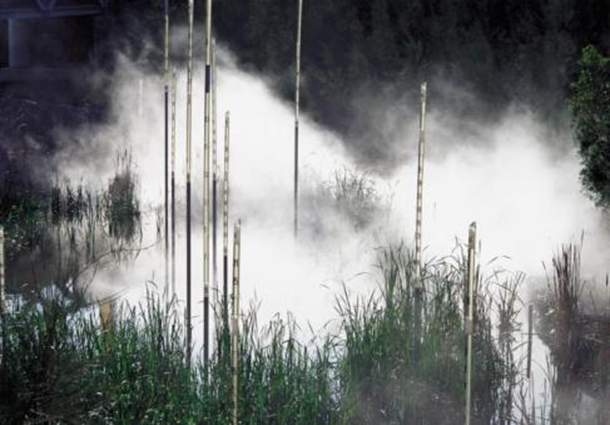
The following public artwork aimed to restore natural vegetation to Sydney’s Olympic Park, on Homebush Bay. In addition to extensive planting of native plants, the work included the installation of twenty-one vertical sensors to monitor the chemical composition of the river water. By encouraging the growth of native plants in a suburban area of Sydney, “In the Shadow, oxygenates an otherwise rather sterile area” (Felicity Fenner, Art & Australia, p. 64). According to the scholar Bronwyn Bailey-Charteris:
Laurence’s work is configured as a nebulous “anti-monument” in that it does not limit itself to satisfying an anthropocentric experience or gaze: the work, on the contrary, regulates and develops a microclimate within the Homebush stream, integrating itself with the local ecology.7
Through the hydro-artistic method of nebulization, the artist not only conveys a fundamental message—that is, the possibility of going beyond the boundaries of the Anthropocene—but this work also reveals its power to regenerate the environment itself. The artist cares for the damaged environment of Homebush. Her installation is located inside the stream, and precisely because of this positioning, the artwork takes shape and embodies the fog. In this regard, Bronwyn wrote:
Over time, as the trees grew, the stream became a place of aquatic regeneration. Through the hydro-artistic method of misting, Laurence directs the audience toward the possibility that art can act as a healing and regenerative force in damaged ecosystems.8
This is an example of what I think of eco-aesthetics: working with art and the environment to care for the environment itself, both from a practical and theoretical point of view. Working with art and the environment to heal the environment itself, both practically and theoretically. The theoretical importance of this curatorial hydro-artistic practice lies in its ability to rewrite concepts of philosophy and aesthetics in terms of a broad, inclusive, and undisciplined theory, dismantling old oppositions (nature/culture, inside/outside, etc.) and providing the possibility of acting by resisting categorizations.
Head in the Clouds: Conclusion
“Having head in the clouds” is an everyday expression not to be underestimated. It suggests the possibility of being elsewhere, of being other, of thinking with the clouds. Being in the clouds is a state of dialogue between the elements and the body itself; it also means incarnating oneself in the clouds, surrounded by water in all its forms. Water represents the element through which we manifest ourselves as dynamic and interconnected entities, and constitutes the vital substance of our composition. «Water as body; water as communicator between bodies; water as facilitating bodies into being. Entity, medium, transformative and gestational milieu. All of this enfolded in, seeping from, sustaining and saturating, our bodies of water. “There are tides in the body,” writes Virginia Woolf.9
It is precisely on this entity that we can begin to construct an aesthetic paradigm with a completely alternative development: a conception of art and the environment that is neither anthropocentric nor phallocentric, but rather watery, destructive, and disorienting. In conclusion, accepting water as fluid and vaporous, that is, not rigidly defined, both in form and meaning, means going beyond the existing categories on which Western thought and culture are built. Breaking with these consolidated paradigms means opening up to new possibilities; for example, we can build alternative methods of doing art by taking care of the environment and its problems.
References
[1] Bailey-Charteris, Bronwyn, The Hydrocene: Eco-Aesthetics in the Age of Water, Routledge Environmental Humanities (eds), 2024, p. 78.
[2] Bailey-Charteris, p. 8.
[3] Crawford, Donald W., “Nature and Art: Some Dialectical Relationships,” The Journal of Aesthetics and Art Criticism 42, no. 1 (1983): 57.
[4] Baker, Elizabeth C., “Artworks on the Land,” in Art in the Land: A Critical Anthology of Environmental Art, ed. Alan Sonfist (New York: Dutton, 1983), 83.
[5] I refer to what scholar Bronwyn Bailey-Charteris writes in the aforementioned book The Hydrocene: Eco-Aesthetics in the Age of Water about aesthetics and its combination with ecology… pp. 6-7.
[6] Morton, T., Hyperobjects: Philosophy and Ecology after the End of the World, University of Minnesota Press, 2013.
[7] Bailey-Charteris, The Hydrocene: Eco-Aesthetics in the Age of Water, p. 242.
[8] Bailey-Charteris, p. 242.
[9] A. Neimanis, Hydrofeminism: Or, On Becoming a Body of Water, in Undutiful Daughters… Palgrave Macmillan, New York, 2012, p. 87.