

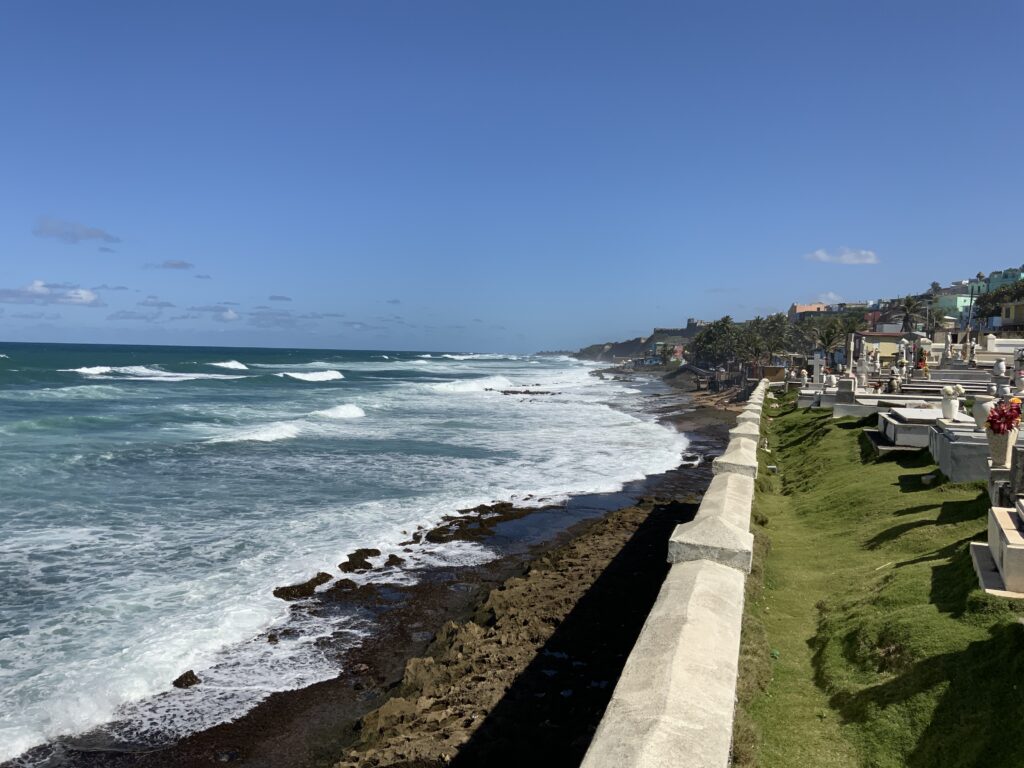
The boundless dimension that characterizes the element of water, as well as the sea itself, cannot be captured in simple terms, but various scholars, authors, and theorists have tried to describe its essence. Whether it is through a tale of travel, war, the conquest of new lands, death, birth and rebirth, or ancestry, the sea is often present as an integral part of a literary work, especially in the Caribbean. And although the historical past can bring pain and suffering, there is also the possibility of moving to new places and experiences while preserving memories of the sea. In “‘I Have Seen the Sea’: Caribbean Aquatic Poetics in Monique Roffey’s The Mermaid of Black Conch,” Leighan Renaud states that water “has been a site of exploration and theorisation for numerous Caribbean thinkers” (1). Dionne Brand describes the sea as overwhelming, as “bigger than feeling’” (1). Because there is an archive of oral histories and stories that circulate around the Caribbean collective like ocean waves, they reach the coast and are retrieved until an author finds or captures them and delivers a compelling version. Three novels by Caribbean authors in which infinite reverence for the sea is expressed are Daughters of the Stone (2009) by Dahlma Llanos-Figueroa, The Mermaid of Black Conch (2022) by Monique Roffey, and Village Weavers (2024) by Myriam J.A. Chancy. Therefore, this paper aims to identify how the sea is represented in Caribbean fiction, particularly as an element of connectedness, ancestral linkage, and a “device” for tracking memory.
In relation to the immensity of water, it is within this vastness that healing occurs. In this context, healing arises from water’s capacity to enable connection. This connection bridges places that seem distant and divided by the ocean, yet water flows and swirls between them, closing the gaps. To begin with a more scientific approach to the aspects of healing through water, in “The Healing Sea: A Sustainable Coastal Ocean Resource: Thalassotherapy” by Roger H. Charlier and Marie-Claire P. Chaineux, the term thalassotherapy is defined as “a medical approach based on the systematic use of seawater, sea products, shore climate” (3). Thus, healing by saltwater can be identified or traced in the works of Caribbean authors (such as the three selected) whose experiences are unalterably surrounded by this element and who, in one way or another, always return to the sea. Accordingly, the authors of this article take this theme a step further:
…the use of seawater for therapeutic aims was known in what are contemporary Egypt, France, Italy, and Greece as far back as 3000 BC. Nor was thalassotherapy a stranger in the medical arsenal of classical times. Its knowledge and practice were spread by Celts, Gauls, and especially Romans (Buchet, 1985). Bath, in England (Aquae Sulis in Roman times), got its name from the Romans’ custom. Greeks put considerable faith in the healing power of the sea. Greek poet Euripides (480–460 BC) wrote “The sea restores man’s health.” Greek philosopher Plato (428–437) held that “The sea washes all man’s ailments.” (9)
The fact that this kind of alternative medicine practice can be defined by a specific term, which can be traced back to its origins, indicates the historical importance of water as a healing element—whether by human instinct, the uncanny feeling of recognition it provides or by discovery and exploration. Water is given the effect of cleansing and renewal, which are attributes that are observed from the element in its natural state.
Critical and literary analyses of the aforementioned novels include an examination of: (a) the ocean as both metaphor and body, which can be perceived as a healing and traumatic space; (b) aquatic connections, emphasizing the importance of bodies of water in the literature such as streams, rivers, among others; and (c) hybridities, including archipelagic connections between the texts and the bodies of water they represent. As part of the study, it is important to identify that these texts or narratives become sites of encounter, not containment, and are as fluid as water.
Through Puerto Rican Generations
It is precisely this fluidity and contact with the ever-present water that allows novels like Daughters of Stone by the Afro-Puerto Rican author, Dahlma Llanos-Figueroa, and its well-designed web of characters to flourish and nurture their connection to African soil, from the Middle Passage to their new reality in Puerto Rico. In this novel, five generations of women of African descent are woven together to reveal their journey from an enslaved ancestor to a modern-day Afro-Puerto Rican scholar and writer who chooses to become the keeper of her family’s legacy. This constant wandering is characteristic of diasporas, but it is a wandering shared between leaving and returning, suffering and healing, that occurs mostly through their history of forced migration. Nevertheless, the author succeeds in preserving these central female personalities across five generations with great talent and skill in her novel.
One of the predominant aspects of the storyline is the connection to Oshun, who is culturally referred to as an African mother and goddess. Since Oshun is the goddess of water, this means the contact with the character’s origins is still present through the passage of time and the changes of space, no matter how far they have traveled from their motherland. Llanos mentions: “Mother Oshun, goddess of the river, patron of women, of motherhood, of fertility, had come to her in that dream, leaving strange images, sharp, piercing Fela’s brain—the river flowing backward, the skies opening and crying down on the flaming forest, sparks alighting the village, …” (10-11). These images link the goddess to birth and new beginnings, but also to death and possibly rebirth, since Fela dies while giving birth to her daughter Mati next to a flowing river. The author could have crafted a different scene and access to nature on this occasion, but she instinctively chose flowing water to shower the mother and new life, as a kind of welcoming to the world from their ancestors. Here, water serves as the first bath and “baptism” before Mati takes her first views and experiences of life, while at the same time, her mother’s soul departs from her exhausted body. This image draws attention back to the power of water as an element, since Oshun is basically depicted sitting on a bed of fresh water, opposite and in communion with Yemayá, the goddess of the ocean.
The soothing mosaic pieces of familiar stories are thus placed together by the first character, Fela, in a matrilineal line that includes five women who are linked by blood, beyond time, place, and circumstance. The stone that Fela carries with her is part of this symbolical, spiritual, and emotional connection to her West African homeland. As with water, when her ancestress Fela first arrived at the shores of the island by sea, it was this vast element that provided access to her lineage. Therefore, the striking differences between the settings and the practices when she arrives in Puerto Rico are not appealing to her, in other words, it is an unknown territory. As the novel evolves, so do the characters. There is Mati—spiritually inclined from an early age; she showed signs of being a healer and was very connected to nature. Interestingly, she also had a connection to water, and the goddess Oshun: “The Lady Oshun spoke about a long-ago village, about Mati’s mother, Fela, and father, Imo, and her grandfather, the keeper of tales. She spoke about the drummers and dancers and the gods and goddesses that ruled life. She told Mati about the ancestors who would always be waiting” (Llanos 67).
However, because of the connections drawn from a motherland to the receiving country, Carisa, the last daughter born in the novel, embodies the shifting nature of the mixed and evolving generations because she is the child of Elena, who decides to move to the United States and begins the family’s diasporic journey. This move allows Carisa access to quality higher education and literacy, leading her to become a writer and the keeper of their legacy in the future. Later, Carisa crosses the ocean to the African continent and begins her ancestral research in Nigeria. She opens the door to a generation that exists between possibilities. In addition, the aspect of connectedness and access to memory and ancestral knowledge (beyond time and space) is also attributed to water here, as the goddess of water makes this access possible.
Parallel to this, Carisa does not have a positive experience growing up and expressing her Puerto Rican and African ancestry, symbolized by the sacred stone her ancestors had carried to her. Llanos writes: “I opened one finger at a time to add to the mystery. The students snaked their necks to see what I was holding. Then there it was, the black stone in my hand. ‘Oh, come on!’ ‘Big deal, it’s just a rock.’” (246). All this is also made possible by the presence of the sea. Fela, the first in the bloodline, was part of the enslaved past of the Middle Passage, and she had brought this stone with her in her body, marking an unbreakable link to Africa that she subsequently left to her newborn daughter after she died from childbirth by the flowing water. Like her predecessors, Carisa finds herself between two spaces: the space of her Puerto Rican identity and the space of her life in New York along with the clash of cultures and people’s perceptions. In this case, the simple stone she holds brings her confidence and symbolizes a whole legacy of female power carried down through the women of her family.
The Unnatural and the Human Come Together
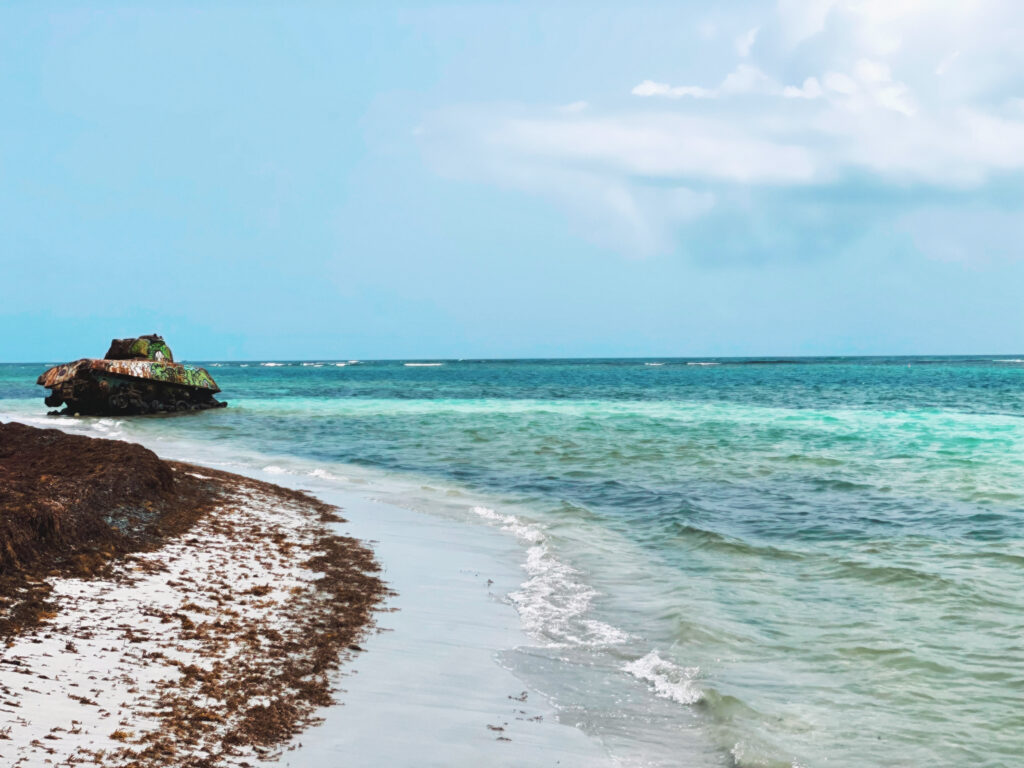
In the second novel, The Mermaid of Black Conch, the Trinidadian-born British author, unmistakably opens her book with a kind of prayer to her ancestors, addressed to the deep waters, which sets the tone for the novel and the enigmatic character of Aycayia. The world of this mermaid is intertwined with the human world. She has been exiled from the Black Conch area and has roamed the oceans for years, maintaining her unnatural mermaid state, but is rescued by a man who becomes key to her return to humanity. That comeback is threatened by others who do not understand her or her circumstances. The author begins her acknowledgements with the following words: “for the Goddess, the muse, the legends of the deep you are, to me” (1) for the reader to continue with the mermaid’s journey. This figure is not described as ordinary because, apart from being non-human, with manly features and size, and “fished” from the water, she is also magnetic. This is because she is unknown, different from everyone around her: “The men stared. Everyone felt it, the sadness of her existence, a woman who’d been alone in the sea. Had she jumped from a boat? Had her mother mated with a fish? Every man could feel his heart pounding hard in his chest, with fear and a sense of wonderment, at this half and half” (Roffey 29). Most of the male characters in the novel are impressed by Aycayia, her top and bottom halves, and crave to find out her secrets. The author masterfully links this magnetism to the mermaid’s being with so much depth that it frightens people, since it can reflect their own souls, just like the sea. Yet some want to dive into evil and harmful ways, as colonizers and oppressors would in a newly plundered land. But she only gets close to one of them, David, and that is the romance at the heart of the story, as this unifies the sea and land.
In this designed world, the sea is indeed history, as Derek Walcott’s poem “The Sea is History” (1979) portrays, for it represents all the possibilities that lie within it, connections to the past and the present, and all the extensions that the sea simultaneously has to other realities and places. Roffey wrote:
She was spitting up seawater, it seemed to be flowing out of her from deep in her gullet. Water seeped from her gills. She was a fish out of water, and yet she wasn’t going to expire like an ordinary fish. She was taking in big fast gulps of air like a thirsty child, trying to stay alive. Her hair was moving, spreading itself across the deck. Numerous pilot fish were dying off around her. She already looked smaller than when she was in the sea. (Roffey 30)
The power that lies within this mermaid is enhanced by the element of seawater, by her connection to it—with the saltwater scent that she still carries when she sheds her tail and grows back a pair of legs—which is said to be part of a curse that keeps her in the water. Even though Aycayia was human in her past, precisely because of her current state (as mermaid) she knows much about the hidden sea world that lies beneath the surface. Thus, she confidently says, “I have seen the sea,”—denoting the experience of lifetimes, for the sea is boundless and considered limitless, and the mermaid has seen it. Aycayia, as a mermaid, can move through the immeasurable waters of the oceans to different points of the world, and therefore she carries a lot of knowledge within her. She is the link between the sea and land, but also past and future, as well as the known and the unknown.
Within Connections That Transcend Place and Time
Connectedness thrives in Village Weavers by Chancy, who is a Haitian-Canadian-American author, when the relationship between the characters Sissi (Simone) and Gertie (Gertrude) transforms and evolves across time, space, and the elements. This novel traces the relationship between two girls from childhood into adulthood, exploring the challenges of a close relationship shaped by life struggles and a family secret that changes its dynamics. In it, water is mentioned repeatedly—as an almost magical element that interweaves memories and time. In other words, their connection is challenged and at the same time maintained in one way or another by water. There is even a moment when Gertie refers to Sissy as her “Simbi”—a Haitian water spirit that appears frequently in the novel. This becomes even clearer when the birds (village weavers) are described as having a deep connection to water, as follows: “It is true that the male birds’ black-hooded heads extend to their chests like the kerchiefs the women wear to shelter themselves, knotted behind their necks, above the shoulders, while the female birds, all of yellow, make her think of Ochún, the maternal sea [sic] goddess” (Chancy 42). The mention of the goddess Oshun (in the corresponding language variation) in this context, and from a Haitian perspective, opens a dimension that suggests how the author has carefully made water an essential element in her designed world.
Correspondingly, there is the moment when Gertie dreams of flying away like a bird, and plunges into this melancholic, introspective attitude, with “a humming that comes from the water, a lullaby that lulls children to sleep” (Chancy 23), and her eyes search for the birds until she sees the sea. The blackbirds are synonymous with childhood, with simpler times, that is, with memories. Chancy wrote: “She knows them, feels a familiarity that reminds her of childhood. Soon, they swoop together over rivers, following the movement out toward the ocean. But as the city flanked by the sea comes into view, Gertie falters. The other birds fall away, back toward the interior of the island” (23). The birds, who remind her of her childhood, are divided into those that fly out to sea and those that stay on the island—hauntingly representing the people who migrate and remain connected by love and memories.
Caribbean Waters Linked In Theory
In the field of theoretical works that assist the boundless dimension of the sea, but from an academic, non-fictional perspective that supports the sense of connectedness of this body of water, there are also Poetics of Relation (1990) by Edouard Glissant, The Repeating Island (1992), Antonio Benítez-Rojo, The Poetics of Space (1958) by Gaston Bachelard and Sea Changes: Historicizing the Ocean (2003) by Bernhard Klein and Gesa Mackenthun. Glissant reveals the persistent and pervasive connection to African ancestry that has permeated the waters of history since the Middle Passage, as in the three novels. Benitez-Rojo invites readers to circulate around the archipelagic tapestry of islands, which are connected not only by water but also by shared experiences, cultures, and peoples. Bachelard describes a space beyond the physical, one that opens to the creator or explorer and is intimate, allowing for a connection to oneself, the spiritual dimension of the person, and, in some cases, ancestral bonds. Klein and Mackenthun gathered various perspectives on the ocean, highlighting its unifying agency through a diverse range of literary works, which also support this research. Freud’s interpretation of the oceanic concept, which extends even beyond the uncanny to the eternal, reveals an unknown aspect of the sea that contains and connects all aspects of life, reflected in the depth and unexplored essence of the ocean.
In contrast to what the ocean offers in terms of connectedness and continuity, in the first part of his book Civilization and its Discontents (1930), Sigmund Freud explains “oceanic” (the nightmarish term that was borrowed from his friend Rolland in an exchange of letters with him) as “a feeling which he would like to call a sensation of ‘eternity’, a feeling as of something limitless, unbounded—as it were, ‘oceanic’. This feeling, he adds, is a purely subjective fact, not an article of faith; it brings with it no assurance of personal immortality,” (2). In other words, this well-known thinker of the early twentieth century emphasizes this term by highlighting the word “ocean” to denote its vastness, as used to define something that is considered infinite, but in his words, is uncertain. This is the nature of the sea in the selected literature that sets the tone for the Caribbean waters that are constantly present in the memories, stories, births, deaths and almost every breath of the characters as well as the authors’ thoughts who venture into this reflective fiction.
The relations that Glissant traces in his book “The Open Boat” reflect this transpiring space in which the enslaved ancestors were practically and unthinkably related to one another because they were in the same “belly of the boat” (as Glissant exposes), in the same womb that carried them to the forced destination, right down to Glissant’s coined term “rhizomatic” roots that grew as a result. In the context of these intertwined reflections of fiction writers and theoretical thinkers, in the article “Notes on The Caribbean Essay from an Archipelagic Perspective (Kamau Brathwaite, Édouard Glissant and Antonio Benítez Rojo),” Florencia Bonfiglio highlights that there is “the production of an essay ‘in a certain kind of way’ that the writers share: an ‘archipelagic’ kind of way in which the recurrence of aquatic metaphor s—a legacy from founders of Caribbeanness like Aimé Césaire—allow writers to inscribe a regional (decolonizing) imprint in postmodern thought” (147). As Glissant emphasizes in his work, this points to a relationship between them as writers or weavers of the Caribbean, which Bonfiglio additionally refers to as a display of cooperation that brings them “together with the imagination of the Caribbean as a ‘common place’” (158).
Likewise, in reference to Gaston Bachelard, Bonfiglio argues that: “If water, and especially the sea, according to Bachelard’s phenomenology of imagination, is a melancholic element par excellence which incites memory and remembrance, recalling in the Caribbean can in turn lead to re-membering (re-assembling) the archipelagic fragments” (166). This coincides with the statements of other theorists about a space that can transcend its physical form, as in the case of the sea of liquid and flowing “re-membering.” In Poetics of Space, specifically in chapter eight “Intimate Immensity,” Bachelard establishes the presence of a space that has no boundaries and reveals an intimate aspect like that of the sea since, in most cases where it is mentioned, the character is in deep reflection on life. He illustrates this as follows:
“Immensity is within ourselves. It is attached to a sort of expansion of being that life curbs and caution arrests, but which starts again when we are alone. As soon as we become motionless, we are elsewhere; we are dreaming in a world that is immense. Indeed, immensity is the movement of motionless man. It is one of the dynamic characteristics of quiet daydreaming” (184).
In relation to the sea, there is no need to be motionless, because there is movement in the waves, through boats, people walking on the beach, swimming, etc. This motionlessness is more of a necessary inner and individual meditative or contemplative state.
Just as the meditative state of the mind in solitude and immobility opens a space in which the intimate develops, Bachelard also theorizes that “…it is through their ‘immensity’ that these two kinds of space—the space of intimacy and world space—blend. When human solitude deepens, then the two immensities touch and become identical” (203). This is part of what happens in life with the personal and social dimensions of an individual. Nature is a space that, due to the possibility of relaxation and openness, also enables reflection and connection to the intimate. And one of the manifestations of nature is water, to return to the element of the sea, which can open access to the intimate or inner space that is healing and liberating.
For Benítez-Rojo, there is an intertwined continuation of everything in The Repeating Island, specifically the islands of the Caribbean, which are part of a “meta-archipelago” that inevitably shares a connection transcending place and time. The reality of the “Caribbean basin,” as he calls the region, makes it easy for Caribbeanness to be reproduced not only on the islands themselves but also outside the region through diasporas that carry these characteristics beyond the shores. As the word suggests, if the subject is an island, there is water and the sea that surrounds it:
In this (today’s) rereading, I propose, for example, to start with something concrete and easily demonstrated, a geographical fact: that the Antilles are an island bridge connecting, in “another way,” North and South America. This geographical accident gives the entire area, including its continental foci, the character of an archipelago, that is, a discontinuous conjunction (of what?): unstable condensations, turbulences, whirlpools, clumps of bubbles, frayed seaweed, sunken galleons, crashing breakers, flying fish, seagull squawks, downpours, nighttime phosphorescences, eddies and pools, uncertain voyages of signification; in short, a field of observation quite in tune with the objectives of Chaos. (Benítez-Rojo 19)
For Benítez-Rojo, the island that repeats itself does so in so many aspects that the island eventually disappears in its reproducibility. This relation is also true for some Caribbean music, as he mentions: “The copper, black, and yellow rhythms, if quite different from one another, have something in common: they belong to the Peoples of the Sea” (26). He refers to the Peoples of the Seas as those who marked the repeating islands with their cultures of union and preserved the ancestral knowledge brought to them from the African continent.
Similarly, in Sea Changes: Historicizing the Ocean, the editors assembled a collection of articles that examine the ocean as more than a vast body of water that serves as source for transportation, food, or separation of parts of the land. In the introduction “The Sea is History,” Walcott emerges as the voice that sets the tone for the book. The editors render tribute to him mentioning that his “poetic metaphor works to restore the sea to the dynamics of the historical process, energizing it for the project of re-imagining, re-writing, and re-membering the past as a complex and polysemic dialogue, a meeting place of different cultures rather than solely the battleground of antagonistic forces” (Klein and Mackenthun 1-2). And as part of this research, a key phrase comes from these lines: “meeting place,” that is, the sea as the link or meeting ground between different peoples who must use or meet by the sea in one way or another.
However, the Caribbean Sea or Caribbean waters also elicit references to slavery, oppression, and colonization. As Klein and Mackenthun argue, the sea “has been a site of loss, dispersal, and enforced migration but also of new forms of solidarity and affective kinship, a paradigm of modern capitalism but also of its creative reinterpretation, a figure of death but also of life (2). Yet it is also due to the ocean itself that we go beyond this fact, for water is constantly moving, flowing, and purifying. The process of healing involves a similar movement, a cyclical swirl of renewed water, away from the presumptuous spirit of conquest or taking possession of the greatest space for the sake of power, especially when the element that made it all possible in the first place holds the power, in this case the sea.
Ultimately, water is essentially as vital as the air people breathe, and this is reflected in literature, not only in poetry and non-fiction, but also in works of fiction. In the Caribbean, particularly in Puerto Rico, Haiti, and Trinidad and Tobago (based on the chosen novels), a region that is surrounded by salt water but also has a great abundance of fresh water, the importance of the sea is emphasized. The healing aspect of water is that it can often wash away pain but also induces acknowledgment or recognition and the process of addressing that pain by bringing it to the surface. In fact, pain and trauma must be recognized because only then can they be released and overcome. In novels such as Daughters of the Stone, The Mermaid of Black Conch,and Village Weavers, healing takes place through connectedness, relationships, love, and support; through connections that transcend time and space in the narratives (similar to the sea), even when the presence and growth of resistance to this notion beyond borders and separation naturally permeates the idea of what the sea might represent. An important reflection on the significance of the sea, prompted by the reading and analyses of these novels and the theoretical discussions that surround them, reveals a vast collection of connections, memories, and possibilities. Returning to Bonfiglio’s article, where she cites the works of prominent Caribbean writers, theorists, and thinkers, the sea and the waters of the Caribbean take center stage in the narratives. There is an aquatic bond present in many Caribbean literary works, reflecting an undeniable interconnectedness. This is also evident in the region’s hybrid nature, with hybridity appearing in many forms—cultural, racial, and even in its shared waters.
Madyanis Santiago Díaz was born in Puerto Rico and is currently a Ph.D. candidate in Literatures and Languages of the Caribbean in English at the University of Puerto Rico. She writes primarily fiction that evokes a sense of recognition, to honor the heritage and spirituality of Caribbean ancestors. Her works have appeared in Vernacular: New Connections in Language, Literature, & Culture, Latino Book Review, Wicazo Sa Review, The Puerto Rico Review, La Torre (UPR), The Caribbean Writer (TCW), Siyabonana: The Journal of Africana Studies, The Art of Belonging: Migration, Citizenship and the Caribbean (UNESCO, OBMICA, CARICOM, UWI) and others.
Works Cited
Bachelard, Gaston, and Maria Jolas. The Poetics of Space: The Classic Look at How We Experience Intimate Places. Beacon P, 1994.
Benítez Rojo, Antonio, and James E. Maraniss. The Repeating Island the Caribbean and the
Postmodern Perspective Antonio Benítez-Rojo. Transl. by James Maraniss. Duke UP, 2006.
Bonfiglio, Florencia. “Notes On the Caribbean Essay from An Archipelagic Perspective (Kamau
Brathwaite, Édouard Glissant and Antonio Benítez Rojo).” Caribbean Studies, vol. 43,
no. 1, 2015, pp. 147–73.
Brand, Dionne. At the Full and Change of the Moon a Novel Dionne Brand. Grove Press, 2002.
Chancy, Myriam J. A. Village Weavers: A Novel. Tin House, 2024.
Charlier, R. and Chaineux, M. “The healing sea: a sustainable coastal ocean resource:
Thalassotherapy.” Journal of Coastal Research, 25(4), 838–856.
Freud, Sigmund. “Chapter I.” Civilization and Its Discontents. W.W. Norton & Company, 2010.
Glissant, Édouard. Poetics of Relation. U of Michigan P, 2010.
Klein, Bernhard, and Gesa Mackenthun. Sea Changes: Historicizing the Ocean. Routledge,
2004.
Llanos-Figueroa, Dahlma. Daughters of the Stone. Published by Dahlma Llanos-Figueroa, 2019.
Renaud, Leighan. 2025. “‘I Have Seen the Sea’: Caribbean Aquatic Poetics in Monique Roffey’s The Mermaid of Black Conch.” Humanities 14: 154.
Roffey, Monique. The Mermaid of Black Conch. Alfred A. Knopf, 2022.