Tag: Nature Writing

  • Commodified and Digital Airscapes: Reflections on sensing and breathing air in the 21st century

    Commodified and Digital Airscapes: Reflections on sensing and breathing air in the 21st century

    The LA fires that wreaked havoc in Hollywood earlier this year were only one instance of many over the past years when wildfires ravaged communities and polluted the air. Apart from catastrophic wildfires, industry and vehicle emissions are sources of pollution many people experience on an everyday basis. With increasing levels of air pollution in the world’s biggest cities, it is perhaps no surprise to see the emergence of commodified and digital air as a new frontier of commodification and extraction: air domes, air purifiers, bottled mountain air, and digital air quality index applications (AQI-apps) are only a few examples of the ways in which society has responded to worsening air quality. But what do these developments mean in terms of the ways we inhabit and sense air?  

    On a smog-infested January day in Beijing, a user on the social media platform Sina Weibo writes: “AQI app shows 400!!! I’m inside with the air purifier on.” In another time and part of the world, in a sweltering June, a Reddit user writes: “The smoke from the wildfires has reached New York. It is apocalyptic outside, and I’m blasting the air purifiers. Feels fine inside.”

    Although the fate of these two social media users with their air purifiers is unknown, we may safely assume they survived the apocalypse, which stands in stark contrast to William Delisle Hay’s science fiction novella, The Doom of the Great City, from 1880.1 Like the apocalyptic scenes described by the social media users’ of today, Hay’s fictional London is covered in a toxic soot blanket. But only a single person survives to tell the tragic story as the rest of Londoners suffocate to death. Needless to say, there are no air quality apps or air purifiers in this fictional London. And if there were – would it have made a difference? Can technology save us from air pollution? Probably not. But it can do a great deal of other things. 

    In fact, these two social media comments exemplify ways in which technological and digital equipment have entered our relationship with the air. Not only that, these devices also have profound effects on how air is experienced. In these short descriptions, the outdoor and indoor air become different entities due to the air purifiers, which create a secluded and, allegedly, pure airscape indoors, as opposed to the apocalyptic scenes outside that are physically sensed and mediated through the AQI-numbers. The notion of airscapes suggests the construction and conceptualizations of different forms of air that we come to inhabit. These airscapes can be conceptualized simply by our sensual understanding of air, the report of others, digital and other types of technical equipment, or a combination of all the above. The question is what happens to our understandings of air when our experiences of air are increasingly mediated by digital devices? 

    Bodily senses and airscapes

    Seventy years before Hay’s novel, the London air is also a topic that vexes Mr. Woodhouse, a character in Jane Austen’s Emma from 1816. When learning about the many colds his eldest daughter and grandchildren have recently experienced, Mr. Woodhouse immediately finds the villain of these ills – the London air. 

    “Nobody is healthy in London, nobody can be. It is a dreadful thing to have you forced to live there! so far off!—and the air so bad!”2  

    In his assessments of the London air, Mr. Woodhouse is not in the wrong. Historical records estimate that the city experienced a rapid worsening of air quality from the beginning of the 19th century, the presumed time frame in which Emma is set.3 Yet, unlike us, Mr. Woodhouse couldn’t know this through sensors, satellite imaging, or AQI-apps, providing the latest updates and forecasts. No, he used his senses or relied on the sensual experiences of others. Presumably agreeing with Mr. Woodhouse’s assessment of the London air, the family doctor has prescribed another type of air as a remedy for the illness-prone family – sea air and its salty winds. In Emma, air is thus categorized as the healthy rural air, the healthy sea air, and the toxic London air, forming airscapes based on bodily and emotional sensations of the air. 

    Skip forward 200 years, and similar airscapes to the ones in Emma are artificially produced for consumption. There are air humidifiers and purifiers simulating sea-air for preserving health; there is bottled mountain air promising the consumer up to 160 breaths of fresh air, and let’s not forget about city air domes – a bubble like, inflatable structure of PVC fabric which pumps air into a designated area, protected from pollutants outside.4 These are artificially created micro-airscapes, presenting a controlled and limited airscape for those who can afford it. Moreover, they are formed regardless of our bodily sensations – they are based on someone else’s definition of air. The bottled air is proclaimed to be fresh and healthy; the air purifiers are certified to create beneficial sea air. In short, these artificial airscapes come with established ideas of air, and they are furthermore part of a larger invisible network of actors and their inbuilt understandings of air; notions which users may come to internalize. 

    Of course, our bodies have not disappeared in the 21st century, nor have they been replaced by technological devices. Indeed, understanding the air through our senses and experiences is not a practice isolated to the 19th century. Timothy Choy describes in his ethnography on contemporary environmentalism in Hong Kong how his interlocutors first and foremost speak of air in terms of feelings, experiences, and health, illustrating the centrality of the body in assessing air: foul air  smells, gives headaches, and irritates lungs. Air also carries other smells: of flowers, sea, autumn, and of afternoon tea in one’s favourite chair – perhaps comforting and healing properties in themselves.5 But in the Anthropocene, the body is a site where the terraforming of our environments by different means, including the employment of technological innovations, is manifested and negotiated.6 And in regard to air, digitally and technologically mediated experiences of air increasingly mix with our bodily perceptions. Simultaneously, this also shapes our conceptions of the environment. 

    Digitally mediated airscapes

    As we are encountering numerical, comparable, commodified, and artificially constructed air, it is not a surprise that our relation to nature has been described as increasingly mediated through digital technologies, influencing our perceptions of the environment and, by extension, our airscapes.7  Research of people’s interaction with AQI-apps in the US and China illustrates how the numbers and the bodily experiences sometimes diverge: the AQI-value proclaims decent air quality, but bodily reactions to the air indicate otherwise, creating confusion around what one experiences.8 This prompts the question of how one combines and makes sense of bodily sensations and the information of AQI-apps?

    The increasingly popular AQI-apps construct airscapes based on air quality scores (AQI-values), and not bodily sensations. Measured levels of nitrogen dioxide, ozone, sulphur dioxide, carbon monoxide, PM2.5 and PM10 generate a particular idea of air as constructed of mainly four gases and two particles deemed adverse to human health9. A specific understanding of air is manifest already in the chosen measured components; air is stripped of smell, sound, breeze, humidity, feelings, and of other scientific gases such as oxygen or carbon dioxide. Furthermore, the AQI-apps rank the best/worst air in the world, blending and connecting geographical areas, or sometimes separating them, based on the AQI-values of different locations. Some days, places like Beijing, New Delhi, Cairo, and Sarajevo share a common airscape, regardless of geographical boundaries, smells, breeze, or memories. Other days, neighbouring cities couldn’t be placed further apart, creating a sense among AQI-app users of air as comparable – a  competitive gaming entity.10

    As digital and artificially produced airscapes increasingly influence our experiences of air, how we live, feel, and create our airscapes emerge as central issues to explore. What kind of airscapes do we inhabit? Who gets to breathe what kind of air, and how is it constructed, simulated, and understood? Instead of succumbing to the dreariness of simulated sea air or caged air domes in lieu of the real air, the notion of airscapes provides a viewpoint from which we can critically ask who gets to breathe and inhabit a certain air and take measures to change the situation. Moreover, while toxins nowadays dominate narratives of air, Emma and Choy’s interlocutors remind us that air is composed of different atmospheric experiences and entities – smells, breeze, memories, power, feelings, and sounds. The multitude of contemporary airscapes can act as sites from which we learn and understand – the broken, the hopeful, the hidden, and not least, our more-than-human relationships. 

    Works cited

    1. Hay, W. D.  The Doom of the Great City. 2025 (1880) West Virginia University Press. ↩︎
    2. Austen, J. Emma. London: Penguin Classics, 2009 (1816) p.129. ↩︎
    3. Ritchie, H. “What the history of London’s air pollution can tell us about the future of today’s growing megacities”. 2017. https://ourworldindata.org/london-air-pollution ↩︎
    4. Li, Y. “Dome sweet dome.” 2014 https://www.globaltimes.cn/content/848220.shtml2014 ↩︎
    5. Choy, T. Ecologies of Comparison: An Ethnography of Endangerment in Hong Kong. Durham, NC: Duke University Press, 2011. ↩︎
    6. Fjalland, E. Terraforming. In Krogh, S. (Ed.) Connectedness: an incomplete encyclopedia of the Anthropocene. Strandberg Publishing, Copenhagen. 2020, pp. 360-363. ↩︎
    7. Goldstein, J., & Nost, E. The nature of data: infrastructures, environments, politics. University of Nebraska Press, 2022. ↩︎
    8. Graminius C., & Haider J. (preprint) Anticipating airpocalypse: air quality apps and implicit modes of anticipatory practices. Futures. https://papers.ssrn.com/sol3/papers.cfm?abstract_id=4952462 ↩︎
    9. Graminius C., & Haider, J. (2018). Air pollution online: Everyday environmental information on the social media site Sina Weibo. Journal of Documentation. 74(4), pp.722-740.
      ↩︎
    10. Ibid. ↩︎

    About the author:
    Carin Graminius is a researcher in environmental communication who received her PhD in Information Studies from Lund University, Sweden, in 2023. Her interdisciplinary research spans the fields of environmental humanities, cultural studies, environmental communication, and sinology, with a particular focus on eco-aesthetics, climate fiction, affect, and practices of anticipation and datafication.

  • Ecocriticism and Birding

    Ecocriticism and Birding

    Having written a PhD dissertation about human–bird relations in contemporary Scandinavian novels while also being an active birder, I’ve often thought about the links between birding, literary fiction, and ecocriticism. While my dissertation is grounded in literary theory, only drawing on field experience in indirect ways, surely there must be more to be said about writing and birding. As Jemma Deer (2022) points out, birds “have been making music, visual art, and aesthetic judgments for far longer than humans have,” and “provide the blueprint or muse for much human artistic production” (10). One would think that texts about birds, aside from reflecting interest in them, might be influenced by the practice of birding in ways that are evident in form and style.

    Among literary scholars, however, the notion that observing birds and writing about them go together is far from being the rule. On the contrary, until the late twentieth century it was commonplace to read birds in literature solely as symbols or metaphors. While Beryl Rowland (1978) primarily saw birds as Jungian symbols, Atle Kittang (1988) argued that birds in poetry rarely if ever correlate with the models from which they are derived and are not intended to do so either. Then again, as early as 1972, Joseph Meeker (1997) argued that birds can provide a mirror “to help us to understand human relationships” (108) and that “human conversation is not much different from birdsong” (109). Leonard Lutwack, in Birds in Literature (1994), tentatively suggested the possibility of reading birds ecologically, but it was only with the emergence of ecocriticism as a distinct field that reading environmental texts through a framework of “kinship between nonhuman and human” was recognized as a legitimate critical pursuit (Buell 1995, 180).

    The University of Stavanger, where I did my research, is located at the edge of Jæren, a coastal plain in south-western Norway known for its rich birdlife. I would spend the day writing about books about birds and then, on my way home, stop off by one of the nearby lakes to catch up on actual birds, taking notes and photos and often reporting my observations. In late spring, a pair of European oystercatchers would nest on a roof below our third-floor office space, bringing food for their young and driving away intruders, and in winter, hooded crows and jackdaws in their hundreds could be seen flocking to and from their communal nighttime roost. With literary birds in the office and actual birds out the window, I took my cue from what Lawrence Buell, with reference to Barry Lopez, calls “the aspiration to write and think more ecocentrically,” acknowledging that one’s approach to art and scholarship is not exclusively formed through reading but also through embodied experience of specific environments (Buell 2005, 99).

    Strolling or hiking through natural landscapes tends to trigger reflection, which can be conducive to writing, but this is not necessarily true of birding, where one is wholly absorbed in detecting and identifying species or interpreting their behavior and vocalizations. Where some make a case for “slow birding” (e.g. Strassmann 2022), this is a reaction to the realization that birding generally is not a particularly slow practice. Birding engages one’s senses of sight and hearing, as well as memory and intuition, in direct and immediate ways, and even when a birder is stationary, waiting for a skulking bird to show, attention tends to be directed outward, toward the bird, rather than to inner thought processes. To combine birding with writing or literary scholarship can therefore seem like a precarious endeavour. If nothing else, birding is a source of inspiration, and the genre of the trip report is not entirely unrelated to that of nature writing.

    Standing beneath the highway bridge at the mouth of the Hafrsfjord, watching Arctic terns and common terns at their breeding colonies, I had Charlotte McConaghy’s dystopian novel Migrations (2021) fresh in mind. Considering that the narrator of Migrations tries to follow the last Arctic terns on their migration to Antarctica, seeing them as a last remnant of wildness in a world destroyed by humans, I couldn’t help but read the terns as beacons of hope. While a life of birding offers a wealth of peak experiences, it can also lead to a keen awareness of habitat loss and population declines. Arctic terns are not endangered yet, though their populations are decreasing in some places (BirdLife International 2018). In Norway, a more pressing concern is a dramatic regional decline in the population of common terns, which has led to their being categorized as Endangered on the National Red List (Stokke et al. 2021). Regardless of Red List assessments, I counted myself lucky to see the two species breeding side by side, despite overfishing, predation from American mink, and the mounting threat of climate change. While Arctic terns migrate further and see more daylight in the year than any other known species, common terns are not far behind.

    Watching the terns hovering and diving, catching fish and feeding their young, swooping and turning with supreme elegance, I recalled narratologist Marco Caracciolo’s (2020) concept of “kinesthetic empathy,” how empathy does not necessarily have to entail imagining our way into an individual mind but rather into a moving body, or even an assemblage of bodies (239–240). Accounting for “embodied collectivity” demands moving beyond the focus on individual agency that has been the norm in narratology and literary scholarship (241). Observing a murmuration of starlings, a skein of geese, or swallows gathered in their hundreds, our attention is drawn not to the individual, but to the group, of which the individual forms a part.

    Whether one is panning a bird in the viewfinder or taking in the jizz of a bird briefly glimpsed, kinesthetic empathy is integral to birdwatching. With time, one develops a knack for tracing—and anticipating—the movements of birds, effectively predicting where they’ll be from one moment to the next. Embodied skills are arguably also manifest in the process of reading fiction, the ability to trace plot developments and follow them through to their conclusion, while uncovering underlying themes and motifs. Ecocriticism and birding are both comparative practices in which subtle contrasts can be crucial. Beyond that, birding calls for keen eyes and ears, identification skills and field experience, while ecocriticism requires theoretical knowledge and sensitivity to cultural context. Where bird identification is based on diagnostic features, however, literary texts demand hermeneutical forms of interpretation that are rarely conclusive.

    If the relevance of birding to literary fiction can seem obscure, the “naturalist gaze” through which birders perceive the world (Cherry 2019, 9, 41–42) is central to analysis of nature writing. Some ecocritics are bound to disagree, but I would contend that birding can contribute toward sharpening or even reorienting one’s “ecocritical gaze.” Take a classic work of nature writing such as J. A. Baker’s The Peregrine (1967), written with such nuance and attention to detail that even those unfamiliar with the species described can appreciate its aesthetic qualities. Where non-birders are enamored by its form and style, its poetic, densely layered language, birders are led to recall the flight patterns of actual species ranging from snipe to kestrel, patterns that are not metaphorical but literal, idiosyncratic to the point of being diagnostic, easy to apprehend but difficult to describe. Rather than making intertextual references, Baker refers to a shared body of field-ornithological knowledge and transposes it into literary form. By presenting recognizable perceptual experiences in striking and unexpected ways, nature writing can challenge and broaden our worldview. Birds can be evocative of places, memories, and impressions, as well as entire narratives. There are countless ways to account for their presence, but no matter how dense a layer of metaphor we cloak them in, the starting point must surely be the birds themselves.

    References

    Baker, J. A. 1967. The Peregrine. New York Review of Books.

    BirdLife International. 2018. Sterna paradisaea. The IUCN Red List of Threatened Species. https://dx.doi.org/10.2305/IUCN.UK.2018-2.RLTS.T22694629A132065195.en. Accessed on 13 March 2024.

    Buell, Lawrence. 1996 (1995). The Environmental Imagination: Thoreau, Nature Writing, and the Formation of American Culture. Cambridge, Massachusetts, and London: The Belknap Press of Harvard University Press.

    Buell, Lawrence. 2005. The Future of Environmental Criticism: Environmental Crisis and Literary Imagination. Malden, Massachusetts: Blackwell Publishing.

    Caracciolo, Marco. 2020. “Flocking Together: Collective Animal Minds in Contemporary Fiction.” PMLA, vol. 135, no. 2, 239–253. https://doi.org/10.1632/pmla.2020.135.2.239

    Cherry, Elizabeth. 2019. For the Birds: Protecting Wildlife through the Naturalist Gaze. New Brunswick, New Jersey: Rutgers University Press.

    Deer, Jemma. 2022. “Birdwatching and Wordwatching: The Avian Aesthetics of Virginia Woolf’s Mrs. Dalloway.” In Danette DiMarco and Timothy Ruppert (eds.), Avian Aesthetics in Literature and Culture: Birds and Humans in the Popular Imagination, 9–23. Lanham, Maryland: Lexington Books.

    Kittang, Atle. 1988. “Fuglar og poesi.”  In Atle Kittang, Møtestader: Utvalde artiklar om litteratur og litteraturteori, 52–67. Oslo: Det Norske Samlaget.

    McConaghy, Charlotte. 2021. Migrations. London: Vintage.

    Meeker, Joseph W. 1997. The Comedy of Survival: Literary Ecology and a Play Ethic. Third edition. Tucson: The University of Arizona Press.

    Rowland, Beryl. 1978. Birds with Human Souls: A Guide to Bird Symbolism. Knoxville: University of Tennessee Press.

    Stokke, B. G. et al. 2021. “Fugler: Vurdering av makrellterne Sterna hirundo for Norge.” In Norwegian Red List for Species 2021. Trondheim: Norwegian Biodiversity Information Centre (Artsdatabanken). http://www.artsdatabanken.no/lister/rodlisteforarter/2021/31752

    Strassmann, Joan E. 2022. Slow Birding: The Art and Science of Enjoying the Birds in Your Own Backyard. New York: TarcherPerigee.

    About the Author

    Endre Harvold Kvangraven recently defended his PhD dissertation in Nordic Literature at the
    University of Stavanger, Norway, with the title Literary Birding: Human–Bird Relations in
    Contemporary Novels from Norway and Sweden. He is also the author of Ulv i det norske
    kulturlandskapet (Wolves in a Cultural Landscape, Res Publica, 2021), a work of literary
    nonfiction tracing the role of wolves in Norwegian cultural history.

  • You are a sky full of stars

    by Demet Uygun

    You are a sky full of stars,
    A floating voyage,
    Infinite beauty that never leaves scars,
    Cause you light up the path through the dark.
    Like the Sirius, the brightest star in the night sky,
    Continuous as the stars that shine,
    You light up the world from afar.

    Working Notes on Demet’s poem:

    I chose the line “continuous as the stars that shine” because it reminded me of Coldplay’s song “A
    Sky Full of Stars.” Then, I looked at the names of the stars, especially the brightest star, which is
    Sirius. I gathered the lines of the song, the poem, and a basic definition I found on Wikipedia about
    Sirius.

  • Beside the lake, beneath the trees 

    by Charmaine Küllenberg 

    The wind rises 

    Like a wave upon the sea 

    Where the weeds are growing free  

    There deep, deep in the forest night  

    Some are born to sweet delight  

    _

    There we wander, there we weep 

    As the crows fall asleep 

    Hear the forest talking, insects and birds  

    An idiot prayer of empty words 

    With no alarms and no surprises 

    _

    I looked up to the sky above 

    To you, who was dearly loved 

    Working notes on Charmaine’s poem:

    For the Wordsworth rewriting poem, I chose the line “Beside the lake, beneath the trees” because I
    had the idea of describing a new scene based on it. So when I was collecting lines, I picked the ones
    that I thought would fit the scene I had in mind. I had a lot of fun working on the poem, but it was
    also quite challenging. What made it difficult for me was that I found lines that rhymed at the end
    (the first pair I found was ‘night’, ‘delight’) and decided that I wanted the whole poem to rhyme. I
    found most lines from songs I’ve been listening to at the time and other things I’ve read. The line
    “Some are born to sweet delight” is taken from William Blake’s ‘Auguries of Innocence’ because I
    just like that poem and wanted to use a line for this. Personally, the poem invokes a feeling of
    solitude and melancholy, but also calmness. The first two stanzas build a sort of frame as I put the
    rhyming lines at the beginning of the first stanza and the end of the second one (‘rises’, ‘surprises’).
    I’m not quite sure why I wanted to frame it like that; it just felt right to me.

  • Unframing Wordsworth’s Daffodils. A practical and theoretical poetry class

    Even outside of environmental literature circles, William Wordsworth’s poem ‘I wandered lonely as a cloud’, also commonly known as ‘Daffodils’, is widely recognised as ‘one of England’s most famous and most quintessentially Romantic poems’ (British Library). In 2007, local tourism officials of the Lake District even released a pop video and hip hop version to celebrate its bicentennial legacy – and to advertise Wordsworth’s beloved home to a younger audience. In environmental discourse, Wordsworth’s status as an “ecopoet” whose sensitivity to emotions, elements, and place turns poems into “imaginary parks in which we may breathe an air that is not toxic and accommodate ourselves to a mode of dwelling that is not alienated” (Bate 64) has been particularly secured by Jonathan Bate. Other critics, however, are more skeptical of what they see as an erasure of material, economical, and political conditions in favour of an idealised pristine natural idyll (cf. Hess, McGann, Levinson). Though acknowledging the Romantics’ attentiveness to the non-human, later strands of ecocriticism and ecopoetics have further pushed against traditions of nature poetry that reduce nature to a pastoral scene we admire from afar. Moving beyond this, ecopoetics, as Evelyn Reilly writes, includes the “rejection of compensatory notions of nature as retreat and of our role as consumers of consoling description” and engages “the recuperation of cultural, industrial, and political erasures; the dismantling of dichotomies of self/other, nature/ culture, indigenous/alien and central/peripheral” (257). 

    The creative writing & artistic research seminar “Beyond Nature Poetry: Ecopoetics” that I currently teach at Düsseldorf University aims to foster critical engagements with so-called nature poetry precisely along these lines of investigation. Open to BA and MA students in the English department, it seeks to explore the capacities of ecopoetics to disclose, reflect on, and reimagine the power dynamics between humans, language, and what we refer to as “nature”. In this context, we discussed how the poetic I in Wordsworth’s “Daffodils” encounters the natural world and how we as readers encounter it in turn. The students were quick to point out that the first iconic line “I wandered lonely as a cloud” suggests a bird’s-eye perspective that places the speaker outside the landscape. The description of the “crowd” of daffodils that come into view “all at once”, like in a picture, adds to the picturesque spell of the poem that frames nature as a spectacle the disconnected spectator observes from distance. Driven by an exclusive focus on the visual – “saw I”; “I saw”; “I gazed and gazed” – this distance continues throughout all four stanzas. As students noted, the poem thus appears to be more about us seeing the poet seeing the daffodils rather than the daffodils themselves. Although the content of the poem seems to suggest an emotional connection with the daffodils as “company” for the lonely poet, the way it is presented, framed by the narrator and an omnipresent lyrical eye, simultaneously continues to separate the disembodied speaker’s mind from the natural, socio-political, and physical environment they are engaging – or, rather, failing to engage with. 

    Scott Hess, who reads Wordsworth’s poem in relation to the conventions of Romantic-period landscape aesthetics, suggests that it demonstrates the persistence of the picturesque as a mode of structuring perception and framing landscape. Focusing quite literally on “that peculiar kind of beauty, which is agreeable in a picture” (Gilpin xii), the emergence of the picturesque as an aesthetic ideal propelled a new way of looking at nature as if it were a landscape painting. From the 18th century onwards, the Lake District in particular became popular with new picturesque tourists who used the Claude glass, a portable convex tinted mirror, to impose a perceptual frame around the landscape whilst – not only metaphorically, but physically – turning their back to it. Enacting a similar framing technique through its point of view and emphasis on the visual, Wordsworth’s poem arguably implies separations between viewer and landscape, subject and object, mind and body – separations that are unhelpful when we are searching for reparative ways of ecological interconnectedness. Anthropomorphised only, it seems, to make the poetic I feel less lonely, the daffodils that are “tossing their heads in sprightly dance” are exclusively bent towards the human, suggesting a non-reciprocal and anthropocentric relationship between human and nature. The final stanza adds to this reading, as the daffodil scene is now completely interiorised and becomes an imaginative resource for the narrator’s pleasure and sense of individual self. In that sense, the poem’s activation of picturesque framing can thus be read as reinforcing a persistent perception of nature as a projection surface and separate stylised idyllic retreat for anthropocentric purposes.

    With this in mind, we set out to re- or unframe Wordsworth’s daffodil poem. Since my seminar embraces ecopoetics as a “creative-critical edge” (Skinner 1) that combines theoretical and practical modes of investigation, our critical discussion was paired with a creative writing task. Inspired by a combination of conceptual/procedural poetry techniques, Charles Bernstein’s language experiments and this playful Daffodil variation I found online, I asked the students to pick a line from the Wordsworth poem that spoke to them in some way. They were then supposed to find material (leaflets, newspaper articles, dictionary entries, other poems…) that somehow related to that line and to finally make a new poem composed of phrases from the new sources, juxtaposed with lines from the original if desired.

    The results are surprising and wonderful in many ways. Students’ materials included songs, references to Blake, bureaucratic forms, research on dance, manuals, and advertisements that begin to move Wordsworth’s poem into the chaos of our contemporary present. Unraveling a detached bird’s-eye view on nature, the new poems became expressions of embedded narrators whose reading experience, context, and environment shape and in-form their writing. In that sense, many of the new poems no longer describe but start to embody a more connected, interdependent sense of being in the world and having to deal with its material, physical, and economic conditions: Wordsworth meets the struggles of applying for student funding; “dancing daffodils” are complicated by the bodily strains of professional athletes and commercialised resource extraction. Often questioning nature as an idyllic retreat separated from the human realm, the poems disclose various contact points between humans and their multifaceted environments. Juxtaposing different registers and sources, they open themselves up to new relations between textual and extratextual ecologies and reflect on the various uses of language as it connects us to “the fragile and finite territory our species named, claimed, exploited, sentimentalized, and aggrandized as ‘our world.’” (Retallack para 30) We do not need to wander out into nature, we are in the midst of it, part of it, and it is not always pretty but includes “fear, dominance, confusion, or pain”. Amidst this confusion, we can find poetry and “experience art” that is not separated from but fully embedded in everyday life and thereby directly interacting with its social, political, and historical layers.

    The writing and reading procedures/process of these poems invite closer attention to these layers and how they are curated by language, searching for an ecopoetics of disruption, imagination, and critical consciousness that can make us aware and perhaps push the limits of our view. Resembling branches that grow out of Wordsworth’s original poem, as one the student described it, all of the new, unframed poems emphasize process and offer new perspectives on and beyond Wordsworth’s “Daffodils”. My intention with this task has not been to disparage his poem, but rather to show it is not the end of the story and encourage us to investigate, shift, and lift the frames that structure our perception. One voice, one poem, one frame is simply not enough to register the fullness, multiplicity, and complexity of this ancient earth we humans inhabit only briefly.

    References

    Bate, Jonathan. The Song of the Earth. Picador, 2001.

    British Library. “William Wordsworth’s ‘I wandered lonely as a cloud’. https://www.britishlibrary.cn/ en/works/i-wandered-lonely-as-a-cloud/ 

    Gilpin, William. An Essay on Prints. A. Strahan, 1802. 

    Hess, Scott. “John Clare, William Wordsworth, and the (Un)framing of Nature”. John Clare Society  Journal, Iss. 27, 2008. pp. 27-44. 

    Levinson, Marjorie. Wordsworth’s Great Period Poems. Cambridge University Press, 1986. 

    McGann, Jerome. The Romantic Ideology: A Critical Investigation. University of Chicago Press, 1983. 

    Reilly, Evelyn. “Eco-Noise and the Flux of Lux”. Eco Language Reader, edited by Brenda, Iijima, Portable P at Yo-Yo Labs/Nightboat, 2010, pp. 255–74. 

    Retallack, Joan. ‘What Is Experimental Poetry and Why Do We Need It’. Jacket Magazine, 2007,  jacketmagazine.com/32/p-retallack.shtml. 

    Skinner, Jonathan. ecopoetics 01. Periplum, 2001.  

    Soth, Amelia. ‘The Claude Glass Revolutionized the Way People Saw Landscapes.’ JSTOR Daily, 2021.

    Wordsworth, William. “I wandered lonely as a cloud.” PoetryFoundation, https://www.poetryfoundation.org/poems/45521/i-wandered-lonely-as-a-cloud. 

  • Queer relation and the landscape: animals, the neutral, and significant otherness

    Queer relation and the landscape: animals, the neutral, and significant otherness

    In this writerly contemplation of queer relation with animals and landscapes, Clare Patterson draws connections between sheep trapped in snow drifts, Clarice Lispector’s cockroach, Leslie Feinberg’s crow, and various “significant othernesses” that shape our lives and queer literature.

    🏵

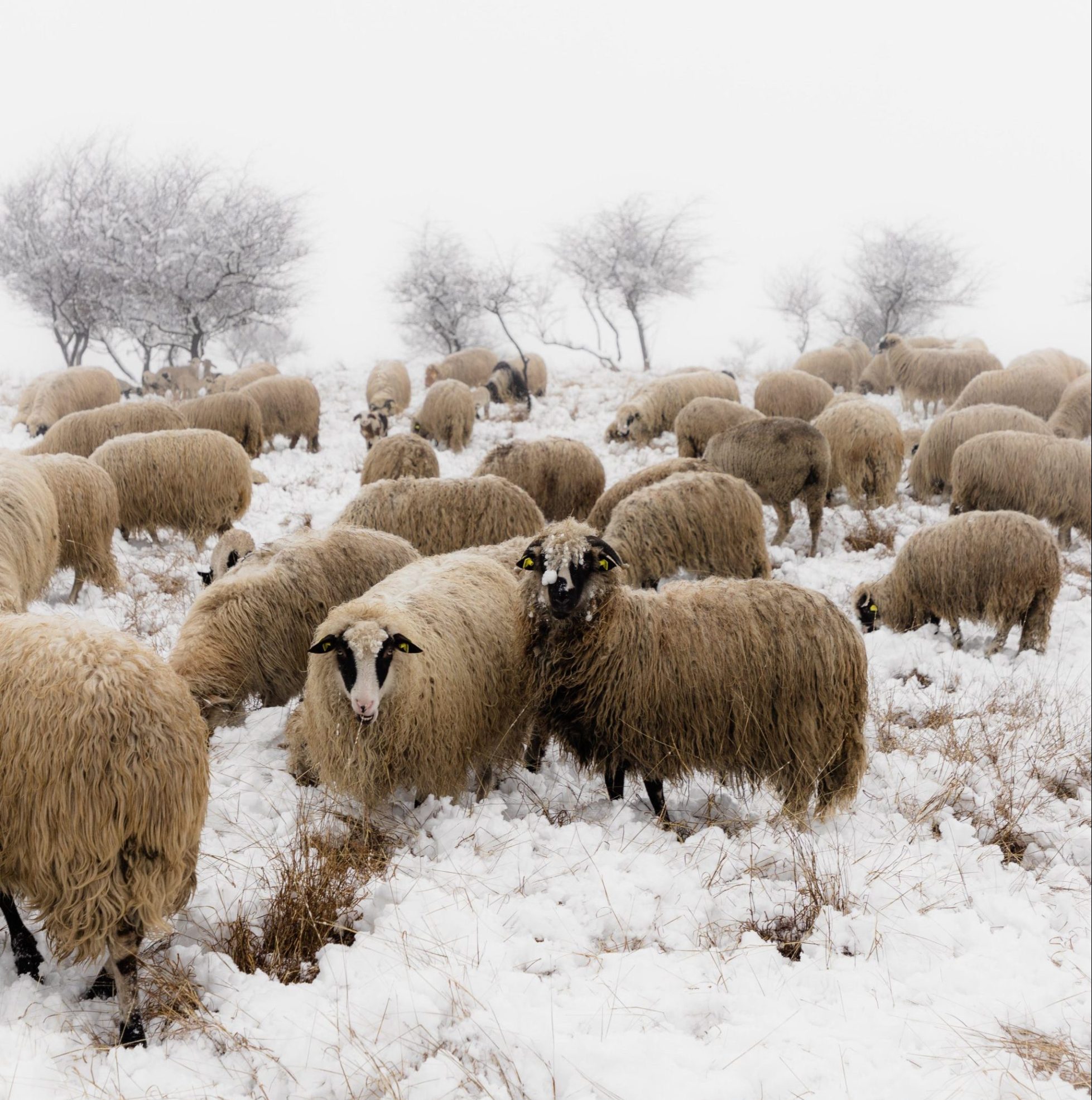
    At my grandmother’s house, I slept in a small back bedroom, with one window that looked out onto the fell behind. In the winter, I would wake up to a changed landscape of white fields, the absolute white rendering the sheep the murky pale yellow of teeth. Sometimes my uncle or grandad had to dig out sheep that had been buried under snowdrifts – huddled together in flocks and protected by their thick wool, they could survive for multiple days buried completely. 

    This image stuck in my mind as a child – the flock of sheep crowded together in some deep, blue hole, wool coats pressed together for warmth, hot breath clouding the air. In my head, it was like an image I’d seen in a children’s book, one in which mice, squirrels, and other small animals lived in trees hollowed out into human houses. In the winter they dug tunnels between them to travel to each other’s homes, lit them with Victorian gas lamps and candles. In reality, the sheep probably huddled and shivered, terrified, until human hands came along and dragged them out. 

    Many of the children’s books I read involved these anthropomorphised animals, cute little animal societies whose denizens wore non-specific “old fashioned” clothing and lived in cosy cottages with roaring log fires. There was an ecological bent to these stories, which made children engage with the natural world and the changing of the seasons, but also a deeply anthropocentric one, making animals agents of storytelling relatable, empathy-worthy creatures through human narratives. 

    I held both ideas in tandem in my mind – saw mice as both the subjects of sweet children’s stories, who lived nearly-human lives in churches or hedgerows, but also as creatures that needed to be caught in traps when they came into the house. They were the reason why farms have barn cats, why cats were domesticated in the first place. When my mum grew up on the farm it was filled with cats, both feral ones in the barn and tame and semi-tame ones in the house. Some were only seen in glimpses carrying mice in their jaws, some let my mum dress them up in doll clothes and slept in her toy cot. By the time I was there they had far fewer cats on the farm, only feral ones we hardly saw, but my mum always had pet ones at home who, despite their pampered indoor lives, retained their own instincts and strangenesses. 

    The cats would often bring dead birds into the house. They would also bring them in alive, sending them flapping around the living room in a wild panic. My mum found the birds frightening, but I was one of those children who loved animals, so catching and rereleasing them was always my job. I would do this by first backing them into a high corner of the room, and would then gently close my hands around them, the weight of them between my palms like a smooth stone. If I could, I would grasp them with their head poking out between my thumbs, hoping this would prevent them from being frightened, but sometimes they cowered in my hands in a little ball. 

    There was always a soft thrill in holding them for a moment – the tickle of their wings against my palms as they panicked, the release of tension as they realised they were trapped and froze completely still. I carried all kinds of birds this way – wrens, sparrows, blue tits, robins, even a woodpecker. Once, just before I let the bird go, he pecked me sharply on the hand, drew blood. In my child’s mind I was deeply offended that a creature I had rescued could be so ungrateful. Another time, the bird flew out of my hands before circling back to me once more, as if to say thank you. My cats once brought in a half-dead bird – I don’t remember what kind, but his chest was white, and a blossom of bright red blood had flowered there. I took him and carried him gently to our front garden, shut the cats in the house, and placed him on a large, cool leaf. I knew he was still living because his red chest moved up and down heavily, as if with effort. I checked back on him hourly or so, hoping he might recover but knowing deep down that he wouldn’t. As it was getting dark, my mum stepped out to look at him, and came back to tell me she was very sorry, but he was dead. I was furious at my cats and their claws and teeth, even though I understood they couldn’t help their nature. 

    Their nature – an idea we apply to animals, an idea of what separates us from animals. Something inherent to them that they have no control over, no consciousness of. Animals are unmoral, thinking only in terms of instincts, prey drives, motivations that live only within the body. There is no love in nature, only maternal instinct and hunger. Clarice Lispector, in her novel The Passion According to G.H., calls this unmorality “the neutral” – life that doesn’t think about law or morality, life that doesn’t think, life as life itself only. 

    In the novel, a middle-class Brazilian sculptress known only as G.H., the initials embossed on her luggage, crushes a cockroach with a cupboard door and, looking upon its dying, oozing body, experiences something between a psychic break, a transcendence of physical form, and a return to this animal, “neutral” state of being. In G.H.’s loss of self, Lispector describes a “link of mutual ferocity” connecting all life, all things human and nonhuman. This phrase containsg both comradely connection and uncontrollable violence. It is a phrase that makes me think of the food chain diagrams we filled in in biology class, drawing big, red arrows connecting soil to an earthworm to a robin to a hawk then looping the hawk and its postmortem decay back around to the soil to represent transference of energy. Animals eat each other forever – they know no better; they know nothing else. 

    Lispector’s protagonist begins this text as a specifically gendered subject – she is a “pretty replica,” someone who men read as “a woman of generosity and grace, and one who isn’t a bother, and one who doesn’t eat away at a man.” Her class position and her role as an artist gives her some freedom – she is seen to inhabit a social role “between man and woman”, able to move with conviviality across both male and female spaces, but within this is still limited to a extent by her gender – her sculptures “would be good if they weren’t so amateurish”. Her fear of “being a bother” exemplifies how her welcome in these spaces, her treatment as an equal, are conditional to the extent that they exist at all. This idea of (not) “eating away” at a man is notable when, at the climax of the novel, G.H. feels compelled to consume the innards of the dead cockroach, giving herself over to the “mutual ferocity” of nonhuman life. She begins from the female urge to fold herself up, to repress desire. Indeed,  Andrea Long Chu has described femaleness as “any psychic operation in which the self is sacrificed to make room for the desires of another”. The “neutral” she eventually embraces, this unmoral form of life, no longer makes room for the desires of another, and in fact barely contains the “desires” of the self, beyond the need to eat, to sleep, to procreate. The novel ends with an unselfconscious, in the most literal sense, consummation of the pure desire-driven actions of animal instinct. G. H.’s loss of self, her surrender to the neutral, is not only an act of un-humanisation but an act of ungendering. 

    🏵

    In winter evening half-consciousness, I watch something on the news about glaciers receding. Later, in an episode of a David Attenborough documentary, an arctic fox is shown crossing the open tundra, all white under a blue-purple winter night. These documentaries often wring so much pathos out of animals lives, projecting human emotions that are as unknowable to them as their minds are to us – assuming they experience love like we do, grief like we do, envy like we do. Here, though, we seem to be seeing a creature only as it is – for a moment it is just the fox, beautiful and white, crossing the tundra alone. I would quite like to be a creature of snow, I think absentmindedly, something with thick wool or fur and hardened paws. Generating my own warmth and sleeping in an ice hole in cold, blue safety. 

    I would like to have the relationship to my body that an animal has, I think – difficult to gender by sight, just living with little thought of it. Of course, many creatures have sex characteristics that can be easily read by humans, but not all. For those that can’t, most people don’t try too hard to read them. People sometimes seem irritated when I inadvertently misgender their dogs, as if it is something that should be immediately obvious. In Leslie Feinberg’s novel, Stone Butch Blues, the protagonist Jess Goldberg has a similar feeling about animals. Jess is a young adult still comprehending her gender identity, and doing so within a nuclear family that punishes her for the gender transgressions of wearing jeans or having short hair. Upset by her family’s conditional love and their attempts to feminise her, Jess finds some solace in nature:

    ‘I hurried out to the pond to catch polywogs in a jar. I leaned on my elbow and looked up close at the little frogs that climbed up on the sun-baked rocks.

    “Caw, caw!” A huge black crow circled above me in the air and landed on a rock nearby. We looked at each other in silence.

    “Crow, are you a boy or a girl?”

    “Caw, caw!”

    I laughed and rolled over on my back. The sky was crayon blue. I pretended I was lying on the white cotton clouds. The earth was damp against my back. The sun was hot, the breeze was cool. I felt happy. Nature held me close and seemed to find no fault with me.’

    The unintelligible response (for Jess) to an unintelligible question (for the crow) shows our ability to look at animals and their ability to look back – but also the vast gulf of communication between us, and our desire to make and project meaning onto that unknowability. Animals do not have gender, at least not as far as we know, and at least not in the way we do. In our mutual unknowing is an acceptance of the limits of our understanding. Donna Haraway calls this “relating in significant otherness”, the act of living with something we cannot know. Writing about her relationship with her dogs, she compares it to the love the worshipper has for God – the act of loving something too big or strange or far away to know its nature, the act of loving something that can only be understood by what it is not, and by knowing what one cannot understand. 

    “Nature” is often used in appeals to conservatism, especially around queerness – queer relationships aren’t “natural,” transition isn’t “natural,” in nature we only see reproductive sex and so only reproductive sex is “natural”. I could make appeals here to scientific evidence to the contrary – that many animals engage in same-sex relationships, that male seahorses carry pregnancies. I could cite numerous examples of reproduction in flora and fauna that are different and alien to ours – but that isn’t really the point I’m making. My appeal is more to a meeting with something unknowable without finding fault – to queer relation as a meeting with the limits of our understanding of another creature, or another being, without the desire to mould it into our own shape. Queerness opens up the idea that not everyone’s desires are the same, and in that are endless possibilities. Nature has never seemed to find any fault with me.

  • Organic Farming: A Spirit of Ecofeminism in India

    Organic Farming: A Spirit of Ecofeminism in India

    According to the Food and Agriculture Organization (FAO), organic farming is a production management system that is unique and promotes biological cycles, biodiversity, and biological activity in the soil [4]. This is accomplished by using biological, mechanical, and farm-based agronomic approaches while reducing the amount of synthetic farm input from outside sources.

    The primary goal of organic farming is to enhance the interdependent communities of flora, animals, soil, and humans as well as their ability to produce food and maintain their health (Scialabba and Hattam, 2002) [6].

    Origin of Organic Farming in India

    The main historical examples of organic agriculture in India revolve around the following:

    Period/Literature  Description of organic farming
    Ancient periodNeolithic civilizations used this 10,000-year-old tradition, which was also embraced by Mesopotamian and other civilizations like the Hwang-Ho.
    RamayanaDead matter that returns to the earth, such as trash or rotting corpses, is transformed into nutrient-rich material. According to C. Rajagopalachari, it is Mother Earth’s power.
    Mahabharata (5500 BC)There have been references to the celestial cow, Kamadhenu. Its contribution to human existence and function in ensuring soil fertility has been described.
    Arthashastra by Kautilya (300 BC)Refers to various kinds of manure, including oil cakes and animal excrement.
    Brihad-Sanhita by VarahmihirExplains the numerous ways to collect manure and how to choose the right manure for different types of crops.
    Rig-Veda (2500–1500 BC)The Rig Veda 1,161,10 (written between 2500 and 1500 BC) and the Atharva Veda II 8.3 (written around 1000 BC) both provide descriptions of organic farming. In Vrksayurveda, Surpala also makes reference to manure. According to the Sukra, a plant needs water, meat, excrement from cows, goats, and sheep, among other things, to develop healthily (IV, V, 94, 107-112).
    Holy Quran (590 AD)An indication of harvest and recycling is the return of one-third of the portion removed from the soil.

    Source: Bhattacharya and Chakraborty, 2005

    Organic Farming and Indian Women

    In the arena of Indian culture, a woman is particularly called “Prakriti” which in its literal sense means “Nature”[8]. Prakriti is the feminine essence for conservation, development, and being purely ecological. She is also referred to as “Shakti”, who furnishes energy to steer the living system.

    In present times, the organic farming movement has taken the form of a social movement. India, the holder of the oldest agricultural fields in the entire world where agriculture has been practiced for around 10,000 years, has women as the leaders in organic farming [2]. Indian female farmers devote a significant amount of their work hours on farmlands, which is much above than those invested by male farmers. During the sowing and harvesting seasons, women spend 3300 hours on the fields while men do it for 1860 hours [3]. Women’s contribution to nature supports sustainable development and agricultural systems. This hypothesis develops a stronger bond between women and organic farming.

    In the Odagaon region of Nayagarh district, Odisha, an area of 90 acres of degraded forest has been transformed into a forest that provides food for the nearby population. The idea of change was first sown in Sabarmatee’s mind in the 1980s, when she began experimenting with her father on the land for cultivating organic food [5]. Later, when the efforts started to bear fruit, a non-governmental organization called Sambhav was founded. Today, this organization is aimed at promoting ecological conversation, women capacity, and organic farming. Sabarmatee has done a brilliant job of collecting and preserving 800 varieties of seeds of indigenous origin, which have a strong relationship in combating climate change. Greater than 30 varieties of seeds withstood the cyclonic storms between the time periods 2013-2014.

    Rohibai Popre has the face of a leader of the organic farming movement in Maharashtra [9]. Without any formal education, Rohibai has been successful in leading a women-oriented agro-biodiversity initiative. She has cultivated 17 crop varieties on 50 acres of farmland and shares her knowledge with 3,500 farmers. Her seed bank is meant for the conservation of 122 landraces of 32 crop varieties.

    Bibi Kamaljit Kaur made her endeavor in the field of organic products and farming. Around 39% of the soil in Punjab is absolutely degraded owing to over irrigation. In 2019–20 and 2020–21, the use of pesticides was 4995 MT (technical grade) and 5193 MT (technical grade), respectively, in the state of Punjab [1]. With keeping in mind the paramount damage caused to the environment from the aforementioned factor, organic farming being done by Bibi Kamaljit Kaur in Punjab has assisted in breaking the toxic web of inorganic farming based on pesticide and chemical use. After participating in a seminar by the Agriculture Heritage Mission, Bibi Kaur learned about the negative impacts of pesticides on the environment and human health. Soon she got trained and well-informed about organic farming and started to practice the same in her kitchen garden. She had reached farmers from over 20 neighboring villages and imparted knowledge about the deadly consequences of using harmful chemical fertilizers. Inspired by her, the villages of Bhotna, Malliya, and Chughan have undergone a shift towards organic farming. Presently, she has received overwhelming support from 2000 women farmers and runs 2000 organic kitchen gardens.

    Two villages named Damodarpur and Murakhati in the Jhargram district of West Bengal narrate the revolutionary stories of two women organic cultivators.Panchabati BaskeandNirmala Mahato have seeded organic indigenous rice varieties in their individual villages. These women organic farmers are leading movements at the grassroots level. 55 male and 21 female farmers are each associated with them in Damodarpur and Murakhati villages, helping and making each other realize the power of organic agriculture and womanhood [7]. Rice varieties, namely Kalabhat, Sathia, Kerala Sundari, and Mallifullo, are being grown in the district. With time, the number of women organic cultivators has increased to over 4500 in all 5 gram panchayats of Block Nayagram in the district Jhargram. As per Panchabati, they are saving Rs 4000-Rs 5000 per bigha[1] in relation to fertilizers, and there is hardly any difference witnessed in the crop yield. For additional income plates made up of sal leaves are sold by the women supported by the women enterprise Aamon.

    Conclusion

    Organic farming has done the work of improving women’s role in Indian agriculture. The above-listed real-life examples are a clear indication of the same. This process of women’s involvement in organic farming needs to be constantly ameliorated. Active entrepreneurship opportunities, education, social and environmental justice, equity, farming rights, training, and skill development are some of the ways that can assure their vital contribution to organic farming. This must continue.

    References

    1. CONSUMPTION OF CHEMICAL PESTICIDES IN VARIOUS STATES/UTs DURING 2017-18 TO 2021-22. (2022, July 22). Directorate of Plant Protection, Quarantine, and Storage, Ministry of Agriculture and Farmers Welfare, Government of India. https://ppqs.gov.in/statistical-database
    2. Fernandes, S. (2017, June 17). Farming took root in India only 10,000 years ago, study finds. Hindustan Times. https://www.hindustantimes.com/mumbai-news/farming-took-root-in-india-only-10-000-years-ago-study-finds/story znhMgOYjQOWWtgX49PkUsJ.html
    3. Kamdar, B. (n.d.). Women grow as much as 80% of India’s food – but its new farm laws overlook their struggles. The Conversation. https://theconversation.com/women-grow-as-much-as-80-of-indias-food-but-its-new-farm-laws-overlook-their-struggles-155083
    4. Organic Agriculture: What is organic agriculture? (n.d.). https://www.fao.org/organicag/oa-faq/oa-faq1/en/
    5. Padma Shri For Father-Daughter Who Transformed Wasteland Into A Forest. (n.d.). NDTV.com. https://www.ndtv.com/offbeat/padma-shri-for-father-daughter-radha-mohan-and-sabarmatee-who-transformed-wasteland-into-a-forest-2175441
    6. Scialabba, N. & C. Hattam, Eds. (2002). Organic agriculture, environment and food security. Environment and Natural Resources Series. Rome, Food and Agriculture Organization of the United Nations (FAO). (n.d.-b). http://www.sciepub.com/reference/90645
    7. Singh, S. S. (2022, August 21). Women farmers of Bengal’s Jhargram reap fortunes with organic rice. The Hindu. https://www.thehindu.com/news/national/other-states/women-farmers-reap-fortunes-with-organic-indigenous-rice-varieties-in-bengals-jhargram/article65790956.ece
    8. The Incarnate Word. (n.d.). https://incarnateword.in/dict/sans/prakriti-1
    9. Wikipedia contributors. (2022, July 25). Rahibai Soma Popere. Wikipedia. https://en.wikipedia.org/wiki/Rahibai_Soma_Popere

    [1] Bigha is a unit for land measurement in northern India.


    Sonali Sharma is the author of this post.

  • The Eco-Gender Gap: When Sustainability Became a Women’s Issue

    The Eco-Gender Gap: When Sustainability Became a Women’s Issue

    When looking at the faces of the sustainability movement, what do you see? A campaign for environmental justice that is synonymous with names like Jane Goodall, Alexandria Ocasio-Cortez, Greta Thunberg, Autumn Petlier, Vanessa Nakate, and Sylvia Earle. Companies dedicated to sustainability, such as Blueland, Stasher, and Bite are led by Sarah Paiji Yoo, Kat Nouri, and Lindsay McCormick, respectively. Women are the advocates, voices of change, and the ones paving the future.

    This trend is called the eco-gender gap, a term created by British marketing company Mintel to describe the “difference in environmental awareness and eco-friendly behavior between men and women, with men being much less likely to feel connected to these issues than women” (Liddell, 2021). Sustainability has become a women’s issue, and in turn, their responsibility. Much of this plays into gender roles, gender-based personality differences, and marketing, as corporations provide gendered messages about sustainability.

    The authors of “Is Eco-Friendly Unmanly? The Green-Feminine Stereotype and Its Effect on Sustainable Consumption,” published in Journal of Consumer Research in 2016, examined this systemic issue, delving deep into working to find the root cause of why the majority of men will not purchase sustainable products. Their studies asked men and women to designate products as either “green” or “non-green”, “feminine” or “masculine”, to choose a product as “better for the environment” or “better at performing ___”, and to gauge affinity for eco-conscious wording and imagery. Across all metrics, green products almost always equated to femininity and were therefore avoided by men. Associating greenness with femininity may also explain why “women display greater concern and willingness to take action to help the environment… across age groups and countries… in contrast, men litter more, recycle less, have a larger overall carbon footprint, and feel less guilty about living a non-green lifestyle” (Brough et al., 2016). There are larger repercussions of this association, as it “may discourage men from engaging in green behaviors, particularly if they are motivated to maintain a macho image and wish to avoid being stereotyped as feminine” (Brough et al., 2016).

    Men feeling turned away from sustainable products parallels women feeling drawn in. Though women might in part feel inclined to make sustainable choices to enhance their femininity, they also face more “eco-anxiety,” a chronic fear of environmental doom (American Psychological Association). Globally, women are more susceptible to the effects of climate change, despite men causing more environmental damage, from avoiding sustainable practices like recycling or using less electricity where possible to engaging in “petro-masculinity,” a denial-rooted, climate-destructive reaction – from mostly white, politically conservative men –  to the fear of environmental crisis where they choose to consume the most pollutant energy in response to being told to reduce (Nelson, 2020).  Natural disasters disproportionately affect people in poverty, which is often communities of women, children, elderly, and disabled people. Studies have even shown that “gender-based violence, including physical, psychological, and reproductive violence against women, becomes more prevalent after natural disasters, with complex… consequences on health and well-being” (Gloor et al., 2022). Researchers have also seen an uptick in hormonal imbalance disorders such as polycystic ovary syndrome linked to the consumption of endocrine-disrupting microplastics. Microplastics were also just discovered in breast milk (Ragusa et al., 2022). On the consumer side, women are told their bodies are hurting the earth, from cosmetics to menstrual products, and told to make better – often more expensive – choices before it is too late. Perhaps most importantly, women are typically the main caregivers to their children, who will grow up in a polluted world. Creating a better future for their well-being is the most influential drive of them all.

    The first step in closing the eco-gender gap is to normalize men caring about the climate. In the consumer product industry, companies themselves create much of the issue. Women predominantly assume responsibility for purchasing goods for the household, and thus the items are tailored to them. Some of the most prominent sustainable products are for cleaning, cosmetics, clothing, storage, and office supplies, categories falling within a woman’s stereotypical responsibilities. Men can feel uncatered to and simply avoid sustainability for fear of being seen as feminine. This pattern appears repeatedly and ranges from choosing vegan or vegetarian diets to bringing a reusable shopping bag to a store. These trends have been helpful in spreading awareness, but it is crucial that all genders climb aboard.

    The authors of “Is Eco-Friendly Unmanly?…” designed a solution to address the eco-gender gap: explicitly catering eco-conscious services and products to men. In an experiment with two hypothetical conservation nonprofits, one called Friends of Nature with a tree logo (feminine directed) and one called Wilderness Rangers with a wolf logo (masculine directed), it was found that though both nonprofits carried the same values, Wilderness Rangers attracted more men (Brough et al., 2016). Additionally, they found that while Friends of Nature attracted women yet turned men away, men and women were similarly likely to donate to Wilderness Rangers (Brough et al., 2016). If women are not deterred by clear masculine branding, perhaps this is a solution in catering to everyone.

    As we look at sustainability, we must remember that its core value is caring for the earth. In our patriarchal society, women are assigned the role of caregivers, and the idea of sustainability being a “women’s issue” is “already insidious due to the persistent portrayal of women as caregivers – even of the planet” (Abbiss & Hunt, 2020). Men often hold the most power, especially leading companies responsible for pollution. Watching nineteen-year-old Greta Thunberg in a room of older men encapsulates the gender-based power dynamic embedded in environmental dicussion, demostrating “for climate skeptics, it was not [only] the environment that was threatened; it was a certain kind of modern industrial society built and dominated by their form of masculinity” (Abbiss & Hunt, 2020). Women will continue to lead the way and make change, and thankfully, younger generations of men seem more open to sustainable practices as our livelihoods are eminently threatened. While we have many advocates, women are still outnumbered in many spaces where it counts most. Women make up 27% of STEM roles, 29% of corporate senior management roles, and 25% of US congressional roles. It is especially crucial to open more opportunities for women to bring sustainability issues to the forefront and provide the necessary support to create change.

    As the need to live sustainably grows omnipresent, it is important to remember that everyone – regardless of gender – is responsible for working towards a solution. Society needs to move closer to making sustainability a movement everyone feels welcomed, affirmed, and empowered.

    Bibliography

    Ballew, M., Marlon, J., Leiserowitz, A., & Maibach, E. (2018, December 12). Gender

    Differences in Public Understanding of Climate Change. Yale Program on Climate Change Communication. Retrieved October 4, 2022, from https://climatecommunication.yale.edu/publications/gender-differences-in-public-und erstanding-of-climate-change/

    Brough, A. R., Wilkie, J. E., Ma, J., Isaac, M. S., & Gal, D. (2016). Is Eco-Friendly Unmanly? The Green-Feminine Stereotype and its Effect on Sustainable Consumption. Journal of Consumer Research, 43(4), 567–582. https://doi.org/10.1093/jcr/ucw044

    Gloor, J. L., Mestre, E. B., Post, C., & Ruigrok, W. (2022, July 26). We Can’t Fight Climate Change Without Fighting for Gender Equity. Harvard Business Review. Retrieved October 4, 2022, from https://hbr.org/2022/07/we-cant-fight-climate-change-without-fighting-for-gender-eq uity

    Hunt, E., & Abbiss, R. (2020, February 6). The Eco Gender Gap: Why is Saving the Planet Seen as Women’s Work? The Guardian. Retrieved October 4, 2022, from https://www.theguardian.com/environment/2020/feb/06/eco-gender-gap-why-savingplanet-seen-womens-work

    Liddell, A. (2021, May 7). The Eco-Gender Gap. Cherwell. Retrieved October 4, 2022, from https://cherwell.org/2021/05/07/the-eco-gender-gap/

    Mintel Press Team. (2018, July 27). UK Women Try to Live More Ethically Than Men. Mintel. Retrieved October 4, 2022, from https://www.mintel.com/press-centre/social-and-lifestyle/the-eco-gender-gap-71-of-w omen-try-to-live-more-ethically-compared-to-59-of-men

    Nelson, J. (2020). Petro‐Masculinity and Climate Change Denial Among White, Politically Conservative American Males. International Journal of Applied Psychoanalytic Studies, 17(4), 282–295. https://doi.org/10.1002/aps.1638

    Piyatissa, Y. (2021, May 22). What Is The Eco Gender Gap and How Can We Bridge It? IVolunteer International. Retrieved October 4, 2022, from

    Ragusa, A., Notarstefano, V., Svelato, A., Belloni, A., Gioacchini, G., Blondeel, C.,

    Zucchelli, E., De Luca, C., D’Avino, S., Gulotta, A., Carnevali, O., & Giorgini, E.

    (2022, June 30). Raman Microspectroscopy Detection and Characterisation of

    Microplastics in Human Breastmilk. Polymers (Basel). 2022 Jun 30;14(13):2700. doi:

    10.3390/polym14132700. PMID: 35808745; PMCID: PMC9269371. Retrieved

    October 29, 2022, from https://www.ncbi.nlm.nih.gov/pmc/articles/PMC9269371/

    Wallis, J. (2021, July 26). Why Do Women Experience More Eco-Anxiety Than Men? Is There A Sustainability Gender Gap? Retrieved October 4, 2022, from https://www.refinery29.com/en-au/sustainability-gender-gap


    Sophie Bravo is the author of this post.

  • A Case for Denise Levertov as an Ecofeminist

    A Case for Denise Levertov as an Ecofeminist

    Ecofeminism was not refined in its usage until the 1980’s when Levertov was losing popularity as a poet, so it is unlikely she ever would have used this term in her life (ignoring the fact that she did not want to be labelled as a feminist in the first place), however, her work and personal ideologies closely aligns with the general theories of ecofeminism established and refined throughout her lifetime. Most ecofeminist work written during the ’70s centres around “dualisms such as woman-nature that worked in opposition to that of men-culture” (Estévez-Saá and Lorenzo-Modia 126). These dualisms are the subject of many of Levertov’s early poems such as “Losing Track” and “Stepping Westward,” making her one of the trailblazers of this movement.

    Many of Levertov’s poems use the moon or tides as a metaphor for celebrating her innate femininity, which follows one of Gretchen Legler’s, an ecofeminist literary critic, “emancipatory strategies” of ecofeminist criticism. In Levertov’s “Stepping Westward,” she says, “If woman is inconstant, /good, I am faithful to/ ebb and flow” (lines 3–5). The “ebb and flow” suggests images of tides, oceans, and water. Tides are controlled by the moon, which is a common motif for femininity. This image, coupled with her statement that it is good if a woman is “inconstant,” ever-changing, and unfaithful, shows a devotion to nature and its reflection of her inner femininity. In this poem, Levertov expresses the joy she finds in being a woman, the sense of self-sufficiency she feels, and the stability of her innate femininity in her life.

    The forces of water are powerful and are always tied to femininity in Levertov’s work. Water is controlled by the moon in many of her poems, suggesting a devotion to this feminine power. Water often exposes dreams and acts as a source of creativity, while removing men and patriarchal forces in Levertov’s work. These images of water are important because they blur the “boundaries between inner (emotional, psychological, personal) and outer (geographic landscapes),” which is one of Legler’s emancipatory strategies, an ecofeminist way to think about the relationships between women and nature (Estévez-Saá and Lorenzo-Modia 140).

    Not many of Levertov’s poems take a direct, feminist approach. Many of her poems, like “Losing Track,” encode ecofeminist values through the description of personal experience. In “Losing Track,” the speaker describes the tide as a force that takes a lover (presumably a man) away from her and exposes her dreams. Levertov puts her readers in a surreal experience in “The Room,” relying on the senses to make a feminine experience. Levertov adheres to Leger’s strategy of blurring boundaries between woman and nature in “Losing Track” as well. The poem ends with the image of “mud sucking at gray and black/ timbers of me,/ a light growth of green dreams drying” (Levertov lines 16–18). In this poem, the speaker is a pier, and the “green dreams” are moss on her piles (line 18). This moss is only exposed when her feminine force, the tide, takes her presumably male lover away. From this imagery, we infer that she is only able to see her dreams clearly when the presence of a man is removed. She is only free to explore her “green dreams” when the influence of the patriarchy is gone from her life and the tide has taken her love away (line 18). Levertov uses Leger’s strategies by blurring the lines between women’s inner desire and nature in both “Losing Track” and “Stepping Westward.”

    In both “Stepping Westward” and “Losing Track” Levertov associates the colour green with feminine dreams. “Stepping Westward” opens with the lines “What is green in me/ darkens, muscadine” (Levertov lines 1–2). Muscadine is a plant, a grapevine that produces grapes used to make wine. These grapes are green when unripe and turn a dark purple as they ripen. The colour green is often associated with fertility and growing, while the colour purple is often associated with power and wealth. As the speaker in this poem is “Stepping Westward,” an idea long associated with the American dream, her dreams ripen or begin to come to fruition. The idea that the speaker is stepping into her power and passing through the stage of growth or fertility in her life into a place where she can “hold steady” is conveyed completely through images of the natural world (Levertov line 11). Levertov’s images work as a metaphor for a woman’s ambitions and dreams, blurring the boundaries between nature and human, because the woman is the plant in this metaphor.

    Most early ecofeminist writers operated with “dualisms” as mentioned earlier. These dualisms are consistent in Levertov’s work. In her “Stepping Westward,” Levertov contrasts the bliss of being a woman with the “burdens” being “gifts, goods, a basket/ of bread that hurts.” These images are items to be bought, sold, and consumed; products of a capitalist society that tie the speaker to a system that she is “inconstant” to (lines 3, 26, 28, and 29). Similarly, in “Losing Track,” the speaker aligns herself as a manmade structure, a pier, to symbolize that she is a product of the patriarchy. She, a pier, is “half-in half-out of the water,” suggesting that she is partly feminine, partly masculine. The speaker also compares her lover to a boat, a manmade symbol of technology, the opposite of nature. When this lover comes to her, she loses track of the moon, her femininity, and the tide takes her lover away, exposing her “green dreams.” The presence of masculine, capitalistic forces in the speaker’s life made her forget her femininity and dreams. These images and metaphors reiterate Levertov’s dislike for the patriarchy and distaste for its degradation of women.

    Levertov’s work demonstrates a deep awareness of the effects the patriarchy can have on women through dualism and exposes a dislike for those effects. While she disliked the label of feminist and preferred her work to be thought of holistically, the values expressed in her poetry are that of an ecofeminist. Her subtle connection of woman to nature and reverent tone when describing the natural world indicate her as a pioneer in ecofeminism.

    Works Cited

    Estévez-Saá, Margarita, and María Jesús Lorenzo-Modia. “The Ethics and Aesthetics of Eco-Caring: Contemporary Debates on Ecofeminism(S).” Women’s Studies, vol. 47, no. 2, Mar. 2018, pp. 123–46. doi.org/10.1080/00497878.2018.1425509.

    Jarman, Mark. “Lives of a Poet: Denise Levertov.” The Hudson Review, www.hudsonreview.com/2014/02/lives-of-a-poet-denise-levertov/#.YuxJU3bMK3C. Accessed July 15, 2022.

    Levertov, Denise. “Hypocritical Women.” Poetry Foundation, www.poetryfoundation.org/poems/42524/hypocrite-women. Accessed July 15, 2022.

    —. “Losing Track.” Poetry Foundation, www.poetryfoundation.org/poetrymagazine/browse?contentId=29543. Accessed July 15, 2022.

    —.  “The Room.” Poetry Foundation, www.poetryfoundation.org/poetrymagazine/browse?contentId=27828. Accessed July 15, 2022.

    —. “Stepping Westward.” All Poetry, www.allpoetry.com/poem/8503363-Stepping-Westward-by-Denise-Levertov. Accessed July 15, 2022.

    —.  “The Well.” Poetry Foundation, www.poetryfoundation.org/poetrymagazine/browse?contentId=28573. Accessed July 15, 2022.

    Siwatch, Pooja. “Ecofeminism and Value Based Social Economy in Feminine Literature: Allied Resistance to the Age of Anthropocene.” Research Horizons, vol. 7, July 2017, pp. 57–63. Academic Search Complete, https://search.ebscohost.com/login.aspx?direct=true&AuthType=sso&db=a9h&AN=138606072&site=ehost-live&scope=site.


    Abigail Zajac is the author of this post.

  • Can Indian Ecofeminists be “Ethically” Vegan?

    Can Indian Ecofeminists be “Ethically” Vegan?

    A 2019 report by IndiaSpend stated that since 2012 more than 133 instances of cow vigilantism have been reported, with 50 deaths and 290 injuries (Team IndiaSpend). Cow vigilantism is a form of violent, sectarian activism that aims to prohibit eating beef and/or engaging in beef-related transactions. Among the victims, 57% were Muslims, 9% Dalits and 9% Hindus. In 2016, two women in Haryana were gang-raped on the pretext of being beef-eating Muslims (BBC News). Human rights activist, Bondita Acharya, was threatened with rape and acid attacks by the fundamentalist organisation Bajrang Dal in 2017 for commenting that even “higher caste Hindus” consume beef, and Muslims should not be singled out for punishment (Wire Staff). In the light of the aforementioned statistical data on the interconnection between cow vigilantism and sexual abuse, I would like to explore two crucial questions of personal ethics: is veganism the approach to become an ecofeminist in India? Two, where do animal rights and human rights overlap within the Indian vegan movement?

    While the aggression that fuels the urge to protect cows is alarming, it also raises questions as to why the violence is singularly directed against consumers or dealers of beef. Notably, it appears that instances of “goat vigilantism” or “pork vigilantism” are unheard of. Most Indians who abstain from beef-eating do indulge in pork and mutton.

    Cow vigilantism is not fuelled by compassion for the non-human or to reduce the carbon footprint produced by consuming red meat, but by religious beliefs which make Hindus worship cows as their mother. Most Hindus try countering beef-eating with pork-eating, emphasising that if Muslims abstain from pork, then Hindus should abstain from beef too. Such selective environmentalism seeks to oppress religious and other social minorities whose access to basic nourishment is already severely restricted by inflation, and now by verdicts from self-proclaimed “godmen”[i] wielding their powerful tools to ostracise the non-conformists. It does not promote environmental awareness.

    Where does veganism stand in this nexus of religion, caste, class, and politics? Most Indian vegans trace veganism to Hinduism and Jainism – the primary advocates of vegetarianism. However, they gloss over an important aspect of the dietary restrictions advocated by these religions: none of these ask you to switch to a plant-based diet. Hindu scriptures like Valmiki’s Ramayana and the Adi Parva of Mahabharata even talk of Kamadhenu, the Divine Mother Cow, the Hindu equivalent of the fabled golden goose, who could be milked every time her owner, Vashistha rishi, wanted material amenities. Kamadhenu was regarded to be closely related to Mother Earth or Prithivi- so harnessing the mother cow for material benefits had a subtextual implication of milking/exploiting the earth for human consumption. In fact, the history of untouchability in India is rooted in beef consumption. B.R Ambedkar, India’s pioneering anti-caste activist describes in his book The Untouchables, how Brahmins, who once ate horse-meat from Ashvamedha, beef of sacrificed cows, and honey-slathered cow and goat meat in “madhuparka”, quit meat to resist Buddhism and Jainism, – religions which staunchly advocated compassion towards nature, soil and non-human animals (Ambedkar 89). However, the Dalits or the untouchables were not allowed to practise agriculture, for fear of polluting the soil with their touch, so, to their lot, fell the carcass of the dead animals, after they had served their purpose to the caste Hindus.

    As an ecofeminist, when I started experimenting with vegan foods, these were the problems that I had to grapple with. Why was nobody talking about the problematic equation of the cow with the mother? Hindu feminists like the Kailaasa.org often claim that worshipping the cow and abstaining from eating its meat is a move towards the empowerment of women, for it involves respecting the mother figure through the non-human (Kailaasa Hindu Feminism). Similarly, non-Hindu critics writing on this intersection, such as Peter Sondheim, write that feminists should protest the abuse of dairy cows (Sondheim). Such compassion for animals and protest against animal suffering can lead to an ecofeminist conversation, yet it fails to do so.

    Ecofeminism primarily seeks to dispel patriarchal notions of reducing the human as well as the non-human to their reproductive functions. Greta Gaard adopts this approach of ecofeminism in her definition of vegetarian ecofeminism by saying, “Vegetarian ecofeminism puts into action the feminist insight that “the personal is political” and examines the politic of dietary choices as well as strategic and operational choices in economics” (117). When she asks about what prevents ecofeminists from giving a political direction to their compassion for animals, she commits the fallacy of assumption from a Western purview.

    What Greta Gaard has overlooked in her critique, was the socio-political nuances that inform animal rights activism in the Indian subcontinent. I have always wondered if the passion for protecting cows in India would be so heightened if they did not produce milk, a main source of nourishment and financial revenue in India’s primarily agrarian economy. If vegetarianism is motivated by a utilitarian approach of not murdering the source of nourishment and keeping it alive for man’s own interests, veganism in India aims to be an elite cultural phenomenon of overpriced imported vegan alternatives to locally sourced dairy and meat.

    Indian veganism cannot be scrutinised under Western eyes. One needs to assess India’s nutritional graph and economy to understand why Western veganism will fail unless modified to suit the socio-economic climate of a country whose Gross Development Product (GDP) has been steadily declining and the value of the rupee falling to an unfathomable low, and where meat-eating can lead to mob-lynching. As Rama Ganesan highlighted, “What the West knows about Hindu vegetarianism has been controlled by the upper caste narrative, which couches it in terms of Gandhian ahimsa” (Ganesan). It is a hypocritical narrative among Hindu vegetarians to proclaim themselves as followers of “Ahimsa” or “non-violence” where they murder humans for consuming meat.

    Vegan foods like plant-based mock-meat and tofu, are sold, not by local farmers, but by capitalist organizations, at exorbitant rates (Sahani). In a country where the general yearly income is less than 1 lac INR per annum, can we expect mass adoption of vegan foods? Moreover, the levying of taxes on fresh produce makes the vegan diet a mirage for Indians. How shall I, an ecofeminist, then ask them to go vegan even when I know that meat-eating goes against my ecological ethics?

    I cannot ask them to consume the cake of vegan alternatives to their affordable and widely accessible bread when the cake is alienated from them by capitalist monopoly on the food market. And how can I forget the history of caste-class violence that shapes the diet of the Indians who are not caste Hindus? Beef-eating, unlike in the West, does not symbolise prosperity, but a simple fare that nourishes hungry mouths deprived of the expensive vegetables. Nirmala Sitharaman, the Finance Minister of India commented in 2019 that she does not eat much onion or garlic, in response to the rising prices of these two vegetables in India  (Agencies). Sitharaman can afford highly-priced vegetables, unlike the masses. Thus, asking them to adopt veganism is to ask them to starve.

    As an ecofeminist, I would assert the need for sustainable living concept in India, considering the plight of the human and non-human. However, industry-produced vegan foods do no good to the marginalised whose source of meat is locally bred cattle and poultry, or locally sourced fish. Without giving the oppressed Indian a viable reason to adopt veganism, we cannot call ourselves proponents of vegan ecofeminism. And unless we demonstrate how veganism needs to be linked with ecofeminism to enunciate its benefits, we will fail to transform our ecofeminism into praxis. Our obsession with protecting a certain domesticated animal because of our (sexual) reverence for its reproductivity, while endorsing the consumptive exploitation of other animals might not make us hypocritical in the majority’s eyes, but it will certainly put into question the authenticity of our ecofeminism.

    References:

    Agencies. “’I Don’t Eat Much Onion’: Sitharaman in Lok Sabha – Times of India.” The Times of India, TOI, 5 Dec. 2019, 12:28 IST, timesofindia.indiatimes.com/business/india-business/i-dont-eat-much-of-onion-says-sitharaman-in-lok-sabha/articleshow/72379267.cms.

    Ambedkar, B. R. The Untouchables. Siddharth Books, 2008.

    Gaard, Greta Claire. “Vegetarian Ecofeminism: A Review Essay.” Frontiers: A Journal of Women Studies, vol. 23, no. 3, 2002, pp. 117–146., doi:10.1353/fro.2003.0006.

    Ganesan, Rama. “Brahminical Patriarchy & Carol Adams’ The Sexual Politics of Meat.” Feminism in India, 10 Sept. 2021, feminisminindia.com/2020/12/25/carol-adams-the-sexual-politics-of-meat-brahminical-patriarchy/.

    “India Muslim Women ‘Raped’ in Fatal Attack ‘over Beef’.” BBC News, BBC, 12 Sept. 2016, www.bbc.com/news/world-asia-india-37336050.

    Kailasa Hindu Feminism. Worshipping cow on Mother’s Day. Facebook, 10 May 2020. https://m.facebook.com/HinduFeminism/photos/a.359124804952763/606856446846263/?type=3&source=57

    Shahani, Shradha. “7 Indian Mock Meat Brands to Try If You like Mutton, Chicken, Seafood.” Condé Nast Traveller India, Condé Nast Traveller India, 6 Dec. 2020, www.cntraveller.in/story/7-indian-mock-meat-brands-to-try-if-you-like-goa-mutton-chicken-seafood-mumbai-delhi-chennai-hyderabad/.

    Sondheim, Peter. “Op-Ed: The Abuse of Dairy Cows Is a Feminist Issue. the ‘Moo Too’ Movement Is Here.” Los Angeles Times, Los Angeles Times, 4 Mar. 2020, www.latimes.com/opinion/story/2020-03-04/dairy-cows-moo-too-movement-biden.

    Team, IndiaSpend. “Every Third Indian Cop Thinks Mob Violence over Cow Slaughter Is ‘Natural’: New Survey.” Indiaspend, Indiaspend, 28 Aug. 2019, www.indiaspend.com/every-third-indian-cop-thinks-mob-violence-over-cow-slaughter-is-natural-new-survey/.

    Wire Staff. “Assam: Activist Threatened with Rape, Acid Attacks for Condemning Beef Arrests.” The Wire, 10 Apr. 2017, thewire.in/rights/bondita-acharya-beef-bajrang-dal.


    [i] Godmen is a colloquial albeit pejorative term used to describe self-proclaimed gurus with cult following who claim that they are the only ones who have received the word of God. A Hindu godman, Sadhguru asserted in an interview taken by NDTV​ ​Consulting Editor Barkha Dutt that Indian culture has never recommended beef eating. Sadhguru’s use of Indian as a monolithic cultural label is highly debatable, due to the geopolitical diversity and his deliberate choice of the term refers to a subcontinental past prior to the rule of the Muslim emperors.


    Author:

    Debadrita Saha is the author of a blog post.