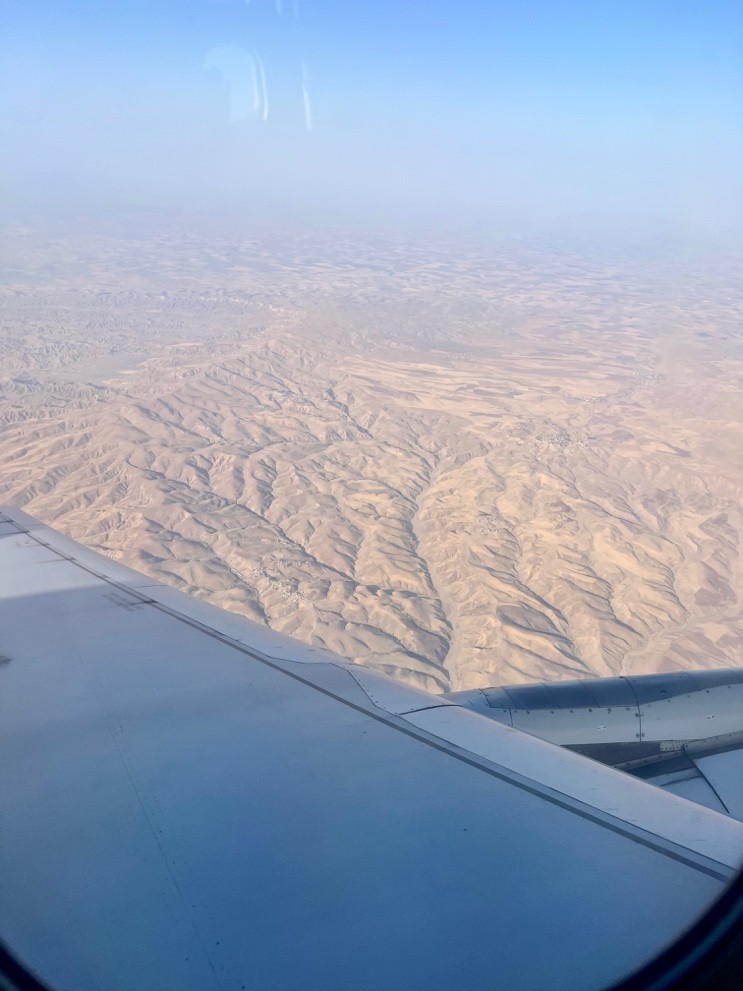
Featured image: Photo taken from a plane over Erbil, Iraq in August 2025.
Water has always been a powerful motif in literary and cultural history, but a critical framework of engagement with it as a non-human agent is a relatively recent phenomenon. I come from a region whose very name—Mesopotamia—is defined by two fluvial bodies, along which one of the earliest recorded human civilizations emerged. The growing water crisis in the world has affected Iraq dramatically—alarming footage from the summer of 2025 shows individuals walking across the bed of the Tigris. But being introduced to the field of Blue Humanities in Jena, Germany, opened a new intellectual avenue for me. This “cultural turn to the sea,” as John R. Gillis writes in Humanities, activates the mode of “thinking with water” (Oppermann 2023: 4), allowing for a critical engagement with “today’s ecocatastrophic times” (Mentz 2024: 1), and an exploration of how literary texts, and art more broadly, can meaningfully respond to contemporary ecological concerns.
This focused lens on water surfaced with the publication of Steve Mentz’s article “Toward a Blue Cultural Studies: The Sea, Maritime Culture, and Early Modern English Literature” (2009) and later more comprehensively in his book An Introduction to the Blue Humanities (2024). Likewise, Serpil Oppermann’s Blue Humanities (2023) encourages us to understand water as a being with agency. Oppermann views waterscapes as sites of unlimited symbolic dimensions and cultural meanings. Employing a “cognitive wet paradigm” (Oppermann 2023: 12), waterscapes, then, can be analyzed through a lens which grants them agency, viewed as ecological systems, cultural spaces, sites of colonial history, engines of globalization, and dynamic environments deeply entangled with human and nonhuman life. On the other hand, remaining unaware, indifferent, and unwilling to rethink this human–water relationship risks perpetuating anthropocentric assumptions and further distancing humans from their entanglement with water, thereby reinforcing the illusion that water exists merely as passive.
Seen in this context, doom by water is not a myth from ancient history; it shadows the future of human life itself. In contrast to optimistic water discourses like that of American Transcendentalism, for instance, such as the views of Henry David Thoreau and Ralph Waldo Emeron, the framework I introduce redirects positive narratives toward darker, more unsettling dimensions. I merge multiple theoretical approaches—the Blue Humanities, the Gothic, the Ecogothic, and the Nautical Gothic—in order to develop a critical framework I call the Hydrogothic. This framework explores water and adjacent fluids in Gothic modes, arguing that it is water that produces the Gothic effect.
The Gothic and Water
It would be a valid question to ask, why the Gothic? As a mode and genre, the Gothic is used as a tool to “write about all sorts of taboos and transgressions” (Hillard 2009: 690), and people get relieved that the dark events do not take place in real life—a false belief because the Gothic reveals real darkness that does happen. Maisha Wester and Xavier Aldana Reyes emphasize that the Gothic is the genre that functions as a critical mode through which the “oppressed and forgotten” (Wester and Reyes 2019: 1) are brought into focus. And in fact, the term ‘Gothic,’ is more a mode than a genre. Tom J. Hillard remarks that it “describ[es] certain aspects of the texts, rather than a discrete category into which these works unerringly fit” (Hillard 2009: 689).
Throughout history, from the term’s first application to describe Horace Walpole’s novel The Castle of Otranto (1764) in Britain, to its migration across the Atlantic Ocean, the Gothic has demonstrated its remarkable adaptability to shifting historical periods, geographical landscapes, and cultural anxieties. In an American context, specifically, it often expressed cultural fears surrounding the wilderness, westward expansion, the legacies of slavery, and the Civil War. Twentieth-century Gothic shifted its focus to grapple with industrialization, as reflected in John Steinbeck’s The Grapes of Wrath (1939) in which industrial modernity is depicted as an ecological and economic force that transforms land into a site of extraction and renders human life precarious; the First and Second World Wars, as seen in works such as Norman Mailer’s The Naked and the Dead (1948), portraying warfare as a mechanized system of control and exhaustion that reduces human beings’ value; and the Vietnam War, written by authors such as Tim O’Brian who draws on his own experience as a soldier. A key example is his In the Lake of the Woods (1994), which explores trauma, memory, and uncertainty in the aftermath of war. In the twenty-first century, the Gothic continues to adapt, addressing environmental crises, climate change and ecological degradation. The Gothic, like water, resists containment, and slips across human-made borders. As William Hughes remarks: “[the Gothic] has kept it up with times, passing almost effortlessly from romanticism to modernism to postmodernism, and adapting to feminist literature, to queer literature, and even science fiction. It really seems as if nothing can stop it…and why should it stop?” (Hughes 2013: xi).
As matter of fact, the Gothic has long foregrounded water as an active entity, or at the very least an indispensable element without which the Gothic imagination can scarcely be complete. A case in point is the flood story. In Antiquity, The Epic of Gilgamesh describes a deluge that obliterates humanity and leaves the world drowned and lifeless. In The Bible, before water is positioned as life-giving, the first lines of the Old Testament already describe water in a Gothic mode, declaring that “darkness was upon the face of the deep. And the Spirit of God moved upon the face of the waters” (Gen. 1: 2).
In the United States, one of the first novels produced in the New World, William Hill Brown’s The Power of Sympathy (1789), is not a Gothic text by classification, yet it nevertheless deploys unsettling water imagery. One instance occurs when a lover in despair throws himself into the river, with the narrator describing the site of his death as “a watery tomb” (Brown 1969: 79). Similarly, Nathaniel Hawthorne’s “The Vision of the Fountain” depicts a crystal spring, also referred to as “the haunted spring” (Hawthorne 1882: 244), which brings the illusion of a nymph-like girl to the narrator.
The Hydrogothic: Defining a New Framework
Over the years, several theoretical frameworks have emerged to examine the intersections between nature and the Gothic. In what follows, I briefly outline two relevant and widely discussed approaches upon which I base my term, the Hydrogothic. In 2013, Andrew Smith and William Hughes coined the eponymous term in their edited collection The EcoGothic (2013). This is a sub-genre that explores human fears and anxieties about the natural world, often featuring haunted, decaying, or threatening landscapes to reveal the destructive and precarious relationship between humans and nature. However, while the interconnectedness of humans and the natural world are deconstructed and questioned through the Ecogothic, the term only narrowly touches on water.
The other term which links nature, and water more specifically, and the Gothic is Emily Elder’s Nautical Gothic. Alder constructs a “lens [that] focuses on how the sea is represented in Gothic literature” (Alder 2017. 1; italics mine). However, Alder’s Nautical Gothic lens is limited. The term ‘nautical’ restricts the analytical lens to narratives of the sea alone, excluding other forms of water such as swamps, rivers, blood, to name a few. In order to extend the focus beyond the sea—an expansion from the nautical to the elemental—it becomes fitting to introduce the lens of the Hydrogothic.
. . . the Hydrogothic foregrounds water as an agentive element which causes the Gothic effect, and not vice versa. It encompasses all water bodies and forms. It is not only elemental water in its liquid, vaporous, and frozen forms, but also the broader category of fluid substances that are ubiquitous in Gothic narratives, such as blood, poison, venom, tears, marsh, liquor, ink, sap, seepage, ichor, wine, brandy, and coffee. It also extends to the linguistic residues of fluidity embedded in Gothic discourse: verbs and metaphors of flowing, streaming, seeping, or flooding.
Over the course of approximately half a decade, additional terms have become evident in discussions of water linked to the Gothic. These include Frederick S. Frank’s “aqua-Gothic” (1976) and Coral Ann Howells’ “Maritime Gothic” (2004). Frank’s term refers to the exploration of transcendentalism through the aqua-Gothic (Frank 1976: 85), grounding his concept in Poe’s “A Descent into the Maelström.” This, however, proves untenable, as Poe’s sea writings, and that particular story, do quite the opposite: they dismantle transcendental aspiration and put them in their place. Finally, Howells’ term refers to a regional variant of the Gothic that is shaped by its relationship to the sea and coastal environments, especially within a Canadian context (Howells 2004: xviii).
Unlike these limited previous terms, the Hydrogothic foregrounds water as an agentive element which causes the Gothic effect, and not vice versa. It encompasses all water bodies and forms. It is not only elemental water in its liquid, vaporous, and frozen forms, but also the broader category of fluid substances that are ubiquitous in Gothic narratives, such as blood, poison, venom, tears, marsh, liquor, ink, sap, seepage, ichor, wine, brandy, and coffee. It also extends to the linguistic residues of fluidity embedded in Gothic discourse: verbs and metaphors of flowing, streaming, seeping, or flooding. Also, idiomatic expressions like ‘in hot water,’ ‘dead in the water,’ ‘to come hell or high water,’ to name just a few.
Why the term ‘hydro’ instead of, say, ‘aqua’ or ‘blue’? Not only does it refer to the Greek word “water” (Salowey 2021: 72) and the immortal microorganism Hydra (Khokhlov 2014: 153), it also signals the Greek marsh-born monster: Hydra of Lerna. Lerna is a region located on a narrow point between mountains and the sea on the eastern coast of Peloponnesus in Greece. The entrance to the underworld is said to be situated through Alcyonian Lake nearby. Whoever attempts to cross its seemingly-calm waters will be swallowed. Possessing a myriad of “snake heads” (Salowey 2021: 73) and poisonous blood coursing through her body, the Hydra has a famous regenerative ability: if a head is cut off, more would “grow back in place of the one” (ibid. 74). Its final head, immortal, was allegedly buried by Heracles under a rock—and legend persists that it still exists somewhere in Greece. The refusal of death is a prominent Gothic trope, one with which the legend of the Hydra closely aligns. Diffusing the framework with non-aqueous Gothic liquid, Heracles dips his arrows in the Hydra’s venom as her “vapors wriggle […] through the waters of the marsh away from the corpse” (R. Waterfield and K. Waterfield 2012: 146).
The Hydra’s symbolic potential exceeds water as a pure substance as it no longer refers to merely H₂O. Alluding to death and immortality, it denotes decay, contamination, and persistence—liquid matter that cannot be contained or resolved. The Hydra then embodies a wet ontology in which liquidity is agentive and threatening, capable of sustaining life only by entwining it with unease and malaise. Likewise, the Hydrogothic functions as a medium of transformation: it destabilizes boundaries between human and nonhuman, body and landscape, life and death. It insists on liquid’s agency, its capacity to unsettle anthropocentric knowledge systems, and its power to induce Gothic horror precisely through its interconnectedness and unpredictability.
In this respect, I argue that the Hydrogothic anticipates contemporary ecological thought about planetary change, revealing how Gothic narratives long recognized the impossibility of human mastery over the wet matter. Through the Hydrogothic, water’s numerous aggregates become the medium through which human fragility is exposed, and it enables close examination of its ambiguous and foreboding qualities as a non-human agent of uncertainty, disruption, and destabilization of anthropocentric epistemologies. The Hydrogothic imagines a world in which the nonhuman entity relentlessly resurfaces, reclaims, and reconfigures, where humans realize their fragility. If plants, organisms that wilt and die without water, are able to decenter human-centered ego as suggested by Dawn Keetley (Keetley 2017: 1), then how much more water itself?
The Substantiation of the Hydrogothic in Edgar Allan Poe
I define and substantiate the Hydrogothic by applying it to Edgar Allan Poe specifically for a few reasons. First, in my opinion, he is a highly suitable American author to elucidate present water anxieties, one whose work remains catalytic and influential across the globe. Second, Poe is the author who “gave a face to American Gothic” (Keetley and Sivils 2018: 98), and is considered to be the “Father of the American Gothic” (Pagan 2019). Third, despite being “one of the inventors of the sea Gothic” (Crow 2009: 38) where water “saturates the pages of [his] texts” (Keetley and Sivils 2018: 98), his oeuvre is often overlooked in the Blue Humanities conversations, even though his work predates the environmental and water-focused literature that contemporary scholarship tends to emphasize.
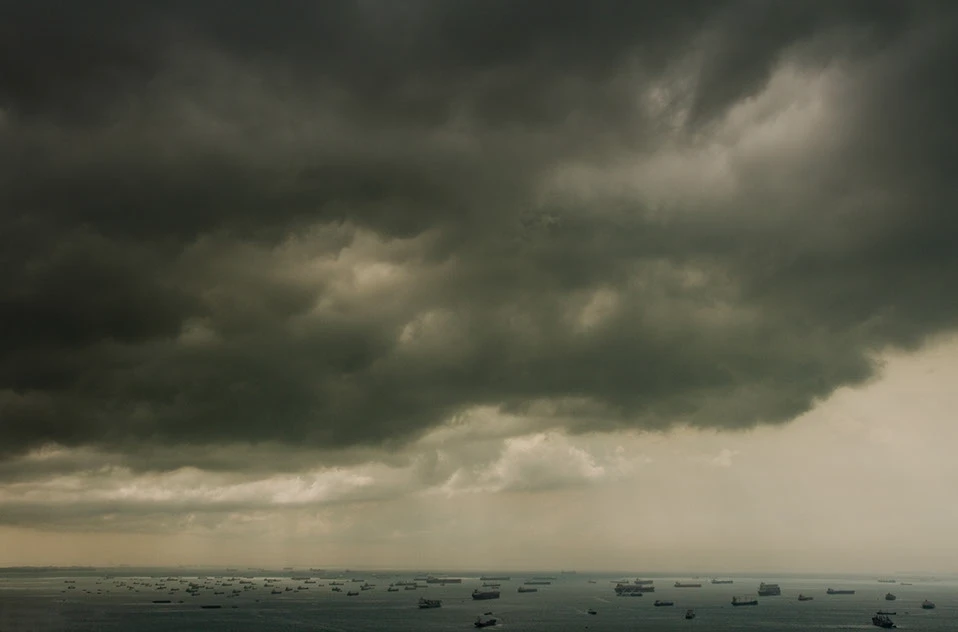
When considering Poe’s oeuvre, there are numerous texts wherein water manifests as an agent in Gothic contexts. One of the first texts that comes to mind is “The Fall of the House of Usher” (1839). Frequently analyzed, say, for its artistic strategy, motifs of duplication, or its engagement with phrenological discourse, the tale’s central elemental component—the tarn—has received remarkably little critical attention, despite bookending the entire narrative from its opening to its tragic conclusion. From the story’s opening, the narrative is saturated with aquatic foreboding—almost like doomsday by water. The phrase “the clouds hung oppressively low in the heavens” (Poe 2011: 195) give clouds agency from the start and evokes a sense of imminent inundation, as if the sky itself threatens to collapse with water.
Before even entering the house, and as the narrator looks down within this moraine-encircled body of water, it produces a powerful effect on him which he phrases as “a shudder more thrilling than before” (Poe 2011: 196). This highlights that before any event takes place, Poe centers the tarn as an agentic water body that induces disturbance within the human subject. In the same manner, the Hydrogothic has already claimed the Usher house and the people living in it, Roderick Usher and Lady Madeline, as the adjacent tarn’s rancid air slowly consumes them and the architecture. While Roderick Usher is steadily claimed by the water body that even his hair begins to float, the atmosphere inside is thick and a fissure runs down its exterior, Lady Madeline is marked by blood. In fact, she is connected with wine imagery: another Hydrogothic element. Wine bears a visual and symbolic resemblance to blood, and Lady Madeline—blood-covered and entombed beneath the house—becomes a figure of fermented excess, sealed away only to return eventually with catastrophic force.
Therefore, the Hydrogothic reconfigures water from a passive backdrop into an active, agentic force that demands a reconsideration of human responsibility within ecological systems.
As the story develops, every water-related force assumes a more radical agency. For instance, a tempest rises as the narrator reads a romance to the narrator. Eventually, the storm, the tarn, and the moon—all water-related entities—coalesce into collapsing and volatile agentic network that, through the mediating force of the tarn, dismantles the Usher estate. Although static and seemingly insignificant, the tarn functions like an ontological solvent, gradually destabilizing the house before vocally devouring the house and the last of the family’s bloodline.
Therefore, the Hydrogothic reconfigures water from a passive backdrop into an active, agentic force that demands a reconsideration of human responsibility within ecological systems. It disrupts anthropocentric hierarchies that position humans as external observers of nature, and at the same time, it insists on relationality: humans are always already immersed within aqueous systems that shape, sustain, and ultimately exceed them. In this sense, the Hydrogothic contributes to an ethical reorientation toward more-than-human worlds by rendering visible the consequences of ecological disregard—whether in the form of flooding, drought, contamination, or submersion—as expressions of a dynamic and responsive environment. This lens underscores the necessity of thinking with water in its darker tropes, encouraging an attentiveness to its eerie, unsettling, and Gothic manifestations.
References
Alder, Emily. “Through Oceans Darkly: Sea Literature and the Nautical Gothic.” Gothic Studies, 19: 2, (2017), 1–11.
Bible, The. “Genesis.” Holy Bible: Pure Cambridge Edition. Australia: Waking Lion Press, 2016, 1–42.
Brown, William Hill. The Power of Sympathy. 1789. Edited by William S. Kable. Ohio, USA: Ohio State University Press, 1969.
Crow, Charles L. American Gothic. Cardiff, UK: University of Wales Press, 2009.
Frank, Frederick S. “The Aqua-Gothic Voyage of ‘a Descent into the Maelstorm.’ Transcendental Quarterly 29: 1, (1976), 85–92.
Gillis, John R. ‘The Blue Humanities.’ The National Endowment for the Humanities, 2013. Online at: www.neh.gov/humanities/2013/mayjune/feature/the-blue-humanities (accessed 10 May 2026).
Hawthorne, Nathaniel. The Complete Works of Nathaniel Hawthorne, with Introductory Notes by George Parsons Lathrop. Cambridge, UK: The Riverside Press, 1887.
Hillard, Tom J. ““Deep into That Darkness Peering”: An Essay on Gothic Nature.” Interdisciplinary Studies in Literature and Environment 16: 4, 2009, 685–695.
Howells, Coral Ann. Where Are the Voices Coming From? Canadian Culture and the Legacies of History. Amsterdam, the Netherlands: Rodopi, 2004.
Hughes, William. Historical Dictionary of Gothic Literature. Maryland, USA: Scarecrow Press, 2013.
Keetley, Dawn. “Introduction: Six Theses on Plant Horror; Or, Why Are Plants Horrifying?” Plant Horror: Approaches to the Monstrous Vegetal in Fiction and Film, edited by Dawn Keetley and Angela Tenga. London, UK: Palgrave Macmillan, 2017, 1–31.
Keetley, Dawn, and Matthew Wynn Sivils. Ecogothic in Nineteenth-Century American Literature. New York, USA: Routledge, 2018.
Khokhlov, A.N. “On the Immortal Hydra. Again.” Moscow University Biological Sciences Bulletin 69: 4, (2014), 153–157.
Mentz, Steve. An Introduction to the Blue Humanities. New York, USA: Taylor & Francis, 2023.
Oppermann, Serpil. Blue Humanities. Cambridge, UK: Cambridge University Press, 2023.
Pagan, Amanda. “Where to Start with Edgar Allan Poe.” The New York Public Library, 2019. Online at: www.nypl.org/blog/2019/01/18/where-start-edgar-allan-poe (accessed 11 May 2026).
Poe, Edgar Allan. “The Fall of the House of Usher.” Edgar Allan Poe: Collected Works, edited by Adrienne J. Odasso. San Diego, USA: Canterbury Classics, 2011, 195–207.
Salowey, Christina. “Labor II: The Lernean Hydra.” The Oxford Handbook of Heracles, edited by Daniel Ogden. Oxford, UK: Oxford University Press, 2021, 71–85.
Smith, Andrew, and William Hughes. EcoGothic. Manchester, UK: Manchester University Press, 2013.
Walpole, Horace. The Castle of Otranto. 2001. London, UK: Penguin Books, 1764.
Waterfield, Robin, and Kathryn Waterfield. The Greek Myths: Stories of the Greek Gods and Heroes Vividly Retold. New York, USA: Quercus Publishing, 2012.
Wester, Maisha, and Xavier Aldana Reyes. Twenty-First-Century Gothic. Edinburgh, UK: Edinburgh University Press, 2019.
About the Author
Jarjis Jarjis is a Master’s student at the department of English and American Studies at Friedrich Schiller University Jena, Germany. He is also a Research Assistant at the chair of North American Literature under Prof. Dr. Caroline Rosenthal. Recently, he submitted his Master’s thesis entitled “Hydrogothic: Edgar Allan Poe through a Blue Humanities Lens,” and received perfect marks for it. Coming from Iraq, one of the most water-stressed countries in the world, where water scarcity continues to intensify, and now living in close proximity to the Saale River in Germany, Jarjis has developed a deeply personal and intellectual relationship with water. Beyond his Master’s thesis, Jarjis seeks to make scholarly and artistic contributions to the field of Blue Humanities.