Tag: Anthropocene

  • The Sea Remembers, the River Haunts: Fluid Archives in Contemporary Hispanic Fiction

    Contemporary crises have made water into a medium through which ecological, political, and social conflicts can be understood. Droughts, pollution, rising sea levels and increasing inequalities in access are just a few of the reasons why water occupies such a central place in environmental politics and ecological imaginaries. Across the Hispanic world, these environmental transformations acquire different meanings according to local ecological, historical, and cultural contexts. While some are linked to pollution and biodiversity loss, others foreground questions of memory, territorial violence, or the relationships between humans and more-than-human worlds.

    It is crucial to highlight that, although water has always been a central motif in art, culture, and literature, contemporary ecological concerns have given these representations a new resonance. Across these literary and artistic imaginaries, water is often a force of agency that connects human and more-than-human bodies across memories, histories, myths, affects, and forms of grief. This relational understanding of water resonates with Astrida Neimanis’s proposition that “we are bodies of water”.[1] According to this cultural theorist, our watery embodiment is characterized by a “constant process of intake, transformation, and exchange,”[2] which suggests that bodies cannot be understood as autonomous or exclusively human entities. Rather, water highlights the porous connections that link human and more-than-human bodies, environments, and ecosystems through ongoing processes of relation and transformation. This approach understands water not only as a material force that maintains the physical links between bodies, territories, and environments, but also as a medium through which memories, histories, affects, and ecological traces circulate across time and space. From this perspective, oceans, rivers, and aquatic bodies appear as fluid archives, which can be understood as dynamic and living spaces where colonial, ecological, and emotional traces are preserved, reactivated, and continuously transformed.

    Different manifestations of such aquatic archives can be found across contemporary Hispanic literature and artistic production. Examples include Rita Indiana’s Tentacle (2018), originally published as La mucama de Omicunlé (2015), Selva Almada’s Not a River (2024), originally published as No es un río (2020), and the aquatic imaginaries and siren-like figures present in Irene Solà’s literary and artistic creations. Although these works emerge from distinct geopolitical and cultural contexts—the Caribbean in Indiana’s case, the Argentine littoral in Almada’s, and the Catalan landscape in Solà’s—they share a common concern with water as a place of memory and relation. In each of these aforementioned works, oceans, rivers, and aquatic beings become active agents through which colonial, ecological, and affective histories are preserved, transmitted, and continually reshaped across interconnected human and more-than-human worlds.

    In Rita Indiana’s polyphonic novel Tentacle, the ocean, water, and aquatic beings occupy the core of the narrative. This centrality is inextricably tied to the insularity of the Dominican Republic, in which water is not just a geographical point but a force that determines space, time and action. Through the novel’s time travels and multiple temporal layers, different aquatic configurations reflect the specific problems associated with water in each historical period. In the seventeenth century, the buccaneers move along the coasts of Hispaniola, and their presence is based on maritime commerce in the ocean. In the twenty-first century, Playa Bo becomes the site of fundraising initiatives aimed at preserving marine life, while events such as the tsunami, the disappearance of marine species, and the contamination of the Atlantic Ocean emphasize the ecological vulnerability of the Caribbean Sea. Finally, the marine anemone is a key figure not only in ontological and epistemological fluidity but also in relationality between human and more-than-human bodies. Water therefore does not play a merely decorative role in the novel. It determines actions, shapes the lives of the characters, and becomes a central character itself: a fluid presence that preserves, transmits, and transforms memories, histories, and epistemologies across time.

    The novel’s non-linear structure, characterized by multiple temporalities and time travel, resonates with Kamau Brathwaite’s concept of tidalectics, which understands Caribbean history as a continuous process of excavation through the movements of the sea. Rather than disappearing, memories and lived experiences circulate across time and space, remaining inscribed in the ocean.[3] From this perspective, Tentacle suggests that contemporary forms of violence constitute a prolongation of those initiated during colonization. The violence associated with evangelization and the transatlantic slave trade extends into the present through new forms of neocolonial domination, political corruption, and environmental exploitation. As discussed in the introduction, environmental degradation has become one of the major challenges of the contemporary world, and  in Indiana’s novel, this is reflected in the ecological catastrophe caused by the contamination of the Atlantic Ocean, which spreads across marine ecosystems as a consequence of the corrupt decisions of the Dominican government.

    Nevertheless, the novel also imagines forms of resistance to these hegemonic structures through the figure of Olokun, the Yoruba deity associated with the depths, mysteries, and transformative power of the ocean. By recovering an Afro-Caribbean spiritual tradition, Olokun reconnects the colonial present with ancestral knowledge that had been marginalized by colonial domination. Together with the sea anemone, this figure further emphasizes the agentive role of the sea, as it is depicted not only as an archive of colonial violence but also as a space of transformation and renewal. Through the initiation of Acilde, one of the novel’s central characters, as Omo Olokun, contact with both Olokun and the anemone grants access to new forms of perception, temporal mobility, and ultimately the possibility of altering the course of history. As the priest explains to Acilde: “Eric te inició y ya sabes que eres el Omo Olokun: el que sabe lo que hay en el fondo del mar (…). Salva el mar…”[4] [“Eric initiated you and now you know that you are Omo Olokun: the one who knows what lies at the bottom of the sea (…). Save the sea…”; the author’s translation]. This encounter not only illustrates the transformative power of the ocean but also brings back the watery relationality discussed earlier. In Stacy Alaimo’s terms, it exemplifies transcorporeality: the material interpenetration of human and more-than-human bodies,[5] through which the sea becomes an active participant in the constitution and transformation of embodied existence. The ocean is then not only a repository of memory but also a means for imagining alternative futures.
    While Rita Indiana situates these fluid archives in the Caribbean Sea, Selva Almada relocates them to the river landscapes of Argentina, where water similarly becomes a living repository of memory, violence, and more-than-human relations. In Not a River, the river functions again as another character whose agency shapes the lives, emotions, and experiences of those who approach it. Whereas Indiana points to the repetition of colonial and neocolonial violence, Almada explores violence against the river by exposing the extractivist logic through which nature is treated as a mere resource. This dynamic is already visible in the opening scene, in which a group of men go fishing. Instead of a harmonious relationship with nature, the episode shows a gratuitous act of domination: the fish is shot with a gun, left to rot and eventually thrown back into the river without ever being eaten. Far from being a simple hunting episode, this scene depicts violence that is no longer connected to subsistence, exposing a relationship with the river based on exploitation rather than coexistence. By doing so, the river becomes a contested territory and, as Almada herself explains, it is represented as a body violated by masculine forms of domination and extractivist violence.[6]

    Here again, Neimanis’s notion of bodies of water provides a useful framework for understanding Almada’s representation of the river as a living body rather than a passive landscape. Such a perspective destabilizes the idea of autonomous and self-contained bodies, emphasizing instead their relational and more-than-human constitution.[7] This relational understanding reaches one of its most powerful expressions in the passage where the narrator insists that “it’s not a river. It’s this river” and, similarly, “it wasn’t a ray. It was that ray.”[8] By rejecting generic categories in favor of singular beings, Almada refuses to reduce the river and its inhabitants to abstract natural resources. Instead, every body acquires its own material presence, history, and agency. The title Not a River therefore acquires a deeper ontological meaning: the novel is not about “the river” as a single, universal entity but about a living body which cannot be divorced from the memories, feelings and more-than-human relationships that are present in it. Consequently, violence against the river affects not only nature but also the human communities that depend on it, highlighting the close relationship between human and more-than-human life.

    It is worth noting that this understanding of interconnectedness and relationality is further reinforced through the fate of one of the novel’s protagonists, Eusebio, who dies in the river. His death, however, does not imply his complete disappearance since his spirit continues to haunt the narrative, suggesting that the past constantly resurfaces and illustrating how the river itself functions as a fluid archive. This particular relationship between death, water, and haunting also reinforces Brathwaite’s tidalectic logic discussed earlier. Once again, the past refuses to disappear and repeatedly resurfaces in the present, underscoring the cyclical circulation of memory, grief, and violence rather than their progression according to linear chronology.  Following this logic, the river becomes more than the site of death. Rather than functioning merely as a setting of loss, it emerges as a material space in which past and present constantly overlap, preventing death from marking a definitive ending. Because Eusebio’s presence never completely disappears, those who remain continue to experience him as part of the river. The past therefore never becomes fully detached from the present. In this sense, the river functions as a fluid archive, not because it simply stores memories, but because it keeps them in circulation and returns them to the world of the living.

    As the previous examples have shown, water functions as an archive of colonial and affective violence in both Rita Indiana’s and Selva Almada’s novels. Irene Solà, however, offers a different perspective by turning towards aquatic female figures whose fluid bodies preserve marginalized forms of knowledge, memory, and expression. In her acclaimed novel When I Sing, Mountains Dance (2022)originally published as Canto jo i la muntanya balla (2019), the polyphony of voices, the coexistence of multiple temporalities, and the constant blurring of boundaries between reality and the supernatural create a profoundly relational narrative. Among the novel’s most compelling liminal figures are the dones d’aigua (“women of water”), mythical female beings from the Catalan tradition associated with rivers and springs. Neither fully human nor entirely supernatural, they break down rigid ontological categories and expand the novel’s polyphony beyond the human. Oscillating between myth, history, and imagination, their presence remains uncertain: some characters claim to have seen them, while others dismiss them as mere legends. They thus exist in the unstable space between memory and oblivion, a tension that is powerfully expressed when one of the characters admits: “Ya no me acuerdo del recuerdo de las mujeres de agua.”[9] [“I no longer remember the memory of the women of water”;the author’s translation]. What is being lost, therefore, is not only the mythical figures themselves but also the collective memory through which they have been transmitted across generations. Nevertheless, despite this apparent process of oblivion, Solà restores narrative agency to the dones d’aigua by allowing them to speak. In doing so, she transforms them into fluid archives through which marginalized voices, submerged histories, and alternative epistemologies continue to circulate despite the threat of disappearance.
    The reflection on aquatic female figures continues in Sirena, the performance created by Irene Solà and performance artist Laia Estruch in 2021, where the relationship between water, voice, and agency occupies a central role. Like the dones d’aigua, sirens have long been represented through patriarchal imaginaries as seductive, dangerous, eroticized, or monstrous beings whose voices were mediated by male narratives rather than belonging to themselves. Drawing on multiple literary traditions—from Homer’s destructive sirens to Andersen’s Little Mermaid, who sacrifices her voice in exchange for a human body—the performance reclaims these hybrid aquatic figures as speaking subjects capable of narrating their own stories. According to Solà and Estruch, the performance investigates the possibilities of the voice travelling within and beyond a body of water, transforming water into a medium through which the voice circulates, resonates, and acquires agency.[10] In this sense, voice itself becomes a form of watery embodiment, allowing these fluid bodies to be read once again through Neimanis’s notion of bodies of water, while simultaneously recalling Haraway’s chthonic and boundary-crossing bodies that destabilize distinctions between human and more-than-human, body and voice, nature and culture.[11] A common thread running through the work of Neimanis and Haraway is the rejection of the logics of autonomy and individualism in favour of relational modes of existence. Both emphasize that beings emerge through their relationships with other bodies, ecosystems, and environments. In this sense, water is not simply a setting but an active agent that, on the one hand, shapes the bodies of these aquatic figures and, on the other, endows them with a voice. The sirens’ voices therefore do not simply cross the boundaries between human and more-than-human or nature and culture; they inhabit these liminal spaces, making them sites where forgotten histories can resurface. Another significant aspect is that rather than functioning merely as mythical creatures, these aquatic bodies become fluid archives of forgotten voices, recovering stories, memories, and forms of knowledge that hegemonic patriarchal discourses have historically silenced.

    This analysis demonstrates that fluid archives do not constitute a single or homogeneous category. Rather, they emerge through multiple aquatic configurations that preserve and reactivate different forms of memory across interconnected human and more-than-human bodies. In Rita Indiana’s Tentacle, the sea functions as an archive of colonial memory, exposing the continuity of colonial violence within contemporary ecological crises. In Selva Almada’s Not a River, the river becomes a haunted archive where grief, absence, and unresolved violence continually resurface. Finally, Irene Solà’s literary and performative creations transform aquatic female figures into archives of silenced voices, recovering forms of knowledge and agency historically marginalized by patriarchal narratives.

    Taken together, these works reveal that water is never merely a setting or a metaphor. Oceans, rivers, and aquatic bodies emerge as active material forces that preserve, transmit, and transform memories, affects, and histories while also reshaping the relationships between bodies, territories, and environments. Rather than proposing a nostalgic return to nature, these authors invite us to rethink ecological crises through relational forms of coexistence, reminding us that environmental violence, colonial histories, and social inequalities are inseparable processes circulating through the same fluid worlds.

    Finally, these fluid archives encourage us to reconsider that water does not simply preserve what has been forgotten; it continuously dissolves the boundaries through which we have traditionally understood memory, bodies, and the more-than-human world. To read water as a fluid archive is therefore not only to rethink memory, but also to recognize an ethical responsibility towards the living worlds whose histories continue to circulate through it. Such an ethical perspective ultimately calls not only for protecting water as an external resource, but also for the recognition that violence against water is inseparable from violence against the interconnected worlds it sustains. It consequently offers a way of understanding water as a relational space of memory, coexistence, and shared responsibility through which alternative forms of knowledge and resistance continue to emerge and circulate.


    [1] Astrida Neimanis, Bodies of Water: Posthuman Feminist Phenomenology, London, Bloomsbury, 2017, 3.

    [2] Ibid.16.

    [3] Kamau Brathwaite, Conversations with Nathaniel Mackey, Rhinebeck, NY, We Press, 1999, 34.

    [4] Rita Indiana, La mucama de Omicunlé, Cáseres, Editorial Periférica, 2015, 133.

    [5] Stacy Alaimo, Bodies of Water. Posthuman Feminist Phenomenology, London, New York, Oxford, New Delhi, Sydney, Bloomsbury Academic, 33.

    [6] María Malusardi, “El río, ese cuerpo avasallado por el machismo. Entrevista a Selva Almada,” Era Verde, April 26, 2022, https://eraverde.com.ar/el-rio-ese-cuerpo-avasallado-por-el-machismo/ (accessed June 25, 2026).

    [7] Neimanis, Bodies of Water, 17.

    [8] Selva Almada, Not a River, Edinburgh, Charco Press, 2024, 76-77.

    [9] Irene Solà, Canto yo y la montaña baila, Barcelona, Anagrama, 2019, 232.

    [10] Palau de la Música Catalana, “Laia Estruch i Irene Solà presenten al Palau de la Música Catalana Sirena, una performance que explora el poder i la flexibilitat de la veu dins l’aigua,” https://www.palaumusica.cat/ca/laia-estruch-i-irene-sola-presenten-al-palau-de-la-musica-catalana-sirena-una-performance-que-explora-el-poder-i-la-flexibilitat-de-la-veu-dins-l-aigua_942290 September 14, 2021, (accessed June 28, 2026).

    [11] Donna J. Haraway, Staying with the Trouble. Making Kin in the Chtulucene, Durham and London, Duke University Press, 2026, 19.


    Bibliography

    ALAIMO, Stacy, Bodies of Water. Posthuman Feminist Phenomenology, London, New York, Oxford, New Delhi, Sydney, Bloomsbury Academic.

    ALMADA, Selva, Not a River, Edinburg, Charco Press, 2024.

    BRATHWAITE, Kamau, Conversations with Nathaniel Mackey, Rhinebeck, NY, We Press, 1999.

    HARAWAY, Donna J., Staying with the Trouble. Making Kin in the Chtulucene, Durham and London, Duke University Press, 2026.

    INDIANA, Rita, La mucama de Omicunlé, Cáseres, Editorial Periférica, 2015.

    MALUSARDI, María, “El río, ese cuerpo avasallado por el machismo. Entrevista a Selva Almada.” Era Verde. April 26, 2020. Accessed June 25, 2026. https://eraverde.com.ar/el-rio-ese-cuerpo-avasallado-por-el-machismo/.

    NEIMANIS, Astrida, Bodies of Water: Posthuman Feminist Phenomenology, London, Bloomsbury, 2017.

    Palau de la Música Catalana. “Laia Estruch i Irene Solà presenten al Palau de la Música Catalana Sirena, una performance que explora el poder i la flexibilitat de la veu dins l’aigua.” September 14, 2021. Accessed June 28, 2026. https://www.palaumusica.cat/ca/laia-estruch-i-irene-sola-presenten-al-palau-de-la-musica-catalana-sirena-una-performance-que-explora-el-poder-i-la-flexibilitat-de-la-veu-dins-l-aigua_942290.

    SOLÀ Irene, Canto yo y la montaña baila, Barcelona, Anagrama, 2019.

    Bio

    Katarzyna SOBONIAK is a PhD candidate in Hispanic Studies at the Université de La Réunion (France). Her research is grounded in ecofeminist and decolonial perspectives and focuses on representations of ecological crises in contemporary Hispanic literature. Her interests center on the analysis of the relationships between body, nature, and power in works by women writers from Spain and Latin America.
  • The Hydrogothic

    The Hydrogothic

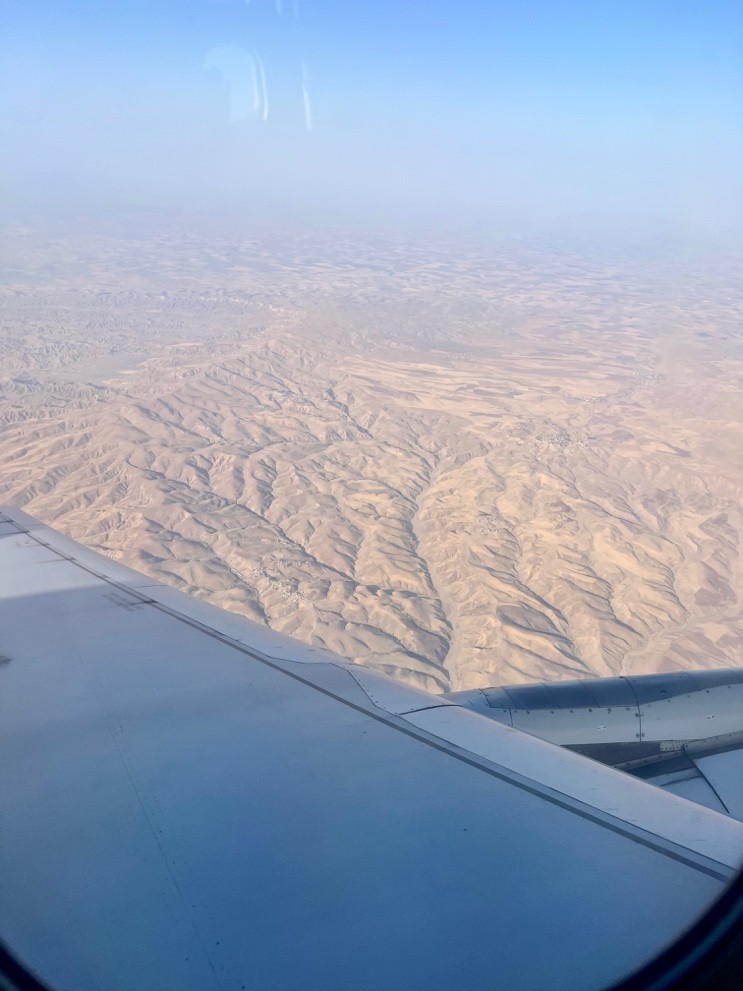
    Featured image: Photo taken from a plane over Erbil, Iraq in August 2025.

    Water has always been a powerful motif in literary and cultural history, but a critical framework of engagement with it as a non-human agent is a relatively recent phenomenon. I come from a region whose very name—Mesopotamia—is defined by two fluvial bodies, along which one of the earliest recorded human civilizations emerged. The growing water crisis in the world has affected Iraq dramatically—alarming footage from the summer of 2025 shows individuals walking across the bed of the Tigris. But being introduced to the field of Blue Humanities in Jena, Germany, opened a new intellectual avenue for me. This “cultural turn to the sea,” as John R. Gillis writes in Humanities, activates the mode of “thinking with water” (Oppermann 2023: 4), allowing for a critical engagement with “today’s ecocatastrophic times” (Mentz 2024: 1), and an exploration of how literary texts, and art more broadly, can meaningfully respond to contemporary ecological concerns.

    This focused lens on water surfaced with the publication of Steve Mentz’s article “Toward a Blue Cultural Studies: The Sea, Maritime Culture, and Early Modern English Literature” (2009) and later more comprehensively in his book An Introduction to the Blue Humanities (2024). Likewise, Serpil Oppermann’s Blue Humanities (2023) encourages us to understand water as a being with agency. Oppermann views waterscapes as sites of unlimited symbolic dimensions and cultural meanings. Employing a “cognitive wet paradigm” (Oppermann 2023: 12), waterscapes, then, can be analyzed through a lens which grants them agency, viewed as ecological systems, cultural spaces, sites of colonial history, engines of globalization, and dynamic environments deeply entangled with human and nonhuman life. On the other hand, remaining unaware, indifferent, and unwilling to rethink this human–water relationship risks perpetuating anthropocentric assumptions and further distancing humans from their entanglement with water, thereby reinforcing the illusion that water exists merely as passive.

    Seen in this context, doom by water is not a myth from ancient history; it shadows the future of human life itself. In contrast to optimistic water discourses like that of American Transcendentalism, for instance, such as the views of Henry David Thoreau and Ralph Waldo Emeron, the framework I introduce redirects positive narratives toward darker, more unsettling dimensions. I merge multiple theoretical approaches—the Blue Humanities, the Gothic, the Ecogothic, and the Nautical Gothic—in order to develop a critical framework I call the Hydrogothic. This framework explores water and adjacent fluids in Gothic modes, arguing that it is water that produces the Gothic effect.

    The Gothic and Water

    It would be a valid question to ask, why the Gothic? As a mode and genre, the Gothic is used as a tool to “write about all sorts of taboos and transgressions” (Hillard 2009: 690), and people get relieved that the dark events do not take place in real life—a false belief because the Gothic reveals real darkness that does happen. Maisha Wester and Xavier Aldana Reyes emphasize that the Gothic is the genre that functions as a critical mode through which the “oppressed and forgotten” (Wester and Reyes 2019: 1) are brought into focus. And in fact, the term ‘Gothic,’ is more a mode than a genre. Tom J. Hillard remarks that it “describ[es] certain aspects of the texts, rather than a discrete category into which these works unerringly fit” (Hillard 2009: 689).

    Throughout history, from the term’s first application to describe Horace Walpole’s novel The Castle of Otranto (1764) in Britain, to its migration across the Atlantic Ocean, the Gothic has demonstrated its remarkable adaptability to shifting historical periods, geographical landscapes, and cultural anxieties. In an American context, specifically, it often expressed cultural fears surrounding the wilderness, westward expansion, the legacies of slavery, and the Civil War. Twentieth-century Gothic shifted its focus to grapple with industrialization, as reflected in John Steinbeck’s The Grapes of Wrath (1939) in which industrial modernity is depicted as an ecological and economic force that transforms land into a site of extraction and renders human life precarious; the First and Second World Wars, as seen in works such as Norman Mailer’s The Naked and the Dead (1948), portraying warfare as a mechanized system of control and exhaustion that reduces human beings’ value; and the Vietnam War, written by authors such as Tim O’Brian who draws on his own experience as a soldier. A key example is his In the Lake of the Woods (1994), which explores trauma, memory, and uncertainty in the aftermath of war. In the twenty-first century, the Gothic continues to adapt, addressing environmental crises, climate change and ecological degradation. The Gothic, like water, resists containment, and slips across human-made borders. As William Hughes remarks: “[the Gothic] has kept it up with times, passing almost effortlessly from romanticism to modernism to postmodernism, and adapting to feminist literature, to queer literature, and even science fiction. It really seems as if nothing can stop it…and why should it stop?” (Hughes 2013: xi).

    As matter of fact, the Gothic has long foregrounded water as an active entity, or at the very least an indispensable element without which the Gothic imagination can scarcely be complete. A case in point is the flood story. In Antiquity, The Epic of Gilgamesh describes a deluge that obliterates humanity and leaves the world drowned and lifeless. In The Bible, before water is positioned as life-giving, the first lines of the Old Testament already describe water in a Gothic mode, declaring that “darkness was upon the face of the deep. And the Spirit of God moved upon the face of the waters” (Gen. 1: 2).

    In the United States, one of the first novels produced in the New World, William Hill Brown’s The Power of Sympathy (1789), is not a Gothic text by classification, yet it nevertheless deploys unsettling water imagery. One instance occurs when a lover in despair throws himself into the river, with the narrator describing the site of his death as “a watery tomb” (Brown 1969: 79). Similarly, Nathaniel Hawthorne’s “The Vision of the Fountain” depicts a crystal spring, also referred to as “the haunted spring” (Hawthorne 1882: 244), which brings the illusion of a nymph-like girl to the narrator.

    The Hydrogothic: Defining a New Framework

    Over the years, several theoretical frameworks have emerged to examine the intersections between nature and the Gothic. In what follows, I briefly outline two relevant and widely discussed approaches upon which I base my term, the Hydrogothic. In 2013, Andrew Smith and William Hughes coined the eponymous term in their edited collection The EcoGothic (2013). This is a sub-genre that explores human fears and anxieties about the natural world, often featuring haunted, decaying, or threatening landscapes to reveal the destructive and precarious relationship between humans and nature. However, while the interconnectedness of humans and the natural world are deconstructed and questioned through the Ecogothic, the term only narrowly touches on water.

    The other term which links nature, and water more specifically, and the Gothic is Emily Elder’s Nautical Gothic. Alder constructs a “lens [that] focuses on how the sea is represented in Gothic literature” (Alder 2017. 1; italics mine). However, Alder’s Nautical Gothic lens is limited. The term ‘nautical’ restricts the analytical lens to narratives of the sea alone, excluding other forms of water such as swamps, rivers, blood, to name a few. In order to extend the focus beyond the sea—an expansion from the nautical to the elemental—it becomes fitting to introduce the lens of the Hydrogothic.

    . . . the Hydrogothic foregrounds water as an agentive element which causes the Gothic effect, and not vice versa. It encompasses all water bodies and forms. It is not only elemental water in its liquid, vaporous, and frozen forms, but also the broader category of fluid substances that are ubiquitous in Gothic narratives, such as blood, poison, venom, tears, marsh, liquor, ink, sap, seepage, ichor, wine, brandy, and coffee. It also extends to the linguistic residues of fluidity embedded in Gothic discourse: verbs and metaphors of flowing, streaming, seeping, or flooding.

    Over the course of approximately half a decade, additional terms have become evident in discussions of water linked to the Gothic. These include Frederick S. Frank’s “aqua-Gothic” (1976) and Coral Ann Howells’ “Maritime Gothic” (2004). Frank’s term refers to the exploration of transcendentalism through the aqua-Gothic (Frank 1976: 85), grounding his concept in Poe’s “A Descent into the Maelström.” This, however, proves untenable, as Poe’s sea writings, and that particular story, do quite the opposite: they dismantle transcendental aspiration and put them in their place. Finally, Howells’ term refers to a regional variant of the Gothic that is shaped by its relationship to the sea and coastal environments, especially within a Canadian context (Howells 2004: xviii).

    Unlike these limited previous terms, the Hydrogothic foregrounds water as an agentive element which causes the Gothic effect, and not vice versa. It encompasses all water bodies and forms. It is not only elemental water in its liquid, vaporous, and frozen forms, but also the broader category of fluid substances that are ubiquitous in Gothic narratives, such as blood, poison, venom, tears, marsh, liquor, ink, sap, seepage, ichor, wine, brandy, and coffee. It also extends to the linguistic residues of fluidity embedded in Gothic discourse: verbs and metaphors of flowing, streaming, seeping, or flooding. Also, idiomatic expressions like ‘in hot water,’ ‘dead in the water,’ ‘to come hell or high water,’ to name just a few.

    Why the term ‘hydro’ instead of, say, ‘aqua’ or ‘blue’? Not only does it refer to the Greek word “water” (Salowey 2021: 72) and the immortal microorganism Hydra (Khokhlov 2014: 153), it also signals the Greek marsh-born monster: Hydra of Lerna. Lerna is a region located on a narrow point between mountains and the sea on the eastern coast of Peloponnesus in Greece. The entrance to the underworld is said to be situated through Alcyonian Lake nearby. Whoever attempts to cross its seemingly-calm waters will be swallowed. Possessing a myriad of “snake heads” (Salowey 2021: 73) and poisonous blood coursing through her body, the Hydra has a famous regenerative ability: if a head is cut off, more would “grow back in place of the one” (ibid. 74). Its final head, immortal, was allegedly buried by Heracles under a rock—and legend persists that it still exists somewhere in Greece. The refusal of death is a prominent Gothic trope, one with which the legend of the Hydra closely aligns. Diffusing the framework with non-aqueous Gothic liquid, Heracles dips his arrows in the Hydra’s venom as her “vapors wriggle […] through the waters of the marsh away from the corpse” (R. Waterfield and K. Waterfield 2012: 146).

    The Hydra’s symbolic potential exceeds water as a pure substance as it no longer refers to merely H₂O. Alluding to death and immortality, it denotes decay, contamination, and persistence—liquid matter that cannot be contained or resolved. The Hydra then embodies a wet ontology in which liquidity is agentive and threatening, capable of sustaining life only by entwining it with unease and malaise. Likewise, the Hydrogothic functions as a medium of transformation: it destabilizes boundaries between human and nonhuman, body and landscape, life and death. It insists on liquid’s agency, its capacity to unsettle anthropocentric knowledge systems, and its power to induce Gothic horror precisely through its interconnectedness and unpredictability.

    In this respect, I argue that the Hydrogothic anticipates contemporary ecological thought about planetary change, revealing how Gothic narratives long recognized the impossibility of human mastery over the wet matter. Through the Hydrogothic, water’s numerous aggregates become the medium through which human fragility is exposed, and it enables close examination of its ambiguous and foreboding qualities as a non-human agent of uncertainty, disruption, and destabilization of anthropocentric epistemologies. The Hydrogothic imagines a world in which the nonhuman entity relentlessly resurfaces, reclaims, and reconfigures, where humans realize their fragility. If plants, organisms that wilt and die without water, are able to decenter human-centered ego as suggested by Dawn Keetley (Keetley 2017: 1), then how much more water itself?

    The Substantiation of the Hydrogothic in Edgar Allan Poe

    I define and substantiate the Hydrogothic by applying it to Edgar Allan Poe specifically for a few reasons. First, in my opinion, he is a highly suitable American author to elucidate present water anxieties, one whose work remains catalytic and influential across the globe. Second, Poe is the author who “gave a face to American Gothic” (Keetley and Sivils 2018: 98), and is considered to be the “Father of the American Gothic” (Pagan 2019). Third, despite being “one of the inventors of the sea Gothic” (Crow 2009: 38) where water “saturates the pages of [his] texts” (Keetley and Sivils 2018: 98), his oeuvre is often overlooked in the Blue Humanities conversations, even though his work predates the environmental and water-focused literature that contemporary scholarship tends to emphasize.

    When considering Poe’s oeuvre, there are numerous texts wherein water manifests as an agent in Gothic contexts. One of the first texts that comes to mind is “The Fall of the House of Usher” (1839). Frequently analyzed, say, for its artistic strategy, motifs of duplication, or its engagement with phrenological discourse, the tale’s central elemental component—the tarn—has received remarkably little critical attention, despite bookending the entire narrative from its opening to its tragic conclusion. From the story’s opening, the narrative is saturated with aquatic foreboding—almost like doomsday by water. The phrase “the clouds hung oppressively low in the heavens” (Poe 2011: 195) give clouds agency from the start and evokes a sense of imminent inundation, as if the sky itself threatens to collapse with water.

    Before even entering the house, and as the narrator looks down within this moraine-encircled body of water, it produces a powerful effect on him which he phrases as “a shudder more thrilling than before” (Poe 2011: 196). This highlights that before any event takes place, Poe centers the tarn as an agentic water body that induces disturbance within the human subject. In the same manner, the Hydrogothic has already claimed the Usher house and the people living in it, Roderick Usher and Lady Madeline, as the adjacent tarn’s rancid air slowly consumes them and the architecture. While Roderick Usher is steadily claimed by the water body that even his hair begins to float, the atmosphere inside is thick and a fissure runs down its exterior, Lady Madeline is marked by blood. In fact, she is connected with wine imagery: another Hydrogothic element. Wine bears a visual and symbolic resemblance to blood, and Lady Madeline—blood-covered and entombed beneath the house—becomes a figure of fermented excess, sealed away only to return eventually with catastrophic force.

    Therefore, the Hydrogothic reconfigures water from a passive backdrop into an active, agentic force that demands a reconsideration of human responsibility within ecological systems. 

    As the story develops, every water-related force assumes a more radical agency. For instance, a tempest rises as the narrator reads a romance to the narrator. Eventually, the storm, the tarn, and the moon—all water-related entities—coalesce into collapsing and volatile agentic network that, through the mediating force of the tarn, dismantles the Usher estate. Although static and seemingly insignificant, the tarn functions like an ontological solvent, gradually destabilizing the house before vocally devouring the house and the last of the family’s bloodline.

    Therefore, the Hydrogothic reconfigures water from a passive backdrop into an active, agentic force that demands a reconsideration of human responsibility within ecological systems. It disrupts anthropocentric hierarchies that position humans as external observers of nature, and at the same time, it insists on relationality: humans are always already immersed within aqueous systems that shape, sustain, and ultimately exceed them. In this sense, the Hydrogothic contributes to an ethical reorientation toward more-than-human worlds by rendering visible the consequences of ecological disregard—whether in the form of flooding, drought, contamination, or submersion—as expressions of a dynamic and responsive environment. This lens underscores the necessity of thinking with water in its darker tropes, encouraging an attentiveness to its eerie, unsettling, and Gothic manifestations.

    References

    Alder, Emily. “Through Oceans Darkly: Sea Literature and the Nautical Gothic.” Gothic Studies, 19: 2, (2017), 1–11.

    Bible, The. “Genesis.” Holy Bible: Pure Cambridge Edition. Australia: Waking Lion Press, 2016, 1–42.

    Brown, William Hill. The Power of Sympathy. 1789. Edited by William S. Kable. Ohio, USA: Ohio State University Press, 1969.

    Crow, Charles L. American Gothic. Cardiff, UK: University of Wales Press, 2009.

    Frank, Frederick S. “The Aqua-Gothic Voyage of ‘a Descent into the Maelstorm.’ Transcendental Quarterly 29: 1, (1976), 85–92.

    Gillis, John R. ‘The Blue Humanities.’ The National Endowment for the Humanities, 2013. Online at: www.neh.gov/humanities/2013/mayjune/feature/the-blue-humanities (accessed 10 May 2026).

    Hawthorne, Nathaniel. The Complete Works of Nathaniel Hawthorne, with Introductory Notes by George Parsons Lathrop. Cambridge, UK: The Riverside Press, 1887.

    Hillard, Tom J. ““Deep into That Darkness Peering”: An Essay on Gothic Nature.” Interdisciplinary Studies in Literature and Environment 16: 4, 2009, 685–695.

    Howells, Coral Ann. Where Are the Voices Coming From? Canadian Culture and the Legacies of History. Amsterdam, the Netherlands: Rodopi, 2004.

    Hughes, William. Historical Dictionary of Gothic Literature. Maryland, USA: Scarecrow Press, 2013.

    Keetley, Dawn. “Introduction: Six Theses on Plant Horror; Or, Why Are Plants Horrifying?” Plant Horror: Approaches to the Monstrous Vegetal in Fiction and Film, edited by Dawn Keetley and Angela Tenga. London, UK: Palgrave Macmillan, 2017, 1–31.

    Keetley, Dawn, and Matthew Wynn Sivils. Ecogothic in Nineteenth-Century American Literature. New York, USA: Routledge, 2018.

    Khokhlov, A.N. “On the Immortal Hydra. Again.” Moscow University Biological Sciences Bulletin 69: 4, (2014), 153–157.

    Mentz, Steve. An Introduction to the Blue Humanities. New York, USA: Taylor & Francis, 2023.

    Oppermann, Serpil. Blue Humanities. Cambridge, UK: Cambridge University Press, 2023.

    Pagan, Amanda. “Where to Start with Edgar Allan Poe.” The New York Public Library, 2019. Online at: www.nypl.org/blog/2019/01/18/where-start-edgar-allan-poe (accessed 11 May 2026).

    Poe, Edgar Allan. “The Fall of the House of Usher.” Edgar Allan Poe: Collected Works, edited by Adrienne J. Odasso. San Diego, USA: Canterbury Classics, 2011, 195–207.

    Salowey, Christina. “Labor II: The Lernean Hydra.” The Oxford Handbook of Heracles, edited by Daniel Ogden. Oxford, UK: Oxford University Press, 2021, 71–85.

    Smith, Andrew, and William Hughes. EcoGothic. Manchester, UK: Manchester University Press, 2013.

    Walpole, Horace. The Castle of Otranto. 2001. London, UK: Penguin Books, 1764.

    Waterfield, Robin, and Kathryn Waterfield. The Greek Myths: Stories of the Greek Gods and Heroes Vividly Retold. New York, USA: Quercus Publishing, 2012.

    Wester, Maisha, and Xavier Aldana Reyes. Twenty-First-Century Gothic. Edinburgh, UK: Edinburgh University Press, 2019.

    About the Author

    Jarjis Jarjis is a Master’s student at the department of English and American Studies at Friedrich Schiller University Jena, Germany. He is also a Research Assistant at the chair of North American Literature under Prof. Dr. Caroline Rosenthal. Recently, he submitted his Master’s thesis entitled “Hydrogothic: Edgar Allan Poe through a Blue Humanities Lens,” and received perfect marks for it. Coming from Iraq, one of the most water-stressed countries in the world, where water scarcity continues to intensify, and now living in close proximity to the Saale River in Germany, Jarjis has developed a deeply personal and intellectual relationship with water. Beyond his Master’s thesis, Jarjis seeks to make scholarly and artistic contributions to the field of Blue Humanities.

  • Eco-Aesthetics: A Framework of Watery Bodies and Fog-Scapes in Art

    Eco-Aesthetics: A Framework of Watery Bodies and Fog-Scapes in Art

    Water, Bodies, and Environment Aesthetics

    Water, besides being a central element of the environmental crisis, plays a profoundly symbolic and political role within contemporary societies. It is at the heart of numerous social struggles, embodying the demands of environmentalists, trade unions, and workers who oppose its privatization. The defense of water as a common and public good serves as a bulwark against the risk of amplifying social inequalities, especially in times of environmental crisis, when equitable access to water becomes a matter of justice and collective survival. In this context, water takes on the value of a symbol of resistance and solidarity, evoking movements fighting for environmental and social justice, for vital resources, and for the protection of the most vulnerable communities.

    However, the importance of water as a political and philosophical element is not limited to its social and political value; it is also a necessary presence within our bodies, permeating them, nourishing them, and defining their very essence. According to hydrofeminist perspectives and recent eco-aesthetic reflections, water is the original fluid matter from which we are composed, a substance that connects us to the natural world and at the same time reminds us of our vulnerability and our capacity to be part of a larger, more boundless whole. In this sense, water is not merely a physical substance, or corporeal “substance”, but becomes an element of identity, capable of shaping the way we perceive ourselves and our relationships with the environment. Its presence, both in the social and biological dimensions, pushes us to rethink artistic, curatorial, and philosophical practices, inviting us to recognize its transformative power in the construction of new, more inclusive and fluid imaginaries, capable of embracing the plurality of identities and experiences. The possibility of being “bodies made of water” allows the bodies themselves to assume a non-fixed, but continually changing, status. It is precisely this fluidity that the performing arts, land art, and philosophical aesthetics in general should also refer to, in order to cast our gaze toward new theoretical and practical horizons.

    A fundamental reference for creating a new horizon for environmental philosophy (especially for the aesthetics of landscape and environment) can be found in the words of the scholar Bronwyn Bailey-Charteris, when—in the book The Hydrocene: Eco-Aesthetics in the Age of Water (2024)—she writes about the importance of water as an element and the new Hydrocene paradigm:

    Water is a central figure of the current climate crisis: through sea-level risings, acidified oceans, extreme droughts and floods, polluted waterways and a lack of drinking water, the planet faces more and more extreme climate chaos dominated by water-related problems. Simultaneously a new wave of artistic water work has begun reconfiguring imagination where nature and culture inescapably meet and mingle; art is going into the blue. These works offer a model that considers the contemporary context of the climate crisis in ecoaesthetics. With the curatorial theory of the Hydrocene, this tide of artistic practices is shared and celebrated, and by thinking through the curatorial, recognised as a potential means of planetary caretaking.1

    The scholar repeatedly describes, for the first time, an aesthetic paradigm (comprising artworks, curatorial techniques, performing arts, and eco-aesthetics) linked to the climate crisis and environmental issues, with a focus on water. Once again, in her book The Hydrocene: Eco-Aesthetics in the Age of Water, she writes:

    The Hydrocene is a wet ontological shift in eco-aesthetics which redefines our approach to water, transcending anthropocentric, neo-colonial and environmentally destructive ways of relating to water. By engaging hydrofeminist, care-based and planetary thinking, The Hydrocene learns from the knowledge and agency of water itself within the tide of art going into the blue. The Hydrocene articulates and embodies the distinctive ways contemporary artists relate and engage with water, offering valuable lessons towards climate action.2

    The concept of the “Hydrocene” introduces new ways of making art, curating art, and decolonizing certain forms and narratives of art. In fact, it’s not the first time in the history of art and aesthetics that the question of how to address the climate crisis and how to represent socio-environmental concerns through art has been raised. One such approach is so-called land art, an artistic practice that centers on the nature-human dichotomy, seeking to artistically represent ecological and environmental challenges. There are even critical scholars like Crawford and Baker who affirm other intentions of doing environmental and land art. For example, Donald Crawford maintains that many environmental artworks are aesthetic affronts to nature by “forcibly assert[ing] their artifactuality over against nature” (Crawford 1983, 57)3, and Elisabeth Baker maintains that earthworks, as stages of an artistic pilgrimage, indirectly exercise a “preservational effect” on the territory even though they are not forms of “ecological art” (Baker 1983, 83).4 The fact remains that land art can be considered as a first effort, even theorized in the aesthetics of landscape and the environment, to conceive of art concerns that could be considered more ethical than aesthetic. Land art and environmental art focus the “aesthetic attention” on the climate, but in which ways? Through what theoretical paradigms and philosophical categories?

    I think art can be a valid medium through which to discuss current issues, including climate, environmental, and gender. To do so, however, it’s not enough to philosophically position oneself within the Anthropocene paradigm and argue that humanity’s impact on the environment is devastating, attempting to challenge the nature/culture dichotomy. This is insufficient for an aesthetic theory of the environment that seeks to address environmental discourse in all its facets. Indeed, placing oneself within the neologism of the Anthropocene means reiterating a series of problems and cultural biases that are believed to be overcome but are in reality ever-present. The concept of the Anthropocene doesn’t help us move beyond the nature/culture category, it doesn’t encourage us to listen to different, alternative theories, it doesn’t create dialogues with different cultures, it doesn’t consider other types of relationships that the environment creates and that are created with the environment itself. For these reasons, we will analyze public works of art such as the fog-scapes of Fujiko Nakaya and Janet Laurence, which express aesthetic and environmental issues through the fog. Therefore, to validate aesthetic discourse, we need to broaden the conceptual field and observe other ways of experiencing the environment, the identities that form within it, and the possibility of perceiving it in its multiplicity, contamination, and fluidity.

    The Hydrocene and the Reshaping of Eco-aesthetics

    One way to do justice both to aesthetics as an artistic practice and as a philosophical field that deals with art, the environment, and landscape, and to the plurality of identities, ways of being, and ways of being in the world, is provided by the concept of the Hydrocene. The book The Hydrocene: Eco-Aesthetics in the Age of Water, written by scholar Bronwyn Bailey-Charteris, is an initial introduction to environmental aesthetic discourse that breaks with anthropocentric and exceptionalist narratives and instead engages with the philosophical paradigm of hydrofeminism, ecology, and alternatives. Through the concept of the Hydrocene—which does not concern the geographical era as such but describes a conceptual path alternative to dominant narratives—we can investigate the performing arts, a new “environmental art”, and philosophical aesthetics starting from porous and fluid, aqueous bodies.

    Constable’s Cloud Studies

    If land art has always been based on a terrestrial matrix, probably now is the time to change and create a type of art that also works with other elements of the planet, such as air, water, fog, and everything that remains outside the exclusive aesthetic intervention on landscape. We could first begin by rethinking the term land art, which at this point no longer seems to be an appropriate term to express aesthetic practices involving all the atmospheric elements of the environment. To describe this kind of art that takes into consideration other elements than the land, we can use the term “environmental art”. If we think of the natural environment, we quickly understand that it is made up of “land”, but the environment we observe and perceive is not only made up of this terrestrial element.

    Already in the 19th century, John Constable, a landscape artist, claimed that the sky and atmospheric phenomena were also an important part of nature, which needed to be studied scientifically and represented. On these premises, he created a cycle of works of art called Cloud Studies (1821-1822) that focused on the scientific recording of meteorological phenomena. He painted the clouds, and on the back of his canvas, he wrote down the date, the day, and data regarding the wind and the temperature.

    From that 19th-century artistic experience, we can already understand the desire to broaden the horizons of the concept of environment, starting from the various natural elements that are often overlooked. In that case, the air takes on an important aesthetic status, and with it the rain and various atmospheric events. Today, we have various artistic practices that use water in all its forms: fog, ice, and liquid—elements of the environment (natural and urban) that require a new connotation, gathered under the name of eco-aesthetic practices.5

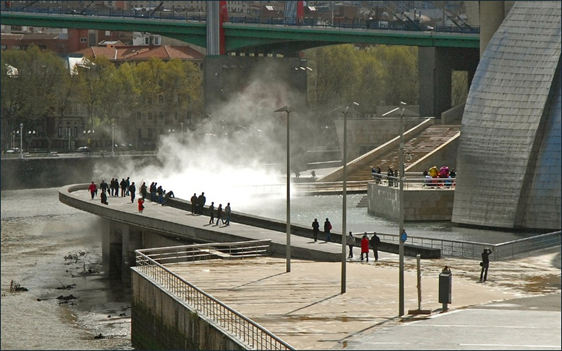
    These are important experiments concerning fog and clouds. Both are aquatic environments that prompt deeper reflection on both nature and our embodied experience within it. This is represented by some recent installations by artists who seek to use fog and clouds as part of a broader aquatic paradigm that highlights not only the corporeal experience of them but also a climatic perspective on the toxicity of fog. The artist Fujiko Nakaya herself fostered an aesthetic experience of fog through the first exhibition of fog sculptures (or cloud sculptures) at the Osaka Expo (Japan) in 1970.

    Fujiko Nakaya’s Fog Sculptures

    By manipulating shapeless materials like water or smoke, and various vaporous elements like clouds, the artist suggests the possibility of transforming these hyperobjects6(that is, realities like clouds that, by their very nature, surpass the capacity for rational knowledge and require a different approach). In this way, through the manipulation of these shapeless objects (fog, water, etc.), the artist manages to create an altered and unconventional experience of the environment. Representing fog and clouds means representing, through art, pollution, toxicity, and their inequalities, reinforced through the hydrological cycle, and highlights a reading of the urgency of the natural-cultural water crisis through completely transformed microclimates. Thinking and immersing oneself in fog and clouds means focusing on the various ways of transformation of water.

    There are many artists (e.g., Emily Parsons-Lord, Olafur Eliasson, and Janet Laurence) who interact and dialogue with water: they interact with vaporous bodies of water in order to create embodied aesthetic experiences. In their artistic expressions, the fog reorients ideas and perceptions. A possible review of the artists is provided by the book Weather as Medium: Toward a Meteorological Art, written by Janine Randerson, in which the author explores a series of meteorological art projects from the 1960s to the present, drawing on sources ranging from dynamical, technological, and physical systems to indigenous cosmology.

    Janet Laurence: Fog-Scapes as a Way to Care for the Environment

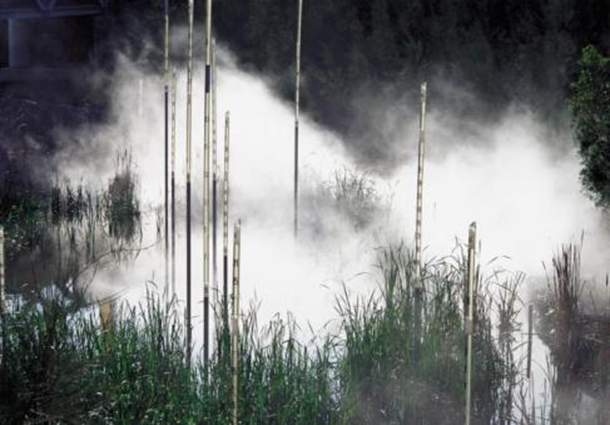
    Another environmental artist who uses fog as an artistic material and as a means to create certain aesthetic experiences is the Australian artist Janet Laurence. Within the Australian art context, Laurence has contributed significantly to the development of eco-aesthetics. An example of this is her famous installation called In The Shadow (2000). This work was commissioned by the Olympic Park, part of Homebush Bay in Sydney, and installed along a stretch of stream crossed by three bridges. In the Shadow responds to the transformation of the site from a contaminated industrial area to a new “green” area.

    The following public artwork aimed to restore natural vegetation to Sydney’s Olympic Park, on Homebush Bay. In addition to extensive planting of native plants, the work included the installation of twenty-one vertical sensors to monitor the chemical composition of the river water. By encouraging the growth of native plants in a suburban area of Sydney, “In the Shadow, oxygenates an otherwise rather sterile area” (Felicity Fenner, Art & Australia, p. 64). According to the scholar Bronwyn Bailey-Charteris:

    Laurence’s work is configured as a nebulous “anti-monument” in that it does not limit itself to satisfying an anthropocentric experience or gaze: the work, on the contrary, regulates and develops a microclimate within the Homebush stream, integrating itself with the local ecology.7

    Through the hydro-artistic method of nebulization, the artist not only conveys a fundamental message—that is, the possibility of going beyond the boundaries of the Anthropocene—but this work also reveals its power to regenerate the environment itself. The artist cares for the damaged environment of Homebush. Her installation is located inside the stream, and precisely because of this positioning, the artwork takes shape and embodies the fog. In this regard, Bronwyn wrote:

    Over time, as the trees grew, the stream became a place of aquatic regeneration. Through the hydro-artistic method of misting, Laurence directs the audience toward the possibility that art can act as a healing and regenerative force in damaged ecosystems.8

    This is an example of what I think of eco-aesthetics: working with art and the environment to care for the environment itself, both from a practical and theoretical point of view. Working with art and the environment to heal the environment itself, both practically and theoretically. The theoretical importance of this curatorial hydro-artistic practice lies in its ability to rewrite concepts of philosophy and aesthetics in terms of a broad, inclusive, and undisciplined theory, dismantling old oppositions (nature/culture, inside/outside, etc.) and providing the possibility of acting by resisting categorizations.

    Head in the Clouds: Conclusion

    “Having head in the clouds” is an everyday expression not to be underestimated. It suggests the possibility of being elsewhere, of being other, of thinking with the clouds. Being in the clouds is a state of dialogue between the elements and the body itself; it also means incarnating oneself in the clouds, surrounded by water in all its forms. Water represents the element through which we manifest ourselves as dynamic and interconnected entities, and constitutes the vital substance of our composition. «Water as body; water as communicator between bodies; water as facilitating bodies into being. Entity, medium, transformative and gestational milieu. All of this enfolded in, seeping from, sustaining and saturating, our bodies of water. “There are tides in the body,” writes Virginia Woolf.9

    It is precisely on this entity that we can begin to construct an aesthetic paradigm with a completely alternative development: a conception of art and the environment that is neither anthropocentric nor phallocentric, but rather watery, destructive, and disorienting. In conclusion, accepting water as fluid and vaporous, that is, not rigidly defined, both in form and meaning, means going beyond the existing categories on which Western thought and culture are built. Breaking with these consolidated paradigms means opening up to new possibilities; for example, we can build alternative methods of doing art by taking care of the environment and its problems.

    References

    [1] Bailey-Charteris, Bronwyn, The Hydrocene: Eco-Aesthetics in the Age of Water, Routledge Environmental Humanities (eds), 2024, p. 78.

    [2] Bailey-Charteris, p. 8.

    [3] Crawford, Donald W., “Nature and Art: Some Dialectical Relationships,” The Journal of Aesthetics and Art Criticism 42, no. 1 (1983): 57.

    [4] Baker, Elizabeth C., “Artworks on the Land,” in Art in the Land: A Critical Anthology of Environmental Art, ed. Alan Sonfist (New York: Dutton, 1983), 83.

    [5] I refer to what scholar Bronwyn Bailey-Charteris writes in the aforementioned book The Hydrocene: Eco-Aesthetics in the Age of Water about aesthetics and its combination with ecology… pp. 6-7.

    [6] Morton, T., Hyperobjects: Philosophy and Ecology after the End of the World, University of Minnesota Press, 2013.

    [7] Bailey-Charteris, The Hydrocene: Eco-Aesthetics in the Age of Water, p. 242.

    [8] Bailey-Charteris, p. 242.

    [9] A. Neimanis, Hydrofeminism: Or, On Becoming a Body of Water, in Undutiful Daughters… Palgrave Macmillan, New York, 2012, p. 87.

  • The Power of Sea Water as an Element of Healing and Connectedness in Caribbean and Diasporic Narratives

    The boundless dimension that characterizes the element of water, as well as the sea itself, cannot be captured in simple terms, but various scholars, authors, and theorists have tried to describe its essence. Whether it is through a tale of travel, war, the conquest of new lands, death, birth and rebirth, or ancestry, the sea is often present as an integral part of a literary work, especially in the Caribbean. And although the historical past can bring pain and suffering, there is also the possibility of moving to new places and experiences while preserving memories of the sea. In “‘I Have Seen the Sea’: Caribbean Aquatic Poetics in Monique Roffey’s The Mermaid of Black Conch,” Leighan Renaud states that water “has been a site of exploration and theorisation for numerous Caribbean thinkers” (1). Dionne Brand describes the sea as overwhelming, as “bigger than feeling’” (1). Because there is an archive of oral histories and stories that circulate around the Caribbean collective like ocean waves, they reach the coast and are retrieved until an author finds or captures them and delivers a compelling version. Three novels by Caribbean authors in which infinite reverence for the sea is expressed are Daughters of the Stone (2009) by Dahlma Llanos-Figueroa, The Mermaid of Black Conch (2022) by Monique Roffey, and Village Weavers (2024) by Myriam J.A. Chancy. Therefore, this paper aims to identify how the sea is represented in Caribbean fiction, particularly as an element of connectedness, ancestral linkage, and a “device” for tracking memory.

    In relation to the immensity of water, it is within this vastness that healing occurs. In this context, healing arises from water’s capacity to enable connection. This connection bridges places that seem distant and divided by the ocean, yet water flows and swirls between them, closing the gaps. To begin with a more scientific approach to the aspects of healing through water, in “The Healing Sea: A Sustainable Coastal Ocean Resource: Thalassotherapy” by Roger H. Charlier and Marie-Claire P. Chaineux, the term thalassotherapy is defined as “a medical approach based on the systematic use of seawater, sea products, shore climate” (3). Thus, healing by saltwater can be identified or traced in the works of Caribbean authors (such as the three selected) whose experiences are unalterably surrounded by this element and who, in one way or another, always return to the sea. Accordingly, the authors of this article take this theme a step further:

    …the use of seawater for therapeutic aims was known in what are contemporary Egypt, France, Italy, and Greece as far back as 3000 BC. Nor was thalassotherapy a stranger in the medical arsenal of classical times. Its knowledge and practice were spread by Celts, Gauls, and especially Romans (Buchet, 1985). Bath, in England (Aquae Sulis in Roman times), got its name from the Romans’ custom. Greeks put considerable faith in the healing power of the sea. Greek poet Euripides (480–460 BC) wrote “The sea restores man’s health.” Greek philosopher Plato (428–437) held that “The sea washes all man’s ailments.” (9)

    The fact that this kind of alternative medicine practice can be defined by a specific term, which can be traced back to its origins, indicates the historical importance of water as a healing element—whether by human instinct, the uncanny feeling of recognition it provides or by discovery and exploration. Water is given the effect of cleansing and renewal, which are attributes that are observed from the element in its natural state.

    Critical and literary analyses of the aforementioned novels include an examination of:  (a) the ocean as both metaphor and body, which can be perceived as a healing and traumatic space; (b) aquatic connections, emphasizing the importance of bodies of water in the literature such as streams, rivers, among others; and (c) hybridities, including archipelagic connections between the texts and the bodies of water they represent. As part of the study, it is important to identify that these texts or narratives become sites of encounter, not containment, and are as fluid as water.

    Through Puerto Rican Generations

    It is precisely this fluidity and contact with the ever-present water that allows novels like Daughters of Stone by the Afro-Puerto Rican author, Dahlma Llanos-Figueroa, and its well-designed web of characters to flourish and nurture their connection to African soil, from the Middle Passage to their new reality in Puerto Rico. In this novel, five generations of women of African descent are woven together to reveal their journey from an enslaved ancestor to a modern-day Afro-Puerto Rican scholar and writer who chooses to become the keeper of her family’s legacy. This constant wandering is characteristic of diasporas, but it is a wandering shared between leaving and returning, suffering and healing, that occurs mostly through their history of forced migration. Nevertheless, the author succeeds in preserving these central female personalities across five generations with great talent and skill in her novel.

    One of the predominant aspects of the storyline is the connection to Oshun, who is culturally referred to as an African mother and goddess. Since Oshun is the goddess of water, this means the contact with the character’s origins is still present through the passage of time and the changes of space, no matter how far they have traveled from their motherland. Llanos mentions: “Mother Oshun, goddess of the river, patron of women, of motherhood, of fertility, had come to her in that dream, leaving strange images, sharp, piercing Fela’s brain—the river flowing backward, the skies opening and crying down on the flaming forest, sparks alighting the village, …” (10-11). These images link the goddess to birth and new beginnings, but also to death and possibly rebirth, since Fela dies while giving birth to her daughter Mati next to a flowing river. The author could have crafted a different scene and access to nature on this occasion, but she instinctively chose flowing water to shower the mother and new life, as a kind of welcoming to the world from their ancestors. Here, water serves as the first bath and “baptism” before Mati takes her first views and experiences of life, while at the same time, her mother’s soul departs from her exhausted body. This image draws attention back to the power of water as an element, since Oshun is basically depicted sitting on a bed of fresh water, opposite and in communion with Yemayá, the goddess of the ocean.

    The soothing mosaic pieces of familiar stories are thus placed together by the first character, Fela, in a matrilineal line that includes five women who are linked by blood, beyond time, place, and circumstance. The stone that Fela carries with her is part of this symbolical, spiritual, and emotional connection to her West African homeland. As with water, when her ancestress Fela first arrived at the shores of the island by sea, it was this vast element that provided access to her lineage. Therefore, the striking differences between the settings and the practices when she arrives in Puerto Rico are not appealing to her, in other words, it is an unknown territory. As the novel evolves, so do the characters. There is Mati—spiritually inclined from an early age; she showed signs of being a healer and was very connected to nature. Interestingly, she also had a connection to water, and the goddess Oshun: “The Lady Oshun spoke about a long-ago village, about Mati’s mother, Fela, and father, Imo, and her grandfather, the keeper of tales. She spoke about the drummers and dancers and the gods and goddesses that ruled life. She told Mati about the ancestors who would always be waiting” (Llanos 67).

    However, because of the connections drawn from a motherland to the receiving country, Carisa, the last daughter born in the novel, embodies the shifting nature of the mixed and evolving generations because she is the child of Elena, who decides to move to the United States and begins the family’s diasporic journey. This move allows Carisa access to quality higher education and literacy, leading her to become a writer and the keeper of their legacy in the future. Later, Carisa crosses the ocean to the African continent and begins her ancestral research in Nigeria. She opens the door to a generation that exists between possibilities. In addition, the aspect of connectedness and access to memory and ancestral knowledge (beyond time and space) is also attributed to water here, as the goddess of water makes this access possible.

    Parallel to this, Carisa does not have a positive experience growing up and expressing her Puerto Rican and African ancestry, symbolized by the sacred stone her ancestors had carried to her. Llanos writes: “I opened one finger at a time to add to the mystery. The students snaked their necks to see what I was holding. Then there it was, the black stone in my hand. ‘Oh, come on!’ ‘Big deal, it’s just a rock.’” (246). All this is also made possible by the presence of the sea. Fela, the first in the bloodline, was part of the enslaved past of the Middle Passage, and she had brought this stone with her in her body, marking an  unbreakable link to Africa that she subsequently left to her newborn daughter after she died from childbirth by the flowing water. Like her predecessors, Carisa finds herself between two spaces: the space of her Puerto Rican identity and the space of her life in New York along with the clash of cultures and people’s perceptions. In this case, the simple stone she holds brings her confidence and symbolizes a whole legacy of female power carried down through the women of her family.

    The Unnatural and the Human Come Together

    In the second novel, The Mermaid of Black Conch, the Trinidadian-born British author, unmistakably opens her book with a kind of prayer to her ancestors, addressed to the deep waters, which sets the tone for the novel and the enigmatic character of Aycayia. The world of this mermaid is intertwined with the human world. She has been exiled from the Black Conch area and has roamed the oceans for years, maintaining her unnatural mermaid state, but is rescued by a man who becomes key to her return to humanity. That comeback is threatened by others who do not understand her or her circumstances. The author begins her acknowledgements with the following words: “for the Goddess, the muse, the legends of the deep you are, to me” (1) for the reader to continue with the mermaid’s journey. This figure is not described as ordinary because, apart from being non-human, with manly features and size, and “fished” from the water, she is also magnetic. This is because she is unknown, different from everyone around her: “The men stared. Everyone felt it, the sadness of her existence, a woman who’d been alone in the sea. Had she jumped from a boat? Had her mother mated with a fish? Every man could feel his heart pounding hard in his chest, with fear and a sense of wonderment, at this half and half” (Roffey 29). Most of the male characters in the novel are  impressed by Aycayia, her top and bottom halves, and crave to find out her secrets. The author masterfully links this magnetism to the mermaid’s being with so much depth that it frightens people, since it can reflect their own souls,  just like the sea. Yet some want to dive into evil and harmful ways, as colonizers and oppressors would in a newly plundered land. But she only gets close to one of them, David, and that is the romance at the heart of the story, as this unifies the sea and land.

    In this designed world, the sea is indeed history, as Derek Walcott’s poem “The Sea is History” (1979) portrays, for it represents all the possibilities that lie within it, connections to the past and the present, and all the extensions that the sea simultaneously has to other realities and places. Roffey wrote:

    She was spitting up seawater, it seemed to be flowing out of her from deep in her gullet. Water seeped from her gills. She was a fish out of water, and yet she wasn’t going to expire like an ordinary fish. She was taking in big fast gulps of air like a thirsty child, trying to stay alive. Her hair was moving, spreading itself across the deck. Numerous pilot fish were dying off around her. She already looked smaller than when she was in the sea. (Roffey 30)

    The power that lies within this mermaid is enhanced by the element of seawater, by her connection to it—with the saltwater scent that she still carries when she sheds her tail and grows back a pair of legs—which is said to be part of a curse that keeps her in the water. Even though Aycayia was human in her past, precisely because of her current state (as mermaid) she knows much about the hidden sea world that lies beneath the surface. Thus, she confidently says, “I have seen the sea,”—denoting the experience of lifetimes, for the sea is boundless and considered limitless, and the mermaid has seen it. Aycayia, as a mermaid, can move through the immeasurable waters of the oceans to different points of the world, and therefore she carries a lot of knowledge within her. She is the link between the sea and land, but also past and future, as well as the known and the unknown.

    Within Connections That Transcend Place and Time

    Connectedness thrives in Village Weavers by Chancy, who is a Haitian-Canadian-American author, when the relationship between the characters Sissi (Simone) and Gertie (Gertrude) transforms and evolves across time, space, and the elements. This novel traces the relationship between two girls from childhood into adulthood, exploring the challenges of a close relationship shaped by life struggles and a family secret that changes its dynamics. In it, water is mentioned repeatedly—as an almost magical element that interweaves memories and time. In other words, their connection is challenged and at the same time maintained in one way or another by water. There is even a moment when Gertie refers to Sissy as her “Simbi”—a Haitian water spirit that appears frequently in the novel. This becomes even clearer when the birds (village weavers) are described as having a deep connection to water, as follows: “It is true that the male birds’ black-hooded heads extend to their chests like the kerchiefs the women wear to shelter themselves, knotted behind their necks, above the shoulders, while the female birds, all of yellow, make her think of Ochún, the maternal sea [sic] goddess” (Chancy 42). The mention of the goddess Oshun (in the corresponding language variation) in this context, and from a Haitian perspective, opens a dimension that suggests how the author has carefully made water an essential element in her designed world.

    Correspondingly, there is the moment when Gertie dreams of flying away like a bird, and plunges into this melancholic, introspective attitude, with “a humming that comes from the water, a lullaby that lulls children to sleep” (Chancy 23), and her eyes search for the birds until she sees the sea. The blackbirds are synonymous with childhood, with simpler times, that is, with memories. Chancy wrote: “She knows them, feels a familiarity that reminds her of childhood. Soon, they swoop together over rivers, following the movement out toward the ocean. But as the city flanked by the sea comes into view, Gertie falters. The other birds fall away, back toward the interior of the island” (23). The birds, who remind her of her childhood, are divided into those that fly out to sea and those that stay on the island—hauntingly representing the people who migrate and remain connected by love and memories.

    Caribbean Waters Linked In Theory

    In the field of theoretical works that assist the boundless dimension of the sea, but from an academic, non-fictional perspective that supports the sense of connectedness of this body of water, there are also Poetics of Relation (1990) by Edouard Glissant, The Repeating Island (1992), Antonio Benítez-Rojo, The Poetics of Space (1958) by Gaston Bachelard and Sea Changes: Historicizing the Ocean (2003) by Bernhard Klein and Gesa Mackenthun. Glissant reveals the persistent and pervasive connection to African ancestry that has permeated the waters of history since the Middle Passage, as in the three novels. Benitez-Rojo invites readers to circulate around the archipelagic tapestry of islands, which are connected not only by water but also by shared experiences, cultures, and peoples. Bachelard describes a space beyond the physical, one that opens to the creator or explorer and is intimate, allowing for a connection to oneself, the spiritual dimension of the person, and, in some cases, ancestral bonds. Klein and Mackenthun gathered various perspectives on the ocean, highlighting its unifying agency through a diverse range of literary works, which also support this research. Freud’s interpretation of the oceanic concept, which extends even beyond the uncanny to the eternal, reveals an unknown aspect of the sea that contains and connects all aspects of life, reflected in the depth and unexplored essence of the ocean.

    In contrast to what the ocean offers in terms of connectedness and continuity, in the first part of his book Civilization and its Discontents (1930), Sigmund Freud explains “oceanic” (the nightmarish term that was borrowed from his friend Rolland in an exchange of letters with him) as “a feeling which he would like to call a sensation of ‘eternity’, a feeling as of something limitless, unbounded—as it were, ‘oceanic’. This feeling, he adds, is a purely subjective fact, not an article of faith; it brings with it no assurance of personal immortality,” (2). In other words, this well-known thinker of the early twentieth century emphasizes this term by highlighting the word “ocean” to denote its vastness,  as used to define something that is considered infinite, but in his words, is uncertain. This is the nature of the sea in the selected literature that sets the tone for the Caribbean waters that are constantly present in the memories, stories, births, deaths and almost every breath of the characters as well as the authors’ thoughts who venture into this reflective fiction.

    The relations that Glissant traces in his book “The Open Boat” reflect this transpiring space in which the enslaved ancestors were practically and unthinkably related to one another because they were in the same “belly of the boat” (as Glissant exposes), in the same womb that carried them to the forced destination, right down to Glissant’s coined term “rhizomatic” roots that grew as a result. In the context of these intertwined reflections of fiction writers and theoretical thinkers, in the article “Notes on The Caribbean Essay from an Archipelagic Perspective (Kamau Brathwaite, Édouard Glissant and Antonio Benítez Rojo),” Florencia Bonfiglio highlights that there is “the production of an essay ‘in a certain kind of way’ that the writers share: an ‘archipelagic’ kind of way in which the recurrence of aquatic metaphor s—a legacy from founders of Caribbeanness like Aimé Césaire—allow writers to inscribe a regional (decolonizing) imprint in postmodern thought” (147). As Glissant emphasizes in his work, this points to a relationship between them as writers or weavers of the Caribbean, which Bonfiglio additionally refers to as a display of cooperation that brings them “together with the imagination of the Caribbean as a ‘common place’” (158).

    Likewise, in reference to Gaston Bachelard, Bonfiglio argues that: “If water, and especially the sea, according to Bachelard’s phenomenology of imagination, is a melancholic element par excellence which incites memory and remembrance, recalling in the Caribbean can in turn lead to re-membering (re-assembling) the archipelagic fragments” (166). This coincides with the statements of other theorists about a space that can transcend its physical form, as in the case of the sea of liquid and flowing “re-membering.” In Poetics of Space, specifically  in chapter eight “Intimate Immensity,” Bachelard establishes the presence of a space that has no boundaries and reveals an intimate aspect like that of the sea since, in most cases where it is mentioned, the character is in deep reflection on life. He illustrates this as follows:

    “Immensity is within ourselves. It is attached to a sort of expansion of being that life curbs and caution arrests, but which starts again when we are alone. As soon as we become motionless, we are elsewhere; we are dreaming in a world that is immense. Indeed, immensity is the movement of motionless man. It is one of the dynamic characteristics of quiet daydreaming” (184).

    In relation to the sea, there is no need to be motionless, because there is movement in the waves, through boats, people walking on the beach, swimming, etc. This motionlessness is more of a necessary inner and individual meditative or contemplative state.

    Just as the meditative state of the mind in solitude and immobility opens a space in which the intimate develops, Bachelard also theorizes that “…it is through their ‘immensity’ that these two kinds of space—the space of intimacy and world space—blend. When human solitude deepens, then the two immensities touch and become identical” (203). This is part of what happens in life with the personal and social dimensions of an individual. Nature is a space that, due to the possibility of relaxation and openness, also enables reflection and connection to the intimate. And one of the manifestations of nature is water, to return to the element of the sea, which can open access to the intimate or inner space that is healing and liberating.

    For Benítez-Rojo, there is an intertwined continuation of everything in The Repeating Island, specifically the islands of the Caribbean, which are part of a “meta-archipelago” that inevitably shares a connection transcending place and time. The reality of the “Caribbean basin,” as he calls the region, makes it easy for Caribbeanness to be reproduced not only on the islands themselves but also outside the region through diasporas that carry these characteristics beyond the shores. As the word suggests, if the subject is an island, there is water and the sea that surrounds it:

    In this (today’s) rereading, I propose, for example, to start with something concrete and easily demonstrated, a geographical fact: that the Antilles are an island bridge connecting, in “another way,” North and South America. This geographical accident gives the entire area, including its continental foci, the character of an archipelago, that is, a discontinuous conjunction (of what?): unstable condensations, turbulences, whirlpools, clumps of bubbles, frayed seaweed, sunken galleons, crashing breakers, flying fish, seagull squawks, downpours, nighttime phosphorescences, eddies and pools, uncertain voyages of signification; in short, a field of observation quite in tune with the objectives of Chaos. (Benítez-Rojo 19)

    For Benítez-Rojo, the island that repeats itself does so in so many aspects that the island eventually disappears in its reproducibility. This relation is also true for some Caribbean music, as he mentions: “The copper, black, and yellow rhythms, if quite different from one another, have something in common: they belong to the Peoples of the Sea” (26). He refers to the Peoples of the Seas as those who marked the repeating islands with their cultures of union and preserved the ancestral knowledge brought to them from the African continent.

    Similarly, in Sea Changes: Historicizing the Ocean, the editors assembled a collection of articles that examine the ocean as more than a vast body of water that serves as source for transportation, food, or separation of parts of the land. In the introduction “The Sea is History,” Walcott emerges as the voice that sets the tone for the book. The editors render tribute to him mentioning that his “poetic metaphor works to restore the sea to the dynamics of the historical process, energizing it for the project of re-imagining, re-writing, and re-membering the past as a complex and polysemic dialogue, a meeting place of different cultures rather than solely the battleground of antagonistic forces” (Klein and Mackenthun 1-2). And as part of this research, a key phrase comes from these lines: “meeting place,” that is, the sea as the link or meeting ground between different peoples who must use or meet by the sea in one way or another.

    However, the Caribbean Sea or Caribbean waters also elicit  references to slavery, oppression, and colonization. As Klein and Mackenthun argue, the sea “has been a site of loss, dispersal, and enforced migration but also of new forms of solidarity and affective kinship, a paradigm of modern capitalism but also of its creative reinterpretation, a figure of death but also of life (2). Yet it is also due to the ocean itself that we go beyond this fact, for water is constantly moving, flowing, and purifying. The process of healing involves a similar movement, a cyclical swirl of renewed water, away from the presumptuous spirit of conquest or taking possession of the greatest space for the sake of power, especially when the element that made it all possible in the first place holds the power, in this case the sea.

    Ultimately, water is essentially as vital as the air people breathe, and this is reflected in literature, not only in poetry and non-fiction, but also in works of fiction. In the Caribbean, particularly in Puerto Rico, Haiti, and Trinidad and Tobago (based on the chosen novels), a region that is surrounded by salt water but also has a great abundance of fresh water, the importance of the sea is emphasized. The healing aspect of water is that it can often wash away pain but also induces acknowledgment or recognition and the process of addressing that pain by bringing it to the surface. In fact, pain and trauma must be recognized because only then can they be released and overcome. In novels such as Daughters of the Stone, The Mermaid of Black Conch,and Village Weavers, healing takes place through connectedness, relationships, love, and support; through connections that transcend time and space in the narratives (similar to the sea), even when the presence and growth of resistance to this notion  beyond borders and separation naturally permeates the idea of what the sea might represent. An important reflection on the significance of the sea, prompted by the reading and analyses of these novels and the theoretical discussions that surround them, reveals a vast collection of connections, memories, and possibilities. Returning to Bonfiglio’s article, where she cites the works of prominent Caribbean writers, theorists, and thinkers, the sea and the waters of the Caribbean take center stage in the narratives. There is an aquatic bond present in many Caribbean literary works, reflecting an undeniable interconnectedness. This is also evident in the region’s hybrid nature, with hybridity appearing in many forms—cultural, racial, and even in its shared waters.


    Madyanis Santiago Díaz was born in Puerto Rico and is currently a Ph.D. candidate in Literatures and Languages of the Caribbean in English at the University of Puerto Rico. She writes primarily fiction that evokes a sense of recognition, to honor the heritage and spirituality of Caribbean ancestors. Her works have appeared in Vernacular: New Connections in Language, Literature, & Culture, Latino Book Review, Wicazo Sa Review, The Puerto Rico Review, La Torre (UPR), The Caribbean Writer (TCW), Siyabonana: The Journal of Africana Studies, The Art of Belonging: Migration, Citizenship and the Caribbean (UNESCO, OBMICA, CARICOM, UWI) and others.

    Works Cited

    Bachelard, Gaston, and Maria Jolas. The Poetics of Space: The Classic Look at How We Experience Intimate Places. Beacon P, 1994.

    Benítez Rojo, Antonio, and James E. Maraniss. The Repeating Island the Caribbean and the

    Postmodern Perspective Antonio Benítez-Rojo. Transl. by James Maraniss. Duke UP,       2006.

    Bonfiglio, Florencia. “Notes On the Caribbean Essay from An Archipelagic Perspective (Kamau

    Brathwaite, Édouard Glissant and Antonio Benítez Rojo).” Caribbean Studies, vol. 43,

    no. 1, 2015, pp. 147–73.

    Brand, Dionne. At the Full and Change of the Moon a Novel Dionne Brand. Grove Press, 2002.

    Chancy, Myriam J. A. Village Weavers: A Novel. Tin House, 2024.

    Charlier, R. and Chaineux, M. “The healing sea: a sustainable coastal ocean resource:

    Thalassotherapy.” Journal of Coastal Research, 25(4), 838–856.

    Freud, Sigmund. “Chapter I.” Civilization and Its Discontents. W.W. Norton & Company, 2010.

    Glissant, Édouard. Poetics of Relation. U of Michigan P, 2010.

    Klein, Bernhard, and Gesa Mackenthun. Sea Changes: Historicizing the Ocean. Routledge,

    2004.

    Llanos-Figueroa, Dahlma. Daughters of the Stone. Published by Dahlma Llanos-Figueroa, 2019.

    Renaud, Leighan. 2025. “‘I Have Seen the Sea’: Caribbean Aquatic Poetics in Monique Roffey’s The Mermaid of Black Conch.” Humanities 14: 154.

    Roffey, Monique. The Mermaid of Black Conch. Alfred A. Knopf, 2022.

  • Commodified and Digital Airscapes: Reflections on sensing and breathing air in the 21st century

    Commodified and Digital Airscapes: Reflections on sensing and breathing air in the 21st century

    The LA fires that wreaked havoc in Hollywood earlier this year were only one instance of many over the past years when wildfires ravaged communities and polluted the air. Apart from catastrophic wildfires, industry and vehicle emissions are sources of pollution many people experience on an everyday basis. With increasing levels of air pollution in the world’s biggest cities, it is perhaps no surprise to see the emergence of commodified and digital air as a new frontier of commodification and extraction: air domes, air purifiers, bottled mountain air, and digital air quality index applications (AQI-apps) are only a few examples of the ways in which society has responded to worsening air quality. But what do these developments mean in terms of the ways we inhabit and sense air?  

    On a smog-infested January day in Beijing, a user on the social media platform Sina Weibo writes: “AQI app shows 400!!! I’m inside with the air purifier on.” In another time and part of the world, in a sweltering June, a Reddit user writes: “The smoke from the wildfires has reached New York. It is apocalyptic outside, and I’m blasting the air purifiers. Feels fine inside.”

    Although the fate of these two social media users with their air purifiers is unknown, we may safely assume they survived the apocalypse, which stands in stark contrast to William Delisle Hay’s science fiction novella, The Doom of the Great City, from 1880.1 Like the apocalyptic scenes described by the social media users’ of today, Hay’s fictional London is covered in a toxic soot blanket. But only a single person survives to tell the tragic story as the rest of Londoners suffocate to death. Needless to say, there are no air quality apps or air purifiers in this fictional London. And if there were – would it have made a difference? Can technology save us from air pollution? Probably not. But it can do a great deal of other things. 

    In fact, these two social media comments exemplify ways in which technological and digital equipment have entered our relationship with the air. Not only that, these devices also have profound effects on how air is experienced. In these short descriptions, the outdoor and indoor air become different entities due to the air purifiers, which create a secluded and, allegedly, pure airscape indoors, as opposed to the apocalyptic scenes outside that are physically sensed and mediated through the AQI-numbers. The notion of airscapes suggests the construction and conceptualizations of different forms of air that we come to inhabit. These airscapes can be conceptualized simply by our sensual understanding of air, the report of others, digital and other types of technical equipment, or a combination of all the above. The question is what happens to our understandings of air when our experiences of air are increasingly mediated by digital devices? 

    Bodily senses and airscapes

    Seventy years before Hay’s novel, the London air is also a topic that vexes Mr. Woodhouse, a character in Jane Austen’s Emma from 1816. When learning about the many colds his eldest daughter and grandchildren have recently experienced, Mr. Woodhouse immediately finds the villain of these ills – the London air. 

    “Nobody is healthy in London, nobody can be. It is a dreadful thing to have you forced to live there! so far off!—and the air so bad!”2  

    In his assessments of the London air, Mr. Woodhouse is not in the wrong. Historical records estimate that the city experienced a rapid worsening of air quality from the beginning of the 19th century, the presumed time frame in which Emma is set.3 Yet, unlike us, Mr. Woodhouse couldn’t know this through sensors, satellite imaging, or AQI-apps, providing the latest updates and forecasts. No, he used his senses or relied on the sensual experiences of others. Presumably agreeing with Mr. Woodhouse’s assessment of the London air, the family doctor has prescribed another type of air as a remedy for the illness-prone family – sea air and its salty winds. In Emma, air is thus categorized as the healthy rural air, the healthy sea air, and the toxic London air, forming airscapes based on bodily and emotional sensations of the air. 

    Skip forward 200 years, and similar airscapes to the ones in Emma are artificially produced for consumption. There are air humidifiers and purifiers simulating sea-air for preserving health; there is bottled mountain air promising the consumer up to 160 breaths of fresh air, and let’s not forget about city air domes – a bubble like, inflatable structure of PVC fabric which pumps air into a designated area, protected from pollutants outside.4 These are artificially created micro-airscapes, presenting a controlled and limited airscape for those who can afford it. Moreover, they are formed regardless of our bodily sensations – they are based on someone else’s definition of air. The bottled air is proclaimed to be fresh and healthy; the air purifiers are certified to create beneficial sea air. In short, these artificial airscapes come with established ideas of air, and they are furthermore part of a larger invisible network of actors and their inbuilt understandings of air; notions which users may come to internalize. 

    Of course, our bodies have not disappeared in the 21st century, nor have they been replaced by technological devices. Indeed, understanding the air through our senses and experiences is not a practice isolated to the 19th century. Timothy Choy describes in his ethnography on contemporary environmentalism in Hong Kong how his interlocutors first and foremost speak of air in terms of feelings, experiences, and health, illustrating the centrality of the body in assessing air: foul air  smells, gives headaches, and irritates lungs. Air also carries other smells: of flowers, sea, autumn, and of afternoon tea in one’s favourite chair – perhaps comforting and healing properties in themselves.5 But in the Anthropocene, the body is a site where the terraforming of our environments by different means, including the employment of technological innovations, is manifested and negotiated.6 And in regard to air, digitally and technologically mediated experiences of air increasingly mix with our bodily perceptions. Simultaneously, this also shapes our conceptions of the environment. 

    Digitally mediated airscapes

    As we are encountering numerical, comparable, commodified, and artificially constructed air, it is not a surprise that our relation to nature has been described as increasingly mediated through digital technologies, influencing our perceptions of the environment and, by extension, our airscapes.7  Research of people’s interaction with AQI-apps in the US and China illustrates how the numbers and the bodily experiences sometimes diverge: the AQI-value proclaims decent air quality, but bodily reactions to the air indicate otherwise, creating confusion around what one experiences.8 This prompts the question of how one combines and makes sense of bodily sensations and the information of AQI-apps?

    The increasingly popular AQI-apps construct airscapes based on air quality scores (AQI-values), and not bodily sensations. Measured levels of nitrogen dioxide, ozone, sulphur dioxide, carbon monoxide, PM2.5 and PM10 generate a particular idea of air as constructed of mainly four gases and two particles deemed adverse to human health9. A specific understanding of air is manifest already in the chosen measured components; air is stripped of smell, sound, breeze, humidity, feelings, and of other scientific gases such as oxygen or carbon dioxide. Furthermore, the AQI-apps rank the best/worst air in the world, blending and connecting geographical areas, or sometimes separating them, based on the AQI-values of different locations. Some days, places like Beijing, New Delhi, Cairo, and Sarajevo share a common airscape, regardless of geographical boundaries, smells, breeze, or memories. Other days, neighbouring cities couldn’t be placed further apart, creating a sense among AQI-app users of air as comparable – a  competitive gaming entity.10

    As digital and artificially produced airscapes increasingly influence our experiences of air, how we live, feel, and create our airscapes emerge as central issues to explore. What kind of airscapes do we inhabit? Who gets to breathe what kind of air, and how is it constructed, simulated, and understood? Instead of succumbing to the dreariness of simulated sea air or caged air domes in lieu of the real air, the notion of airscapes provides a viewpoint from which we can critically ask who gets to breathe and inhabit a certain air and take measures to change the situation. Moreover, while toxins nowadays dominate narratives of air, Emma and Choy’s interlocutors remind us that air is composed of different atmospheric experiences and entities – smells, breeze, memories, power, feelings, and sounds. The multitude of contemporary airscapes can act as sites from which we learn and understand – the broken, the hopeful, the hidden, and not least, our more-than-human relationships. 

    Works cited

    1. Hay, W. D.  The Doom of the Great City. 2025 (1880) West Virginia University Press. ↩︎
    2. Austen, J. Emma. London: Penguin Classics, 2009 (1816) p.129. ↩︎
    3. Ritchie, H. “What the history of London’s air pollution can tell us about the future of today’s growing megacities”. 2017. https://ourworldindata.org/london-air-pollution ↩︎
    4. Li, Y. “Dome sweet dome.” 2014 https://www.globaltimes.cn/content/848220.shtml2014 ↩︎
    5. Choy, T. Ecologies of Comparison: An Ethnography of Endangerment in Hong Kong. Durham, NC: Duke University Press, 2011. ↩︎
    6. Fjalland, E. Terraforming. In Krogh, S. (Ed.) Connectedness: an incomplete encyclopedia of the Anthropocene. Strandberg Publishing, Copenhagen. 2020, pp. 360-363. ↩︎
    7. Goldstein, J., & Nost, E. The nature of data: infrastructures, environments, politics. University of Nebraska Press, 2022. ↩︎
    8. Graminius C., & Haider J. (preprint) Anticipating airpocalypse: air quality apps and implicit modes of anticipatory practices. Futures. https://papers.ssrn.com/sol3/papers.cfm?abstract_id=4952462 ↩︎
    9. Graminius C., & Haider, J. (2018). Air pollution online: Everyday environmental information on the social media site Sina Weibo. Journal of Documentation. 74(4), pp.722-740.
      ↩︎
    10. Ibid. ↩︎

    About the author:
    Carin Graminius is a researcher in environmental communication who received her PhD in Information Studies from Lund University, Sweden, in 2023. Her interdisciplinary research spans the fields of environmental humanities, cultural studies, environmental communication, and sinology, with a particular focus on eco-aesthetics, climate fiction, affect, and practices of anticipation and datafication.

  • Waterwork: The Clash Between Social Rights and Fossil Capitalism in Norwegian Fiction

    by Karl Emil Rosenbæk Reetz

    Norway – a nation where oil production was born at sea – is by far the largest producer of fossil fuels in Europe. The second largest, the UK, is distanced by a factor of 2.3 according to the EIA (disregarding the Eurasian fossil mastodon of Russia).[1] To zoom in on Norway is therefore an obvious way to grab the question of the so-called green transition championed by Western and especially European nations by its horns and scrutinize the black, extractivist foundation on which it often stands. In this sense, the political discourse of sustainability can be boiled down to an unrealisable fantasy of a green transition without real transformation of any sorts. Here, I will show how ‘roustabout narratives’ from Norway – stories depicting the absurdly profitable offshore oil enterprise of this nation – display how the green paradox is closely related to a long socialist history of class struggle and worker rights.

              Focussing on two recent novels, I urent farvann (2020; In Muddy Waters) by Sidsel Mørck and Puslingar (2019; Mannikins) by Atle Berge, I showcase how they register aspects of offshore austerity related to a corporate trend of cutting expenses in a globalised economy. Cutbacks, untrained personnel working at a lower salary, postponements of regular safety reviews, and use of expired equipment as well as other sorts of measures to ‘trim the fat’ and push the limit, constitute what I term a North Sea peripheralisation of safety. In that sense, these Norwegian offshore petrofictions are best understood as additions to a long tradition of fossil fuel working-class literature from the Global North where issues of safety have surfaced repeatedly as a signifier of class struggle.

    “WE RUN A BUSINESS, NOT POLITICS”

    First, let us look at Sidsel Mørck’s novel I urent farvann. In this bildungsroman about social mobility and national oil development, we follow the protagonist Ole Viktor. Ole Viktor is the only child of a working-class family with firm connections to the labour union. In the beginning of the novel, his father works at a steel nail factory and often goes to after-hour meetings in the local trade union. Later, the father works as a roustabout on a drilling rig at the Ekofisk field in the North Sea, and the father’s background as a factory worker hired under collective agreement comes forth again. When he is onshore, he often talks about the ‘wild west’ security issues offshore and about how he and his fellow roustabout Lars are working on unionising the workforce. But before this ambition of oil labour organisation is ever materialised, he is involved in an accident that crushes his right shoulder. Following the accident, he receives some insurance money and then lives the rest of his life on cash benefits provided by the Norwegian state.

              The timespan of the novel – from the late-1960s onwards – corresponds to the development of Norwegian oil, and further, Ole Viktor’s adulthood, growing up to be an oil engineer, is organised as a tour de force through real Norwegian oil developments, incidents, and scandals both domestic and international. Following Ole Victor’s white-collar employments, I urent farvann, however, focusses on the management level rather than that of roustabouts employed on oil platforms. In this way, the novel registers a socioeconomic and cultural move away from a locally oriented working-class perspective to a globalist middle-class stance. In the novel, this shift is furthermore connected to a decreased social-democratic collectivist position replaced by a liberalistic individualised concern about career and self-fulfillment. “We [run] a business, not politics,” Ole Viktor says, whenever there are problems. Societal concerns and moral conundrums are simply outside the scope of multinational oil enterprises in the neoliberal zeitgeist, the novel asserts.

              Furthermore, as Ole Viktor grows up and gets involved in the oil industry as an engineer, his father functions as an idealistic figure calling him up whenever there is an oil-related accident urging Ole Viktor to do something. Invalidated, the father cannot live out his own ambition of unionising the offshore workforce and consequently the burden is put on his son to reform the oil business. Yet, Ole Viktor quickly begins to pivot towards another stance altogether. The father’s class struggle orthodoxy begins to feel burdensome to Ole Viktor and an instance of cultural patricide can be observed in his life choices. Slowly he turns away from the collectivist ideal and towards becoming what he himself terms “a company man” with a conservative, unapologetic slogan of capitalist reality: “That’s how the world is, take it or leave it.”

              The novel is driven forward by exactly this blue-collar/white-collar dichotomy. Central to the plot is the clash within the family constellation of two distinctive perspectives. On the one side; collectivism and social politics, and on the other side; individualism and capitalist necessity. As such, the novel takes shape as a small chamber play between father and son reflecting larger societal alterations in both the labour market and the national debate over the Norwegian offshore oil enterprise.

              I urent farvann is saturated by a defeatist ethos when it comes to believing in changing the oil enterprise substantially. However, this overall tone of capitalist surrender is suddenly upended on the very last pages of the novel. Throughout the novel, Ole Viktor’s daughter Vera has disarmingly been called “Vesla” (meaning ‘the little one’) by both father and grandfather. But now, instigating her own much more outspoken generational rebellion, Vera tells Ole Viktor that she will study “green economics.” With this rebellious choice and some harsh words against her father’s complicity in the emission of greenhouse gasses, Vera seems to personify the environmentalist aura of Greta Thunberg and the green youth movements more generally as she argues for an alternative study of economy. The ideology that has guided Ole Viktor’s life is confronted and his ‘apolitical’ self-image is being revealed as a highly political stance. Still very much in its infancy, then, the novel ends up suggesting that a new world order could be on the rise driven by the next generation. Just as Ole Viktor himself was part of a massive social, economic, cultural, and political transformation in his time.

    RURAL OIL

    Puslingar by Atle Berge is also structured as a bildungsroman following the child Marita from 1980 till 1991. Marita lives with her parents in a rural neighborhood adjacent to the port city of Bergen where the area’s oil-industry is centred. Throughout the novel an identity-conflict between the urban city and the rural surroundings emerges, but the main story of the book concerns the real Norwegian event of the offshore capsizing of the oil platform Alexander L. Kielland (March 27, 1980) and its traumatic influence on Marita’s teenage life. Her father, Jonny, is one of the victims of the accident leaving Marita alone with her mother Astrid. Some years after the accident she is suddenly approached by one of Jonny’s old friends, Trygve, who was with Jonny at Kielland. And with the help of Trygve as well as her bookish classmate called Settembrini, Marita slowly becomes more and more interested in the accident.

              As Marita and Trygve begins to dig deeper into the possible causes of the accident, the novel makes use of the still-existing distrust towards the official inquiries and reports that were made after the accident. The novel is filled with gestures towards these reports’ explanations as well as references to other mysterious circumstances omitted from the inquiries.

               With this general tone of distrust in the activities of the government, the novel registers a dialectic between rural workers and a seemingly clandestine ruling class. There is a visible animosity towards urbanity and all the connotations that go along with it – power, influence, higher education, capital. This dialectic is one of the defining features of fossil fuel working-class literature. Us, the authentic, down-to-earth working-class, versus them, the capitalist vultures who live withdrawn in their mansions and club houses. Consequently, the general tone of the novel is that the ‘strong forces in the society’ are less occupied with figuring out exactly what happened at Kielland then they are with ensuring that the North Sea region’s contribution to the world-systemic business of oil production carries on.

              As Marita continues to question the reports, we also see how she is finally reproached by her mother and her stepfather Einar in this somewhat timid fashion: “Sometimes you just have to let things go. People who don’t manage to forget and move on eventually becomes unbearable to be around” (223). It is okay, it seems, – even expected – to be critical and almost conspiratorial against the urbanites in the abstract, but it is best not to become too concrete in one’s criticism and skepticism. The emphatic conviction of elitist malpractice must not turn into real political agency. The very last page of the novel describes how Marita also draws this conclusion herself as she thinks: “People who can’t manage to forget are unbearable. People want to forget, need to forget, just as the nation needs to forget in order to live with itself” (247). Subtle, Atle Berge is not. The reader is firmly guided to draw a particular conclusion about the sincerity of the official inquiries on Kielland.

              And yet, it is rarely the oil and therefore also the oil-work itself that is being criticised in these roustabout narratives. An affinity towards the oil enterprise seems to linger on in the cultural unconscious as the energy workers can be said to forego their body to keep the nation both powered and proud: Ole Viktor’s father literally sacrifices his arm in the nation’s service. So, while the author of Puslingar has some critical comments on oil production as well as the comprehensive oil culture, it is interesting to note how adamantly the protagonist Marita defends the wonders of oil. Fittingly, the novel ends with her lifelong dream of enrolling as an oil engineer student being realised. For Marita, the problem is not the extraction of oil from the seabed, but the loose regulations and the corporate inclination to cut costs on behalf of the safety protocols.

              Marita is obviously haunted by the tragic loss of her father, yet, growing up in the rural outskirts of Bergen oil still constitutes the best and often only way to realise a prosperous (and aspiring) future. For these rural working-class families, the oil rig is tragic in a double sense then. It is the haunting accident of the past and still the only possible future.

    CONCLUSION

    To conclude, a clear tension is registered in these recent Norwegian roustabout narratives. On the one hand, they expose a neoliberal ideal about cost-efficient fossil fuel enterprises driven without organisationally imposed measures or governmental restrictions. On the other hand, they argue for worker-oriented oversight based on a moral sense of righteousness. Another way to frame this is to say that these working-class oil fictions illustrate an imperfect match between world-systemic fossil capitalism and the Nordic welfare state model.

              When thinking of the historical legacy of Norwegian oil revenue, this internal conflict is perhaps not that surprising. In Norway, a discussion of ownership and control has always been in the foreground. At the beginning of the Norwegian North Sea endeavour, environmental and industrial concerns went hand in hand at the governmental level. In 1971, the Government of Norway decided on ‘ten oil commands’ revolving around the management and control of this burgeoning industrial sector. In the mid-1970s, to avoid what is called the ‘Dutch Disease’ where rapid growth in one sector of the economy causes decline in other sectors and to prevent ecological depletion, the Government furthermore decreed a principle of ‘moderate extraction tempo.’ However, this principle was eventually overhauled by grand expansions to the Norwegian North Sea territory in the late 1980s. And then, the culminating success of developing the oil sector while preventing a sudden decline in other parts of the economy came in 1990 with the construction of a sovereign wealth fund – Statens pensjonsfond utland – internationally known as the Norwegian Oil Fund.

              The unique construction of the Oil Fund works to ensure that the revenue from offshore oil and gas extraction benefits the Norwegian public, but it has not entirely eliminated the tension between oil workers and managers. Thus, core class related questions of who benefits from who, how to secure right and proper distribution of wealth, and how the local and national history of offshore oil is to be told still saturates Norway.

              These contemporary Norwegian roustabout narratives, I argue, invoke a nostalgic longing for a strong welfare system of social security and worker rights – a thus another world possible – while showcasing how the reality of fossil capitalism’s neoliberal search for cost-cuts has played out in recent decades. As such, they extend to the waterscape the tradition of working-class fiction as they register and critically comment upon the offshore perspective of the continuing, deregulated fossil world economy in an era of havocking climate changes.

    Reworked paper presented at the EASCLE Symposium: Sea More Blue: Interdisciplinary Approaches to Blue Ecopoetics, June 17-20, 2024.

    About the author:
    Karl Emil Rosenbæk Reetz, PhD, is a postdoctoral researcher in the Department of Culture and Language at the University of Southern Denmark.


    [1] Visit https://www.eia.gov/international/rankings/world?pa=288&u=2&f=A&v=none&y=01%2F01%2F2022

  • Blossoming Hope in Eco-dystopian times: Deniz Gezgin’s Eyes Wings Flowers Tails

    by Merve Günday

    Deniz Gezgin’s1 poetic novel Eyes Wings Flowers Tails (2023)2 welcomes its readers to a magical realist universe where weird and fantastic characters become the everyday victims of environmental degradation. Though plunged into the darkness of the exploitation of nature, its “[w]orld is more sudden than we fancy it/…crazier and more of it than we think/ incorrigibly plural” (MacNeice 24).

    The novel is set in a dystopian space where ecological balance is shattered and an inexplicable sense of fear looms around. In this setting, winters witness trees with budding branches, new seasons are lived every day, and winds continuously change their direction; everything is in the constant threat of rising water. What is more threatening, plants start to fly, seeds become lighter than ever, birds’ wings get shorter, seas turn into smoke holes while mine workers get poisoned, and following the death of trees even weeds and insects disappear. Moreover, the number of artificial species increases, and natural human-animal-insect subjects are replaced with talking puppets, toy animals, and artificial bees.

    Amidst the chaos of this shattered ecology reverberating with a dystopian sense of fear and anxiety, surprisingly “[a]ll the living beings are on the move, everything is in constant transposition” (Gezgin 13). I suggest that this movement implies in a way that there are still some glitters of hope blossoming despite all the death, sickness, or distress caused by the Anthropocene. 

    Only what Gezgin calls the Randoms (Gelişigüzeller) can cross the boundaries of rationality by slipping into the constant flow of waters and passing through closed roads. Unlike the Anthropos, notoriously intoxicated with the dream of gaining mastery over the nonhuman, the Randoms are not poisoned by this greed. They are not compelled by the linearity of time and they sense time only through light, similar to the way plants do. In the absence of linearity, “the corridors of the wind, water mouths, and gaps” become their homes (Gezgin 14)3. Gezgin doesn’t give a clear depiction of what she means by the Randoms. They address, I would argue, whatever resists the codes of binarism or mathematical formulation.                 

    Inspired by the Randoms, Luçe and Kara, two peripheral characters whose paths cross at the beginning of the novel, resist in this dystopian world.

    Echoing the spirit of the Randoms for regeneration, Luçe, the son of a mine worker named Siti, emerges from the magma of a volcano: sleeping in a cradle made of black ashes, he holds on to life. Similarly to Luçe, Kara is also depicted as a victim of ecological devastation: he is found in the middle of a burnt forest surrounded by ashes. Put in a mental institution together with other marginalized children, Kara is not allowed to get in touch with the outside world. However, unlike the others, he does not bend to the will of those who attempt to silence and tame him but rather confronts what lies beyond the cold walls of the institution. 

    In the midst of the unsettling Gezgin’s scenery where life and death and natural and artificial are difficult to distinguish, it is shown that the world is surrounded by infinite possibilities of liberation. To put it in the words of the narrator,

    “[a]lthough there were no flowers anymore, bees would see petals in the globules and find the nectar in this way…Aren’t globules opened on their own?…Nothing gets lost without leaving a trace…While the Randoms walk around all these traces, they are neither in the past nor in the future. Tails stars bones, lights waters volcanoes, everything is in a constant motion” (Gezgin 39)4.

    Despite the loss of bees and their replacement with artificial ones, there are still some natural bees that can find “eucalyptuses, downy oaks, and cedars in grains” (Gezgin 43)5. Motivated by the constant move of the Randoms, as mentioned earlier, Kara finds in the heavy rain that turns everything into mud an opportunity to create a new narrative: following the deep arcs opened by waters, he finds a road, but he does not falter. Rather, in a state of drowsiness, he finds a breach opened by the constant drops of water and follows Bohemian waxwings into the darkness. 

    Then, at the end of the tunnel, he meets wooden-legged Çilaba and the rock goat Patina who collect seeds from the few spaces remaining still uninvaded by the Anthropos and plant them in sandbags for their preservation. He also meets a puppet named Avel, who comforts Çilaba and Patina away from the harsh reality of the world by singing and playing. With his help, Kara discovers the world of poetry: “Poetry was a seed of transposition and growth sprouting infinite possibilities” (Gezgin 68)6.

    Having encountered such magical characters, Kara reaches the volcano presented at the very beginning of the novel and meets Luçe there. The novel ends with this encounter, implying the beginning of a new phase for both of them: they jump into the volcano crater hand-in-hand and as they pass through, they die into life. 

    In conclusion, despite all the exploitative practices of the Anthropos that erase nature’s blissful melodies, nature is always pregnant with multiple possibilities connecting everything like a rhizome and resisting immobility. As the author puts it in the last lines of the novel: “Wouldn’t the world turn upside down if the living always gathered on the same slope of the same hill?” (Gezgin 95). That’s what the Randoms represent in the novel. Given that the Randoms always find a way to freedom from the tyranny of ecological degradation, I argue that Eyes Wings Flowers Tails make our hopes blossom amidst the darkness of the Anthropocene. What is more important, the human-nonhuman hierarchy is overturned in the novel, as what unlocks the chains of stillness for Kara and Luçe is in fact the nonhuman.

    About the author

    Merve Günday completed her PhD in English Literature at Middle East Technical University (2022) with a thesis entitled “Alternative Subject Positions and Subject-Object Relations in Keats’s Poetry.”

    References

    • Gezgin, Deniz. Eyes Wings Flowers Tails (Gözler Kanatlar Çiçekler Kuyruklar). İstanbul: Can Publishing, 2023.  
    • MacNeice, Louis. “Snow” in Peter McDonald (ed), CollectedPoems: p. 24. London: Faber and Faber, 2007.   

    Footnotes

    1. Gezgin is a graduate of Protohistory and Asia Minor Archeology Departments at Ege University. She made her first entrance into literature with her novel Ahraz, followed by YerKuşAğı and Eyes Wings Flowers Tails.   ↩︎
    2. Gezgin’s novel hasn’t been translated into English yet. The translated sections of the work from Turkish to English belong to me. ↩︎
    3. “Gelişigüzellerin konağı rüzgâr koridorları, su ağızları ve boşluklar” (Gezgin 14).
      ↩︎
    4. “Orada artık hiç çiçek olmadığı halde arılar yuvalarda taç yapraklar görür, nektarları böyle bulurdu…Yuvarlar açılmıyor mu kendiliğinden? …Hiçbir şey iz bırakmadan sönüp gitmiyor…Gelişigüzeller bütün bu izlerin üstünde gezinirken ne geçmişte ne gelecekte. Kuyruklar yıldızlar kemikler, ışıklar sular volkanlar her şey kendi boşluğunda sonsuz hareketli” (Gezgin 39).  
      ↩︎
    5. “(…)zerrelerde okaliptüsleri, tüylü meşeleri ve sedirleri” (Gezgin 43). ↩︎
    6.  “Bir yer değiştirme ve büyüme kozasıydı şiir, sesle örülmüş deriyi soyunurken sonsuzca hareketin uç vermesi” (Gezgin 68). ↩︎
  • Rivers as Emblems of Hope and Resilience: Drowning and Resurfacing in the Ganga

    by Saloni Shokeen

    I still remember the extreme experience of drowning in the Ganga. A few years back, I went up the river with the intention of acquainting myself with rafting. As we got on our rafts, the river appeared to be calm and serene, except for a few rapids that shook the raft with great intensity. We were now moving closer to the end of our route and I was brimming with a sense of achievement and thrill.

    This was our last and most difficult rapid to cross. The waves hit our raft with unimaginable force, which made me lose all control. Within the next few seconds, I was one with the river, and the waves were carrying me from one end to the other. My fate was completely up to the river water now, since I could not anticipate where the waves would eventually take me. Although I was wearing a life jacket, I could have hit large rocks in the river while I was flowing like a leaf on its surface. It was becoming more and more difficult to not let the water suffocate me, I was struggling to keep my face above the surface. During these brief minutes of resistance, I witnessed the evening sun right in the middle of the valleys that surrounded the Ganga. With its low light, the sun was about to disappear into nothingness, and so was I. 

    All I could think of was getting just one more chance to live, and how I would lead a different life from hereon. The life that I had experienced so far flashed before my eyes, and I was filled with remorse for the precious moments wasted. I was not able to accept that this could possibly be the end of my life and this led my body to revolt more strongly. Exhausted, I almost surrendered to the nothingness that lay beneath the river, until a hand pulled me back up on the raft. Gasping for breath, rubbing my eyes in disbelief, I sat in deep quietude watching the river. 

    Over the years, people asked me what changed in my life after this accident, but it is impossible to translate such experiences into words. However, some changes did indeed happen, and they were majorly internal; I became more reflective, hopeful and humble. Moreover, I became grateful for each day of life and I formed a special connection with the Ganga. Instead of getting forever scared by its waters, they started representing immense hope, the place where a new and more conscious life began for me. 

    Meditating upon this incident, I wonder:” What is it about rivers that makes us calm and reflective?”. Standing on the banks of a river, an individual witnesses the unstoppable flow moving. An inevitable parallel that comes to our minds is that of the trajectory of life itself: similar to rivers, human life has to constantly overcome obstacles. The river, like life’s flow, does not stop, irrespective of the magnitude of challenges. In order to reach their destination, streams never stop. The breeze that swiftly moves above the water surface only symbolizes temporary disturbances. The patterns created by the wind are mirages. The human eyes see them appear and disappear every second. Whatever enters into the river surrenders itself to its waters and here it finds the place to express freely. The river water, as it symbolizes fluidity and transitionality, provides a special place for hope in our times. 

    The metaphor of transitoriness associated with rivers goes back to the rhetoric current of Ancient Greek philosophy of the 6th century BC. The following lines from Heraclitus’ works are the most famous today:

    A man cannot step into the same river twice, because it is not the same river, and he is not the same man.

    The two main ideas in Heraclitus’s philosophy are the doctrine of flux and the unity of opposites.  It is difficult to locate the complete body of work where Heraclitus said this sentence, or point to what he exactly meant by those words. Nonetheless, this line greatly influenced thinkers that succeeded Heraclitus, and most of all Plato and Aristotle. Although Heraclitus is considered as a pessimistic philosopher, in my opinion the river could be an emblem of choices and alternatives: by emphasizing the natural flow of the river, Heraclitus describes the succession of momentary situations. If nothing is permanent, the possibility of positive change will always persist. After a steam leaves the river, a new one enters and fills the heart with hope. 

    One could argue that Heraclitus is mourning the instant gone forever and that will never return. That is to say, we can never turn time backwards just as a stream cannot reverse its route. But in the context of human life, it also signifies that opportunities continually arise in our present world. The river, similar to life, unendingly rejuvenates and revitalizes itself. Rather than being remorseful about what is lost forever (if anything really is), can we imagine a scenario where re-entering into the river flow is better than before? In other words, perhaps a new moment was worth the wait and the hope? Especially in a planet that is increasingly threatened by anthropogenic activities, can rivers become embodiments of respite? 

    Across the globe, rivers hold distinct cultural and social value. By virtue of belonging to particular geographies for centuries, rivers greatly influence the language and knowledge systems. Rivers have intricate relationships with human beings, especially those who live in close proximity to them. This is a difficult thing to trace and map out. W.H Herendeen’s essay The Rhetoric of Rivers, analyzes history of river representations in literature and philosophy. Herendeen’s argument is that rivers are the central repository of wisdom for mankind. Rivers evoke a feeling of reflectiveness that leads to meditating upon life. This is intimately tied, Heredeen states, with the geographical and social existence of a river. It embodies the voice(s) of a specific region and informs its people’s identity. A prime example of this is the significance of the Ganga river in Hinduism. The first words that come to one’s mind when the name Ganga is mentioned are purity and liveliness. Apart from the religious associations, the river has an ecologically rich life that we cant see from the surface. Over the years, the Ganga has been represented across Indian literature and films. In the national award winning movie Massan (2015), the Ganga becomes the epitome of hope, depicted through the metaphor of confluence. Ironically, the title Massan, literally translates into “crematorium”, yet the story ends on a hopeful note for the two main characters of the movie Devi and Deepak. 

    Deepak, an engineer in the making, works with his family as they cremate bodies on the banks of the Ganga. In the Hindu tradition, the Ganga is considered to be the ultimate pious place for the rebirth of human life. When cremated on the banks of the Ganga, a soul never ‘dies’. The river waters symbolizes immortality and rejuvenation of the soul. One day, without any prior warning, Deepak receives his girlfriend’s body, which he must cremate. In the same period of time Devi loses her beloved boyfriend, while also being shamed for having an intimate relationship with him outside of marriage. Her entourage, even her father, begins to question her ‘purity’, and the movie portrays the hardships she encounters facing a patriarchal society. The Ganga is a constant part of both their lives. Despite the tragic screenplay, Massan ends on an optimistic note where the audience is left full of hopefulness. In the final scene, Devi and Deepak’s stories come naturally together as two streams flowing in the same direction: they accidentally meet on a boat, as if the river were bringing them together. 

    They will never swim in the same river again, yet the tragic past they have already lived through has come to an end. Nothing could take away their hope, because life’s flow never stops. It might just change its course temporarily. Heraclitus’ lines encapsulate the transitoriness central to human life and have strong echoes in this situation: Deepak, after cremating his past, has to eventually overcome his grief, and so does Devi, for if they had lost all hope they could not meet each other. Massan’s ending, along with Heraclitus’ thinking, could offer us a generative method to think about rivers. 

    Hope is perhaps the rarest emotion to find in our times. Everyday, our anxiety escalates after reading shocking news about climate change and increasing instances of violence worldwide. This pessimism does not let us appreciate the beauty of the present moment, and makes us feel hopeless and lost.

    I would leave you with these questions: is it still possible to feel a glimmer of hope for our future? Moreover, is it possible to gather the courage to welcome change, and believe it doesn’t have to always be negative? Despite the unfortunate scenery, can we really afford to miss the present beauty that surrounds us? 

    About the author: 

    I am Saloni Shokeen, instructor and PhD scholar at SUNY Binghamton. Here at Binghamton I have so far undertaken specialization courses in environmental literature. This is in fact my primary area of research, as I am interested in how different forms of storytelling can enlighten our minds on the subject of climate change. Within the broad field of environment, I am curious about water bodies, and especially in how rivers prefigure literary narratives: along with being a significant resource to any civilization, rivers shape our cultural and personal horizon in various ways. Belonging to specific regional geographies, rivers represent multiple voices at once, enriching our knowledge. While this is one of my major interests, through my research I also look at interspecies, planetary and animal studies. My goal is to find generative and sustainable methods of research that expand our understanding of nature.

    References

    • Herendeen, W. H. “The Rhetoric of Rivers: The River and the Pursuit of Knowledge.” Studies in Philology, vol. 78, no. 2, 1981, pp. 107–27. JSTOR, http://www.jstor.org/stable/4174068. Accessed 10 April 2024.
    • Kirk, G. S. “Natural Change in Heraclitus.” Mind, vol. 60, no. 237, 1951, pp. 35–42. JSTOR, http://www.jstor.org/stable/2251397. Accessed 10 April 2024.
    • Stern, David G. “HERACLITUS’ AND WITTGENSTEIN’S RIVER IMAGES: STEPPING TWICE INTO THE SAME RIVER.” The Monist, vol. 74, no. 4, 1991, pp. 579–604. JSTOR, http://www.jstor.org/stable/27903264. Accessed 10 April 2024.
    • Colvin, Matthew. “Heraclitean Flux and Unity of Opposites in Plato’s ‘Theaetetus’ and ‘Cratylus.’” The Classical Quarterly, vol. 57, no. 2, 2007, pp. 759–69. JSTOR, http://www.jstor.org/stable/27564109. Accessed 10 April 2024.

  • Organic Farming: A Spirit of Ecofeminism in India

    Organic Farming: A Spirit of Ecofeminism in India

    According to the Food and Agriculture Organization (FAO), organic farming is a production management system that is unique and promotes biological cycles, biodiversity, and biological activity in the soil [4]. This is accomplished by using biological, mechanical, and farm-based agronomic approaches while reducing the amount of synthetic farm input from outside sources.

    The primary goal of organic farming is to enhance the interdependent communities of flora, animals, soil, and humans as well as their ability to produce food and maintain their health (Scialabba and Hattam, 2002) [6].

    Origin of Organic Farming in India

    The main historical examples of organic agriculture in India revolve around the following:

    Period/Literature  Description of organic farming
    Ancient periodNeolithic civilizations used this 10,000-year-old tradition, which was also embraced by Mesopotamian and other civilizations like the Hwang-Ho.
    RamayanaDead matter that returns to the earth, such as trash or rotting corpses, is transformed into nutrient-rich material. According to C. Rajagopalachari, it is Mother Earth’s power.
    Mahabharata (5500 BC)There have been references to the celestial cow, Kamadhenu. Its contribution to human existence and function in ensuring soil fertility has been described.
    Arthashastra by Kautilya (300 BC)Refers to various kinds of manure, including oil cakes and animal excrement.
    Brihad-Sanhita by VarahmihirExplains the numerous ways to collect manure and how to choose the right manure for different types of crops.
    Rig-Veda (2500–1500 BC)The Rig Veda 1,161,10 (written between 2500 and 1500 BC) and the Atharva Veda II 8.3 (written around 1000 BC) both provide descriptions of organic farming. In Vrksayurveda, Surpala also makes reference to manure. According to the Sukra, a plant needs water, meat, excrement from cows, goats, and sheep, among other things, to develop healthily (IV, V, 94, 107-112).
    Holy Quran (590 AD)An indication of harvest and recycling is the return of one-third of the portion removed from the soil.

    Source: Bhattacharya and Chakraborty, 2005

    Organic Farming and Indian Women

    In the arena of Indian culture, a woman is particularly called “Prakriti” which in its literal sense means “Nature”[8]. Prakriti is the feminine essence for conservation, development, and being purely ecological. She is also referred to as “Shakti”, who furnishes energy to steer the living system.

    In present times, the organic farming movement has taken the form of a social movement. India, the holder of the oldest agricultural fields in the entire world where agriculture has been practiced for around 10,000 years, has women as the leaders in organic farming [2]. Indian female farmers devote a significant amount of their work hours on farmlands, which is much above than those invested by male farmers. During the sowing and harvesting seasons, women spend 3300 hours on the fields while men do it for 1860 hours [3]. Women’s contribution to nature supports sustainable development and agricultural systems. This hypothesis develops a stronger bond between women and organic farming.

    In the Odagaon region of Nayagarh district, Odisha, an area of 90 acres of degraded forest has been transformed into a forest that provides food for the nearby population. The idea of change was first sown in Sabarmatee’s mind in the 1980s, when she began experimenting with her father on the land for cultivating organic food [5]. Later, when the efforts started to bear fruit, a non-governmental organization called Sambhav was founded. Today, this organization is aimed at promoting ecological conversation, women capacity, and organic farming. Sabarmatee has done a brilliant job of collecting and preserving 800 varieties of seeds of indigenous origin, which have a strong relationship in combating climate change. Greater than 30 varieties of seeds withstood the cyclonic storms between the time periods 2013-2014.

    Rohibai Popre has the face of a leader of the organic farming movement in Maharashtra [9]. Without any formal education, Rohibai has been successful in leading a women-oriented agro-biodiversity initiative. She has cultivated 17 crop varieties on 50 acres of farmland and shares her knowledge with 3,500 farmers. Her seed bank is meant for the conservation of 122 landraces of 32 crop varieties.

    Bibi Kamaljit Kaur made her endeavor in the field of organic products and farming. Around 39% of the soil in Punjab is absolutely degraded owing to over irrigation. In 2019–20 and 2020–21, the use of pesticides was 4995 MT (technical grade) and 5193 MT (technical grade), respectively, in the state of Punjab [1]. With keeping in mind the paramount damage caused to the environment from the aforementioned factor, organic farming being done by Bibi Kamaljit Kaur in Punjab has assisted in breaking the toxic web of inorganic farming based on pesticide and chemical use. After participating in a seminar by the Agriculture Heritage Mission, Bibi Kaur learned about the negative impacts of pesticides on the environment and human health. Soon she got trained and well-informed about organic farming and started to practice the same in her kitchen garden. She had reached farmers from over 20 neighboring villages and imparted knowledge about the deadly consequences of using harmful chemical fertilizers. Inspired by her, the villages of Bhotna, Malliya, and Chughan have undergone a shift towards organic farming. Presently, she has received overwhelming support from 2000 women farmers and runs 2000 organic kitchen gardens.

    Two villages named Damodarpur and Murakhati in the Jhargram district of West Bengal narrate the revolutionary stories of two women organic cultivators.Panchabati BaskeandNirmala Mahato have seeded organic indigenous rice varieties in their individual villages. These women organic farmers are leading movements at the grassroots level. 55 male and 21 female farmers are each associated with them in Damodarpur and Murakhati villages, helping and making each other realize the power of organic agriculture and womanhood [7]. Rice varieties, namely Kalabhat, Sathia, Kerala Sundari, and Mallifullo, are being grown in the district. With time, the number of women organic cultivators has increased to over 4500 in all 5 gram panchayats of Block Nayagram in the district Jhargram. As per Panchabati, they are saving Rs 4000-Rs 5000 per bigha[1] in relation to fertilizers, and there is hardly any difference witnessed in the crop yield. For additional income plates made up of sal leaves are sold by the women supported by the women enterprise Aamon.

    Conclusion

    Organic farming has done the work of improving women’s role in Indian agriculture. The above-listed real-life examples are a clear indication of the same. This process of women’s involvement in organic farming needs to be constantly ameliorated. Active entrepreneurship opportunities, education, social and environmental justice, equity, farming rights, training, and skill development are some of the ways that can assure their vital contribution to organic farming. This must continue.

    References

    1. CONSUMPTION OF CHEMICAL PESTICIDES IN VARIOUS STATES/UTs DURING 2017-18 TO 2021-22. (2022, July 22). Directorate of Plant Protection, Quarantine, and Storage, Ministry of Agriculture and Farmers Welfare, Government of India. https://ppqs.gov.in/statistical-database
    2. Fernandes, S. (2017, June 17). Farming took root in India only 10,000 years ago, study finds. Hindustan Times. https://www.hindustantimes.com/mumbai-news/farming-took-root-in-india-only-10-000-years-ago-study-finds/story znhMgOYjQOWWtgX49PkUsJ.html
    3. Kamdar, B. (n.d.). Women grow as much as 80% of India’s food – but its new farm laws overlook their struggles. The Conversation. https://theconversation.com/women-grow-as-much-as-80-of-indias-food-but-its-new-farm-laws-overlook-their-struggles-155083
    4. Organic Agriculture: What is organic agriculture? (n.d.). https://www.fao.org/organicag/oa-faq/oa-faq1/en/
    5. Padma Shri For Father-Daughter Who Transformed Wasteland Into A Forest. (n.d.). NDTV.com. https://www.ndtv.com/offbeat/padma-shri-for-father-daughter-radha-mohan-and-sabarmatee-who-transformed-wasteland-into-a-forest-2175441
    6. Scialabba, N. & C. Hattam, Eds. (2002). Organic agriculture, environment and food security. Environment and Natural Resources Series. Rome, Food and Agriculture Organization of the United Nations (FAO). (n.d.-b). http://www.sciepub.com/reference/90645
    7. Singh, S. S. (2022, August 21). Women farmers of Bengal’s Jhargram reap fortunes with organic rice. The Hindu. https://www.thehindu.com/news/national/other-states/women-farmers-reap-fortunes-with-organic-indigenous-rice-varieties-in-bengals-jhargram/article65790956.ece
    8. The Incarnate Word. (n.d.). https://incarnateword.in/dict/sans/prakriti-1
    9. Wikipedia contributors. (2022, July 25). Rahibai Soma Popere. Wikipedia. https://en.wikipedia.org/wiki/Rahibai_Soma_Popere

    [1] Bigha is a unit for land measurement in northern India.


    Sonali Sharma is the author of this post.

  • The Eco-Gender Gap: When Sustainability Became a Women’s Issue

    The Eco-Gender Gap: When Sustainability Became a Women’s Issue

    When looking at the faces of the sustainability movement, what do you see? A campaign for environmental justice that is synonymous with names like Jane Goodall, Alexandria Ocasio-Cortez, Greta Thunberg, Autumn Petlier, Vanessa Nakate, and Sylvia Earle. Companies dedicated to sustainability, such as Blueland, Stasher, and Bite are led by Sarah Paiji Yoo, Kat Nouri, and Lindsay McCormick, respectively. Women are the advocates, voices of change, and the ones paving the future.

    This trend is called the eco-gender gap, a term created by British marketing company Mintel to describe the “difference in environmental awareness and eco-friendly behavior between men and women, with men being much less likely to feel connected to these issues than women” (Liddell, 2021). Sustainability has become a women’s issue, and in turn, their responsibility. Much of this plays into gender roles, gender-based personality differences, and marketing, as corporations provide gendered messages about sustainability.

    The authors of “Is Eco-Friendly Unmanly? The Green-Feminine Stereotype and Its Effect on Sustainable Consumption,” published in Journal of Consumer Research in 2016, examined this systemic issue, delving deep into working to find the root cause of why the majority of men will not purchase sustainable products. Their studies asked men and women to designate products as either “green” or “non-green”, “feminine” or “masculine”, to choose a product as “better for the environment” or “better at performing ___”, and to gauge affinity for eco-conscious wording and imagery. Across all metrics, green products almost always equated to femininity and were therefore avoided by men. Associating greenness with femininity may also explain why “women display greater concern and willingness to take action to help the environment… across age groups and countries… in contrast, men litter more, recycle less, have a larger overall carbon footprint, and feel less guilty about living a non-green lifestyle” (Brough et al., 2016). There are larger repercussions of this association, as it “may discourage men from engaging in green behaviors, particularly if they are motivated to maintain a macho image and wish to avoid being stereotyped as feminine” (Brough et al., 2016).

    Men feeling turned away from sustainable products parallels women feeling drawn in. Though women might in part feel inclined to make sustainable choices to enhance their femininity, they also face more “eco-anxiety,” a chronic fear of environmental doom (American Psychological Association). Globally, women are more susceptible to the effects of climate change, despite men causing more environmental damage, from avoiding sustainable practices like recycling or using less electricity where possible to engaging in “petro-masculinity,” a denial-rooted, climate-destructive reaction – from mostly white, politically conservative men –  to the fear of environmental crisis where they choose to consume the most pollutant energy in response to being told to reduce (Nelson, 2020).  Natural disasters disproportionately affect people in poverty, which is often communities of women, children, elderly, and disabled people. Studies have even shown that “gender-based violence, including physical, psychological, and reproductive violence against women, becomes more prevalent after natural disasters, with complex… consequences on health and well-being” (Gloor et al., 2022). Researchers have also seen an uptick in hormonal imbalance disorders such as polycystic ovary syndrome linked to the consumption of endocrine-disrupting microplastics. Microplastics were also just discovered in breast milk (Ragusa et al., 2022). On the consumer side, women are told their bodies are hurting the earth, from cosmetics to menstrual products, and told to make better – often more expensive – choices before it is too late. Perhaps most importantly, women are typically the main caregivers to their children, who will grow up in a polluted world. Creating a better future for their well-being is the most influential drive of them all.

    The first step in closing the eco-gender gap is to normalize men caring about the climate. In the consumer product industry, companies themselves create much of the issue. Women predominantly assume responsibility for purchasing goods for the household, and thus the items are tailored to them. Some of the most prominent sustainable products are for cleaning, cosmetics, clothing, storage, and office supplies, categories falling within a woman’s stereotypical responsibilities. Men can feel uncatered to and simply avoid sustainability for fear of being seen as feminine. This pattern appears repeatedly and ranges from choosing vegan or vegetarian diets to bringing a reusable shopping bag to a store. These trends have been helpful in spreading awareness, but it is crucial that all genders climb aboard.

    The authors of “Is Eco-Friendly Unmanly?…” designed a solution to address the eco-gender gap: explicitly catering eco-conscious services and products to men. In an experiment with two hypothetical conservation nonprofits, one called Friends of Nature with a tree logo (feminine directed) and one called Wilderness Rangers with a wolf logo (masculine directed), it was found that though both nonprofits carried the same values, Wilderness Rangers attracted more men (Brough et al., 2016). Additionally, they found that while Friends of Nature attracted women yet turned men away, men and women were similarly likely to donate to Wilderness Rangers (Brough et al., 2016). If women are not deterred by clear masculine branding, perhaps this is a solution in catering to everyone.

    As we look at sustainability, we must remember that its core value is caring for the earth. In our patriarchal society, women are assigned the role of caregivers, and the idea of sustainability being a “women’s issue” is “already insidious due to the persistent portrayal of women as caregivers – even of the planet” (Abbiss & Hunt, 2020). Men often hold the most power, especially leading companies responsible for pollution. Watching nineteen-year-old Greta Thunberg in a room of older men encapsulates the gender-based power dynamic embedded in environmental dicussion, demostrating “for climate skeptics, it was not [only] the environment that was threatened; it was a certain kind of modern industrial society built and dominated by their form of masculinity” (Abbiss & Hunt, 2020). Women will continue to lead the way and make change, and thankfully, younger generations of men seem more open to sustainable practices as our livelihoods are eminently threatened. While we have many advocates, women are still outnumbered in many spaces where it counts most. Women make up 27% of STEM roles, 29% of corporate senior management roles, and 25% of US congressional roles. It is especially crucial to open more opportunities for women to bring sustainability issues to the forefront and provide the necessary support to create change.

    As the need to live sustainably grows omnipresent, it is important to remember that everyone – regardless of gender – is responsible for working towards a solution. Society needs to move closer to making sustainability a movement everyone feels welcomed, affirmed, and empowered.

    Bibliography

    Ballew, M., Marlon, J., Leiserowitz, A., & Maibach, E. (2018, December 12). Gender

    Differences in Public Understanding of Climate Change. Yale Program on Climate Change Communication. Retrieved October 4, 2022, from https://climatecommunication.yale.edu/publications/gender-differences-in-public-und erstanding-of-climate-change/

    Brough, A. R., Wilkie, J. E., Ma, J., Isaac, M. S., & Gal, D. (2016). Is Eco-Friendly Unmanly? The Green-Feminine Stereotype and its Effect on Sustainable Consumption. Journal of Consumer Research, 43(4), 567–582. https://doi.org/10.1093/jcr/ucw044

    Gloor, J. L., Mestre, E. B., Post, C., & Ruigrok, W. (2022, July 26). We Can’t Fight Climate Change Without Fighting for Gender Equity. Harvard Business Review. Retrieved October 4, 2022, from https://hbr.org/2022/07/we-cant-fight-climate-change-without-fighting-for-gender-eq uity

    Hunt, E., & Abbiss, R. (2020, February 6). The Eco Gender Gap: Why is Saving the Planet Seen as Women’s Work? The Guardian. Retrieved October 4, 2022, from https://www.theguardian.com/environment/2020/feb/06/eco-gender-gap-why-savingplanet-seen-womens-work

    Liddell, A. (2021, May 7). The Eco-Gender Gap. Cherwell. Retrieved October 4, 2022, from https://cherwell.org/2021/05/07/the-eco-gender-gap/

    Mintel Press Team. (2018, July 27). UK Women Try to Live More Ethically Than Men. Mintel. Retrieved October 4, 2022, from https://www.mintel.com/press-centre/social-and-lifestyle/the-eco-gender-gap-71-of-w omen-try-to-live-more-ethically-compared-to-59-of-men

    Nelson, J. (2020). Petro‐Masculinity and Climate Change Denial Among White, Politically Conservative American Males. International Journal of Applied Psychoanalytic Studies, 17(4), 282–295. https://doi.org/10.1002/aps.1638

    Piyatissa, Y. (2021, May 22). What Is The Eco Gender Gap and How Can We Bridge It? IVolunteer International. Retrieved October 4, 2022, from

    Ragusa, A., Notarstefano, V., Svelato, A., Belloni, A., Gioacchini, G., Blondeel, C.,

    Zucchelli, E., De Luca, C., D’Avino, S., Gulotta, A., Carnevali, O., & Giorgini, E.

    (2022, June 30). Raman Microspectroscopy Detection and Characterisation of

    Microplastics in Human Breastmilk. Polymers (Basel). 2022 Jun 30;14(13):2700. doi:

    10.3390/polym14132700. PMID: 35808745; PMCID: PMC9269371. Retrieved

    October 29, 2022, from https://www.ncbi.nlm.nih.gov/pmc/articles/PMC9269371/

    Wallis, J. (2021, July 26). Why Do Women Experience More Eco-Anxiety Than Men? Is There A Sustainability Gender Gap? Retrieved October 4, 2022, from https://www.refinery29.com/en-au/sustainability-gender-gap


    Sophie Bravo is the author of this post.