Category: BLOG

  • The Sea Remembers, the River Haunts: Fluid Archives in Contemporary Hispanic Fiction

    Contemporary crises have made water into a medium through which ecological, political, and social conflicts can be understood. Droughts, pollution, rising sea levels and increasing inequalities in access are just a few of the reasons why water occupies such a central place in environmental politics and ecological imaginaries. Across the Hispanic world, these environmental transformations acquire different meanings according to local ecological, historical, and cultural contexts. While some are linked to pollution and biodiversity loss, others foreground questions of memory, territorial violence, or the relationships between humans and more-than-human worlds.

    It is crucial to highlight that, although water has always been a central motif in art, culture, and literature, contemporary ecological concerns have given these representations a new resonance. Across these literary and artistic imaginaries, water is often a force of agency that connects human and more-than-human bodies across memories, histories, myths, affects, and forms of grief. This relational understanding of water resonates with Astrida Neimanis’s proposition that “we are bodies of water”.[1] According to this cultural theorist, our watery embodiment is characterized by a “constant process of intake, transformation, and exchange,”[2] which suggests that bodies cannot be understood as autonomous or exclusively human entities. Rather, water highlights the porous connections that link human and more-than-human bodies, environments, and ecosystems through ongoing processes of relation and transformation. This approach understands water not only as a material force that maintains the physical links between bodies, territories, and environments, but also as a medium through which memories, histories, affects, and ecological traces circulate across time and space. From this perspective, oceans, rivers, and aquatic bodies appear as fluid archives, which can be understood as dynamic and living spaces where colonial, ecological, and emotional traces are preserved, reactivated, and continuously transformed.

    Different manifestations of such aquatic archives can be found across contemporary Hispanic literature and artistic production. Examples include Rita Indiana’s Tentacle (2018), originally published as La mucama de Omicunlé (2015), Selva Almada’s Not a River (2024), originally published as No es un río (2020), and the aquatic imaginaries and siren-like figures present in Irene Solà’s literary and artistic creations. Although these works emerge from distinct geopolitical and cultural contexts—the Caribbean in Indiana’s case, the Argentine littoral in Almada’s, and the Catalan landscape in Solà’s—they share a common concern with water as a place of memory and relation. In each of these aforementioned works, oceans, rivers, and aquatic beings become active agents through which colonial, ecological, and affective histories are preserved, transmitted, and continually reshaped across interconnected human and more-than-human worlds.

    In Rita Indiana’s polyphonic novel Tentacle, the ocean, water, and aquatic beings occupy the core of the narrative. This centrality is inextricably tied to the insularity of the Dominican Republic, in which water is not just a geographical point but a force that determines space, time and action. Through the novel’s time travels and multiple temporal layers, different aquatic configurations reflect the specific problems associated with water in each historical period. In the seventeenth century, the buccaneers move along the coasts of Hispaniola, and their presence is based on maritime commerce in the ocean. In the twenty-first century, Playa Bo becomes the site of fundraising initiatives aimed at preserving marine life, while events such as the tsunami, the disappearance of marine species, and the contamination of the Atlantic Ocean emphasize the ecological vulnerability of the Caribbean Sea. Finally, the marine anemone is a key figure not only in ontological and epistemological fluidity but also in relationality between human and more-than-human bodies. Water therefore does not play a merely decorative role in the novel. It determines actions, shapes the lives of the characters, and becomes a central character itself: a fluid presence that preserves, transmits, and transforms memories, histories, and epistemologies across time.

    The novel’s non-linear structure, characterized by multiple temporalities and time travel, resonates with Kamau Brathwaite’s concept of tidalectics, which understands Caribbean history as a continuous process of excavation through the movements of the sea. Rather than disappearing, memories and lived experiences circulate across time and space, remaining inscribed in the ocean.[3] From this perspective, Tentacle suggests that contemporary forms of violence constitute a prolongation of those initiated during colonization. The violence associated with evangelization and the transatlantic slave trade extends into the present through new forms of neocolonial domination, political corruption, and environmental exploitation. As discussed in the introduction, environmental degradation has become one of the major challenges of the contemporary world, and  in Indiana’s novel, this is reflected in the ecological catastrophe caused by the contamination of the Atlantic Ocean, which spreads across marine ecosystems as a consequence of the corrupt decisions of the Dominican government.

    Nevertheless, the novel also imagines forms of resistance to these hegemonic structures through the figure of Olokun, the Yoruba deity associated with the depths, mysteries, and transformative power of the ocean. By recovering an Afro-Caribbean spiritual tradition, Olokun reconnects the colonial present with ancestral knowledge that had been marginalized by colonial domination. Together with the sea anemone, this figure further emphasizes the agentive role of the sea, as it is depicted not only as an archive of colonial violence but also as a space of transformation and renewal. Through the initiation of Acilde, one of the novel’s central characters, as Omo Olokun, contact with both Olokun and the anemone grants access to new forms of perception, temporal mobility, and ultimately the possibility of altering the course of history. As the priest explains to Acilde: “Eric te inició y ya sabes que eres el Omo Olokun: el que sabe lo que hay en el fondo del mar (…). Salva el mar…”[4] [“Eric initiated you and now you know that you are Omo Olokun: the one who knows what lies at the bottom of the sea (…). Save the sea…”; the author’s translation]. This encounter not only illustrates the transformative power of the ocean but also brings back the watery relationality discussed earlier. In Stacy Alaimo’s terms, it exemplifies transcorporeality: the material interpenetration of human and more-than-human bodies,[5] through which the sea becomes an active participant in the constitution and transformation of embodied existence. The ocean is then not only a repository of memory but also a means for imagining alternative futures.

    While Rita Indiana situates these fluid archives in the Caribbean Sea, Selva Almada relocates them to the river landscapes of Argentina, where water similarly becomes a living repository of memory, violence, and more-than-human relations. In Not a River, the river functions again as another character whose agency shapes the lives, emotions, and experiences of those who approach it. Whereas Indiana points to the repetition of colonial and neocolonial violence, Almada explores violence against the river by exposing the extractivist logic through which nature is treated as a mere resource. This dynamic is already visible in the opening scene, in which a group of men go fishing. Instead of a harmonious relationship with nature, the episode shows a gratuitous act of domination: the fish is shot with a gun, left to rot and eventually thrown back into the river without ever being eaten. Far from being a simple hunting episode, this scene depicts violence that is no longer connected to subsistence, exposing a relationship with the river based on exploitation rather than coexistence. By doing so, the river becomes a contested territory and, as Almada herself explains, it is represented as a body violated by masculine forms of domination and extractivist violence.[6]

    Here again, Neimanis’s notion of bodies of water provides a useful framework for understanding Almada’s representation of the river as a living body rather than a passive landscape. Such a perspective destabilizes the idea of autonomous and self-contained bodies, emphasizing instead their relational and more-than-human constitution.[7] This relational understanding reaches one of its most powerful expressions in the passage where the narrator insists that “it’s not a river. It’s this river” and, similarly, “it wasn’t a ray. It was that ray.”[8] By rejecting generic categories in favor of singular beings, Almada refuses to reduce the river and its inhabitants to abstract natural resources. Instead, every body acquires its own material presence, history, and agency. The title Not a River therefore acquires a deeper ontological meaning: the novel is not about “the river” as a single, universal entity but about a living body which cannot be divorced from the memories, feelings and more-than-human relationships that are present in it. Consequently, violence against the river affects not only nature but also the human communities that depend on it, highlighting the close relationship between human and more-than-human life.

    It is worth noting that this understanding of interconnectedness and relationality is further reinforced through the fate of one of the novel’s protagonists, Eusebio, who dies in the river. His death, however, does not imply his complete disappearance since his spirit continues to haunt the narrative, suggesting that the past constantly resurfaces and illustrating how the river itself functions as a fluid archive. This particular relationship between death, water, and haunting also reinforces Brathwaite’s tidalectic logic discussed earlier. Once again, the past refuses to disappear and repeatedly resurfaces in the present, underscoring the cyclical circulation of memory, grief, and violence rather than their progression according to linear chronology.  Following this logic, the river becomes more than the site of death. Rather than functioning merely as a setting of loss, it emerges as a material space in which past and present constantly overlap, preventing death from marking a definitive ending. Because Eusebio’s presence never completely disappears, those who remain continue to experience him as part of the river. The past therefore never becomes fully detached from the present. In this sense, the river functions as a fluid archive, not because it simply stores memories, but because it keeps them in circulation and returns them to the world of the living.

    As the previous examples have shown, water functions as an archive of colonial and affective violence in both Rita Indiana’s and Selva Almada’s novels. Irene Solà, however, offers a different perspective by turning towards aquatic female figures whose fluid bodies preserve marginalized forms of knowledge, memory, and expression. In her acclaimed novel When I Sing, Mountains Dance (2022)originally published as Canto jo i la muntanya balla (2019), the polyphony of voices, the coexistence of multiple temporalities, and the constant blurring of boundaries between reality and the supernatural create a profoundly relational narrative. Among the novel’s most compelling liminal figures are the dones d’aigua (“women of water”), mythical female beings from the Catalan tradition associated with rivers and springs. Neither fully human nor entirely supernatural, they break down rigid ontological categories and expand the novel’s polyphony beyond the human. Oscillating between myth, history, and imagination, their presence remains uncertain: some characters claim to have seen them, while others dismiss them as mere legends. They thus exist in the unstable space between memory and oblivion, a tension that is powerfully expressed when one of the characters admits: “Ya no me acuerdo del recuerdo de las mujeres de agua.”[9] [“I no longer remember the memory of the women of water”;the author’s translation]. What is being lost, therefore, is not only the mythical figures themselves but also the collective memory through which they have been transmitted across generations. Nevertheless, despite this apparent process of oblivion, Solà restores narrative agency to the dones d’aigua by allowing them to speak. In doing so, she transforms them into fluid archives through which marginalized voices, submerged histories, and alternative epistemologies continue to circulate despite the threat of disappearance.

    The reflection on aquatic female figures continues in Sirena, the performance created by Irene Solà and performance artist Laia Estruch in 2021, where the relationship between water, voice, and agency occupies a central role. Like the dones d’aigua, sirens have long been represented through patriarchal imaginaries as seductive, dangerous, eroticized, or monstrous beings whose voices were mediated by male narratives rather than belonging to themselves. Drawing on multiple literary traditions—from Homer’s destructive sirens to Andersen’s Little Mermaid, who sacrifices her voice in exchange for a human body—the performance reclaims these hybrid aquatic figures as speaking subjects capable of narrating their own stories. According to Solà and Estruch, the performance investigates the possibilities of the voice travelling within and beyond a body of water, transforming water into a medium through which the voice circulates, resonates, and acquires agency.[10] In this sense, voice itself becomes a form of watery embodiment, allowing these fluid bodies to be read once again through Neimanis’s notion of bodies of water, while simultaneously recalling Haraway’s chthonic and boundary-crossing bodies that destabilize distinctions between human and more-than-human, body and voice, nature and culture.[11] A common thread running through the work of Neimanis and Haraway is the rejection of the logics of autonomy and individualism in favour of relational modes of existence. Both emphasize that beings emerge through their relationships with other bodies, ecosystems, and environments. In this sense, water is not simply a setting but an active agent that, on the one hand, shapes the bodies of these aquatic figures and, on the other, endows them with a voice. The sirens’ voices therefore do not simply cross the boundaries between human and more-than-human or nature and culture; they inhabit these liminal spaces, making them sites where forgotten histories can resurface. Another significant aspect is that rather than functioning merely as mythical creatures, these aquatic bodies become fluid archives of forgotten voices, recovering stories, memories, and forms of knowledge that hegemonic patriarchal discourses have historically silenced.

    This analysis demonstrates that fluid archives do not constitute a single or homogeneous category. Rather, they emerge through multiple aquatic configurations that preserve and reactivate different forms of memory across interconnected human and more-than-human bodies. In Rita Indiana’s Tentacle, the sea functions as an archive of colonial memory, exposing the continuity of colonial violence within contemporary ecological crises. In Selva Almada’s Not a River, the river becomes a haunted archive where grief, absence, and unresolved violence continually resurface. Finally, Irene Solà’s literary and performative creations transform aquatic female figures into archives of silenced voices, recovering forms of knowledge and agency historically marginalized by patriarchal narratives.

    Taken together, these works reveal that water is never merely a setting or a metaphor. Oceans, rivers, and aquatic bodies emerge as active material forces that preserve, transmit, and transform memories, affects, and histories while also reshaping the relationships between bodies, territories, and environments. Rather than proposing a nostalgic return to nature, these authors invite us to rethink ecological crises through relational forms of coexistence, reminding us that environmental violence, colonial histories, and social inequalities are inseparable processes circulating through the same fluid worlds.

    Finally, these fluid archives encourage us to reconsider that water does not simply preserve what has been forgotten; it continuously dissolves the boundaries through which we have traditionally understood memory, bodies, and the more-than-human world. To read water as a fluid archive is therefore not only to rethink memory, but also to recognize an ethical responsibility towards the living worlds whose histories continue to circulate through it. Such an ethical perspective ultimately calls not only for protecting water as an external resource, but also for the recognition that violence against water is inseparable from violence against the interconnected worlds it sustains. It consequently offers a way of understanding water as a relational space of memory, coexistence, and shared responsibility through which alternative forms of knowledge and resistance continue to emerge and circulate.


    [1] Astrida Neimanis, Bodies of Water: Posthuman Feminist Phenomenology, London, Bloomsbury, 2017, 3.

    [2] Ibid.16.

    [3] Kamau Brathwaite, Conversations with Nathaniel Mackey, Rhinebeck, NY, We Press, 1999, 34.

    [4] Rita Indiana, La mucama de Omicunlé, Cáseres, Editorial Periférica, 2015, 133.

    [5] Stacy Alaimo, Bodies of Water. Posthuman Feminist Phenomenology, London, New York, Oxford, New Delhi, Sydney, Bloomsbury Academic, 33.

    [6] María Malusardi, “El río, ese cuerpo avasallado por el machismo. Entrevista a Selva Almada,” Era Verde, April 26, 2022, https://eraverde.com.ar/el-rio-ese-cuerpo-avasallado-por-el-machismo/ (accessed June 25, 2026).

    [7] Neimanis, Bodies of Water, 17.

    [8] Selva Almada, Not a River, Edinburgh, Charco Press, 2024, 76-77.

    [9] Irene Solà, Canto yo y la montaña baila, Barcelona, Anagrama, 2019, 232.

    [10] Palau de la Música Catalana, “Laia Estruch i Irene Solà presenten al Palau de la Música Catalana Sirena, una performance que explora el poder i la flexibilitat de la veu dins l’aigua,” https://www.palaumusica.cat/ca/laia-estruch-i-irene-sola-presenten-al-palau-de-la-musica-catalana-sirena-una-performance-que-explora-el-poder-i-la-flexibilitat-de-la-veu-dins-l-aigua_942290 September 14, 2021, (accessed June 28, 2026).

    [11] Donna J. Haraway, Staying with the Trouble. Making Kin in the Chtulucene, Durham and London, Duke University Press, 2026, 19.


    Bibliography

    ALAIMO, Stacy, Bodies of Water. Posthuman Feminist Phenomenology, London, New York, Oxford, New Delhi, Sydney, Bloomsbury Academic.

    ALMADA, Selva, Not a River, Edinburg, Charco Press, 2024.

    BRATHWAITE, Kamau, Conversations with Nathaniel Mackey, Rhinebeck, NY, We Press, 1999.

    HARAWAY, Donna J., Staying with the Trouble. Making Kin in the Chtulucene, Durham and London, Duke University Press, 2026.

    INDIANA, Rita, La mucama de Omicunlé, Cáseres, Editorial Periférica, 2015.

    MALUSARDI, María, “El río, ese cuerpo avasallado por el machismo. Entrevista a Selva Almada.” Era Verde. April 26, 2020. Accessed June 25, 2026. https://eraverde.com.ar/el-rio-ese-cuerpo-avasallado-por-el-machismo/.

    NEIMANIS, Astrida, Bodies of Water: Posthuman Feminist Phenomenology, London, Bloomsbury, 2017.

    Palau de la Música Catalana. “Laia Estruch i Irene Solà presenten al Palau de la Música Catalana Sirena, una performance que explora el poder i la flexibilitat de la veu dins l’aigua.” September 14, 2021. Accessed June 28, 2026. https://www.palaumusica.cat/ca/laia-estruch-i-irene-sola-presenten-al-palau-de-la-musica-catalana-sirena-una-performance-que-explora-el-poder-i-la-flexibilitat-de-la-veu-dins-l-aigua_942290.

    SOLÀ Irene, Canto yo y la montaña baila, Barcelona, Anagrama, 2019.

    Bio

    Katarzyna SOBONIAK is a PhD candidate in Hispanic Studies at the Université de La Réunion (France). Her research is grounded in ecofeminist and decolonial perspectives and focuses on representations of ecological crises in contemporary Hispanic literature. Her interests center on the analysis of the relationships between body, nature, and power in works by women writers from Spain and Latin America.

  • The Hydrogothic

    The Hydrogothic

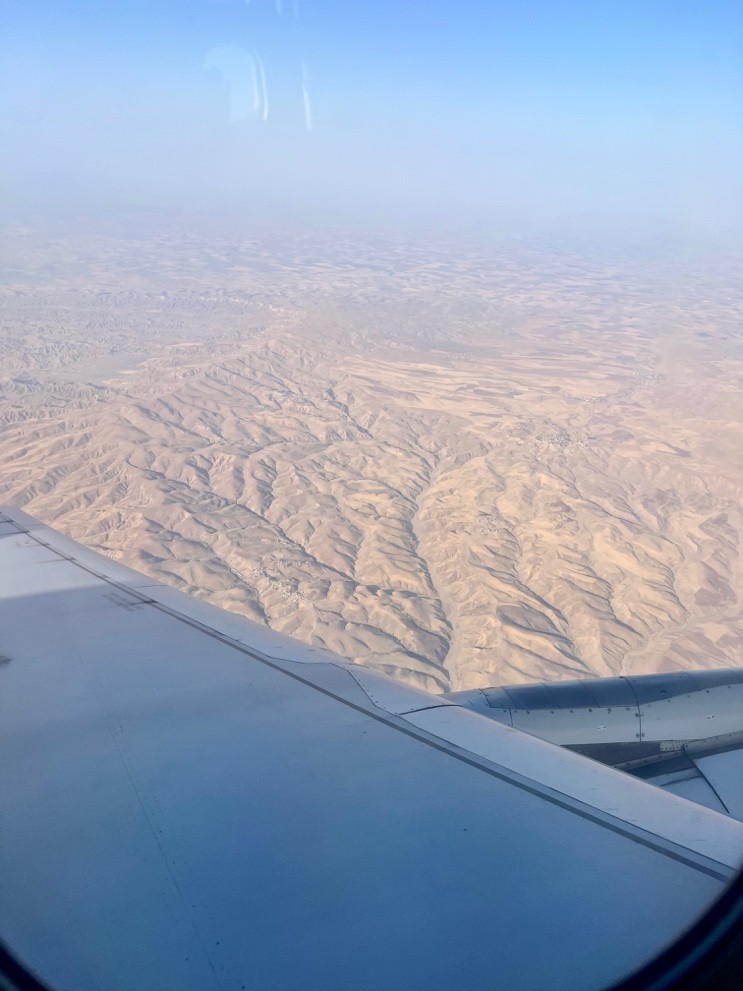
    Featured image: Photo taken from a plane over Erbil, Iraq in August 2025.

    Water has always been a powerful motif in literary and cultural history, but a critical framework of engagement with it as a non-human agent is a relatively recent phenomenon. I come from a region whose very name—Mesopotamia—is defined by two fluvial bodies, along which one of the earliest recorded human civilizations emerged. The growing water crisis in the world has affected Iraq dramatically—alarming footage from the summer of 2025 shows individuals walking across the bed of the Tigris. But being introduced to the field of Blue Humanities in Jena, Germany, opened a new intellectual avenue for me. This “cultural turn to the sea,” as John R. Gillis writes in Humanities, activates the mode of “thinking with water” (Oppermann 2023: 4), allowing for a critical engagement with “today’s ecocatastrophic times” (Mentz 2024: 1), and an exploration of how literary texts, and art more broadly, can meaningfully respond to contemporary ecological concerns.

    This focused lens on water surfaced with the publication of Steve Mentz’s article “Toward a Blue Cultural Studies: The Sea, Maritime Culture, and Early Modern English Literature” (2009) and later more comprehensively in his book An Introduction to the Blue Humanities (2024). Likewise, Serpil Oppermann’s Blue Humanities (2023) encourages us to understand water as a being with agency. Oppermann views waterscapes as sites of unlimited symbolic dimensions and cultural meanings. Employing a “cognitive wet paradigm” (Oppermann 2023: 12), waterscapes, then, can be analyzed through a lens which grants them agency, viewed as ecological systems, cultural spaces, sites of colonial history, engines of globalization, and dynamic environments deeply entangled with human and nonhuman life. On the other hand, remaining unaware, indifferent, and unwilling to rethink this human–water relationship risks perpetuating anthropocentric assumptions and further distancing humans from their entanglement with water, thereby reinforcing the illusion that water exists merely as passive.

    Seen in this context, doom by water is not a myth from ancient history; it shadows the future of human life itself. In contrast to optimistic water discourses like that of American Transcendentalism, for instance, such as the views of Henry David Thoreau and Ralph Waldo Emeron, the framework I introduce redirects positive narratives toward darker, more unsettling dimensions. I merge multiple theoretical approaches—the Blue Humanities, the Gothic, the Ecogothic, and the Nautical Gothic—in order to develop a critical framework I call the Hydrogothic. This framework explores water and adjacent fluids in Gothic modes, arguing that it is water that produces the Gothic effect.

    The Gothic and Water

    It would be a valid question to ask, why the Gothic? As a mode and genre, the Gothic is used as a tool to “write about all sorts of taboos and transgressions” (Hillard 2009: 690), and people get relieved that the dark events do not take place in real life—a false belief because the Gothic reveals real darkness that does happen. Maisha Wester and Xavier Aldana Reyes emphasize that the Gothic is the genre that functions as a critical mode through which the “oppressed and forgotten” (Wester and Reyes 2019: 1) are brought into focus. And in fact, the term ‘Gothic,’ is more a mode than a genre. Tom J. Hillard remarks that it “describ[es] certain aspects of the texts, rather than a discrete category into which these works unerringly fit” (Hillard 2009: 689).

    Throughout history, from the term’s first application to describe Horace Walpole’s novel The Castle of Otranto (1764) in Britain, to its migration across the Atlantic Ocean, the Gothic has demonstrated its remarkable adaptability to shifting historical periods, geographical landscapes, and cultural anxieties. In an American context, specifically, it often expressed cultural fears surrounding the wilderness, westward expansion, the legacies of slavery, and the Civil War. Twentieth-century Gothic shifted its focus to grapple with industrialization, as reflected in John Steinbeck’s The Grapes of Wrath (1939) in which industrial modernity is depicted as an ecological and economic force that transforms land into a site of extraction and renders human life precarious; the First and Second World Wars, as seen in works such as Norman Mailer’s The Naked and the Dead (1948), portraying warfare as a mechanized system of control and exhaustion that reduces human beings’ value; and the Vietnam War, written by authors such as Tim O’Brian who draws on his own experience as a soldier. A key example is his In the Lake of the Woods (1994), which explores trauma, memory, and uncertainty in the aftermath of war. In the twenty-first century, the Gothic continues to adapt, addressing environmental crises, climate change and ecological degradation. The Gothic, like water, resists containment, and slips across human-made borders. As William Hughes remarks: “[the Gothic] has kept it up with times, passing almost effortlessly from romanticism to modernism to postmodernism, and adapting to feminist literature, to queer literature, and even science fiction. It really seems as if nothing can stop it…and why should it stop?” (Hughes 2013: xi).

    As matter of fact, the Gothic has long foregrounded water as an active entity, or at the very least an indispensable element without which the Gothic imagination can scarcely be complete. A case in point is the flood story. In Antiquity, The Epic of Gilgamesh describes a deluge that obliterates humanity and leaves the world drowned and lifeless. In The Bible, before water is positioned as life-giving, the first lines of the Old Testament already describe water in a Gothic mode, declaring that “darkness was upon the face of the deep. And the Spirit of God moved upon the face of the waters” (Gen. 1: 2).

    In the United States, one of the first novels produced in the New World, William Hill Brown’s The Power of Sympathy (1789), is not a Gothic text by classification, yet it nevertheless deploys unsettling water imagery. One instance occurs when a lover in despair throws himself into the river, with the narrator describing the site of his death as “a watery tomb” (Brown 1969: 79). Similarly, Nathaniel Hawthorne’s “The Vision of the Fountain” depicts a crystal spring, also referred to as “the haunted spring” (Hawthorne 1882: 244), which brings the illusion of a nymph-like girl to the narrator.

    The Hydrogothic: Defining a New Framework

    Over the years, several theoretical frameworks have emerged to examine the intersections between nature and the Gothic. In what follows, I briefly outline two relevant and widely discussed approaches upon which I base my term, the Hydrogothic. In 2013, Andrew Smith and William Hughes coined the eponymous term in their edited collection The EcoGothic (2013). This is a sub-genre that explores human fears and anxieties about the natural world, often featuring haunted, decaying, or threatening landscapes to reveal the destructive and precarious relationship between humans and nature. However, while the interconnectedness of humans and the natural world are deconstructed and questioned through the Ecogothic, the term only narrowly touches on water.

    The other term which links nature, and water more specifically, and the Gothic is Emily Elder’s Nautical Gothic. Alder constructs a “lens [that] focuses on how the sea is represented in Gothic literature” (Alder 2017. 1; italics mine). However, Alder’s Nautical Gothic lens is limited. The term ‘nautical’ restricts the analytical lens to narratives of the sea alone, excluding other forms of water such as swamps, rivers, blood, to name a few. In order to extend the focus beyond the sea—an expansion from the nautical to the elemental—it becomes fitting to introduce the lens of the Hydrogothic.

    . . . the Hydrogothic foregrounds water as an agentive element which causes the Gothic effect, and not vice versa. It encompasses all water bodies and forms. It is not only elemental water in its liquid, vaporous, and frozen forms, but also the broader category of fluid substances that are ubiquitous in Gothic narratives, such as blood, poison, venom, tears, marsh, liquor, ink, sap, seepage, ichor, wine, brandy, and coffee. It also extends to the linguistic residues of fluidity embedded in Gothic discourse: verbs and metaphors of flowing, streaming, seeping, or flooding.

    Over the course of approximately half a decade, additional terms have become evident in discussions of water linked to the Gothic. These include Frederick S. Frank’s “aqua-Gothic” (1976) and Coral Ann Howells’ “Maritime Gothic” (2004). Frank’s term refers to the exploration of transcendentalism through the aqua-Gothic (Frank 1976: 85), grounding his concept in Poe’s “A Descent into the Maelström.” This, however, proves untenable, as Poe’s sea writings, and that particular story, do quite the opposite: they dismantle transcendental aspiration and put them in their place. Finally, Howells’ term refers to a regional variant of the Gothic that is shaped by its relationship to the sea and coastal environments, especially within a Canadian context (Howells 2004: xviii).

    Unlike these limited previous terms, the Hydrogothic foregrounds water as an agentive element which causes the Gothic effect, and not vice versa. It encompasses all water bodies and forms. It is not only elemental water in its liquid, vaporous, and frozen forms, but also the broader category of fluid substances that are ubiquitous in Gothic narratives, such as blood, poison, venom, tears, marsh, liquor, ink, sap, seepage, ichor, wine, brandy, and coffee. It also extends to the linguistic residues of fluidity embedded in Gothic discourse: verbs and metaphors of flowing, streaming, seeping, or flooding. Also, idiomatic expressions like ‘in hot water,’ ‘dead in the water,’ ‘to come hell or high water,’ to name just a few.

    Why the term ‘hydro’ instead of, say, ‘aqua’ or ‘blue’? Not only does it refer to the Greek word “water” (Salowey 2021: 72) and the immortal microorganism Hydra (Khokhlov 2014: 153), it also signals the Greek marsh-born monster: Hydra of Lerna. Lerna is a region located on a narrow point between mountains and the sea on the eastern coast of Peloponnesus in Greece. The entrance to the underworld is said to be situated through Alcyonian Lake nearby. Whoever attempts to cross its seemingly-calm waters will be swallowed. Possessing a myriad of “snake heads” (Salowey 2021: 73) and poisonous blood coursing through her body, the Hydra has a famous regenerative ability: if a head is cut off, more would “grow back in place of the one” (ibid. 74). Its final head, immortal, was allegedly buried by Heracles under a rock—and legend persists that it still exists somewhere in Greece. The refusal of death is a prominent Gothic trope, one with which the legend of the Hydra closely aligns. Diffusing the framework with non-aqueous Gothic liquid, Heracles dips his arrows in the Hydra’s venom as her “vapors wriggle […] through the waters of the marsh away from the corpse” (R. Waterfield and K. Waterfield 2012: 146).

    The Hydra’s symbolic potential exceeds water as a pure substance as it no longer refers to merely H₂O. Alluding to death and immortality, it denotes decay, contamination, and persistence—liquid matter that cannot be contained or resolved. The Hydra then embodies a wet ontology in which liquidity is agentive and threatening, capable of sustaining life only by entwining it with unease and malaise. Likewise, the Hydrogothic functions as a medium of transformation: it destabilizes boundaries between human and nonhuman, body and landscape, life and death. It insists on liquid’s agency, its capacity to unsettle anthropocentric knowledge systems, and its power to induce Gothic horror precisely through its interconnectedness and unpredictability.

    In this respect, I argue that the Hydrogothic anticipates contemporary ecological thought about planetary change, revealing how Gothic narratives long recognized the impossibility of human mastery over the wet matter. Through the Hydrogothic, water’s numerous aggregates become the medium through which human fragility is exposed, and it enables close examination of its ambiguous and foreboding qualities as a non-human agent of uncertainty, disruption, and destabilization of anthropocentric epistemologies. The Hydrogothic imagines a world in which the nonhuman entity relentlessly resurfaces, reclaims, and reconfigures, where humans realize their fragility. If plants, organisms that wilt and die without water, are able to decenter human-centered ego as suggested by Dawn Keetley (Keetley 2017: 1), then how much more water itself?

    The Substantiation of the Hydrogothic in Edgar Allan Poe

    I define and substantiate the Hydrogothic by applying it to Edgar Allan Poe specifically for a few reasons. First, in my opinion, he is a highly suitable American author to elucidate present water anxieties, one whose work remains catalytic and influential across the globe. Second, Poe is the author who “gave a face to American Gothic” (Keetley and Sivils 2018: 98), and is considered to be the “Father of the American Gothic” (Pagan 2019). Third, despite being “one of the inventors of the sea Gothic” (Crow 2009: 38) where water “saturates the pages of [his] texts” (Keetley and Sivils 2018: 98), his oeuvre is often overlooked in the Blue Humanities conversations, even though his work predates the environmental and water-focused literature that contemporary scholarship tends to emphasize.

    When considering Poe’s oeuvre, there are numerous texts wherein water manifests as an agent in Gothic contexts. One of the first texts that comes to mind is “The Fall of the House of Usher” (1839). Frequently analyzed, say, for its artistic strategy, motifs of duplication, or its engagement with phrenological discourse, the tale’s central elemental component—the tarn—has received remarkably little critical attention, despite bookending the entire narrative from its opening to its tragic conclusion. From the story’s opening, the narrative is saturated with aquatic foreboding—almost like doomsday by water. The phrase “the clouds hung oppressively low in the heavens” (Poe 2011: 195) give clouds agency from the start and evokes a sense of imminent inundation, as if the sky itself threatens to collapse with water.

    Before even entering the house, and as the narrator looks down within this moraine-encircled body of water, it produces a powerful effect on him which he phrases as “a shudder more thrilling than before” (Poe 2011: 196). This highlights that before any event takes place, Poe centers the tarn as an agentic water body that induces disturbance within the human subject. In the same manner, the Hydrogothic has already claimed the Usher house and the people living in it, Roderick Usher and Lady Madeline, as the adjacent tarn’s rancid air slowly consumes them and the architecture. While Roderick Usher is steadily claimed by the water body that even his hair begins to float, the atmosphere inside is thick and a fissure runs down its exterior, Lady Madeline is marked by blood. In fact, she is connected with wine imagery: another Hydrogothic element. Wine bears a visual and symbolic resemblance to blood, and Lady Madeline—blood-covered and entombed beneath the house—becomes a figure of fermented excess, sealed away only to return eventually with catastrophic force.

    Therefore, the Hydrogothic reconfigures water from a passive backdrop into an active, agentic force that demands a reconsideration of human responsibility within ecological systems. 

    As the story develops, every water-related force assumes a more radical agency. For instance, a tempest rises as the narrator reads a romance to the narrator. Eventually, the storm, the tarn, and the moon—all water-related entities—coalesce into collapsing and volatile agentic network that, through the mediating force of the tarn, dismantles the Usher estate. Although static and seemingly insignificant, the tarn functions like an ontological solvent, gradually destabilizing the house before vocally devouring the house and the last of the family’s bloodline.

    Therefore, the Hydrogothic reconfigures water from a passive backdrop into an active, agentic force that demands a reconsideration of human responsibility within ecological systems. It disrupts anthropocentric hierarchies that position humans as external observers of nature, and at the same time, it insists on relationality: humans are always already immersed within aqueous systems that shape, sustain, and ultimately exceed them. In this sense, the Hydrogothic contributes to an ethical reorientation toward more-than-human worlds by rendering visible the consequences of ecological disregard—whether in the form of flooding, drought, contamination, or submersion—as expressions of a dynamic and responsive environment. This lens underscores the necessity of thinking with water in its darker tropes, encouraging an attentiveness to its eerie, unsettling, and Gothic manifestations.

    References

    Alder, Emily. “Through Oceans Darkly: Sea Literature and the Nautical Gothic.” Gothic Studies, 19: 2, (2017), 1–11.

    Bible, The. “Genesis.” Holy Bible: Pure Cambridge Edition. Australia: Waking Lion Press, 2016, 1–42.

    Brown, William Hill. The Power of Sympathy. 1789. Edited by William S. Kable. Ohio, USA: Ohio State University Press, 1969.

    Crow, Charles L. American Gothic. Cardiff, UK: University of Wales Press, 2009.

    Frank, Frederick S. “The Aqua-Gothic Voyage of ‘a Descent into the Maelstorm.’ Transcendental Quarterly 29: 1, (1976), 85–92.

    Gillis, John R. ‘The Blue Humanities.’ The National Endowment for the Humanities, 2013. Online at: www.neh.gov/humanities/2013/mayjune/feature/the-blue-humanities (accessed 10 May 2026).

    Hawthorne, Nathaniel. The Complete Works of Nathaniel Hawthorne, with Introductory Notes by George Parsons Lathrop. Cambridge, UK: The Riverside Press, 1887.

    Hillard, Tom J. ““Deep into That Darkness Peering”: An Essay on Gothic Nature.” Interdisciplinary Studies in Literature and Environment 16: 4, 2009, 685–695.

    Howells, Coral Ann. Where Are the Voices Coming From? Canadian Culture and the Legacies of History. Amsterdam, the Netherlands: Rodopi, 2004.

    Hughes, William. Historical Dictionary of Gothic Literature. Maryland, USA: Scarecrow Press, 2013.

    Keetley, Dawn. “Introduction: Six Theses on Plant Horror; Or, Why Are Plants Horrifying?” Plant Horror: Approaches to the Monstrous Vegetal in Fiction and Film, edited by Dawn Keetley and Angela Tenga. London, UK: Palgrave Macmillan, 2017, 1–31.

    Keetley, Dawn, and Matthew Wynn Sivils. Ecogothic in Nineteenth-Century American Literature. New York, USA: Routledge, 2018.

    Khokhlov, A.N. “On the Immortal Hydra. Again.” Moscow University Biological Sciences Bulletin 69: 4, (2014), 153–157.

    Mentz, Steve. An Introduction to the Blue Humanities. New York, USA: Taylor & Francis, 2023.

    Oppermann, Serpil. Blue Humanities. Cambridge, UK: Cambridge University Press, 2023.

    Pagan, Amanda. “Where to Start with Edgar Allan Poe.” The New York Public Library, 2019. Online at: www.nypl.org/blog/2019/01/18/where-start-edgar-allan-poe (accessed 11 May 2026).

    Poe, Edgar Allan. “The Fall of the House of Usher.” Edgar Allan Poe: Collected Works, edited by Adrienne J. Odasso. San Diego, USA: Canterbury Classics, 2011, 195–207.

    Salowey, Christina. “Labor II: The Lernean Hydra.” The Oxford Handbook of Heracles, edited by Daniel Ogden. Oxford, UK: Oxford University Press, 2021, 71–85.

    Smith, Andrew, and William Hughes. EcoGothic. Manchester, UK: Manchester University Press, 2013.

    Walpole, Horace. The Castle of Otranto. 2001. London, UK: Penguin Books, 1764.

    Waterfield, Robin, and Kathryn Waterfield. The Greek Myths: Stories of the Greek Gods and Heroes Vividly Retold. New York, USA: Quercus Publishing, 2012.

    Wester, Maisha, and Xavier Aldana Reyes. Twenty-First-Century Gothic. Edinburgh, UK: Edinburgh University Press, 2019.

    About the Author

    Jarjis Jarjis is a Master’s student at the department of English and American Studies at Friedrich Schiller University Jena, Germany. He is also a Research Assistant at the chair of North American Literature under Prof. Dr. Caroline Rosenthal. Recently, he submitted his Master’s thesis entitled “Hydrogothic: Edgar Allan Poe through a Blue Humanities Lens,” and received perfect marks for it. Coming from Iraq, one of the most water-stressed countries in the world, where water scarcity continues to intensify, and now living in close proximity to the Saale River in Germany, Jarjis has developed a deeply personal and intellectual relationship with water. Beyond his Master’s thesis, Jarjis seeks to make scholarly and artistic contributions to the field of Blue Humanities.

  • Eco-Aesthetics: A Framework of Watery Bodies and Fog-Scapes in Art

    Eco-Aesthetics: A Framework of Watery Bodies and Fog-Scapes in Art

    Water, Bodies, and Environment Aesthetics

    Water, besides being a central element of the environmental crisis, plays a profoundly symbolic and political role within contemporary societies. It is at the heart of numerous social struggles, embodying the demands of environmentalists, trade unions, and workers who oppose its privatization. The defense of water as a common and public good serves as a bulwark against the risk of amplifying social inequalities, especially in times of environmental crisis, when equitable access to water becomes a matter of justice and collective survival. In this context, water takes on the value of a symbol of resistance and solidarity, evoking movements fighting for environmental and social justice, for vital resources, and for the protection of the most vulnerable communities.

    However, the importance of water as a political and philosophical element is not limited to its social and political value; it is also a necessary presence within our bodies, permeating them, nourishing them, and defining their very essence. According to hydrofeminist perspectives and recent eco-aesthetic reflections, water is the original fluid matter from which we are composed, a substance that connects us to the natural world and at the same time reminds us of our vulnerability and our capacity to be part of a larger, more boundless whole. In this sense, water is not merely a physical substance, or corporeal “substance”, but becomes an element of identity, capable of shaping the way we perceive ourselves and our relationships with the environment. Its presence, both in the social and biological dimensions, pushes us to rethink artistic, curatorial, and philosophical practices, inviting us to recognize its transformative power in the construction of new, more inclusive and fluid imaginaries, capable of embracing the plurality of identities and experiences. The possibility of being “bodies made of water” allows the bodies themselves to assume a non-fixed, but continually changing, status. It is precisely this fluidity that the performing arts, land art, and philosophical aesthetics in general should also refer to, in order to cast our gaze toward new theoretical and practical horizons.

    A fundamental reference for creating a new horizon for environmental philosophy (especially for the aesthetics of landscape and environment) can be found in the words of the scholar Bronwyn Bailey-Charteris, when—in the book The Hydrocene: Eco-Aesthetics in the Age of Water (2024)—she writes about the importance of water as an element and the new Hydrocene paradigm:

    Water is a central figure of the current climate crisis: through sea-level risings, acidified oceans, extreme droughts and floods, polluted waterways and a lack of drinking water, the planet faces more and more extreme climate chaos dominated by water-related problems. Simultaneously a new wave of artistic water work has begun reconfiguring imagination where nature and culture inescapably meet and mingle; art is going into the blue. These works offer a model that considers the contemporary context of the climate crisis in ecoaesthetics. With the curatorial theory of the Hydrocene, this tide of artistic practices is shared and celebrated, and by thinking through the curatorial, recognised as a potential means of planetary caretaking.1

    The scholar repeatedly describes, for the first time, an aesthetic paradigm (comprising artworks, curatorial techniques, performing arts, and eco-aesthetics) linked to the climate crisis and environmental issues, with a focus on water. Once again, in her book The Hydrocene: Eco-Aesthetics in the Age of Water, she writes:

    The Hydrocene is a wet ontological shift in eco-aesthetics which redefines our approach to water, transcending anthropocentric, neo-colonial and environmentally destructive ways of relating to water. By engaging hydrofeminist, care-based and planetary thinking, The Hydrocene learns from the knowledge and agency of water itself within the tide of art going into the blue. The Hydrocene articulates and embodies the distinctive ways contemporary artists relate and engage with water, offering valuable lessons towards climate action.2

    The concept of the “Hydrocene” introduces new ways of making art, curating art, and decolonizing certain forms and narratives of art. In fact, it’s not the first time in the history of art and aesthetics that the question of how to address the climate crisis and how to represent socio-environmental concerns through art has been raised. One such approach is so-called land art, an artistic practice that centers on the nature-human dichotomy, seeking to artistically represent ecological and environmental challenges. There are even critical scholars like Crawford and Baker who affirm other intentions of doing environmental and land art. For example, Donald Crawford maintains that many environmental artworks are aesthetic affronts to nature by “forcibly assert[ing] their artifactuality over against nature” (Crawford 1983, 57)3, and Elisabeth Baker maintains that earthworks, as stages of an artistic pilgrimage, indirectly exercise a “preservational effect” on the territory even though they are not forms of “ecological art” (Baker 1983, 83).4 The fact remains that land art can be considered as a first effort, even theorized in the aesthetics of landscape and the environment, to conceive of art concerns that could be considered more ethical than aesthetic. Land art and environmental art focus the “aesthetic attention” on the climate, but in which ways? Through what theoretical paradigms and philosophical categories?

    I think art can be a valid medium through which to discuss current issues, including climate, environmental, and gender. To do so, however, it’s not enough to philosophically position oneself within the Anthropocene paradigm and argue that humanity’s impact on the environment is devastating, attempting to challenge the nature/culture dichotomy. This is insufficient for an aesthetic theory of the environment that seeks to address environmental discourse in all its facets. Indeed, placing oneself within the neologism of the Anthropocene means reiterating a series of problems and cultural biases that are believed to be overcome but are in reality ever-present. The concept of the Anthropocene doesn’t help us move beyond the nature/culture category, it doesn’t encourage us to listen to different, alternative theories, it doesn’t create dialogues with different cultures, it doesn’t consider other types of relationships that the environment creates and that are created with the environment itself. For these reasons, we will analyze public works of art such as the fog-scapes of Fujiko Nakaya and Janet Laurence, which express aesthetic and environmental issues through the fog. Therefore, to validate aesthetic discourse, we need to broaden the conceptual field and observe other ways of experiencing the environment, the identities that form within it, and the possibility of perceiving it in its multiplicity, contamination, and fluidity.

    The Hydrocene and the Reshaping of Eco-aesthetics

    One way to do justice both to aesthetics as an artistic practice and as a philosophical field that deals with art, the environment, and landscape, and to the plurality of identities, ways of being, and ways of being in the world, is provided by the concept of the Hydrocene. The book The Hydrocene: Eco-Aesthetics in the Age of Water, written by scholar Bronwyn Bailey-Charteris, is an initial introduction to environmental aesthetic discourse that breaks with anthropocentric and exceptionalist narratives and instead engages with the philosophical paradigm of hydrofeminism, ecology, and alternatives. Through the concept of the Hydrocene—which does not concern the geographical era as such but describes a conceptual path alternative to dominant narratives—we can investigate the performing arts, a new “environmental art”, and philosophical aesthetics starting from porous and fluid, aqueous bodies.

    Constable’s Cloud Studies

    If land art has always been based on a terrestrial matrix, probably now is the time to change and create a type of art that also works with other elements of the planet, such as air, water, fog, and everything that remains outside the exclusive aesthetic intervention on landscape. We could first begin by rethinking the term land art, which at this point no longer seems to be an appropriate term to express aesthetic practices involving all the atmospheric elements of the environment. To describe this kind of art that takes into consideration other elements than the land, we can use the term “environmental art”. If we think of the natural environment, we quickly understand that it is made up of “land”, but the environment we observe and perceive is not only made up of this terrestrial element.

    Already in the 19th century, John Constable, a landscape artist, claimed that the sky and atmospheric phenomena were also an important part of nature, which needed to be studied scientifically and represented. On these premises, he created a cycle of works of art called Cloud Studies (1821-1822) that focused on the scientific recording of meteorological phenomena. He painted the clouds, and on the back of his canvas, he wrote down the date, the day, and data regarding the wind and the temperature.

    From that 19th-century artistic experience, we can already understand the desire to broaden the horizons of the concept of environment, starting from the various natural elements that are often overlooked. In that case, the air takes on an important aesthetic status, and with it the rain and various atmospheric events. Today, we have various artistic practices that use water in all its forms: fog, ice, and liquid—elements of the environment (natural and urban) that require a new connotation, gathered under the name of eco-aesthetic practices.5

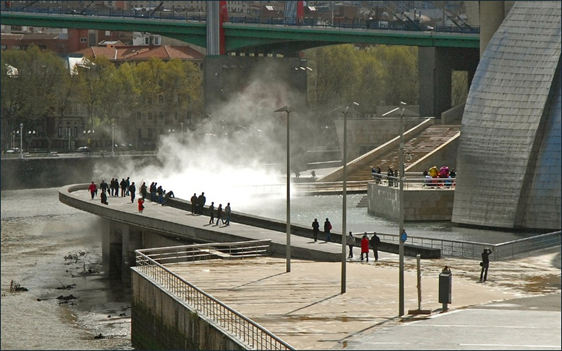
    These are important experiments concerning fog and clouds. Both are aquatic environments that prompt deeper reflection on both nature and our embodied experience within it. This is represented by some recent installations by artists who seek to use fog and clouds as part of a broader aquatic paradigm that highlights not only the corporeal experience of them but also a climatic perspective on the toxicity of fog. The artist Fujiko Nakaya herself fostered an aesthetic experience of fog through the first exhibition of fog sculptures (or cloud sculptures) at the Osaka Expo (Japan) in 1970.

    Fujiko Nakaya’s Fog Sculptures

    By manipulating shapeless materials like water or smoke, and various vaporous elements like clouds, the artist suggests the possibility of transforming these hyperobjects6(that is, realities like clouds that, by their very nature, surpass the capacity for rational knowledge and require a different approach). In this way, through the manipulation of these shapeless objects (fog, water, etc.), the artist manages to create an altered and unconventional experience of the environment. Representing fog and clouds means representing, through art, pollution, toxicity, and their inequalities, reinforced through the hydrological cycle, and highlights a reading of the urgency of the natural-cultural water crisis through completely transformed microclimates. Thinking and immersing oneself in fog and clouds means focusing on the various ways of transformation of water.

    There are many artists (e.g., Emily Parsons-Lord, Olafur Eliasson, and Janet Laurence) who interact and dialogue with water: they interact with vaporous bodies of water in order to create embodied aesthetic experiences. In their artistic expressions, the fog reorients ideas and perceptions. A possible review of the artists is provided by the book Weather as Medium: Toward a Meteorological Art, written by Janine Randerson, in which the author explores a series of meteorological art projects from the 1960s to the present, drawing on sources ranging from dynamical, technological, and physical systems to indigenous cosmology.

    Janet Laurence: Fog-Scapes as a Way to Care for the Environment

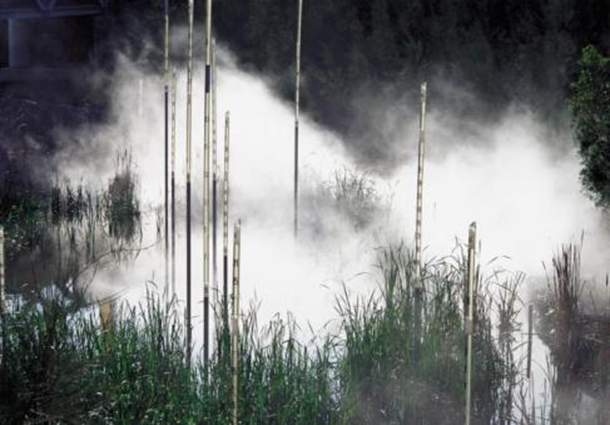
    Another environmental artist who uses fog as an artistic material and as a means to create certain aesthetic experiences is the Australian artist Janet Laurence. Within the Australian art context, Laurence has contributed significantly to the development of eco-aesthetics. An example of this is her famous installation called In The Shadow (2000). This work was commissioned by the Olympic Park, part of Homebush Bay in Sydney, and installed along a stretch of stream crossed by three bridges. In the Shadow responds to the transformation of the site from a contaminated industrial area to a new “green” area.

    The following public artwork aimed to restore natural vegetation to Sydney’s Olympic Park, on Homebush Bay. In addition to extensive planting of native plants, the work included the installation of twenty-one vertical sensors to monitor the chemical composition of the river water. By encouraging the growth of native plants in a suburban area of Sydney, “In the Shadow, oxygenates an otherwise rather sterile area” (Felicity Fenner, Art & Australia, p. 64). According to the scholar Bronwyn Bailey-Charteris:

    Laurence’s work is configured as a nebulous “anti-monument” in that it does not limit itself to satisfying an anthropocentric experience or gaze: the work, on the contrary, regulates and develops a microclimate within the Homebush stream, integrating itself with the local ecology.7

    Through the hydro-artistic method of nebulization, the artist not only conveys a fundamental message—that is, the possibility of going beyond the boundaries of the Anthropocene—but this work also reveals its power to regenerate the environment itself. The artist cares for the damaged environment of Homebush. Her installation is located inside the stream, and precisely because of this positioning, the artwork takes shape and embodies the fog. In this regard, Bronwyn wrote:

    Over time, as the trees grew, the stream became a place of aquatic regeneration. Through the hydro-artistic method of misting, Laurence directs the audience toward the possibility that art can act as a healing and regenerative force in damaged ecosystems.8

    This is an example of what I think of eco-aesthetics: working with art and the environment to care for the environment itself, both from a practical and theoretical point of view. Working with art and the environment to heal the environment itself, both practically and theoretically. The theoretical importance of this curatorial hydro-artistic practice lies in its ability to rewrite concepts of philosophy and aesthetics in terms of a broad, inclusive, and undisciplined theory, dismantling old oppositions (nature/culture, inside/outside, etc.) and providing the possibility of acting by resisting categorizations.

    Head in the Clouds: Conclusion

    “Having head in the clouds” is an everyday expression not to be underestimated. It suggests the possibility of being elsewhere, of being other, of thinking with the clouds. Being in the clouds is a state of dialogue between the elements and the body itself; it also means incarnating oneself in the clouds, surrounded by water in all its forms. Water represents the element through which we manifest ourselves as dynamic and interconnected entities, and constitutes the vital substance of our composition. «Water as body; water as communicator between bodies; water as facilitating bodies into being. Entity, medium, transformative and gestational milieu. All of this enfolded in, seeping from, sustaining and saturating, our bodies of water. “There are tides in the body,” writes Virginia Woolf.9

    It is precisely on this entity that we can begin to construct an aesthetic paradigm with a completely alternative development: a conception of art and the environment that is neither anthropocentric nor phallocentric, but rather watery, destructive, and disorienting. In conclusion, accepting water as fluid and vaporous, that is, not rigidly defined, both in form and meaning, means going beyond the existing categories on which Western thought and culture are built. Breaking with these consolidated paradigms means opening up to new possibilities; for example, we can build alternative methods of doing art by taking care of the environment and its problems.

    References

    [1] Bailey-Charteris, Bronwyn, The Hydrocene: Eco-Aesthetics in the Age of Water, Routledge Environmental Humanities (eds), 2024, p. 78.

    [2] Bailey-Charteris, p. 8.

    [3] Crawford, Donald W., “Nature and Art: Some Dialectical Relationships,” The Journal of Aesthetics and Art Criticism 42, no. 1 (1983): 57.

    [4] Baker, Elizabeth C., “Artworks on the Land,” in Art in the Land: A Critical Anthology of Environmental Art, ed. Alan Sonfist (New York: Dutton, 1983), 83.

    [5] I refer to what scholar Bronwyn Bailey-Charteris writes in the aforementioned book The Hydrocene: Eco-Aesthetics in the Age of Water about aesthetics and its combination with ecology… pp. 6-7.

    [6] Morton, T., Hyperobjects: Philosophy and Ecology after the End of the World, University of Minnesota Press, 2013.

    [7] Bailey-Charteris, The Hydrocene: Eco-Aesthetics in the Age of Water, p. 242.

    [8] Bailey-Charteris, p. 242.

    [9] A. Neimanis, Hydrofeminism: Or, On Becoming a Body of Water, in Undutiful Daughters… Palgrave Macmillan, New York, 2012, p. 87.

  • The Power of Sea Water as an Element of Healing and Connectedness in Caribbean and Diasporic Narratives

    The boundless dimension that characterizes the element of water, as well as the sea itself, cannot be captured in simple terms, but various scholars, authors, and theorists have tried to describe its essence. Whether it is through a tale of travel, war, the conquest of new lands, death, birth and rebirth, or ancestry, the sea is often present as an integral part of a literary work, especially in the Caribbean. And although the historical past can bring pain and suffering, there is also the possibility of moving to new places and experiences while preserving memories of the sea. In “‘I Have Seen the Sea’: Caribbean Aquatic Poetics in Monique Roffey’s The Mermaid of Black Conch,” Leighan Renaud states that water “has been a site of exploration and theorisation for numerous Caribbean thinkers” (1). Dionne Brand describes the sea as overwhelming, as “bigger than feeling’” (1). Because there is an archive of oral histories and stories that circulate around the Caribbean collective like ocean waves, they reach the coast and are retrieved until an author finds or captures them and delivers a compelling version. Three novels by Caribbean authors in which infinite reverence for the sea is expressed are Daughters of the Stone (2009) by Dahlma Llanos-Figueroa, The Mermaid of Black Conch (2022) by Monique Roffey, and Village Weavers (2024) by Myriam J.A. Chancy. Therefore, this paper aims to identify how the sea is represented in Caribbean fiction, particularly as an element of connectedness, ancestral linkage, and a “device” for tracking memory.

    In relation to the immensity of water, it is within this vastness that healing occurs. In this context, healing arises from water’s capacity to enable connection. This connection bridges places that seem distant and divided by the ocean, yet water flows and swirls between them, closing the gaps. To begin with a more scientific approach to the aspects of healing through water, in “The Healing Sea: A Sustainable Coastal Ocean Resource: Thalassotherapy” by Roger H. Charlier and Marie-Claire P. Chaineux, the term thalassotherapy is defined as “a medical approach based on the systematic use of seawater, sea products, shore climate” (3). Thus, healing by saltwater can be identified or traced in the works of Caribbean authors (such as the three selected) whose experiences are unalterably surrounded by this element and who, in one way or another, always return to the sea. Accordingly, the authors of this article take this theme a step further:

    …the use of seawater for therapeutic aims was known in what are contemporary Egypt, France, Italy, and Greece as far back as 3000 BC. Nor was thalassotherapy a stranger in the medical arsenal of classical times. Its knowledge and practice were spread by Celts, Gauls, and especially Romans (Buchet, 1985). Bath, in England (Aquae Sulis in Roman times), got its name from the Romans’ custom. Greeks put considerable faith in the healing power of the sea. Greek poet Euripides (480–460 BC) wrote “The sea restores man’s health.” Greek philosopher Plato (428–437) held that “The sea washes all man’s ailments.” (9)

    The fact that this kind of alternative medicine practice can be defined by a specific term, which can be traced back to its origins, indicates the historical importance of water as a healing element—whether by human instinct, the uncanny feeling of recognition it provides or by discovery and exploration. Water is given the effect of cleansing and renewal, which are attributes that are observed from the element in its natural state.

    Critical and literary analyses of the aforementioned novels include an examination of:  (a) the ocean as both metaphor and body, which can be perceived as a healing and traumatic space; (b) aquatic connections, emphasizing the importance of bodies of water in the literature such as streams, rivers, among others; and (c) hybridities, including archipelagic connections between the texts and the bodies of water they represent. As part of the study, it is important to identify that these texts or narratives become sites of encounter, not containment, and are as fluid as water.

    Through Puerto Rican Generations

    It is precisely this fluidity and contact with the ever-present water that allows novels like Daughters of Stone by the Afro-Puerto Rican author, Dahlma Llanos-Figueroa, and its well-designed web of characters to flourish and nurture their connection to African soil, from the Middle Passage to their new reality in Puerto Rico. In this novel, five generations of women of African descent are woven together to reveal their journey from an enslaved ancestor to a modern-day Afro-Puerto Rican scholar and writer who chooses to become the keeper of her family’s legacy. This constant wandering is characteristic of diasporas, but it is a wandering shared between leaving and returning, suffering and healing, that occurs mostly through their history of forced migration. Nevertheless, the author succeeds in preserving these central female personalities across five generations with great talent and skill in her novel.

    One of the predominant aspects of the storyline is the connection to Oshun, who is culturally referred to as an African mother and goddess. Since Oshun is the goddess of water, this means the contact with the character’s origins is still present through the passage of time and the changes of space, no matter how far they have traveled from their motherland. Llanos mentions: “Mother Oshun, goddess of the river, patron of women, of motherhood, of fertility, had come to her in that dream, leaving strange images, sharp, piercing Fela’s brain—the river flowing backward, the skies opening and crying down on the flaming forest, sparks alighting the village, …” (10-11). These images link the goddess to birth and new beginnings, but also to death and possibly rebirth, since Fela dies while giving birth to her daughter Mati next to a flowing river. The author could have crafted a different scene and access to nature on this occasion, but she instinctively chose flowing water to shower the mother and new life, as a kind of welcoming to the world from their ancestors. Here, water serves as the first bath and “baptism” before Mati takes her first views and experiences of life, while at the same time, her mother’s soul departs from her exhausted body. This image draws attention back to the power of water as an element, since Oshun is basically depicted sitting on a bed of fresh water, opposite and in communion with Yemayá, the goddess of the ocean.

    The soothing mosaic pieces of familiar stories are thus placed together by the first character, Fela, in a matrilineal line that includes five women who are linked by blood, beyond time, place, and circumstance. The stone that Fela carries with her is part of this symbolical, spiritual, and emotional connection to her West African homeland. As with water, when her ancestress Fela first arrived at the shores of the island by sea, it was this vast element that provided access to her lineage. Therefore, the striking differences between the settings and the practices when she arrives in Puerto Rico are not appealing to her, in other words, it is an unknown territory. As the novel evolves, so do the characters. There is Mati—spiritually inclined from an early age; she showed signs of being a healer and was very connected to nature. Interestingly, she also had a connection to water, and the goddess Oshun: “The Lady Oshun spoke about a long-ago village, about Mati’s mother, Fela, and father, Imo, and her grandfather, the keeper of tales. She spoke about the drummers and dancers and the gods and goddesses that ruled life. She told Mati about the ancestors who would always be waiting” (Llanos 67).

    However, because of the connections drawn from a motherland to the receiving country, Carisa, the last daughter born in the novel, embodies the shifting nature of the mixed and evolving generations because she is the child of Elena, who decides to move to the United States and begins the family’s diasporic journey. This move allows Carisa access to quality higher education and literacy, leading her to become a writer and the keeper of their legacy in the future. Later, Carisa crosses the ocean to the African continent and begins her ancestral research in Nigeria. She opens the door to a generation that exists between possibilities. In addition, the aspect of connectedness and access to memory and ancestral knowledge (beyond time and space) is also attributed to water here, as the goddess of water makes this access possible.

    Parallel to this, Carisa does not have a positive experience growing up and expressing her Puerto Rican and African ancestry, symbolized by the sacred stone her ancestors had carried to her. Llanos writes: “I opened one finger at a time to add to the mystery. The students snaked their necks to see what I was holding. Then there it was, the black stone in my hand. ‘Oh, come on!’ ‘Big deal, it’s just a rock.’” (246). All this is also made possible by the presence of the sea. Fela, the first in the bloodline, was part of the enslaved past of the Middle Passage, and she had brought this stone with her in her body, marking an  unbreakable link to Africa that she subsequently left to her newborn daughter after she died from childbirth by the flowing water. Like her predecessors, Carisa finds herself between two spaces: the space of her Puerto Rican identity and the space of her life in New York along with the clash of cultures and people’s perceptions. In this case, the simple stone she holds brings her confidence and symbolizes a whole legacy of female power carried down through the women of her family.

    The Unnatural and the Human Come Together

    In the second novel, The Mermaid of Black Conch, the Trinidadian-born British author, unmistakably opens her book with a kind of prayer to her ancestors, addressed to the deep waters, which sets the tone for the novel and the enigmatic character of Aycayia. The world of this mermaid is intertwined with the human world. She has been exiled from the Black Conch area and has roamed the oceans for years, maintaining her unnatural mermaid state, but is rescued by a man who becomes key to her return to humanity. That comeback is threatened by others who do not understand her or her circumstances. The author begins her acknowledgements with the following words: “for the Goddess, the muse, the legends of the deep you are, to me” (1) for the reader to continue with the mermaid’s journey. This figure is not described as ordinary because, apart from being non-human, with manly features and size, and “fished” from the water, she is also magnetic. This is because she is unknown, different from everyone around her: “The men stared. Everyone felt it, the sadness of her existence, a woman who’d been alone in the sea. Had she jumped from a boat? Had her mother mated with a fish? Every man could feel his heart pounding hard in his chest, with fear and a sense of wonderment, at this half and half” (Roffey 29). Most of the male characters in the novel are  impressed by Aycayia, her top and bottom halves, and crave to find out her secrets. The author masterfully links this magnetism to the mermaid’s being with so much depth that it frightens people, since it can reflect their own souls,  just like the sea. Yet some want to dive into evil and harmful ways, as colonizers and oppressors would in a newly plundered land. But she only gets close to one of them, David, and that is the romance at the heart of the story, as this unifies the sea and land.

    In this designed world, the sea is indeed history, as Derek Walcott’s poem “The Sea is History” (1979) portrays, for it represents all the possibilities that lie within it, connections to the past and the present, and all the extensions that the sea simultaneously has to other realities and places. Roffey wrote:

    She was spitting up seawater, it seemed to be flowing out of her from deep in her gullet. Water seeped from her gills. She was a fish out of water, and yet she wasn’t going to expire like an ordinary fish. She was taking in big fast gulps of air like a thirsty child, trying to stay alive. Her hair was moving, spreading itself across the deck. Numerous pilot fish were dying off around her. She already looked smaller than when she was in the sea. (Roffey 30)

    The power that lies within this mermaid is enhanced by the element of seawater, by her connection to it—with the saltwater scent that she still carries when she sheds her tail and grows back a pair of legs—which is said to be part of a curse that keeps her in the water. Even though Aycayia was human in her past, precisely because of her current state (as mermaid) she knows much about the hidden sea world that lies beneath the surface. Thus, she confidently says, “I have seen the sea,”—denoting the experience of lifetimes, for the sea is boundless and considered limitless, and the mermaid has seen it. Aycayia, as a mermaid, can move through the immeasurable waters of the oceans to different points of the world, and therefore she carries a lot of knowledge within her. She is the link between the sea and land, but also past and future, as well as the known and the unknown.

    Within Connections That Transcend Place and Time

    Connectedness thrives in Village Weavers by Chancy, who is a Haitian-Canadian-American author, when the relationship between the characters Sissi (Simone) and Gertie (Gertrude) transforms and evolves across time, space, and the elements. This novel traces the relationship between two girls from childhood into adulthood, exploring the challenges of a close relationship shaped by life struggles and a family secret that changes its dynamics. In it, water is mentioned repeatedly—as an almost magical element that interweaves memories and time. In other words, their connection is challenged and at the same time maintained in one way or another by water. There is even a moment when Gertie refers to Sissy as her “Simbi”—a Haitian water spirit that appears frequently in the novel. This becomes even clearer when the birds (village weavers) are described as having a deep connection to water, as follows: “It is true that the male birds’ black-hooded heads extend to their chests like the kerchiefs the women wear to shelter themselves, knotted behind their necks, above the shoulders, while the female birds, all of yellow, make her think of Ochún, the maternal sea [sic] goddess” (Chancy 42). The mention of the goddess Oshun (in the corresponding language variation) in this context, and from a Haitian perspective, opens a dimension that suggests how the author has carefully made water an essential element in her designed world.

    Correspondingly, there is the moment when Gertie dreams of flying away like a bird, and plunges into this melancholic, introspective attitude, with “a humming that comes from the water, a lullaby that lulls children to sleep” (Chancy 23), and her eyes search for the birds until she sees the sea. The blackbirds are synonymous with childhood, with simpler times, that is, with memories. Chancy wrote: “She knows them, feels a familiarity that reminds her of childhood. Soon, they swoop together over rivers, following the movement out toward the ocean. But as the city flanked by the sea comes into view, Gertie falters. The other birds fall away, back toward the interior of the island” (23). The birds, who remind her of her childhood, are divided into those that fly out to sea and those that stay on the island—hauntingly representing the people who migrate and remain connected by love and memories.

    Caribbean Waters Linked In Theory

    In the field of theoretical works that assist the boundless dimension of the sea, but from an academic, non-fictional perspective that supports the sense of connectedness of this body of water, there are also Poetics of Relation (1990) by Edouard Glissant, The Repeating Island (1992), Antonio Benítez-Rojo, The Poetics of Space (1958) by Gaston Bachelard and Sea Changes: Historicizing the Ocean (2003) by Bernhard Klein and Gesa Mackenthun. Glissant reveals the persistent and pervasive connection to African ancestry that has permeated the waters of history since the Middle Passage, as in the three novels. Benitez-Rojo invites readers to circulate around the archipelagic tapestry of islands, which are connected not only by water but also by shared experiences, cultures, and peoples. Bachelard describes a space beyond the physical, one that opens to the creator or explorer and is intimate, allowing for a connection to oneself, the spiritual dimension of the person, and, in some cases, ancestral bonds. Klein and Mackenthun gathered various perspectives on the ocean, highlighting its unifying agency through a diverse range of literary works, which also support this research. Freud’s interpretation of the oceanic concept, which extends even beyond the uncanny to the eternal, reveals an unknown aspect of the sea that contains and connects all aspects of life, reflected in the depth and unexplored essence of the ocean.

    In contrast to what the ocean offers in terms of connectedness and continuity, in the first part of his book Civilization and its Discontents (1930), Sigmund Freud explains “oceanic” (the nightmarish term that was borrowed from his friend Rolland in an exchange of letters with him) as “a feeling which he would like to call a sensation of ‘eternity’, a feeling as of something limitless, unbounded—as it were, ‘oceanic’. This feeling, he adds, is a purely subjective fact, not an article of faith; it brings with it no assurance of personal immortality,” (2). In other words, this well-known thinker of the early twentieth century emphasizes this term by highlighting the word “ocean” to denote its vastness,  as used to define something that is considered infinite, but in his words, is uncertain. This is the nature of the sea in the selected literature that sets the tone for the Caribbean waters that are constantly present in the memories, stories, births, deaths and almost every breath of the characters as well as the authors’ thoughts who venture into this reflective fiction.

    The relations that Glissant traces in his book “The Open Boat” reflect this transpiring space in which the enslaved ancestors were practically and unthinkably related to one another because they were in the same “belly of the boat” (as Glissant exposes), in the same womb that carried them to the forced destination, right down to Glissant’s coined term “rhizomatic” roots that grew as a result. In the context of these intertwined reflections of fiction writers and theoretical thinkers, in the article “Notes on The Caribbean Essay from an Archipelagic Perspective (Kamau Brathwaite, Édouard Glissant and Antonio Benítez Rojo),” Florencia Bonfiglio highlights that there is “the production of an essay ‘in a certain kind of way’ that the writers share: an ‘archipelagic’ kind of way in which the recurrence of aquatic metaphor s—a legacy from founders of Caribbeanness like Aimé Césaire—allow writers to inscribe a regional (decolonizing) imprint in postmodern thought” (147). As Glissant emphasizes in his work, this points to a relationship between them as writers or weavers of the Caribbean, which Bonfiglio additionally refers to as a display of cooperation that brings them “together with the imagination of the Caribbean as a ‘common place’” (158).

    Likewise, in reference to Gaston Bachelard, Bonfiglio argues that: “If water, and especially the sea, according to Bachelard’s phenomenology of imagination, is a melancholic element par excellence which incites memory and remembrance, recalling in the Caribbean can in turn lead to re-membering (re-assembling) the archipelagic fragments” (166). This coincides with the statements of other theorists about a space that can transcend its physical form, as in the case of the sea of liquid and flowing “re-membering.” In Poetics of Space, specifically  in chapter eight “Intimate Immensity,” Bachelard establishes the presence of a space that has no boundaries and reveals an intimate aspect like that of the sea since, in most cases where it is mentioned, the character is in deep reflection on life. He illustrates this as follows:

    “Immensity is within ourselves. It is attached to a sort of expansion of being that life curbs and caution arrests, but which starts again when we are alone. As soon as we become motionless, we are elsewhere; we are dreaming in a world that is immense. Indeed, immensity is the movement of motionless man. It is one of the dynamic characteristics of quiet daydreaming” (184).

    In relation to the sea, there is no need to be motionless, because there is movement in the waves, through boats, people walking on the beach, swimming, etc. This motionlessness is more of a necessary inner and individual meditative or contemplative state.

    Just as the meditative state of the mind in solitude and immobility opens a space in which the intimate develops, Bachelard also theorizes that “…it is through their ‘immensity’ that these two kinds of space—the space of intimacy and world space—blend. When human solitude deepens, then the two immensities touch and become identical” (203). This is part of what happens in life with the personal and social dimensions of an individual. Nature is a space that, due to the possibility of relaxation and openness, also enables reflection and connection to the intimate. And one of the manifestations of nature is water, to return to the element of the sea, which can open access to the intimate or inner space that is healing and liberating.

    For Benítez-Rojo, there is an intertwined continuation of everything in The Repeating Island, specifically the islands of the Caribbean, which are part of a “meta-archipelago” that inevitably shares a connection transcending place and time. The reality of the “Caribbean basin,” as he calls the region, makes it easy for Caribbeanness to be reproduced not only on the islands themselves but also outside the region through diasporas that carry these characteristics beyond the shores. As the word suggests, if the subject is an island, there is water and the sea that surrounds it:

    In this (today’s) rereading, I propose, for example, to start with something concrete and easily demonstrated, a geographical fact: that the Antilles are an island bridge connecting, in “another way,” North and South America. This geographical accident gives the entire area, including its continental foci, the character of an archipelago, that is, a discontinuous conjunction (of what?): unstable condensations, turbulences, whirlpools, clumps of bubbles, frayed seaweed, sunken galleons, crashing breakers, flying fish, seagull squawks, downpours, nighttime phosphorescences, eddies and pools, uncertain voyages of signification; in short, a field of observation quite in tune with the objectives of Chaos. (Benítez-Rojo 19)

    For Benítez-Rojo, the island that repeats itself does so in so many aspects that the island eventually disappears in its reproducibility. This relation is also true for some Caribbean music, as he mentions: “The copper, black, and yellow rhythms, if quite different from one another, have something in common: they belong to the Peoples of the Sea” (26). He refers to the Peoples of the Seas as those who marked the repeating islands with their cultures of union and preserved the ancestral knowledge brought to them from the African continent.

    Similarly, in Sea Changes: Historicizing the Ocean, the editors assembled a collection of articles that examine the ocean as more than a vast body of water that serves as source for transportation, food, or separation of parts of the land. In the introduction “The Sea is History,” Walcott emerges as the voice that sets the tone for the book. The editors render tribute to him mentioning that his “poetic metaphor works to restore the sea to the dynamics of the historical process, energizing it for the project of re-imagining, re-writing, and re-membering the past as a complex and polysemic dialogue, a meeting place of different cultures rather than solely the battleground of antagonistic forces” (Klein and Mackenthun 1-2). And as part of this research, a key phrase comes from these lines: “meeting place,” that is, the sea as the link or meeting ground between different peoples who must use or meet by the sea in one way or another.

    However, the Caribbean Sea or Caribbean waters also elicit  references to slavery, oppression, and colonization. As Klein and Mackenthun argue, the sea “has been a site of loss, dispersal, and enforced migration but also of new forms of solidarity and affective kinship, a paradigm of modern capitalism but also of its creative reinterpretation, a figure of death but also of life (2). Yet it is also due to the ocean itself that we go beyond this fact, for water is constantly moving, flowing, and purifying. The process of healing involves a similar movement, a cyclical swirl of renewed water, away from the presumptuous spirit of conquest or taking possession of the greatest space for the sake of power, especially when the element that made it all possible in the first place holds the power, in this case the sea.

    Ultimately, water is essentially as vital as the air people breathe, and this is reflected in literature, not only in poetry and non-fiction, but also in works of fiction. In the Caribbean, particularly in Puerto Rico, Haiti, and Trinidad and Tobago (based on the chosen novels), a region that is surrounded by salt water but also has a great abundance of fresh water, the importance of the sea is emphasized. The healing aspect of water is that it can often wash away pain but also induces acknowledgment or recognition and the process of addressing that pain by bringing it to the surface. In fact, pain and trauma must be recognized because only then can they be released and overcome. In novels such as Daughters of the Stone, The Mermaid of Black Conch,and Village Weavers, healing takes place through connectedness, relationships, love, and support; through connections that transcend time and space in the narratives (similar to the sea), even when the presence and growth of resistance to this notion  beyond borders and separation naturally permeates the idea of what the sea might represent. An important reflection on the significance of the sea, prompted by the reading and analyses of these novels and the theoretical discussions that surround them, reveals a vast collection of connections, memories, and possibilities. Returning to Bonfiglio’s article, where she cites the works of prominent Caribbean writers, theorists, and thinkers, the sea and the waters of the Caribbean take center stage in the narratives. There is an aquatic bond present in many Caribbean literary works, reflecting an undeniable interconnectedness. This is also evident in the region’s hybrid nature, with hybridity appearing in many forms—cultural, racial, and even in its shared waters.


    Madyanis Santiago Díaz was born in Puerto Rico and is currently a Ph.D. candidate in Literatures and Languages of the Caribbean in English at the University of Puerto Rico. She writes primarily fiction that evokes a sense of recognition, to honor the heritage and spirituality of Caribbean ancestors. Her works have appeared in Vernacular: New Connections in Language, Literature, & Culture, Latino Book Review, Wicazo Sa Review, The Puerto Rico Review, La Torre (UPR), The Caribbean Writer (TCW), Siyabonana: The Journal of Africana Studies, The Art of Belonging: Migration, Citizenship and the Caribbean (UNESCO, OBMICA, CARICOM, UWI) and others.

    Works Cited

    Bachelard, Gaston, and Maria Jolas. The Poetics of Space: The Classic Look at How We Experience Intimate Places. Beacon P, 1994.

    Benítez Rojo, Antonio, and James E. Maraniss. The Repeating Island the Caribbean and the

    Postmodern Perspective Antonio Benítez-Rojo. Transl. by James Maraniss. Duke UP,       2006.

    Bonfiglio, Florencia. “Notes On the Caribbean Essay from An Archipelagic Perspective (Kamau

    Brathwaite, Édouard Glissant and Antonio Benítez Rojo).” Caribbean Studies, vol. 43,

    no. 1, 2015, pp. 147–73.

    Brand, Dionne. At the Full and Change of the Moon a Novel Dionne Brand. Grove Press, 2002.

    Chancy, Myriam J. A. Village Weavers: A Novel. Tin House, 2024.

    Charlier, R. and Chaineux, M. “The healing sea: a sustainable coastal ocean resource:

    Thalassotherapy.” Journal of Coastal Research, 25(4), 838–856.

    Freud, Sigmund. “Chapter I.” Civilization and Its Discontents. W.W. Norton & Company, 2010.

    Glissant, Édouard. Poetics of Relation. U of Michigan P, 2010.

    Klein, Bernhard, and Gesa Mackenthun. Sea Changes: Historicizing the Ocean. Routledge,

    2004.

    Llanos-Figueroa, Dahlma. Daughters of the Stone. Published by Dahlma Llanos-Figueroa, 2019.

    Renaud, Leighan. 2025. “‘I Have Seen the Sea’: Caribbean Aquatic Poetics in Monique Roffey’s The Mermaid of Black Conch.” Humanities 14: 154.

    Roffey, Monique. The Mermaid of Black Conch. Alfred A. Knopf, 2022.

  • CALL FOR PAPERS – Fluid Archives: Rethinking Agency in the Hydro-Commons

    CALL FOR PAPERS – Fluid Archives: Rethinking Agency in the Hydro-Commons

    In the “storied seas” of the Anthropocene, water is never merely a backdrop; it is an archive (Oppermann 2019). Its ebb and flow resemble the turning over of eternal epigraphs. The sustained contact between groundwater and surface water over centuries—and indeed, for as long as the earth has existed—has established persistent waterscapes that give life to and sustain numberless ecosystems and communities. Yet, beyond its sustaining and linear role in waterscapes, comprising both the waters and their beneficiaries, water has been an active site of non-linear, cyclical growth, memory, and change. In parallel with its web-like expansion and reliction, water serves as a medium of transfer and a regenerative site where traumas, histories, and possibilities dissolve and reform.

    Consequently, the traumas of the Middle Passage, and figures like the “mad woman in the attic” are not solely buried deep in the human psyche—they are submerged in the waterscape itself. Water, like the rest of the physical world, is articulate; it writes and narrates stories in the interstices of its waves (Oppermann 2013; Iovino and Oppermann 2014; Oppermann 2019). Aligning with this “oceanic ontology,” we view the “living metaphors” that surround water not as mere symbols, but as active physical agents that swallow, reveal, and transform memory. Accordingly, the “sunken ships” of colonial oceanic routes conjure the horrifying stories of capture and enslavement while simultaneously expressing the physical reality of marine life.

    This call for papers seeks to navigate the fluid intersections of Feminisms, Ecocriticism, Environmental Humanities, and (De)Coloniality. As Arcadiana Blog, we invite contributions that challenge the terrestrial and aquatic bias found in traditional ecocritical analysis to witness the storied existence of the seas, blending their semiotic fabric with the physical.

    Drawing from Astrida Neimanis’s concept of hydrofeminism, we acknowledge that we are all “bodies of water”—fluidally interconnected and leaking into one another. However, this watery embodiment is not a neutral state. For an elaborate critique of our fluxive status as subjects, we can turn to Françoise Vergès to interrogate the “Capitalocene” and the racialized politics of exhaustion that play out in our waterscapes (Vergès 2019, 2024). Who pollutes and toxifies our waters, and whose waters are poisoned? When bridged with the narrative agency of water, can our waters give us answers or show us the way—not just through observation, but through being-with water?

    From a parallel perspective, when we layer Neimanis’s hydrofeminism with María Lugones’s “coloniality of gender,” we seek to understand how the masculine tradition of settler colonialism—which prescribed the oceanic routes of the slave trade—also historically mapped the exploitation of the waters that bear the stories of women. Therefore, as Val Plumwood observed, the “feminine closeness to nature” has hardly been a compliment, but rather a justification for mastery and erasure (Plumwood 1993).

    Plumwood’s critique would also imply the urgent need to recognize waterscapes and maritime spaces not solely as economic transit zones, but as gendered and extractive ecologies. Yet, such maritime environments remain largely subdued by patriarchal and racial capitalist structures—the same logics that govern the land. This systemic erasure heavily neglects the agency of women, Indigenous populations, and subaltern communities, as well as their knowledge-making practices.

    Therefore, extending this call to reimagine hydro-narratives through frameworks of care and reciprocity, we ask: Whether in ecological art, oceanic cartographies, or climate fiction and environmental literature, how can we rethink human agency not as positioned above the waves, but as deeply embedded within them? Moreover, if we view waterscapes as incorporating more-than-human elements—ranging from commodities in trade routes to the toxins, chemicals, and pesticides that now inhabit the waves—how might we reimagine a more-than-human relationality that dismantles the paradigms of mastery Plumwood identifies?

    Guiding Questions

    We invite students, scholars, multi-disciplinary artists to explore the ways around dissolving traditional binaries around waterscapes. We ask questions like these:

    • How do contemporary or historical fictions portray the agency of water?
    • How has our relationship with waterscapes evolved as evidenced by literature and art?
    • How can “thinking with water” disrupt colonial and patriarchal narratives?
    • What is the relationship between “haunted” minds and “haunted” waters?
    • How do we decolonize the Blue Humanities? How can we shift focus from the romanticized “blue sublime” to the materialized realities of toxic waters, and the labor of those who live most intimately with the water?

    Suggested Subtopics

    We welcome submissions that engage with, but are not limited to:

    • Hydro-narratives, or Stories of Water
    • Waterways and Water Structures
    • Hydropolitics; Politics Around Canals, Oceanic Borders etc.
    • Water Scarcity: Shortage and Stress
    • Toxicity and Waterscapes
    • Slow Violence and Waterscapes
    • Hydro-Colonialism, or the Coloniality of Water
    • Decolonial Feminism and Waterscapes
    • Ecofeminism and Marine Conservation
    • Water in Elemental Ecocriticism
    • Blue Biopolitics & Toxic Bodies
    • Gender and Maritime Labor
    • Indigenous Epistemologies on Water
    • Maritime Ecologies and the Posthuman
    • Oceanic Relationality and More-than-Human Maritime Ethics

    We invite academic contributions as well as semi-academic, creative, and curatorial work related to the topics outlined above, or that drifts into related currents and uncharted waters fitting the spirit of this call.

    Format: If you are submitted an academic article or blog post, please aim for a maximum of 2000 words. You are free to choose a referencing system to use, but please be consistent in its application throughout your article. Semi-academic, artistic, creative, and curatorial work is welcome in any format.

    Submissions & Deadline

    Submissions are accepted on a rolling basis through May 31, 2026.

    Please send your submissions, along with a short bio, to [email protected].

    References

    Iovino, Serenella and Serpil Oppermann. “Introduction: Stories Come to Matter.” Material Ecocriticism. Ed. Serenella Iovino and Serpil Oppermann. Indiana UP, 2014.

    Lugones, María. “The Coloniality of Gender.” Feminisms in Movement: Theories and Practices from the Americas. Ed. Lívia De Souza Lima, Edith Otero Quezada and Julia Roth. Transcript Verlag, 2024.

    Neimanis, Astrida. Bodies of Water: Posthuman Feminist Phenomenology. Bloomsbury, 2017.

    Oppermann, Serpil. “Material Ecocriticism and the Creativity of Storied Matter.” Frame — Journal Of Literary Studies, vol. 26, no.2, 2013, pp. 55-69.

    ——. “Storied Seas and Living Metaphors in the Blue Humanities.” Configurations, vol. 27, no. 4, 2019, pp. 443-461.

    Plumwood, Val. Feminism and the Mastery of Nature. Routledge, 1993.

    Vergès, François. “Capitalocene, Waste, Race, and Gender.” E-flux Journal, is. 100, 2019.——. Making the World Clean: Wasted Lives, Wasted Environment, and Racial Capitalism. Goldsmiths, 2024.

  • Commodified and Digital Airscapes: Reflections on sensing and breathing air in the 21st century

    Commodified and Digital Airscapes: Reflections on sensing and breathing air in the 21st century

    The LA fires that wreaked havoc in Hollywood earlier this year were only one instance of many over the past years when wildfires ravaged communities and polluted the air. Apart from catastrophic wildfires, industry and vehicle emissions are sources of pollution many people experience on an everyday basis. With increasing levels of air pollution in the world’s biggest cities, it is perhaps no surprise to see the emergence of commodified and digital air as a new frontier of commodification and extraction: air domes, air purifiers, bottled mountain air, and digital air quality index applications (AQI-apps) are only a few examples of the ways in which society has responded to worsening air quality. But what do these developments mean in terms of the ways we inhabit and sense air?  

    On a smog-infested January day in Beijing, a user on the social media platform Sina Weibo writes: “AQI app shows 400!!! I’m inside with the air purifier on.” In another time and part of the world, in a sweltering June, a Reddit user writes: “The smoke from the wildfires has reached New York. It is apocalyptic outside, and I’m blasting the air purifiers. Feels fine inside.”

    Although the fate of these two social media users with their air purifiers is unknown, we may safely assume they survived the apocalypse, which stands in stark contrast to William Delisle Hay’s science fiction novella, The Doom of the Great City, from 1880.1 Like the apocalyptic scenes described by the social media users’ of today, Hay’s fictional London is covered in a toxic soot blanket. But only a single person survives to tell the tragic story as the rest of Londoners suffocate to death. Needless to say, there are no air quality apps or air purifiers in this fictional London. And if there were – would it have made a difference? Can technology save us from air pollution? Probably not. But it can do a great deal of other things. 

    In fact, these two social media comments exemplify ways in which technological and digital equipment have entered our relationship with the air. Not only that, these devices also have profound effects on how air is experienced. In these short descriptions, the outdoor and indoor air become different entities due to the air purifiers, which create a secluded and, allegedly, pure airscape indoors, as opposed to the apocalyptic scenes outside that are physically sensed and mediated through the AQI-numbers. The notion of airscapes suggests the construction and conceptualizations of different forms of air that we come to inhabit. These airscapes can be conceptualized simply by our sensual understanding of air, the report of others, digital and other types of technical equipment, or a combination of all the above. The question is what happens to our understandings of air when our experiences of air are increasingly mediated by digital devices? 

    Bodily senses and airscapes

    Seventy years before Hay’s novel, the London air is also a topic that vexes Mr. Woodhouse, a character in Jane Austen’s Emma from 1816. When learning about the many colds his eldest daughter and grandchildren have recently experienced, Mr. Woodhouse immediately finds the villain of these ills – the London air. 

    “Nobody is healthy in London, nobody can be. It is a dreadful thing to have you forced to live there! so far off!—and the air so bad!”2  

    In his assessments of the London air, Mr. Woodhouse is not in the wrong. Historical records estimate that the city experienced a rapid worsening of air quality from the beginning of the 19th century, the presumed time frame in which Emma is set.3 Yet, unlike us, Mr. Woodhouse couldn’t know this through sensors, satellite imaging, or AQI-apps, providing the latest updates and forecasts. No, he used his senses or relied on the sensual experiences of others. Presumably agreeing with Mr. Woodhouse’s assessment of the London air, the family doctor has prescribed another type of air as a remedy for the illness-prone family – sea air and its salty winds. In Emma, air is thus categorized as the healthy rural air, the healthy sea air, and the toxic London air, forming airscapes based on bodily and emotional sensations of the air. 

    Skip forward 200 years, and similar airscapes to the ones in Emma are artificially produced for consumption. There are air humidifiers and purifiers simulating sea-air for preserving health; there is bottled mountain air promising the consumer up to 160 breaths of fresh air, and let’s not forget about city air domes – a bubble like, inflatable structure of PVC fabric which pumps air into a designated area, protected from pollutants outside.4 These are artificially created micro-airscapes, presenting a controlled and limited airscape for those who can afford it. Moreover, they are formed regardless of our bodily sensations – they are based on someone else’s definition of air. The bottled air is proclaimed to be fresh and healthy; the air purifiers are certified to create beneficial sea air. In short, these artificial airscapes come with established ideas of air, and they are furthermore part of a larger invisible network of actors and their inbuilt understandings of air; notions which users may come to internalize. 

    Of course, our bodies have not disappeared in the 21st century, nor have they been replaced by technological devices. Indeed, understanding the air through our senses and experiences is not a practice isolated to the 19th century. Timothy Choy describes in his ethnography on contemporary environmentalism in Hong Kong how his interlocutors first and foremost speak of air in terms of feelings, experiences, and health, illustrating the centrality of the body in assessing air: foul air  smells, gives headaches, and irritates lungs. Air also carries other smells: of flowers, sea, autumn, and of afternoon tea in one’s favourite chair – perhaps comforting and healing properties in themselves.5 But in the Anthropocene, the body is a site where the terraforming of our environments by different means, including the employment of technological innovations, is manifested and negotiated.6 And in regard to air, digitally and technologically mediated experiences of air increasingly mix with our bodily perceptions. Simultaneously, this also shapes our conceptions of the environment. 

    Digitally mediated airscapes

    As we are encountering numerical, comparable, commodified, and artificially constructed air, it is not a surprise that our relation to nature has been described as increasingly mediated through digital technologies, influencing our perceptions of the environment and, by extension, our airscapes.7  Research of people’s interaction with AQI-apps in the US and China illustrates how the numbers and the bodily experiences sometimes diverge: the AQI-value proclaims decent air quality, but bodily reactions to the air indicate otherwise, creating confusion around what one experiences.8 This prompts the question of how one combines and makes sense of bodily sensations and the information of AQI-apps?

    The increasingly popular AQI-apps construct airscapes based on air quality scores (AQI-values), and not bodily sensations. Measured levels of nitrogen dioxide, ozone, sulphur dioxide, carbon monoxide, PM2.5 and PM10 generate a particular idea of air as constructed of mainly four gases and two particles deemed adverse to human health9. A specific understanding of air is manifest already in the chosen measured components; air is stripped of smell, sound, breeze, humidity, feelings, and of other scientific gases such as oxygen or carbon dioxide. Furthermore, the AQI-apps rank the best/worst air in the world, blending and connecting geographical areas, or sometimes separating them, based on the AQI-values of different locations. Some days, places like Beijing, New Delhi, Cairo, and Sarajevo share a common airscape, regardless of geographical boundaries, smells, breeze, or memories. Other days, neighbouring cities couldn’t be placed further apart, creating a sense among AQI-app users of air as comparable – a  competitive gaming entity.10

    As digital and artificially produced airscapes increasingly influence our experiences of air, how we live, feel, and create our airscapes emerge as central issues to explore. What kind of airscapes do we inhabit? Who gets to breathe what kind of air, and how is it constructed, simulated, and understood? Instead of succumbing to the dreariness of simulated sea air or caged air domes in lieu of the real air, the notion of airscapes provides a viewpoint from which we can critically ask who gets to breathe and inhabit a certain air and take measures to change the situation. Moreover, while toxins nowadays dominate narratives of air, Emma and Choy’s interlocutors remind us that air is composed of different atmospheric experiences and entities – smells, breeze, memories, power, feelings, and sounds. The multitude of contemporary airscapes can act as sites from which we learn and understand – the broken, the hopeful, the hidden, and not least, our more-than-human relationships. 

    Works cited

    1. Hay, W. D.  The Doom of the Great City. 2025 (1880) West Virginia University Press. ↩︎
    2. Austen, J. Emma. London: Penguin Classics, 2009 (1816) p.129. ↩︎
    3. Ritchie, H. “What the history of London’s air pollution can tell us about the future of today’s growing megacities”. 2017. https://ourworldindata.org/london-air-pollution ↩︎
    4. Li, Y. “Dome sweet dome.” 2014 https://www.globaltimes.cn/content/848220.shtml2014 ↩︎
    5. Choy, T. Ecologies of Comparison: An Ethnography of Endangerment in Hong Kong. Durham, NC: Duke University Press, 2011. ↩︎
    6. Fjalland, E. Terraforming. In Krogh, S. (Ed.) Connectedness: an incomplete encyclopedia of the Anthropocene. Strandberg Publishing, Copenhagen. 2020, pp. 360-363. ↩︎
    7. Goldstein, J., & Nost, E. The nature of data: infrastructures, environments, politics. University of Nebraska Press, 2022. ↩︎
    8. Graminius C., & Haider J. (preprint) Anticipating airpocalypse: air quality apps and implicit modes of anticipatory practices. Futures. https://papers.ssrn.com/sol3/papers.cfm?abstract_id=4952462 ↩︎
    9. Graminius C., & Haider, J. (2018). Air pollution online: Everyday environmental information on the social media site Sina Weibo. Journal of Documentation. 74(4), pp.722-740.
      ↩︎
    10. Ibid. ↩︎

    About the author:
    Carin Graminius is a researcher in environmental communication who received her PhD in Information Studies from Lund University, Sweden, in 2023. Her interdisciplinary research spans the fields of environmental humanities, cultural studies, environmental communication, and sinology, with a particular focus on eco-aesthetics, climate fiction, affect, and practices of anticipation and datafication.

  • Waterwork: The Clash Between Social Rights and Fossil Capitalism in Norwegian Fiction

    by Karl Emil Rosenbæk Reetz

    Norway – a nation where oil production was born at sea – is by far the largest producer of fossil fuels in Europe. The second largest, the UK, is distanced by a factor of 2.3 according to the EIA (disregarding the Eurasian fossil mastodon of Russia).[1] To zoom in on Norway is therefore an obvious way to grab the question of the so-called green transition championed by Western and especially European nations by its horns and scrutinize the black, extractivist foundation on which it often stands. In this sense, the political discourse of sustainability can be boiled down to an unrealisable fantasy of a green transition without real transformation of any sorts. Here, I will show how ‘roustabout narratives’ from Norway – stories depicting the absurdly profitable offshore oil enterprise of this nation – display how the green paradox is closely related to a long socialist history of class struggle and worker rights.

              Focussing on two recent novels, I urent farvann (2020; In Muddy Waters) by Sidsel Mørck and Puslingar (2019; Mannikins) by Atle Berge, I showcase how they register aspects of offshore austerity related to a corporate trend of cutting expenses in a globalised economy. Cutbacks, untrained personnel working at a lower salary, postponements of regular safety reviews, and use of expired equipment as well as other sorts of measures to ‘trim the fat’ and push the limit, constitute what I term a North Sea peripheralisation of safety. In that sense, these Norwegian offshore petrofictions are best understood as additions to a long tradition of fossil fuel working-class literature from the Global North where issues of safety have surfaced repeatedly as a signifier of class struggle.

    “WE RUN A BUSINESS, NOT POLITICS”

    First, let us look at Sidsel Mørck’s novel I urent farvann. In this bildungsroman about social mobility and national oil development, we follow the protagonist Ole Viktor. Ole Viktor is the only child of a working-class family with firm connections to the labour union. In the beginning of the novel, his father works at a steel nail factory and often goes to after-hour meetings in the local trade union. Later, the father works as a roustabout on a drilling rig at the Ekofisk field in the North Sea, and the father’s background as a factory worker hired under collective agreement comes forth again. When he is onshore, he often talks about the ‘wild west’ security issues offshore and about how he and his fellow roustabout Lars are working on unionising the workforce. But before this ambition of oil labour organisation is ever materialised, he is involved in an accident that crushes his right shoulder. Following the accident, he receives some insurance money and then lives the rest of his life on cash benefits provided by the Norwegian state.

              The timespan of the novel – from the late-1960s onwards – corresponds to the development of Norwegian oil, and further, Ole Viktor’s adulthood, growing up to be an oil engineer, is organised as a tour de force through real Norwegian oil developments, incidents, and scandals both domestic and international. Following Ole Victor’s white-collar employments, I urent farvann, however, focusses on the management level rather than that of roustabouts employed on oil platforms. In this way, the novel registers a socioeconomic and cultural move away from a locally oriented working-class perspective to a globalist middle-class stance. In the novel, this shift is furthermore connected to a decreased social-democratic collectivist position replaced by a liberalistic individualised concern about career and self-fulfillment. “We [run] a business, not politics,” Ole Viktor says, whenever there are problems. Societal concerns and moral conundrums are simply outside the scope of multinational oil enterprises in the neoliberal zeitgeist, the novel asserts.

              Furthermore, as Ole Viktor grows up and gets involved in the oil industry as an engineer, his father functions as an idealistic figure calling him up whenever there is an oil-related accident urging Ole Viktor to do something. Invalidated, the father cannot live out his own ambition of unionising the offshore workforce and consequently the burden is put on his son to reform the oil business. Yet, Ole Viktor quickly begins to pivot towards another stance altogether. The father’s class struggle orthodoxy begins to feel burdensome to Ole Viktor and an instance of cultural patricide can be observed in his life choices. Slowly he turns away from the collectivist ideal and towards becoming what he himself terms “a company man” with a conservative, unapologetic slogan of capitalist reality: “That’s how the world is, take it or leave it.”

              The novel is driven forward by exactly this blue-collar/white-collar dichotomy. Central to the plot is the clash within the family constellation of two distinctive perspectives. On the one side; collectivism and social politics, and on the other side; individualism and capitalist necessity. As such, the novel takes shape as a small chamber play between father and son reflecting larger societal alterations in both the labour market and the national debate over the Norwegian offshore oil enterprise.

              I urent farvann is saturated by a defeatist ethos when it comes to believing in changing the oil enterprise substantially. However, this overall tone of capitalist surrender is suddenly upended on the very last pages of the novel. Throughout the novel, Ole Viktor’s daughter Vera has disarmingly been called “Vesla” (meaning ‘the little one’) by both father and grandfather. But now, instigating her own much more outspoken generational rebellion, Vera tells Ole Viktor that she will study “green economics.” With this rebellious choice and some harsh words against her father’s complicity in the emission of greenhouse gasses, Vera seems to personify the environmentalist aura of Greta Thunberg and the green youth movements more generally as she argues for an alternative study of economy. The ideology that has guided Ole Viktor’s life is confronted and his ‘apolitical’ self-image is being revealed as a highly political stance. Still very much in its infancy, then, the novel ends up suggesting that a new world order could be on the rise driven by the next generation. Just as Ole Viktor himself was part of a massive social, economic, cultural, and political transformation in his time.

    RURAL OIL

    Puslingar by Atle Berge is also structured as a bildungsroman following the child Marita from 1980 till 1991. Marita lives with her parents in a rural neighborhood adjacent to the port city of Bergen where the area’s oil-industry is centred. Throughout the novel an identity-conflict between the urban city and the rural surroundings emerges, but the main story of the book concerns the real Norwegian event of the offshore capsizing of the oil platform Alexander L. Kielland (March 27, 1980) and its traumatic influence on Marita’s teenage life. Her father, Jonny, is one of the victims of the accident leaving Marita alone with her mother Astrid. Some years after the accident she is suddenly approached by one of Jonny’s old friends, Trygve, who was with Jonny at Kielland. And with the help of Trygve as well as her bookish classmate called Settembrini, Marita slowly becomes more and more interested in the accident.

              As Marita and Trygve begins to dig deeper into the possible causes of the accident, the novel makes use of the still-existing distrust towards the official inquiries and reports that were made after the accident. The novel is filled with gestures towards these reports’ explanations as well as references to other mysterious circumstances omitted from the inquiries.

               With this general tone of distrust in the activities of the government, the novel registers a dialectic between rural workers and a seemingly clandestine ruling class. There is a visible animosity towards urbanity and all the connotations that go along with it – power, influence, higher education, capital. This dialectic is one of the defining features of fossil fuel working-class literature. Us, the authentic, down-to-earth working-class, versus them, the capitalist vultures who live withdrawn in their mansions and club houses. Consequently, the general tone of the novel is that the ‘strong forces in the society’ are less occupied with figuring out exactly what happened at Kielland then they are with ensuring that the North Sea region’s contribution to the world-systemic business of oil production carries on.

              As Marita continues to question the reports, we also see how she is finally reproached by her mother and her stepfather Einar in this somewhat timid fashion: “Sometimes you just have to let things go. People who don’t manage to forget and move on eventually becomes unbearable to be around” (223). It is okay, it seems, – even expected – to be critical and almost conspiratorial against the urbanites in the abstract, but it is best not to become too concrete in one’s criticism and skepticism. The emphatic conviction of elitist malpractice must not turn into real political agency. The very last page of the novel describes how Marita also draws this conclusion herself as she thinks: “People who can’t manage to forget are unbearable. People want to forget, need to forget, just as the nation needs to forget in order to live with itself” (247). Subtle, Atle Berge is not. The reader is firmly guided to draw a particular conclusion about the sincerity of the official inquiries on Kielland.

              And yet, it is rarely the oil and therefore also the oil-work itself that is being criticised in these roustabout narratives. An affinity towards the oil enterprise seems to linger on in the cultural unconscious as the energy workers can be said to forego their body to keep the nation both powered and proud: Ole Viktor’s father literally sacrifices his arm in the nation’s service. So, while the author of Puslingar has some critical comments on oil production as well as the comprehensive oil culture, it is interesting to note how adamantly the protagonist Marita defends the wonders of oil. Fittingly, the novel ends with her lifelong dream of enrolling as an oil engineer student being realised. For Marita, the problem is not the extraction of oil from the seabed, but the loose regulations and the corporate inclination to cut costs on behalf of the safety protocols.

              Marita is obviously haunted by the tragic loss of her father, yet, growing up in the rural outskirts of Bergen oil still constitutes the best and often only way to realise a prosperous (and aspiring) future. For these rural working-class families, the oil rig is tragic in a double sense then. It is the haunting accident of the past and still the only possible future.

    CONCLUSION

    To conclude, a clear tension is registered in these recent Norwegian roustabout narratives. On the one hand, they expose a neoliberal ideal about cost-efficient fossil fuel enterprises driven without organisationally imposed measures or governmental restrictions. On the other hand, they argue for worker-oriented oversight based on a moral sense of righteousness. Another way to frame this is to say that these working-class oil fictions illustrate an imperfect match between world-systemic fossil capitalism and the Nordic welfare state model.

              When thinking of the historical legacy of Norwegian oil revenue, this internal conflict is perhaps not that surprising. In Norway, a discussion of ownership and control has always been in the foreground. At the beginning of the Norwegian North Sea endeavour, environmental and industrial concerns went hand in hand at the governmental level. In 1971, the Government of Norway decided on ‘ten oil commands’ revolving around the management and control of this burgeoning industrial sector. In the mid-1970s, to avoid what is called the ‘Dutch Disease’ where rapid growth in one sector of the economy causes decline in other sectors and to prevent ecological depletion, the Government furthermore decreed a principle of ‘moderate extraction tempo.’ However, this principle was eventually overhauled by grand expansions to the Norwegian North Sea territory in the late 1980s. And then, the culminating success of developing the oil sector while preventing a sudden decline in other parts of the economy came in 1990 with the construction of a sovereign wealth fund – Statens pensjonsfond utland – internationally known as the Norwegian Oil Fund.

              The unique construction of the Oil Fund works to ensure that the revenue from offshore oil and gas extraction benefits the Norwegian public, but it has not entirely eliminated the tension between oil workers and managers. Thus, core class related questions of who benefits from who, how to secure right and proper distribution of wealth, and how the local and national history of offshore oil is to be told still saturates Norway.

              These contemporary Norwegian roustabout narratives, I argue, invoke a nostalgic longing for a strong welfare system of social security and worker rights – a thus another world possible – while showcasing how the reality of fossil capitalism’s neoliberal search for cost-cuts has played out in recent decades. As such, they extend to the waterscape the tradition of working-class fiction as they register and critically comment upon the offshore perspective of the continuing, deregulated fossil world economy in an era of havocking climate changes.

    Reworked paper presented at the EASCLE Symposium: Sea More Blue: Interdisciplinary Approaches to Blue Ecopoetics, June 17-20, 2024.

    About the author:
    Karl Emil Rosenbæk Reetz, PhD, is a postdoctoral researcher in the Department of Culture and Language at the University of Southern Denmark.


    [1] Visit https://www.eia.gov/international/rankings/world?pa=288&u=2&f=A&v=none&y=01%2F01%2F2022

  • Ecocriticism and Birding

    Ecocriticism and Birding

    Having written a PhD dissertation about human–bird relations in contemporary Scandinavian novels while also being an active birder, I’ve often thought about the links between birding, literary fiction, and ecocriticism. While my dissertation is grounded in literary theory, only drawing on field experience in indirect ways, surely there must be more to be said about writing and birding. As Jemma Deer (2022) points out, birds “have been making music, visual art, and aesthetic judgments for far longer than humans have,” and “provide the blueprint or muse for much human artistic production” (10). One would think that texts about birds, aside from reflecting interest in them, might be influenced by the practice of birding in ways that are evident in form and style.

    Among literary scholars, however, the notion that observing birds and writing about them go together is far from being the rule. On the contrary, until the late twentieth century it was commonplace to read birds in literature solely as symbols or metaphors. While Beryl Rowland (1978) primarily saw birds as Jungian symbols, Atle Kittang (1988) argued that birds in poetry rarely if ever correlate with the models from which they are derived and are not intended to do so either. Then again, as early as 1972, Joseph Meeker (1997) argued that birds can provide a mirror “to help us to understand human relationships” (108) and that “human conversation is not much different from birdsong” (109). Leonard Lutwack, in Birds in Literature (1994), tentatively suggested the possibility of reading birds ecologically, but it was only with the emergence of ecocriticism as a distinct field that reading environmental texts through a framework of “kinship between nonhuman and human” was recognized as a legitimate critical pursuit (Buell 1995, 180).

    The University of Stavanger, where I did my research, is located at the edge of Jæren, a coastal plain in south-western Norway known for its rich birdlife. I would spend the day writing about books about birds and then, on my way home, stop off by one of the nearby lakes to catch up on actual birds, taking notes and photos and often reporting my observations. In late spring, a pair of European oystercatchers would nest on a roof below our third-floor office space, bringing food for their young and driving away intruders, and in winter, hooded crows and jackdaws in their hundreds could be seen flocking to and from their communal nighttime roost. With literary birds in the office and actual birds out the window, I took my cue from what Lawrence Buell, with reference to Barry Lopez, calls “the aspiration to write and think more ecocentrically,” acknowledging that one’s approach to art and scholarship is not exclusively formed through reading but also through embodied experience of specific environments (Buell 2005, 99).

    Strolling or hiking through natural landscapes tends to trigger reflection, which can be conducive to writing, but this is not necessarily true of birding, where one is wholly absorbed in detecting and identifying species or interpreting their behavior and vocalizations. Where some make a case for “slow birding” (e.g. Strassmann 2022), this is a reaction to the realization that birding generally is not a particularly slow practice. Birding engages one’s senses of sight and hearing, as well as memory and intuition, in direct and immediate ways, and even when a birder is stationary, waiting for a skulking bird to show, attention tends to be directed outward, toward the bird, rather than to inner thought processes. To combine birding with writing or literary scholarship can therefore seem like a precarious endeavour. If nothing else, birding is a source of inspiration, and the genre of the trip report is not entirely unrelated to that of nature writing.

    Standing beneath the highway bridge at the mouth of the Hafrsfjord, watching Arctic terns and common terns at their breeding colonies, I had Charlotte McConaghy’s dystopian novel Migrations (2021) fresh in mind. Considering that the narrator of Migrations tries to follow the last Arctic terns on their migration to Antarctica, seeing them as a last remnant of wildness in a world destroyed by humans, I couldn’t help but read the terns as beacons of hope. While a life of birding offers a wealth of peak experiences, it can also lead to a keen awareness of habitat loss and population declines. Arctic terns are not endangered yet, though their populations are decreasing in some places (BirdLife International 2018). In Norway, a more pressing concern is a dramatic regional decline in the population of common terns, which has led to their being categorized as Endangered on the National Red List (Stokke et al. 2021). Regardless of Red List assessments, I counted myself lucky to see the two species breeding side by side, despite overfishing, predation from American mink, and the mounting threat of climate change. While Arctic terns migrate further and see more daylight in the year than any other known species, common terns are not far behind.

    Watching the terns hovering and diving, catching fish and feeding their young, swooping and turning with supreme elegance, I recalled narratologist Marco Caracciolo’s (2020) concept of “kinesthetic empathy,” how empathy does not necessarily have to entail imagining our way into an individual mind but rather into a moving body, or even an assemblage of bodies (239–240). Accounting for “embodied collectivity” demands moving beyond the focus on individual agency that has been the norm in narratology and literary scholarship (241). Observing a murmuration of starlings, a skein of geese, or swallows gathered in their hundreds, our attention is drawn not to the individual, but to the group, of which the individual forms a part.

    Whether one is panning a bird in the viewfinder or taking in the jizz of a bird briefly glimpsed, kinesthetic empathy is integral to birdwatching. With time, one develops a knack for tracing—and anticipating—the movements of birds, effectively predicting where they’ll be from one moment to the next. Embodied skills are arguably also manifest in the process of reading fiction, the ability to trace plot developments and follow them through to their conclusion, while uncovering underlying themes and motifs. Ecocriticism and birding are both comparative practices in which subtle contrasts can be crucial. Beyond that, birding calls for keen eyes and ears, identification skills and field experience, while ecocriticism requires theoretical knowledge and sensitivity to cultural context. Where bird identification is based on diagnostic features, however, literary texts demand hermeneutical forms of interpretation that are rarely conclusive.

    If the relevance of birding to literary fiction can seem obscure, the “naturalist gaze” through which birders perceive the world (Cherry 2019, 9, 41–42) is central to analysis of nature writing. Some ecocritics are bound to disagree, but I would contend that birding can contribute toward sharpening or even reorienting one’s “ecocritical gaze.” Take a classic work of nature writing such as J. A. Baker’s The Peregrine (1967), written with such nuance and attention to detail that even those unfamiliar with the species described can appreciate its aesthetic qualities. Where non-birders are enamored by its form and style, its poetic, densely layered language, birders are led to recall the flight patterns of actual species ranging from snipe to kestrel, patterns that are not metaphorical but literal, idiosyncratic to the point of being diagnostic, easy to apprehend but difficult to describe. Rather than making intertextual references, Baker refers to a shared body of field-ornithological knowledge and transposes it into literary form. By presenting recognizable perceptual experiences in striking and unexpected ways, nature writing can challenge and broaden our worldview. Birds can be evocative of places, memories, and impressions, as well as entire narratives. There are countless ways to account for their presence, but no matter how dense a layer of metaphor we cloak them in, the starting point must surely be the birds themselves.

    References

    Baker, J. A. 1967. The Peregrine. New York Review of Books.

    BirdLife International. 2018. Sterna paradisaea. The IUCN Red List of Threatened Species. https://dx.doi.org/10.2305/IUCN.UK.2018-2.RLTS.T22694629A132065195.en. Accessed on 13 March 2024.

    Buell, Lawrence. 1996 (1995). The Environmental Imagination: Thoreau, Nature Writing, and the Formation of American Culture. Cambridge, Massachusetts, and London: The Belknap Press of Harvard University Press.

    Buell, Lawrence. 2005. The Future of Environmental Criticism: Environmental Crisis and Literary Imagination. Malden, Massachusetts: Blackwell Publishing.

    Caracciolo, Marco. 2020. “Flocking Together: Collective Animal Minds in Contemporary Fiction.” PMLA, vol. 135, no. 2, 239–253. https://doi.org/10.1632/pmla.2020.135.2.239

    Cherry, Elizabeth. 2019. For the Birds: Protecting Wildlife through the Naturalist Gaze. New Brunswick, New Jersey: Rutgers University Press.

    Deer, Jemma. 2022. “Birdwatching and Wordwatching: The Avian Aesthetics of Virginia Woolf’s Mrs. Dalloway.” In Danette DiMarco and Timothy Ruppert (eds.), Avian Aesthetics in Literature and Culture: Birds and Humans in the Popular Imagination, 9–23. Lanham, Maryland: Lexington Books.

    Kittang, Atle. 1988. “Fuglar og poesi.”  In Atle Kittang, Møtestader: Utvalde artiklar om litteratur og litteraturteori, 52–67. Oslo: Det Norske Samlaget.

    McConaghy, Charlotte. 2021. Migrations. London: Vintage.

    Meeker, Joseph W. 1997. The Comedy of Survival: Literary Ecology and a Play Ethic. Third edition. Tucson: The University of Arizona Press.

    Rowland, Beryl. 1978. Birds with Human Souls: A Guide to Bird Symbolism. Knoxville: University of Tennessee Press.

    Stokke, B. G. et al. 2021. “Fugler: Vurdering av makrellterne Sterna hirundo for Norge.” In Norwegian Red List for Species 2021. Trondheim: Norwegian Biodiversity Information Centre (Artsdatabanken). http://www.artsdatabanken.no/lister/rodlisteforarter/2021/31752

    Strassmann, Joan E. 2022. Slow Birding: The Art and Science of Enjoying the Birds in Your Own Backyard. New York: TarcherPerigee.

    About the Author

    Endre Harvold Kvangraven recently defended his PhD dissertation in Nordic Literature at the
    University of Stavanger, Norway, with the title Literary Birding: Human–Bird Relations in
    Contemporary Novels from Norway and Sweden. He is also the author of Ulv i det norske
    kulturlandskapet (Wolves in a Cultural Landscape, Res Publica, 2021), a work of literary
    nonfiction tracing the role of wolves in Norwegian cultural history.

  • Join the Team

    Join the Team

    Blog Editor (3 open positions)

    The editors are responsible for running the Arcadiana blog. They are in charge of the blog’s direction, issuing general or themed calls for papers, and contacting universities and PGR/ECR forums to invite contributions from a wide range of research areas.

    Tasks include:

    • Issuing general or themed calls for posts on the ARCADIANA blog.
    • Liaising with authors as well as university departments and networks to increase the reach of the blog.
    • Assessing pitches and selecting pieces for publication.
    • Copy-editing: assisting authors with clarity, structure, and style—also addressing language barriers, where possible and necessary.
    • Proofreading final submissions.
    • Online editing: preparing posts for publication, managing WordPress content, and keeping the website up to date.
    • Liaising with other sections of EASLCE when necessary (e.g., EASLCE Webinar coordinators for webinar summaries; EASLCE webmaster for website issues; ECOZON@ editors for policies and statements about plagiarism and AI usage).
    • Liaising with the ARCADIANA Communications Officer, who will advertise new posts, calls for papers, and other important blog-related information on social media.
    • Optional: Organizing workshops on publishing op-eds and creative writing for new writers at the MA, PhD, and ECR levels (in collaboration with the events coordinator), providing participants the opportunity to publish the writing they develop during workshops on the blog.

    Workload: Co-editors will be responsible for monitoring the email inbox, preparing calls for posts, and assisting with editorial tasks. The work can be divided on a monthly basis, with one editor taking a lead role every three months, or it can be shared by all editors at the same time. Editors are appointed for 12 months, with the possibility of extension. Workload varies depending on the number of submissions to the blog, but it will rarely exceed 5-10 hours per month.

    Preferably, editors are involved in the field of environmental humanities and have an interest in promoting it beyond academia, making ecocritical research accessible to a wider audience. They should have a keen eye for detail and be able to communicate with a wide range of scholars at different career levels. Previous editorial experience, a basic understanding of WordPress, and knowledge of any additional languages besides English would be desirable but are not essential.

    How to Apply:

    Interested candidates are invited to send their applications via email. Your application should include:

    • Updated CV: Highlighting any relevant experience, especially in editorial roles or the environmental humanities field.

    • Cover Letter: Detailing your interest in this position and how you envision contributing to the growth and success of the Arcadiana blog (max 500 words).

    Please email your application materials to [email protected].

    The application deadline is November 15th, 2024.

  • “Forever changed”: Women, Revelation, and the Apocalypse in Wellington, New Zealand, 1846-1853

    In her classic New Zealand novel The Captive Wife, Fiona Kidman’s character Jacky experiences an Apocalypse within an Apocalypse – that is, a Revelation against a Revelation. Against the backdrop of colonial expansion by British imperial interests, Jacky is placed – first by circumstance, then by desire – “in a liminal space with a Māori chief”, momentarily being forced to consider the rapid advance of settler-colonialism from the point of view of the colonised Indigenous population. Concluding her tale, she simply states: “I am forever changed by it,” a brief summary of what was, to her, a Revelation of change defining an Apocalyptic experience against the backdrop of a larger colonial process of transformation.[1]

    It is impossible to document the literary and environmental history of Aotearoa without acknowledging the Apocalyptic forces that have shaped the archipelago. Against the usual assertion that “Apocalypses imply that humans have no control over what will happen,” the changes wrought by colonialism were imposed by people upon others, and, by extension, their environments.[2] The country’s environment, in particular, serves as a reminder of the intensity of the programme of “systematic colonisation” employed by the British Crown in its mission to exploit the natural resources under their occupation. One example is that of Wellington, first colonised by the imperialist New Zealand Company in 1839. The region consists of a series of valleys and hills, once mostly covered in forest, swamps, and temperate grassland. With the arrival of European colonists, these environments would be appropriated and irreversibly altered, pushing Māori to the wayside as their land was acquired and exploited. As historians Lachy Paterson and Angela Wanhalla described, “Māori had the land that Pakeha wanted, not just for the economic aspects of settlement, but also as a means to realise Crown sovereignty and to gain effective control.”[3]

    Over the two decades following Wellington’s initial colonisation, these aspects would prove to be Apocalyptically impactful; however, whereas colonial men impacted their environments in deliberate destruction of landforms, flora, and fauna, colonial women were forced to engage critically in different roles. Likewise, Māori women were pushed by these forces into roles of environmental protection and land tenure management, impacting their society, culture, and their own conceptions of what a woman could achieve. These two groups are split by classical ideas of Apocalypse; Dutch journalist Beracha Meijer has described, for example, “the male gaze that is inherent in the dualism of Revelation, in which women are identified as either ‘the good woman’ or ‘the whore’” depending on their level of resistance to the invariably masculinised forces changing their world.[4]

    This piece explores both aspects through a careful analysis of the primary literary genre produced in the colony at the time: letter-writing. European women’s views on Wellington’s ecological Apocalypse are captured through the letters of Charlotte Godley, a “colonial mistress” exemplary of settler-colonial domestic experiences; Māori experiences, meanwhile, are captured through the extensive network of letters and testimonies produced in direct resistance to the destruction of their land, forms within which the mana of wāhine Māori tended to flourish in appearance. This analysis leads to the conclusion that “these lives departed demonstrably from the ideals of womanhood” of the Victorian era of British hegemony, and that the immense impact of ecological collapse and environmental destruction led these women into a true Revelation that the colony’s landscapes and landforms, as well as their own societies, were being changed irrevocably.[5]

    Observation and Exoticism: Charlotte Godley and the Revelation of Change

    Settler women formed a crucial part of the European literary corpus in Aotearoa throughout this early period of colonisation. Though heavily disenfranchised, colonist women became powerful instruments by which domestic landscapes could be shaped throughout this period. These experiences also allowed them to observe settler environments, and document their destruction; moreover, they could accurately capture colonial attitudes toward this intensive regime of change through their writings.

    Charlotte Godley, a Welsh settler and traveller, was among the most prominent of colonial letter-writers during this period, though her writings would only gain attention following her death five decades later. Godley arrived in Wellington in the winter of 1850, a time wherein settlers were continuing initiatives to convert the land into European-styled cultivations, homesteads, and stations.[6] Within this framework, European women were generally tasked with establishing familial gardens near their homesteads; described by Charlotte Macdonald and Frances Porter, Godley’s mission, as defined by this patriarchally-enforced occupation, was to create “havens of serenity and retreat” in recontextualising colonial landscapes and households.[7] This granted Godley a unique perspective: she was able to directly observe the changes wrought on her local environment as settlement progressed, creating vignettes of ecological Apocalypse through her letters to her family in Wales.

    Apocalypse, in Wellington Province settler society, did not present women as an instrument of “compensation, critique, and change” of environments on a major scale. Due in part to patriarchal conceptions of gender, and, perhaps underlying this, the association of women with environmental growth and maintenance, settlers’ wives were excluded from enacting this change, reducing them to observers of this utopian Apocalypse.[8] As Porter and Macdonald have described, Charlotte Godley “provided a dummy in the shape of a woman … of a standard befitting the company of a lady,” defining her time in the colony with domestic activities in the interests of her husband’s “civilising mission”.[9] Godley consistently reinforces, throughout her letters, this sense of inconsequentiality within her interactions with her immediate environment. Exemplifying this learned passivity, Godley refers to certain events as inevitable: “I must own that I look forward with some fear and trembling to these civilities,” she recounts, regarding a dinner service mandated by her husband; expressing an underlying boredom at her situation, she recalls collecting as many newspapers as possible, “more than I can read in a week, which is delightful … I have nothing from home.”[10] Godley would even express a desire to rebel against her reduction to domesticity, in one letter reciting a poem: “I hope I may never be tempted to roam / From England, dear England, my own native home.”[11] Colonial life represented, for Godley, a remnant of domestic European society, wherein “injustice was a proper topic of conversation, [yet] it was never challenged … a web of ideas and practices that assumed the absolute primacy of men in all things,” as Beryl Fletcher states in her feminist critique of New Zealand colonialism.[12] Even an Apocalypse would not, in her conception, change Godley’s quotidian life by a great amount; women had become regarded as passive objects against the patriarchal advances of larger-scale environmental modification.

    Godley, first and foremost, was an observer of environments and their destruction under the Crown’s rigidly patriarchal colonial regime. Resource gathering by settlers in the province was exploitative and generally indiscriminate. On the 9thof July, Godley wrote that her husband had been sent “up the coast to the north, for the destruction of teal, ducks, and pukakos [sic] innumerable,” an outright statement of colonial intentions to clear the indigenous environment entirely.[13]The following week, Godley would write another account of settler land clearance, passively commenting that “the valley with all its new clearing and half-burnt stumps left in the ground requires sun in the winter to make it look happy.” Later, she would remark again on the visual appearance of the clearing projects: 

    Their clearings have been very artistically done, and a good deal of bush left, in patches, so that it does not look so bare as most places about, and their grand pride is a lawn … which is to be real English grass, and which is already nearly free from stumps; at present the great disfigurement of the Hutt, for the bush, there, has been all cleared with fire, so that when trees are cut down … a black and very unsightly root is left.[14]

    Here, Godley recognises the apocalyptic magnitude of the environmental change that predominantly male colonists were causing to the natural ecosystems of the province. Nonetheless, the “unsightly” nature of this destruction is understood within a context of colonial discourse, a necessary contribution to “androcentric conceptions” of “a promise of justice and liberation,” as Beracha Meijer states, offered by engaging with the settler-colonial establishment.[15] While observing the potential horrors of this Apocalypse, Godley appears as a self-described “ordinary mortal,” powerless to resist these patriarchal forces against nature; to offer resistance would imply opposition to the new colonial order imposed on the land, regardless of one’s opinions.[16]

    Nonetheless, Godley regarded herself, within the confines of this oppressive colonial idea of womanhood, a potential instrument of change within her immediately local environment. Godley engaged extensively in colonial cottage gardening, even in her temporary accommodation in Wellington; she specifically requested, for example, European seeds to plant in order to modify this environment for the sake of familiarity, a minor contribution to the colonial Apocalypse. Godley explained:

    It is very good of Aunt Charlotte to think of us and our seeds; those she has sent will be most valuable … It is, I suppose, rather characteristic, in an English colony, that the gardens here are full of English plants and trees. We have in this garden (e.g.) quantities of fuchsias, roses (which don’t seem to do very well) … very few native things … [this] will be invaluable in making the house … look a little green and verdant.[17]

    Godley describes a small section of colonial life wherein she can contribute to the patriarchal, utopian Apocalypse being imposed on the environment by her male counterparts, a “literary depiction of ‘life in the bedroom’” in which she “suggested a … journey to somewhere else” through minor contributions to ecological change, a theme prevalent in early New Zealand women’s literature.[18] In furnishing the cottage with ornamental plants, Godley’s supposed beautification of her new environment contributes to the colonial establishment through transforming it, much as clearing spaces for construction would. Her desires to establish a European-styled status quo in tandem with men’s efforts to transfigure the province are further reinforced in her expressions of appreciation for “a ‘good park’” and her “antipathy to the black slugs with which the garden swarms,” an enmity toward native environments that would socially contribute to the colonial Apocalypse of environmental transformation if nothing else.[19] Familiarising the landscape of her domestic environment, Godley became an instrument of the patriarchal settler establishment in playing a decidedly feminine role within “the confines of domesticity.”[20]

    Further observing this apocalyptic Revelation of colonial change, Godley re-contextualised her local environments by exoticising and othering native ecologies, seeking to modify normality to fit a European settler perspective of idealism. In her letters home, Godley expressed a strong desire to change the alien environment of the province to something more familiar, even outside of furnishing her cottage garden. She most commonly explained this through emphasising the foreignness of the plants she observed: pohutukawa, a common tree, is described as “very different … I am afraid it does not like cultivation and white people, for I do not see it in any of the gardens.” Conifers, likewise, are portrayed as alien and unfamiliar: “it is not of the sombre colour that our evergreens are at home.” The “unusual” environment is exoticised, both its changeable aspects – which will likely be destroyed or transformed by the incumbent Apocalypse – and its immutable aspects.[21] The inversion of the seasons relative to the Northern Hemisphere, for example, was a particularly confusing aspect of the colony to Godley: “How curious it will seem too, to have a very hot Christmas day, if we live to see it, and the windows ornamented with flowers something like lilac laburnums.” She summarised that, from her perspective, “so many things seem turned upside down … I often come to a standstill. Sun in the north!”[22] Rather than describing what, to the environment, must change, Godley here expresses her experience of a different type of Apocalypse; the climate itself “reveal[s] an alternative reality within this world,” a jarring experience of Revelation that, to her, was a barrier to the construction of a colonial utopia in the province.[23]

    In operating within the domestic confines of a highly patriarchal and enforced order, Godley was forced toward the ideology of changing alien environments to suit settlers’ needs, regardless of how it would affect her. A strong desire to transform her local environment is, here, representative of her desire to become involved with the creation of the Apocalypse by colonial men; furthermore, this illustrates Godley’s need to be recognised as part of settler society and to invert the “injustice” that women have been confined to – that is, to become equal in bringing forth the utopian Revelation of settler-colonialism by the destruction of the environment. Nonetheless, the power structures at play define Godley’s existence within Wellington Province as observational and minor in scope. Godley’s letters, then, are vignettes of a patriarchal society wherein gender is used as a tool to divide the exploitation of a foreign environment, delegating aspects of an ecological Apocalypse between men and women for expansionist ends.

    Inheritance and Embodiment: Wāhine Māori and the Apocalypse

    Observations of this Revelation of change, from the perspective of wāhine Māori, were generally far removed from the notes taken by European settlers. Instead of embodying change as the notation of “unusual” ecologies and the familiarisation of that which was once alien, Māori women would be led to write of this apparent Revelation as one of oppression and destruction, represented through the taking of land and the imposition of exotic new laws and ideals. These documents would take more ephemeral forms, often being told second or third hand through court testimony or the letters and journals kept by Crown negotiators or missionaries. As Paterson and Wanhalla state, “the way in which land was purchased means that women’s voices at these meetings were less likely to be heard, or at least recorded. It is in the written correspondence that their views are made known.”[24] These forms, too, reveal a different type of Apocalypse than that experienced by European settlers.


    By the time Charlotte Godley began to write letters from Wellington Province, a settler economy had become established in its outlying district of Wairarapa, though on a largely unofficial basis. Structures of subsistence landholding among Māori endured for decades afterward; these systems were employed by women of mana as a means of consolidating ownership among whanau and hapū. However, encroaching upon these structures were the forces of official European settler-colonialism, including the ever-present and increasing threat of land seizure and forced sale by Māori, alienating them from their environments. The sporadic European settlement of the district would quickly give way to forces of ecological collapse and imperial conquest, wherein Māori women were compelled to change themselves, their conceptions of gender, and their deep-rooted cultural ideas of power within patriarchy.

    During this period, wāhine Māori were determined to continue systems that had endured before the ‘Revelation’ of colonialism, and would resist this apparent Apocalypse through a strict continuation of “everything that’s established and regarded as normal.” A member of the Ngāti Moe hapū of Palliser Bay described, in Land Court testimony, the movement of their hapū following an 1846 land lease at the coastal kainga of Te Kopi. In this description, the custody of the land between Hiripi Stream and Waipipi Hill was transferred to Te Peehi Tupepakihirangi to fulfil strategic political objectives and continue a line of familial ownership of that land, with a woman at the centre of this negotiation: 

    Wī Kingi [Tutepakihirangi] married Kate Ruia, the granddaughter of Hamahona; this is why Hamahona gave ownership to Tutepakihirangi, firstly because of Wī Kingi’s ability to control Te Peehi, and secondly to return the deed to Te Peehi. Wī Kingi also has an ancestral connection to this land.[25]

    This particular type of land management became common in Wairarapa during this period, and indicative of a general change within seasonal migration practices among hapū along the Ruamahanga River.[26] Women had traditionally been a major part of land transfer agreements, but became increasingly important to them following wider efforts to preserve forest and river resources within Māori groups rather than selling or leasing. Kate Ruia’s specific involvement as a woman of mana indicates that the systems within Ngāti Moe were being subjected to the ‘Revelation of change’ heralded in earlier texts. At the centre of this change, a woman was entrusted with the continued existence of her ancestors’ forest land, despite this apparently inevitable and quickly impending Apocalypse. Furthering this change, a related testimony implies that timber harvesting and forest land use by Rangitāne during this period had become limited to family or small hapūgroups and based on smaller-scale landholdings, differing from the almost entirely communal use among larger groups that Rangitāne saw before the arrival of Europeans in the district.[27] Some change had certainly occurred, either as a response to or in conjunction with the Revelation of settler-colonialism. Patriarchal ideologies of ownership and inheritance were slowly changing due to women’s interactions with their environments, and desires to reclaim these ecologies by any cultural means necessary.

    Soon after this transfer of land, Te Aitu-o-te-Rangi Jury, Ngati Moe wāhine of mana, was transferred land along the Ruamahanga at Waka-a-Paua, where Jury and her family would proceed to engage in traditional cultivation alongside timber harvesting.[28] In an 1868 testimony by Jury’s son Te Whatahoro, he describes:

    [Te Aitu-o-te-Rangi] had a joint interest in the land as a Ngāti Muratu [sic] but it became wholly hers … my mother and I cult[ivated] at Ngā Taira after the gift. At Pakihiroa also – and at Ngaki-a-tōtara also – I lived there and my father’s fence was there – The timber was taken from the bush and some out of the bush that had been given to Te Waka. I also cult[ivated] at Ngara-a-anui.[29]

    It is significant, moreover, that the land at Waka-a-Paua was transferred specifically to Te Aitu and not her husband, a European settler; this seems to have been a deliberate decision by Wī Kingi, who “disputed” the land transfer before granting it to her.[30] This may reflect a desire to keep land within the tribal group rather than transferring ownership of valuable forested land – and its resources – into European hands, though the land was eventually sold to the Crown in 1856.[31] In a sense, this would indicate that women were being centred as instruments for opposing European land tenure as an increasingly relevant force. Though not a blatant or explicit move toward nullifying this Apocalypse, these methods of land transfer reveal “‘whisperings’ and ‘Revelations’” that underlay more prudent anti-imperialist sentiments, protecting their timber, bush, and forest resources through inverting patriarchal systems of inheritance.[32] Here, the Apocalypse constructed a society wherein women began “achieving a greater degree of emancipation and self-determination beyond what was possible in the old world,” though not in the typical Eurocentric sense by which this notion is usually applied.[33]

    Patriarchal systems such as inheritance, ownership, and economics continued to be inverted as the settler-colonial establishment became increasingly entrenched in Aotearoa. Women would continue to play a major role in navigating their hapū through the growing threat of land alienation, becoming the unofficial and undeclared defenders of their environments through rhetoric and defiance. In this, the oppression and destruction that so defined their Apocalypse could be re-stated “outside the patriarchal zone,” wherein their distance from the “influences” of the past and future would aid them in preserving their wilderness, either in memory or in form.[34]

    By 1850, Land Purchase Commissioner Donald McLean was directed by the Crown to negotiate purchases throughout the Wairarapa and its environs. To the north, in the forest district of Te Taperenui-a-Whatonga, two areas of significance were stewarded by women. One, Queen Hine-i-paketia, was described by McLean as the “Principal person of the whole District.”[35] She also occupied a position far senior to her male consort Puhara, in spite of her gender.[36] Hine-i-paketia experienced the colonial Apocalypse as a leader rather than as an observer, much as her predecessors on the Palliser Bay coast had; in land sale negotiations, she was forced to the front and centre in opposing settlers’ encroachment on her territory. Nonetheless, Māori within Wairarapa were swiftly being affected by similarly apocalyptic forces of poverty, illness, and the indirect effects of European settlement; food was generally becoming scarce as ecosystems and environments collapsed in favour of colonial land clearance and doctrines of tenure. Under these apocalyptic forces of change, European land purchase authorities “would not solicit, but merely await, an offer from a tribal group,” an almost siege-like mentality contingent on settler-colonial environmental depletion.[37] While Hine-i-paketia “ha[d] great influence,” her outlook on environmental preservation would be greatly affected by these factors, and she would move to sell her landholdings.[38] Nonetheless, she would also express resistance in doing so. In her final letter to him, Hine-i-paketia sent McLean a demand for immense sums of compensation for the various blocks that she had surrendered. In articulating these high costs, Hine-i-paketia wrote one singular message of resistance: “Do not be annoyed by this statement.”[39] Through the period of change effected by this new Apocalypse, Hine-i-paketia was able to significantly subvert and resist the encroachment of imperialist patriarchy; though she would lose access to the whenua held by her ancestors, she remained relatively untouched, as a woman, by the passing waves that would amount to “a true change in power structures” throughout the region.[40]

    Ani Matenga Te Patukaikino, a “principal chief,” also controlled land in the region. McLean wrote in his diary that she “spoke firmly … as they were now waste [lands], the birds and usual food that rendered the land valuable have disappeared and let us have Europeans to enrich our country and bring goods for all old and young.”[41] Ani’s speech served as a reminder to colonists that their destruction of the environment had manifested itself in creating what, to settlers, would have constituted useless land; moreover, Ani’s presence in negotiations would have effected the Revelation that the power structures of gender were being subverted through ecological change. Ani continued this pointed argument in a following letter: “I do not have anything to say to you … you should perhaps be quick,” she wrote soon afterwards, probably regarding the same land sale.[42] Another letter simply states that McLean “had departed from [his] original intentions” of preserving Māori-stewarded environments.[43] Another letter calls into focus the explicitly gendered component of her environmental resistance, threatening McLean’s perceived masculinity: “I find that all castrated dogs are good dogs”.[44] Ani’s resistance against the further advancement of the colonial establishment is exemplary of an attitude toward the Apocalypse that would come to promote the environment not merely as a resource, but as a place with connections to its people, as Māori had traditionally viewed it. Moreover, this collection of correspondences would indicate that resistance to this Apocalypse was “interpreted as a tool of empowerment,” in that Ani “does not seem to look towards Apocalypse as a goal” but as a method by which these power structures could be subverted and exploited, a “solution to … abuse of power”.[45] Ani, in essence, presented the imperial establishment with the statement that imperial forces, in a gendered context, had already led to environmental collapse, drawing clear connections between settler capitalism, patriarchy, and Apocalyptic ecological downturn.

    In other documents, women occupied a similar niche in standing against the impending colonial Apocalypse. Contemporary court hearings and letters reveal a wealth of information regarding women as centring the environment, whether in person or in folk literature. Such an attitude indicates that forested land – and the gathering of food, such as birds and the natural productions of trees – remained an important part of life within Wairarapa Māori societies, and that women were often at the forefront of navigating these structures throughout the incoming period of change. A collective of Ngāti Kahungunu landholders at Ahiaruhe, constituting a mixed-gender group, stated the following in an 1853 missive to McLean:

    The only place that will be given to you is Wairarapa, Te Ahiaruhe won’t be given to you. That is our own land. And this is our intention, that the gardens will not be given away, never, never, never at all. Don’t let someone come and be given your money for that, because that land belongs to many… moreover, it is a small part that we are retaining and, after all, we have descendants; it would not be right [for our descendants] to have to fly up into the foliage of a tree to live.[46]

    This letter reflects the aims of Wairarapa landholders more explicitly; while the land surrounding the area, which the surveyor Charles Pelichet had assessed as “generally poor, barren, and very broken,” did not directly concern Māori living in Ahiaruhe, the prospect of European settlers purchasing the land “covered with fine timber” comprising their cultivations, gardens, and forests important for kai gathering was a major source of disquiet.[47] The authors of this letter also make it clear that forested land at Ahiaruhe is a concept that cannot be divorced from the ideas of ancestral ownership and the descent of hapū, which they give as another reason that the block cannot readily be sold.[48] Even the name Ahiaruhe – directly translated as “burning bracken” – recalls a more lush and vibrant time period prior to any Apocalypse in the past or present, a symbolic and significant name also serving as a form of  subversive resistance through language. As an Apocalypse, colonialism had evidently changed some power structures within Ahiaruhe; “broken” land became connected inextricably to its residents and their descendants, and women were able to subvert some patriarchal structures for the sake of cultural survival. The group addressing McLean was not simply a group of high-ranking officials by means of being male; instead, women had fought to be included in the process of resistance, leading to a Revelation of change within their community and, by extension, the rohe. In opposing colonial advances, Māori women and their environments had become deeply linked.

    Conclusion

    The stories told in this piece illustrate the historic role of women as observers, chroniclers, and resistors. Charlotte Godley’s experiences display the imperative role of women under a highly patriarchal colonist society, wherein she documented the transformation and Apocalyptic reconfiguration of the land around her while occupying a domestic role in the context of repressive gendered ideals. Women like Ani Matenga Te Patukaikino and Hine-i-paketia, meanwhile, documented their experiences refusing to simply be labelled as victims of imperial expansion, wherein they took on different roles to adapt and thrive against a landscape of resource exploitation. All of these accounts display the complexity of the transfiguration of gender, ecologies, and societies undergone by peoples and communities within Wellington in the nineteenth century.

    As Aotearoa’s climate continues to change, these Apocalyptic shifts will continue to proliferate within its societies. Observing and documenting environmental destruction, too, will continue, likely propelled by the same forces that encouraged women to do so throughout history. These Revelations will continue – and, undoubtedly, so will women’s adaptations to these shifting, transformative changes. We see this in Māori women’s efforts to reclaim their culture, in their moves beyond reductive outlooks on environmental loss, and in the continued resistance of mana whenua to the seizure and alienation of their land. If there is a post-Apocalypse in which this society can thrive, it will certainly be thanks to the efforts of women like these.


    [1] Anna Leclercq, “Fiona Kidman, Writer: A Feminist Critique of New Zealand Society” (MA thesis, Massey University, 2012), 92; Fiona Kidman, The Captive Wife (Auckland: Random House, 2005), 346.

    [2] Beracha Meijer, “Women’s Apocalypses: Apocalypse, Utopia, and Feminist Dystopian Fiction” (BA thesis, Utrecht, 2018), 12-13.

    [3] Lachy Patterson and Angela Wanhalla, He Reo Wahine: Māori Women’s Voices from the Nineteenth Century (Auckland: Auckland University Press, 2017), 3.

    [4] Meijer, “Apocalypses,” 12.

    [5] Frances Porter and Charlotte Macdonald, eds., ‘My Hand Will Write What My Heart Dictates’ (Wellington: Bridget Williams Books, 1996), 5.

    [6] John R. Godley, ed., Letters from Early New Zealand by Charlotte Godley, 1850-1853 (Christchurch: Whitcombe & Tombs, 1951), 57.

    [7] Peter Holland & Jim Williams, “Pioneer Settlers Recognizing and Responding to the Climatic Challenges of Southern New Zealand,” in Climate, Science, and Colonization, ed. James Beattie (New York: Palgrave MacMillan, 2014), 81-82; Porter and Macdonald, ‘My Hand Will Write,‘ 5.

    [8] Meijer, “Apocalypses,” 12-13.

    [9] Porter and Macdonald, ‘My Hand Will Write,’ 5.

    [10] Godley, Letters, 66, 75.

    [11] Godley, Letters, 65.

    [12] Beryl Fletcher, The House at Karamu (Melbourne: Spinifex, 2003), 155.

    [13] Godley, Letters, 67.

    [14] Godley, Letters, 67-70.

    [15] Meijer, “Apocalypses,” 13.

    [16] Godley, Letters, 81.

    [17] Godley, Letters, 80.

    [18] Leclercq, “Kidman,” 92.

    [19] Godley, Letters, 75, 82.

    [20] Leclercq, “Kidman,” 21.

    [21] Godley, Letters, 58, 64.

    [22] Godley, Letters, 64-65.

    [23] Meijer, “Apocalypses,” 26.

    [24] Patterson and Wanhalla, He Reo Wahine, 1-9.

    [25] Māori Land Court Assessor’s Book, c. 1870-1915, MSY-4817, Alexander Turnbull Library (ATL), National Library of New Zealand, Wellington, New Zealand.

    [26] “Miscellaneous Maori notebook,” unpublished notes, MS-0198, ATL.

    [27] White, “Jury,” 13-14.

    [28] White, “Jury,” 13.

    [29] White, “Jury,” 13.

    [30] White, “Jury,” 14.

    [31] H. McCracken, Land Alienation in the Wairarapa District undertaken by the Crown and the Wellington Provincial Council 1854-c.1870s (Wellington: Crown Forest Rental Trust, 2001), 42.

    [32] Meijer, “Apocalypses,” 22. 

    [33] Porter and Macdonald, ‘My Hand Will Write,’ 5.

    [34] Leclercq, “Kidman,” 92.

    [35] Donald McLean, diary entries dated December 14, 1850 to February 12, 1851, 25, MCLEAN-1008793, ATL.

    [36] Angela Ballara, “Wāhine Rangatira: Māori Women of Rank and their Role in the Women’s Kotahitanga Movement of the 1890s,” New Zealand Journal of History 27, no. 2, 1993, 131.

    [37] Patterson and Wanhalla, He Reo Wahine, 1-9.

    [38] Donald McLean, diary entries dated December 14, 1850 to February 12, 1851, 25, MCLEAN-1008793, ATL.

    [39] Hine-i-paketia and Te Hapuku to Donald McLean, June 4, 1851, MCLEAN-1031700, ATL.

    [40] Meijer, “Apocalypses,” 30.

    [41] Donald McLean, diary entries dated December 14, 1850 to February 12, 1851, 25, MCLEAN-1008793, ATL.

    [42] Patterson and Wanhalla, He Reo Wahine, 7.

    [43] McLean, 1851, 25.

    [44] Ani Matenga to Donald McLean, April 21, 1851, MCLEAN-1030318, ATL.

    [45] Meijer, “Apocalypses,” 31.

    [46] Wairarapa Māori to Donald McLean, 19 September 1853, MS-Papers-0032-0677B, Alexander Turnbull Library, Wellington, New Zealand

    [47] Charles H. Louis Pelichet to Donald McLean, 28 April 1852, MS-Papers-0032-0499, ATL.

    [48] Pelichet to McLean, 28 April 1852.