Category: Arcadiana

  • The Sea Remembers, the River Haunts: Fluid Archives in Contemporary Hispanic Fiction

    Contemporary crises have made water into a medium through which ecological, political, and social conflicts can be understood. Droughts, pollution, rising sea levels and increasing inequalities in access are just a few of the reasons why water occupies such a central place in environmental politics and ecological imaginaries. Across the Hispanic world, these environmental transformations acquire different meanings according to local ecological, historical, and cultural contexts. While some are linked to pollution and biodiversity loss, others foreground questions of memory, territorial violence, or the relationships between humans and more-than-human worlds.

    It is crucial to highlight that, although water has always been a central motif in art, culture, and literature, contemporary ecological concerns have given these representations a new resonance. Across these literary and artistic imaginaries, water is often a force of agency that connects human and more-than-human bodies across memories, histories, myths, affects, and forms of grief. This relational understanding of water resonates with Astrida Neimanis’s proposition that “we are bodies of water”.[1] According to this cultural theorist, our watery embodiment is characterized by a “constant process of intake, transformation, and exchange,”[2] which suggests that bodies cannot be understood as autonomous or exclusively human entities. Rather, water highlights the porous connections that link human and more-than-human bodies, environments, and ecosystems through ongoing processes of relation and transformation. This approach understands water not only as a material force that maintains the physical links between bodies, territories, and environments, but also as a medium through which memories, histories, affects, and ecological traces circulate across time and space. From this perspective, oceans, rivers, and aquatic bodies appear as fluid archives, which can be understood as dynamic and living spaces where colonial, ecological, and emotional traces are preserved, reactivated, and continuously transformed.

    Different manifestations of such aquatic archives can be found across contemporary Hispanic literature and artistic production. Examples include Rita Indiana’s Tentacle (2018), originally published as La mucama de Omicunlé (2015), Selva Almada’s Not a River (2024), originally published as No es un río (2020), and the aquatic imaginaries and siren-like figures present in Irene Solà’s literary and artistic creations. Although these works emerge from distinct geopolitical and cultural contexts—the Caribbean in Indiana’s case, the Argentine littoral in Almada’s, and the Catalan landscape in Solà’s—they share a common concern with water as a place of memory and relation. In each of these aforementioned works, oceans, rivers, and aquatic beings become active agents through which colonial, ecological, and affective histories are preserved, transmitted, and continually reshaped across interconnected human and more-than-human worlds.

    In Rita Indiana’s polyphonic novel Tentacle, the ocean, water, and aquatic beings occupy the core of the narrative. This centrality is inextricably tied to the insularity of the Dominican Republic, in which water is not just a geographical point but a force that determines space, time and action. Through the novel’s time travels and multiple temporal layers, different aquatic configurations reflect the specific problems associated with water in each historical period. In the seventeenth century, the buccaneers move along the coasts of Hispaniola, and their presence is based on maritime commerce in the ocean. In the twenty-first century, Playa Bo becomes the site of fundraising initiatives aimed at preserving marine life, while events such as the tsunami, the disappearance of marine species, and the contamination of the Atlantic Ocean emphasize the ecological vulnerability of the Caribbean Sea. Finally, the marine anemone is a key figure not only in ontological and epistemological fluidity but also in relationality between human and more-than-human bodies. Water therefore does not play a merely decorative role in the novel. It determines actions, shapes the lives of the characters, and becomes a central character itself: a fluid presence that preserves, transmits, and transforms memories, histories, and epistemologies across time.

    The novel’s non-linear structure, characterized by multiple temporalities and time travel, resonates with Kamau Brathwaite’s concept of tidalectics, which understands Caribbean history as a continuous process of excavation through the movements of the sea. Rather than disappearing, memories and lived experiences circulate across time and space, remaining inscribed in the ocean.[3] From this perspective, Tentacle suggests that contemporary forms of violence constitute a prolongation of those initiated during colonization. The violence associated with evangelization and the transatlantic slave trade extends into the present through new forms of neocolonial domination, political corruption, and environmental exploitation. As discussed in the introduction, environmental degradation has become one of the major challenges of the contemporary world, and  in Indiana’s novel, this is reflected in the ecological catastrophe caused by the contamination of the Atlantic Ocean, which spreads across marine ecosystems as a consequence of the corrupt decisions of the Dominican government.

    Nevertheless, the novel also imagines forms of resistance to these hegemonic structures through the figure of Olokun, the Yoruba deity associated with the depths, mysteries, and transformative power of the ocean. By recovering an Afro-Caribbean spiritual tradition, Olokun reconnects the colonial present with ancestral knowledge that had been marginalized by colonial domination. Together with the sea anemone, this figure further emphasizes the agentive role of the sea, as it is depicted not only as an archive of colonial violence but also as a space of transformation and renewal. Through the initiation of Acilde, one of the novel’s central characters, as Omo Olokun, contact with both Olokun and the anemone grants access to new forms of perception, temporal mobility, and ultimately the possibility of altering the course of history. As the priest explains to Acilde: “Eric te inició y ya sabes que eres el Omo Olokun: el que sabe lo que hay en el fondo del mar (…). Salva el mar…”[4] [“Eric initiated you and now you know that you are Omo Olokun: the one who knows what lies at the bottom of the sea (…). Save the sea…”; the author’s translation]. This encounter not only illustrates the transformative power of the ocean but also brings back the watery relationality discussed earlier. In Stacy Alaimo’s terms, it exemplifies transcorporeality: the material interpenetration of human and more-than-human bodies,[5] through which the sea becomes an active participant in the constitution and transformation of embodied existence. The ocean is then not only a repository of memory but also a means for imagining alternative futures.

    While Rita Indiana situates these fluid archives in the Caribbean Sea, Selva Almada relocates them to the river landscapes of Argentina, where water similarly becomes a living repository of memory, violence, and more-than-human relations. In Not a River, the river functions again as another character whose agency shapes the lives, emotions, and experiences of those who approach it. Whereas Indiana points to the repetition of colonial and neocolonial violence, Almada explores violence against the river by exposing the extractivist logic through which nature is treated as a mere resource. This dynamic is already visible in the opening scene, in which a group of men go fishing. Instead of a harmonious relationship with nature, the episode shows a gratuitous act of domination: the fish is shot with a gun, left to rot and eventually thrown back into the river without ever being eaten. Far from being a simple hunting episode, this scene depicts violence that is no longer connected to subsistence, exposing a relationship with the river based on exploitation rather than coexistence. By doing so, the river becomes a contested territory and, as Almada herself explains, it is represented as a body violated by masculine forms of domination and extractivist violence.[6]

    Here again, Neimanis’s notion of bodies of water provides a useful framework for understanding Almada’s representation of the river as a living body rather than a passive landscape. Such a perspective destabilizes the idea of autonomous and self-contained bodies, emphasizing instead their relational and more-than-human constitution.[7] This relational understanding reaches one of its most powerful expressions in the passage where the narrator insists that “it’s not a river. It’s this river” and, similarly, “it wasn’t a ray. It was that ray.”[8] By rejecting generic categories in favor of singular beings, Almada refuses to reduce the river and its inhabitants to abstract natural resources. Instead, every body acquires its own material presence, history, and agency. The title Not a River therefore acquires a deeper ontological meaning: the novel is not about “the river” as a single, universal entity but about a living body which cannot be divorced from the memories, feelings and more-than-human relationships that are present in it. Consequently, violence against the river affects not only nature but also the human communities that depend on it, highlighting the close relationship between human and more-than-human life.

    It is worth noting that this understanding of interconnectedness and relationality is further reinforced through the fate of one of the novel’s protagonists, Eusebio, who dies in the river. His death, however, does not imply his complete disappearance since his spirit continues to haunt the narrative, suggesting that the past constantly resurfaces and illustrating how the river itself functions as a fluid archive. This particular relationship between death, water, and haunting also reinforces Brathwaite’s tidalectic logic discussed earlier. Once again, the past refuses to disappear and repeatedly resurfaces in the present, underscoring the cyclical circulation of memory, grief, and violence rather than their progression according to linear chronology.  Following this logic, the river becomes more than the site of death. Rather than functioning merely as a setting of loss, it emerges as a material space in which past and present constantly overlap, preventing death from marking a definitive ending. Because Eusebio’s presence never completely disappears, those who remain continue to experience him as part of the river. The past therefore never becomes fully detached from the present. In this sense, the river functions as a fluid archive, not because it simply stores memories, but because it keeps them in circulation and returns them to the world of the living.

    As the previous examples have shown, water functions as an archive of colonial and affective violence in both Rita Indiana’s and Selva Almada’s novels. Irene Solà, however, offers a different perspective by turning towards aquatic female figures whose fluid bodies preserve marginalized forms of knowledge, memory, and expression. In her acclaimed novel When I Sing, Mountains Dance (2022)originally published as Canto jo i la muntanya balla (2019), the polyphony of voices, the coexistence of multiple temporalities, and the constant blurring of boundaries between reality and the supernatural create a profoundly relational narrative. Among the novel’s most compelling liminal figures are the dones d’aigua (“women of water”), mythical female beings from the Catalan tradition associated with rivers and springs. Neither fully human nor entirely supernatural, they break down rigid ontological categories and expand the novel’s polyphony beyond the human. Oscillating between myth, history, and imagination, their presence remains uncertain: some characters claim to have seen them, while others dismiss them as mere legends. They thus exist in the unstable space between memory and oblivion, a tension that is powerfully expressed when one of the characters admits: “Ya no me acuerdo del recuerdo de las mujeres de agua.”[9] [“I no longer remember the memory of the women of water”;the author’s translation]. What is being lost, therefore, is not only the mythical figures themselves but also the collective memory through which they have been transmitted across generations. Nevertheless, despite this apparent process of oblivion, Solà restores narrative agency to the dones d’aigua by allowing them to speak. In doing so, she transforms them into fluid archives through which marginalized voices, submerged histories, and alternative epistemologies continue to circulate despite the threat of disappearance.

    The reflection on aquatic female figures continues in Sirena, the performance created by Irene Solà and performance artist Laia Estruch in 2021, where the relationship between water, voice, and agency occupies a central role. Like the dones d’aigua, sirens have long been represented through patriarchal imaginaries as seductive, dangerous, eroticized, or monstrous beings whose voices were mediated by male narratives rather than belonging to themselves. Drawing on multiple literary traditions—from Homer’s destructive sirens to Andersen’s Little Mermaid, who sacrifices her voice in exchange for a human body—the performance reclaims these hybrid aquatic figures as speaking subjects capable of narrating their own stories. According to Solà and Estruch, the performance investigates the possibilities of the voice travelling within and beyond a body of water, transforming water into a medium through which the voice circulates, resonates, and acquires agency.[10] In this sense, voice itself becomes a form of watery embodiment, allowing these fluid bodies to be read once again through Neimanis’s notion of bodies of water, while simultaneously recalling Haraway’s chthonic and boundary-crossing bodies that destabilize distinctions between human and more-than-human, body and voice, nature and culture.[11] A common thread running through the work of Neimanis and Haraway is the rejection of the logics of autonomy and individualism in favour of relational modes of existence. Both emphasize that beings emerge through their relationships with other bodies, ecosystems, and environments. In this sense, water is not simply a setting but an active agent that, on the one hand, shapes the bodies of these aquatic figures and, on the other, endows them with a voice. The sirens’ voices therefore do not simply cross the boundaries between human and more-than-human or nature and culture; they inhabit these liminal spaces, making them sites where forgotten histories can resurface. Another significant aspect is that rather than functioning merely as mythical creatures, these aquatic bodies become fluid archives of forgotten voices, recovering stories, memories, and forms of knowledge that hegemonic patriarchal discourses have historically silenced.

    This analysis demonstrates that fluid archives do not constitute a single or homogeneous category. Rather, they emerge through multiple aquatic configurations that preserve and reactivate different forms of memory across interconnected human and more-than-human bodies. In Rita Indiana’s Tentacle, the sea functions as an archive of colonial memory, exposing the continuity of colonial violence within contemporary ecological crises. In Selva Almada’s Not a River, the river becomes a haunted archive where grief, absence, and unresolved violence continually resurface. Finally, Irene Solà’s literary and performative creations transform aquatic female figures into archives of silenced voices, recovering forms of knowledge and agency historically marginalized by patriarchal narratives.

    Taken together, these works reveal that water is never merely a setting or a metaphor. Oceans, rivers, and aquatic bodies emerge as active material forces that preserve, transmit, and transform memories, affects, and histories while also reshaping the relationships between bodies, territories, and environments. Rather than proposing a nostalgic return to nature, these authors invite us to rethink ecological crises through relational forms of coexistence, reminding us that environmental violence, colonial histories, and social inequalities are inseparable processes circulating through the same fluid worlds.

    Finally, these fluid archives encourage us to reconsider that water does not simply preserve what has been forgotten; it continuously dissolves the boundaries through which we have traditionally understood memory, bodies, and the more-than-human world. To read water as a fluid archive is therefore not only to rethink memory, but also to recognize an ethical responsibility towards the living worlds whose histories continue to circulate through it. Such an ethical perspective ultimately calls not only for protecting water as an external resource, but also for the recognition that violence against water is inseparable from violence against the interconnected worlds it sustains. It consequently offers a way of understanding water as a relational space of memory, coexistence, and shared responsibility through which alternative forms of knowledge and resistance continue to emerge and circulate.


    [1] Astrida Neimanis, Bodies of Water: Posthuman Feminist Phenomenology, London, Bloomsbury, 2017, 3.

    [2] Ibid.16.

    [3] Kamau Brathwaite, Conversations with Nathaniel Mackey, Rhinebeck, NY, We Press, 1999, 34.

    [4] Rita Indiana, La mucama de Omicunlé, Cáseres, Editorial Periférica, 2015, 133.

    [5] Stacy Alaimo, Bodies of Water. Posthuman Feminist Phenomenology, London, New York, Oxford, New Delhi, Sydney, Bloomsbury Academic, 33.

    [6] María Malusardi, “El río, ese cuerpo avasallado por el machismo. Entrevista a Selva Almada,” Era Verde, April 26, 2022, https://eraverde.com.ar/el-rio-ese-cuerpo-avasallado-por-el-machismo/ (accessed June 25, 2026).

    [7] Neimanis, Bodies of Water, 17.

    [8] Selva Almada, Not a River, Edinburgh, Charco Press, 2024, 76-77.

    [9] Irene Solà, Canto yo y la montaña baila, Barcelona, Anagrama, 2019, 232.

    [10] Palau de la Música Catalana, “Laia Estruch i Irene Solà presenten al Palau de la Música Catalana Sirena, una performance que explora el poder i la flexibilitat de la veu dins l’aigua,” https://www.palaumusica.cat/ca/laia-estruch-i-irene-sola-presenten-al-palau-de-la-musica-catalana-sirena-una-performance-que-explora-el-poder-i-la-flexibilitat-de-la-veu-dins-l-aigua_942290 September 14, 2021, (accessed June 28, 2026).

    [11] Donna J. Haraway, Staying with the Trouble. Making Kin in the Chtulucene, Durham and London, Duke University Press, 2026, 19.


    Bibliography

    ALAIMO, Stacy, Bodies of Water. Posthuman Feminist Phenomenology, London, New York, Oxford, New Delhi, Sydney, Bloomsbury Academic.

    ALMADA, Selva, Not a River, Edinburg, Charco Press, 2024.

    BRATHWAITE, Kamau, Conversations with Nathaniel Mackey, Rhinebeck, NY, We Press, 1999.

    HARAWAY, Donna J., Staying with the Trouble. Making Kin in the Chtulucene, Durham and London, Duke University Press, 2026.

    INDIANA, Rita, La mucama de Omicunlé, Cáseres, Editorial Periférica, 2015.

    MALUSARDI, María, “El río, ese cuerpo avasallado por el machismo. Entrevista a Selva Almada.” Era Verde. April 26, 2020. Accessed June 25, 2026. https://eraverde.com.ar/el-rio-ese-cuerpo-avasallado-por-el-machismo/.

    NEIMANIS, Astrida, Bodies of Water: Posthuman Feminist Phenomenology, London, Bloomsbury, 2017.

    Palau de la Música Catalana. “Laia Estruch i Irene Solà presenten al Palau de la Música Catalana Sirena, una performance que explora el poder i la flexibilitat de la veu dins l’aigua.” September 14, 2021. Accessed June 28, 2026. https://www.palaumusica.cat/ca/laia-estruch-i-irene-sola-presenten-al-palau-de-la-musica-catalana-sirena-una-performance-que-explora-el-poder-i-la-flexibilitat-de-la-veu-dins-l-aigua_942290.

    SOLÀ Irene, Canto yo y la montaña baila, Barcelona, Anagrama, 2019.

    Bio

    Katarzyna SOBONIAK is a PhD candidate in Hispanic Studies at the Université de La Réunion (France). Her research is grounded in ecofeminist and decolonial perspectives and focuses on representations of ecological crises in contemporary Hispanic literature. Her interests center on the analysis of the relationships between body, nature, and power in works by women writers from Spain and Latin America.

  • The Hydrogothic

    The Hydrogothic

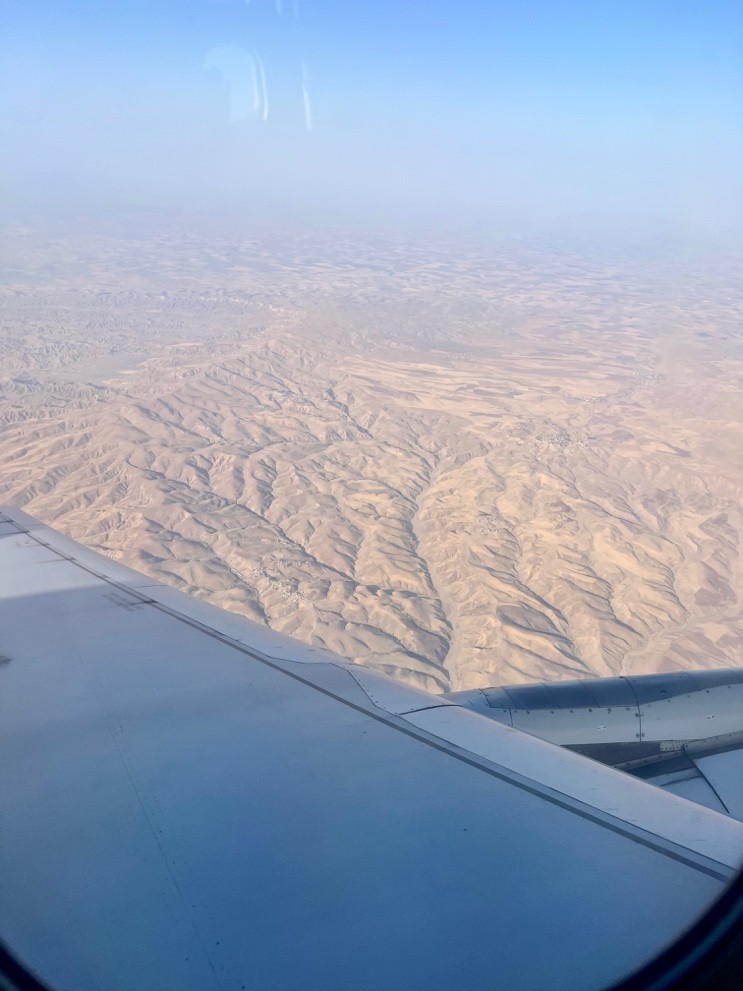
    Featured image: Photo taken from a plane over Erbil, Iraq in August 2025.

    Water has always been a powerful motif in literary and cultural history, but a critical framework of engagement with it as a non-human agent is a relatively recent phenomenon. I come from a region whose very name—Mesopotamia—is defined by two fluvial bodies, along which one of the earliest recorded human civilizations emerged. The growing water crisis in the world has affected Iraq dramatically—alarming footage from the summer of 2025 shows individuals walking across the bed of the Tigris. But being introduced to the field of Blue Humanities in Jena, Germany, opened a new intellectual avenue for me. This “cultural turn to the sea,” as John R. Gillis writes in Humanities, activates the mode of “thinking with water” (Oppermann 2023: 4), allowing for a critical engagement with “today’s ecocatastrophic times” (Mentz 2024: 1), and an exploration of how literary texts, and art more broadly, can meaningfully respond to contemporary ecological concerns.

    This focused lens on water surfaced with the publication of Steve Mentz’s article “Toward a Blue Cultural Studies: The Sea, Maritime Culture, and Early Modern English Literature” (2009) and later more comprehensively in his book An Introduction to the Blue Humanities (2024). Likewise, Serpil Oppermann’s Blue Humanities (2023) encourages us to understand water as a being with agency. Oppermann views waterscapes as sites of unlimited symbolic dimensions and cultural meanings. Employing a “cognitive wet paradigm” (Oppermann 2023: 12), waterscapes, then, can be analyzed through a lens which grants them agency, viewed as ecological systems, cultural spaces, sites of colonial history, engines of globalization, and dynamic environments deeply entangled with human and nonhuman life. On the other hand, remaining unaware, indifferent, and unwilling to rethink this human–water relationship risks perpetuating anthropocentric assumptions and further distancing humans from their entanglement with water, thereby reinforcing the illusion that water exists merely as passive.

    Seen in this context, doom by water is not a myth from ancient history; it shadows the future of human life itself. In contrast to optimistic water discourses like that of American Transcendentalism, for instance, such as the views of Henry David Thoreau and Ralph Waldo Emeron, the framework I introduce redirects positive narratives toward darker, more unsettling dimensions. I merge multiple theoretical approaches—the Blue Humanities, the Gothic, the Ecogothic, and the Nautical Gothic—in order to develop a critical framework I call the Hydrogothic. This framework explores water and adjacent fluids in Gothic modes, arguing that it is water that produces the Gothic effect.

    The Gothic and Water

    It would be a valid question to ask, why the Gothic? As a mode and genre, the Gothic is used as a tool to “write about all sorts of taboos and transgressions” (Hillard 2009: 690), and people get relieved that the dark events do not take place in real life—a false belief because the Gothic reveals real darkness that does happen. Maisha Wester and Xavier Aldana Reyes emphasize that the Gothic is the genre that functions as a critical mode through which the “oppressed and forgotten” (Wester and Reyes 2019: 1) are brought into focus. And in fact, the term ‘Gothic,’ is more a mode than a genre. Tom J. Hillard remarks that it “describ[es] certain aspects of the texts, rather than a discrete category into which these works unerringly fit” (Hillard 2009: 689).

    Throughout history, from the term’s first application to describe Horace Walpole’s novel The Castle of Otranto (1764) in Britain, to its migration across the Atlantic Ocean, the Gothic has demonstrated its remarkable adaptability to shifting historical periods, geographical landscapes, and cultural anxieties. In an American context, specifically, it often expressed cultural fears surrounding the wilderness, westward expansion, the legacies of slavery, and the Civil War. Twentieth-century Gothic shifted its focus to grapple with industrialization, as reflected in John Steinbeck’s The Grapes of Wrath (1939) in which industrial modernity is depicted as an ecological and economic force that transforms land into a site of extraction and renders human life precarious; the First and Second World Wars, as seen in works such as Norman Mailer’s The Naked and the Dead (1948), portraying warfare as a mechanized system of control and exhaustion that reduces human beings’ value; and the Vietnam War, written by authors such as Tim O’Brian who draws on his own experience as a soldier. A key example is his In the Lake of the Woods (1994), which explores trauma, memory, and uncertainty in the aftermath of war. In the twenty-first century, the Gothic continues to adapt, addressing environmental crises, climate change and ecological degradation. The Gothic, like water, resists containment, and slips across human-made borders. As William Hughes remarks: “[the Gothic] has kept it up with times, passing almost effortlessly from romanticism to modernism to postmodernism, and adapting to feminist literature, to queer literature, and even science fiction. It really seems as if nothing can stop it…and why should it stop?” (Hughes 2013: xi).

    As matter of fact, the Gothic has long foregrounded water as an active entity, or at the very least an indispensable element without which the Gothic imagination can scarcely be complete. A case in point is the flood story. In Antiquity, The Epic of Gilgamesh describes a deluge that obliterates humanity and leaves the world drowned and lifeless. In The Bible, before water is positioned as life-giving, the first lines of the Old Testament already describe water in a Gothic mode, declaring that “darkness was upon the face of the deep. And the Spirit of God moved upon the face of the waters” (Gen. 1: 2).

    In the United States, one of the first novels produced in the New World, William Hill Brown’s The Power of Sympathy (1789), is not a Gothic text by classification, yet it nevertheless deploys unsettling water imagery. One instance occurs when a lover in despair throws himself into the river, with the narrator describing the site of his death as “a watery tomb” (Brown 1969: 79). Similarly, Nathaniel Hawthorne’s “The Vision of the Fountain” depicts a crystal spring, also referred to as “the haunted spring” (Hawthorne 1882: 244), which brings the illusion of a nymph-like girl to the narrator.

    The Hydrogothic: Defining a New Framework

    Over the years, several theoretical frameworks have emerged to examine the intersections between nature and the Gothic. In what follows, I briefly outline two relevant and widely discussed approaches upon which I base my term, the Hydrogothic. In 2013, Andrew Smith and William Hughes coined the eponymous term in their edited collection The EcoGothic (2013). This is a sub-genre that explores human fears and anxieties about the natural world, often featuring haunted, decaying, or threatening landscapes to reveal the destructive and precarious relationship between humans and nature. However, while the interconnectedness of humans and the natural world are deconstructed and questioned through the Ecogothic, the term only narrowly touches on water.

    The other term which links nature, and water more specifically, and the Gothic is Emily Elder’s Nautical Gothic. Alder constructs a “lens [that] focuses on how the sea is represented in Gothic literature” (Alder 2017. 1; italics mine). However, Alder’s Nautical Gothic lens is limited. The term ‘nautical’ restricts the analytical lens to narratives of the sea alone, excluding other forms of water such as swamps, rivers, blood, to name a few. In order to extend the focus beyond the sea—an expansion from the nautical to the elemental—it becomes fitting to introduce the lens of the Hydrogothic.

    . . . the Hydrogothic foregrounds water as an agentive element which causes the Gothic effect, and not vice versa. It encompasses all water bodies and forms. It is not only elemental water in its liquid, vaporous, and frozen forms, but also the broader category of fluid substances that are ubiquitous in Gothic narratives, such as blood, poison, venom, tears, marsh, liquor, ink, sap, seepage, ichor, wine, brandy, and coffee. It also extends to the linguistic residues of fluidity embedded in Gothic discourse: verbs and metaphors of flowing, streaming, seeping, or flooding.

    Over the course of approximately half a decade, additional terms have become evident in discussions of water linked to the Gothic. These include Frederick S. Frank’s “aqua-Gothic” (1976) and Coral Ann Howells’ “Maritime Gothic” (2004). Frank’s term refers to the exploration of transcendentalism through the aqua-Gothic (Frank 1976: 85), grounding his concept in Poe’s “A Descent into the Maelström.” This, however, proves untenable, as Poe’s sea writings, and that particular story, do quite the opposite: they dismantle transcendental aspiration and put them in their place. Finally, Howells’ term refers to a regional variant of the Gothic that is shaped by its relationship to the sea and coastal environments, especially within a Canadian context (Howells 2004: xviii).

    Unlike these limited previous terms, the Hydrogothic foregrounds water as an agentive element which causes the Gothic effect, and not vice versa. It encompasses all water bodies and forms. It is not only elemental water in its liquid, vaporous, and frozen forms, but also the broader category of fluid substances that are ubiquitous in Gothic narratives, such as blood, poison, venom, tears, marsh, liquor, ink, sap, seepage, ichor, wine, brandy, and coffee. It also extends to the linguistic residues of fluidity embedded in Gothic discourse: verbs and metaphors of flowing, streaming, seeping, or flooding. Also, idiomatic expressions like ‘in hot water,’ ‘dead in the water,’ ‘to come hell or high water,’ to name just a few.

    Why the term ‘hydro’ instead of, say, ‘aqua’ or ‘blue’? Not only does it refer to the Greek word “water” (Salowey 2021: 72) and the immortal microorganism Hydra (Khokhlov 2014: 153), it also signals the Greek marsh-born monster: Hydra of Lerna. Lerna is a region located on a narrow point between mountains and the sea on the eastern coast of Peloponnesus in Greece. The entrance to the underworld is said to be situated through Alcyonian Lake nearby. Whoever attempts to cross its seemingly-calm waters will be swallowed. Possessing a myriad of “snake heads” (Salowey 2021: 73) and poisonous blood coursing through her body, the Hydra has a famous regenerative ability: if a head is cut off, more would “grow back in place of the one” (ibid. 74). Its final head, immortal, was allegedly buried by Heracles under a rock—and legend persists that it still exists somewhere in Greece. The refusal of death is a prominent Gothic trope, one with which the legend of the Hydra closely aligns. Diffusing the framework with non-aqueous Gothic liquid, Heracles dips his arrows in the Hydra’s venom as her “vapors wriggle […] through the waters of the marsh away from the corpse” (R. Waterfield and K. Waterfield 2012: 146).

    The Hydra’s symbolic potential exceeds water as a pure substance as it no longer refers to merely H₂O. Alluding to death and immortality, it denotes decay, contamination, and persistence—liquid matter that cannot be contained or resolved. The Hydra then embodies a wet ontology in which liquidity is agentive and threatening, capable of sustaining life only by entwining it with unease and malaise. Likewise, the Hydrogothic functions as a medium of transformation: it destabilizes boundaries between human and nonhuman, body and landscape, life and death. It insists on liquid’s agency, its capacity to unsettle anthropocentric knowledge systems, and its power to induce Gothic horror precisely through its interconnectedness and unpredictability.

    In this respect, I argue that the Hydrogothic anticipates contemporary ecological thought about planetary change, revealing how Gothic narratives long recognized the impossibility of human mastery over the wet matter. Through the Hydrogothic, water’s numerous aggregates become the medium through which human fragility is exposed, and it enables close examination of its ambiguous and foreboding qualities as a non-human agent of uncertainty, disruption, and destabilization of anthropocentric epistemologies. The Hydrogothic imagines a world in which the nonhuman entity relentlessly resurfaces, reclaims, and reconfigures, where humans realize their fragility. If plants, organisms that wilt and die without water, are able to decenter human-centered ego as suggested by Dawn Keetley (Keetley 2017: 1), then how much more water itself?

    The Substantiation of the Hydrogothic in Edgar Allan Poe

    I define and substantiate the Hydrogothic by applying it to Edgar Allan Poe specifically for a few reasons. First, in my opinion, he is a highly suitable American author to elucidate present water anxieties, one whose work remains catalytic and influential across the globe. Second, Poe is the author who “gave a face to American Gothic” (Keetley and Sivils 2018: 98), and is considered to be the “Father of the American Gothic” (Pagan 2019). Third, despite being “one of the inventors of the sea Gothic” (Crow 2009: 38) where water “saturates the pages of [his] texts” (Keetley and Sivils 2018: 98), his oeuvre is often overlooked in the Blue Humanities conversations, even though his work predates the environmental and water-focused literature that contemporary scholarship tends to emphasize.

    When considering Poe’s oeuvre, there are numerous texts wherein water manifests as an agent in Gothic contexts. One of the first texts that comes to mind is “The Fall of the House of Usher” (1839). Frequently analyzed, say, for its artistic strategy, motifs of duplication, or its engagement with phrenological discourse, the tale’s central elemental component—the tarn—has received remarkably little critical attention, despite bookending the entire narrative from its opening to its tragic conclusion. From the story’s opening, the narrative is saturated with aquatic foreboding—almost like doomsday by water. The phrase “the clouds hung oppressively low in the heavens” (Poe 2011: 195) give clouds agency from the start and evokes a sense of imminent inundation, as if the sky itself threatens to collapse with water.

    Before even entering the house, and as the narrator looks down within this moraine-encircled body of water, it produces a powerful effect on him which he phrases as “a shudder more thrilling than before” (Poe 2011: 196). This highlights that before any event takes place, Poe centers the tarn as an agentic water body that induces disturbance within the human subject. In the same manner, the Hydrogothic has already claimed the Usher house and the people living in it, Roderick Usher and Lady Madeline, as the adjacent tarn’s rancid air slowly consumes them and the architecture. While Roderick Usher is steadily claimed by the water body that even his hair begins to float, the atmosphere inside is thick and a fissure runs down its exterior, Lady Madeline is marked by blood. In fact, she is connected with wine imagery: another Hydrogothic element. Wine bears a visual and symbolic resemblance to blood, and Lady Madeline—blood-covered and entombed beneath the house—becomes a figure of fermented excess, sealed away only to return eventually with catastrophic force.

    Therefore, the Hydrogothic reconfigures water from a passive backdrop into an active, agentic force that demands a reconsideration of human responsibility within ecological systems. 

    As the story develops, every water-related force assumes a more radical agency. For instance, a tempest rises as the narrator reads a romance to the narrator. Eventually, the storm, the tarn, and the moon—all water-related entities—coalesce into collapsing and volatile agentic network that, through the mediating force of the tarn, dismantles the Usher estate. Although static and seemingly insignificant, the tarn functions like an ontological solvent, gradually destabilizing the house before vocally devouring the house and the last of the family’s bloodline.

    Therefore, the Hydrogothic reconfigures water from a passive backdrop into an active, agentic force that demands a reconsideration of human responsibility within ecological systems. It disrupts anthropocentric hierarchies that position humans as external observers of nature, and at the same time, it insists on relationality: humans are always already immersed within aqueous systems that shape, sustain, and ultimately exceed them. In this sense, the Hydrogothic contributes to an ethical reorientation toward more-than-human worlds by rendering visible the consequences of ecological disregard—whether in the form of flooding, drought, contamination, or submersion—as expressions of a dynamic and responsive environment. This lens underscores the necessity of thinking with water in its darker tropes, encouraging an attentiveness to its eerie, unsettling, and Gothic manifestations.

    References

    Alder, Emily. “Through Oceans Darkly: Sea Literature and the Nautical Gothic.” Gothic Studies, 19: 2, (2017), 1–11.

    Bible, The. “Genesis.” Holy Bible: Pure Cambridge Edition. Australia: Waking Lion Press, 2016, 1–42.

    Brown, William Hill. The Power of Sympathy. 1789. Edited by William S. Kable. Ohio, USA: Ohio State University Press, 1969.

    Crow, Charles L. American Gothic. Cardiff, UK: University of Wales Press, 2009.

    Frank, Frederick S. “The Aqua-Gothic Voyage of ‘a Descent into the Maelstorm.’ Transcendental Quarterly 29: 1, (1976), 85–92.

    Gillis, John R. ‘The Blue Humanities.’ The National Endowment for the Humanities, 2013. Online at: www.neh.gov/humanities/2013/mayjune/feature/the-blue-humanities (accessed 10 May 2026).

    Hawthorne, Nathaniel. The Complete Works of Nathaniel Hawthorne, with Introductory Notes by George Parsons Lathrop. Cambridge, UK: The Riverside Press, 1887.

    Hillard, Tom J. ““Deep into That Darkness Peering”: An Essay on Gothic Nature.” Interdisciplinary Studies in Literature and Environment 16: 4, 2009, 685–695.

    Howells, Coral Ann. Where Are the Voices Coming From? Canadian Culture and the Legacies of History. Amsterdam, the Netherlands: Rodopi, 2004.

    Hughes, William. Historical Dictionary of Gothic Literature. Maryland, USA: Scarecrow Press, 2013.

    Keetley, Dawn. “Introduction: Six Theses on Plant Horror; Or, Why Are Plants Horrifying?” Plant Horror: Approaches to the Monstrous Vegetal in Fiction and Film, edited by Dawn Keetley and Angela Tenga. London, UK: Palgrave Macmillan, 2017, 1–31.

    Keetley, Dawn, and Matthew Wynn Sivils. Ecogothic in Nineteenth-Century American Literature. New York, USA: Routledge, 2018.

    Khokhlov, A.N. “On the Immortal Hydra. Again.” Moscow University Biological Sciences Bulletin 69: 4, (2014), 153–157.

    Mentz, Steve. An Introduction to the Blue Humanities. New York, USA: Taylor & Francis, 2023.

    Oppermann, Serpil. Blue Humanities. Cambridge, UK: Cambridge University Press, 2023.

    Pagan, Amanda. “Where to Start with Edgar Allan Poe.” The New York Public Library, 2019. Online at: www.nypl.org/blog/2019/01/18/where-start-edgar-allan-poe (accessed 11 May 2026).

    Poe, Edgar Allan. “The Fall of the House of Usher.” Edgar Allan Poe: Collected Works, edited by Adrienne J. Odasso. San Diego, USA: Canterbury Classics, 2011, 195–207.

    Salowey, Christina. “Labor II: The Lernean Hydra.” The Oxford Handbook of Heracles, edited by Daniel Ogden. Oxford, UK: Oxford University Press, 2021, 71–85.

    Smith, Andrew, and William Hughes. EcoGothic. Manchester, UK: Manchester University Press, 2013.

    Walpole, Horace. The Castle of Otranto. 2001. London, UK: Penguin Books, 1764.

    Waterfield, Robin, and Kathryn Waterfield. The Greek Myths: Stories of the Greek Gods and Heroes Vividly Retold. New York, USA: Quercus Publishing, 2012.

    Wester, Maisha, and Xavier Aldana Reyes. Twenty-First-Century Gothic. Edinburgh, UK: Edinburgh University Press, 2019.

    About the Author

    Jarjis Jarjis is a Master’s student at the department of English and American Studies at Friedrich Schiller University Jena, Germany. He is also a Research Assistant at the chair of North American Literature under Prof. Dr. Caroline Rosenthal. Recently, he submitted his Master’s thesis entitled “Hydrogothic: Edgar Allan Poe through a Blue Humanities Lens,” and received perfect marks for it. Coming from Iraq, one of the most water-stressed countries in the world, where water scarcity continues to intensify, and now living in close proximity to the Saale River in Germany, Jarjis has developed a deeply personal and intellectual relationship with water. Beyond his Master’s thesis, Jarjis seeks to make scholarly and artistic contributions to the field of Blue Humanities.

  • CALL FOR PAPERS – Fluid Archives: Rethinking Agency in the Hydro-Commons

    CALL FOR PAPERS – Fluid Archives: Rethinking Agency in the Hydro-Commons

    In the “storied seas” of the Anthropocene, water is never merely a backdrop; it is an archive (Oppermann 2019). Its ebb and flow resemble the turning over of eternal epigraphs. The sustained contact between groundwater and surface water over centuries—and indeed, for as long as the earth has existed—has established persistent waterscapes that give life to and sustain numberless ecosystems and communities. Yet, beyond its sustaining and linear role in waterscapes, comprising both the waters and their beneficiaries, water has been an active site of non-linear, cyclical growth, memory, and change. In parallel with its web-like expansion and reliction, water serves as a medium of transfer and a regenerative site where traumas, histories, and possibilities dissolve and reform.

    Consequently, the traumas of the Middle Passage, and figures like the “mad woman in the attic” are not solely buried deep in the human psyche—they are submerged in the waterscape itself. Water, like the rest of the physical world, is articulate; it writes and narrates stories in the interstices of its waves (Oppermann 2013; Iovino and Oppermann 2014; Oppermann 2019). Aligning with this “oceanic ontology,” we view the “living metaphors” that surround water not as mere symbols, but as active physical agents that swallow, reveal, and transform memory. Accordingly, the “sunken ships” of colonial oceanic routes conjure the horrifying stories of capture and enslavement while simultaneously expressing the physical reality of marine life.

    This call for papers seeks to navigate the fluid intersections of Feminisms, Ecocriticism, Environmental Humanities, and (De)Coloniality. As Arcadiana Blog, we invite contributions that challenge the terrestrial and aquatic bias found in traditional ecocritical analysis to witness the storied existence of the seas, blending their semiotic fabric with the physical.

    Drawing from Astrida Neimanis’s concept of hydrofeminism, we acknowledge that we are all “bodies of water”—fluidally interconnected and leaking into one another. However, this watery embodiment is not a neutral state. For an elaborate critique of our fluxive status as subjects, we can turn to Françoise Vergès to interrogate the “Capitalocene” and the racialized politics of exhaustion that play out in our waterscapes (Vergès 2019, 2024). Who pollutes and toxifies our waters, and whose waters are poisoned? When bridged with the narrative agency of water, can our waters give us answers or show us the way—not just through observation, but through being-with water?

    From a parallel perspective, when we layer Neimanis’s hydrofeminism with María Lugones’s “coloniality of gender,” we seek to understand how the masculine tradition of settler colonialism—which prescribed the oceanic routes of the slave trade—also historically mapped the exploitation of the waters that bear the stories of women. Therefore, as Val Plumwood observed, the “feminine closeness to nature” has hardly been a compliment, but rather a justification for mastery and erasure (Plumwood 1993).

    Plumwood’s critique would also imply the urgent need to recognize waterscapes and maritime spaces not solely as economic transit zones, but as gendered and extractive ecologies. Yet, such maritime environments remain largely subdued by patriarchal and racial capitalist structures—the same logics that govern the land. This systemic erasure heavily neglects the agency of women, Indigenous populations, and subaltern communities, as well as their knowledge-making practices.

    Therefore, extending this call to reimagine hydro-narratives through frameworks of care and reciprocity, we ask: Whether in ecological art, oceanic cartographies, or climate fiction and environmental literature, how can we rethink human agency not as positioned above the waves, but as deeply embedded within them? Moreover, if we view waterscapes as incorporating more-than-human elements—ranging from commodities in trade routes to the toxins, chemicals, and pesticides that now inhabit the waves—how might we reimagine a more-than-human relationality that dismantles the paradigms of mastery Plumwood identifies?

    Guiding Questions

    We invite students, scholars, multi-disciplinary artists to explore the ways around dissolving traditional binaries around waterscapes. We ask questions like these:

    • How do contemporary or historical fictions portray the agency of water?
    • How has our relationship with waterscapes evolved as evidenced by literature and art?
    • How can “thinking with water” disrupt colonial and patriarchal narratives?
    • What is the relationship between “haunted” minds and “haunted” waters?
    • How do we decolonize the Blue Humanities? How can we shift focus from the romanticized “blue sublime” to the materialized realities of toxic waters, and the labor of those who live most intimately with the water?

    Suggested Subtopics

    We welcome submissions that engage with, but are not limited to:

    • Hydro-narratives, or Stories of Water
    • Waterways and Water Structures
    • Hydropolitics; Politics Around Canals, Oceanic Borders etc.
    • Water Scarcity: Shortage and Stress
    • Toxicity and Waterscapes
    • Slow Violence and Waterscapes
    • Hydro-Colonialism, or the Coloniality of Water
    • Decolonial Feminism and Waterscapes
    • Ecofeminism and Marine Conservation
    • Water in Elemental Ecocriticism
    • Blue Biopolitics & Toxic Bodies
    • Gender and Maritime Labor
    • Indigenous Epistemologies on Water
    • Maritime Ecologies and the Posthuman
    • Oceanic Relationality and More-than-Human Maritime Ethics

    We invite academic contributions as well as semi-academic, creative, and curatorial work related to the topics outlined above, or that drifts into related currents and uncharted waters fitting the spirit of this call.

    Format: If you are submitted an academic article or blog post, please aim for a maximum of 2000 words. You are free to choose a referencing system to use, but please be consistent in its application throughout your article. Semi-academic, artistic, creative, and curatorial work is welcome in any format.

    Submissions & Deadline

    Submissions are accepted on a rolling basis through May 31, 2026.

    Please send your submissions, along with a short bio, to [email protected].

    References

    Iovino, Serenella and Serpil Oppermann. “Introduction: Stories Come to Matter.” Material Ecocriticism. Ed. Serenella Iovino and Serpil Oppermann. Indiana UP, 2014.

    Lugones, María. “The Coloniality of Gender.” Feminisms in Movement: Theories and Practices from the Americas. Ed. Lívia De Souza Lima, Edith Otero Quezada and Julia Roth. Transcript Verlag, 2024.

    Neimanis, Astrida. Bodies of Water: Posthuman Feminist Phenomenology. Bloomsbury, 2017.

    Oppermann, Serpil. “Material Ecocriticism and the Creativity of Storied Matter.” Frame — Journal Of Literary Studies, vol. 26, no.2, 2013, pp. 55-69.

    ——. “Storied Seas and Living Metaphors in the Blue Humanities.” Configurations, vol. 27, no. 4, 2019, pp. 443-461.

    Plumwood, Val. Feminism and the Mastery of Nature. Routledge, 1993.

    Vergès, François. “Capitalocene, Waste, Race, and Gender.” E-flux Journal, is. 100, 2019.——. Making the World Clean: Wasted Lives, Wasted Environment, and Racial Capitalism. Goldsmiths, 2024.

  • Tossing their heads in sprightly dance

    by Franziska Maria Bergholtz

    resolve these behavioral cancers before
    they become more
    sexually suggestive
    using the method is simple
    a potent message throughout the body

    being “hit in the head” with a bad idea
    fear, dominance, confusion, or pain
    there are over a hundred emotes that let you
    express yourself and swallow

    women (mostly) can show off their hair
    pain could also be triggering this

    (especially of old people)
    a great deal of tension in the neck
    eye staring, and tossing

    you can also produce a like effect
    an opposition reflex or even a displaced behavior
    take a drink of water, lean forward,
    energetic and in good health
    a broadcast signal to anyone

    there isn’t a one-size-fits-all approach
    but that might just be part of the problem

    there are over a dozen unique dances
    you can perform; toss the head back and shake it
    your airway opens and your throat can close off

    these dances can only be obtained
    by purchasing them for real money.

    Working notes on Franziska’s poem:

    When I decided on that stanza of Wordsworth’s poem, I was curious to find out how the head-tossing nowadays would differ from the peaceful, elegant dancing that’s depicted in the poem. I simply searched online for the stanza, and later on for parts of the stanza, because in its entirety it only drew up more articles on Wordsworth. It was very surprising to see that the algorithm didn’t relate those words to dancing at all. Rather, I got a whole lot of websites on the topic of horse riding, also some advice on reading female body language while on a date and an article about the best way to swallow pills. The only website referring to dancing at all gave advice on how to purchase dance moves in a video game – what a brilliant contrast do the sprightly daffodils. I really enjoyed how the algorithm focused so much more on the bodily aspects of that dancing and tossing – incidentally showing in how many ways our bodies are political. Be it in terms of sexism, capitalism or the treatment of animals – which closes the circle to ecopoetics, I suppose.

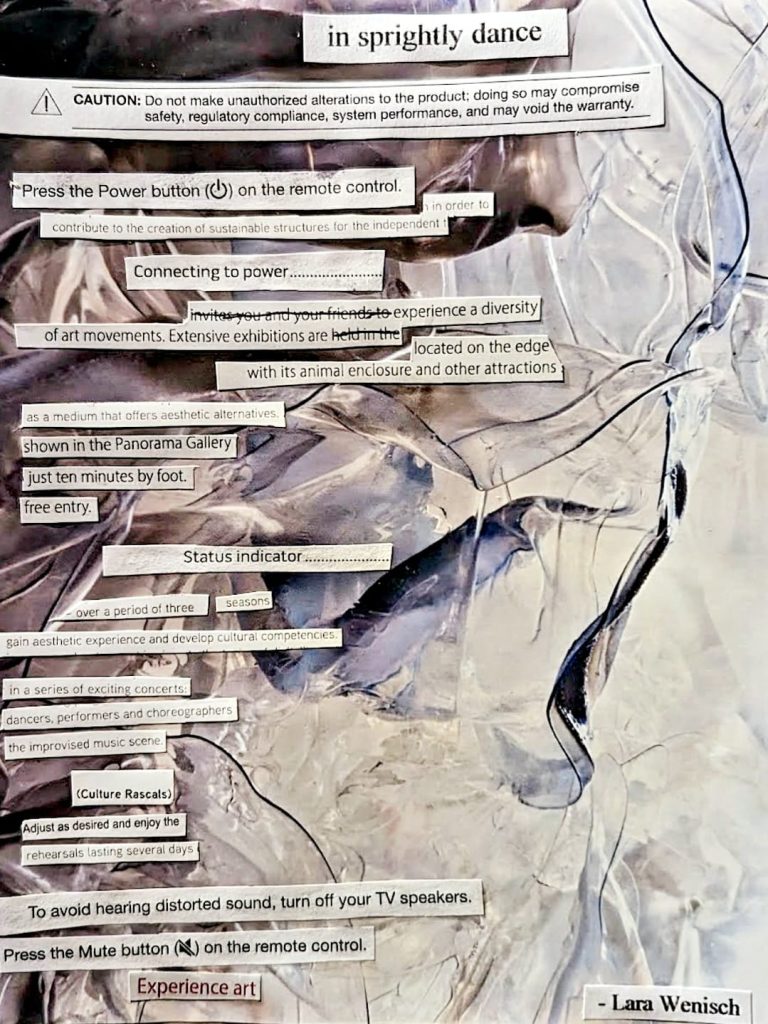
  • in sprightly dance

    by Lara Wenisch

    Working Notes on Lara’s poem:

    When I set out on the project to unframe Wordsworth, I was hesitant to say the least. To me, it felt challenging to an extent that I doubted I could create a piece that could relate blatantly unemotional material to the vision of the picturesque from Wordsworth’s poem. It wasn’t until I found myself sitting in the midst of a cut-up speaker manual and advertisement for a local tourist
    hotspot that I dared to break from a tradition in which I felt perfectly comfortable. But the break was inevitable. The words I chose, relating predominantly to the sense of sound and movement, began conforming to an idea of “sprightly dance”, infringed by technical requirements and still
    upholding the notion of being in one’s senses. Looking back on it now, my poem reflects much more the process of its creation than the relation to the original text. But in the end, I found something to say, even if the words weren’t my own.

  • You are a sky full of stars

    by Demet Uygun

    You are a sky full of stars,
    A floating voyage,
    Infinite beauty that never leaves scars,
    Cause you light up the path through the dark.
    Like the Sirius, the brightest star in the night sky,
    Continuous as the stars that shine,
    You light up the world from afar.

    Working Notes on Demet’s poem:

    I chose the line “continuous as the stars that shine” because it reminded me of Coldplay’s song “A
    Sky Full of Stars.” Then, I looked at the names of the stars, especially the brightest star, which is
    Sirius. I gathered the lines of the song, the poem, and a basic definition I found on Wikipedia about
    Sirius.

  • Beside the lake, beneath the trees 

    by Charmaine Küllenberg 

    The wind rises 

    Like a wave upon the sea 

    Where the weeds are growing free  

    There deep, deep in the forest night  

    Some are born to sweet delight  

    _

    There we wander, there we weep 

    As the crows fall asleep 

    Hear the forest talking, insects and birds  

    An idiot prayer of empty words 

    With no alarms and no surprises 

    _

    I looked up to the sky above 

    To you, who was dearly loved 

    Working notes on Charmaine’s poem:

    For the Wordsworth rewriting poem, I chose the line “Beside the lake, beneath the trees” because I
    had the idea of describing a new scene based on it. So when I was collecting lines, I picked the ones
    that I thought would fit the scene I had in mind. I had a lot of fun working on the poem, but it was
    also quite challenging. What made it difficult for me was that I found lines that rhymed at the end
    (the first pair I found was ‘night’, ‘delight’) and decided that I wanted the whole poem to rhyme. I
    found most lines from songs I’ve been listening to at the time and other things I’ve read. The line
    “Some are born to sweet delight” is taken from William Blake’s ‘Auguries of Innocence’ because I
    just like that poem and wanted to use a line for this. Personally, the poem invokes a feeling of
    solitude and melancholy, but also calmness. The first two stanzas build a sort of frame as I put the
    rhyming lines at the beginning of the first stanza and the end of the second one (‘rises’, ‘surprises’).
    I’m not quite sure why I wanted to frame it like that; it just felt right to me.

  • Application for state-funded jocund company support during higher educational training under the Federal Training Assistance Act

    by Noah Brelage

    1. Extract from Personal Details:

    “I wandered lonely as a cloud 

    In vacant or in pensive mood, 

    Which is the bliss of solitude”

    2.1 Declaration of the person receiving the daffodils:

    I am aware that 

    I am obliged under § 60 of 

    Fluttering and dancing in the breeze 

    to immediately report any changes 

    Beside the lake, beneath the trees, 

    without being asked to do so 

    and to submit the documents required for the final determination of dances with the daffodils. 

    2.1 Appendix: Required supporting documents & other evidence

    ● stars that shine 

    ● sparkling waves in glee 

    ● sprightly dance 

    ● heart with pleasure 

    more documents may be requested upon further processing of the application

    3. Overview of personal information

    A duly enrolled as a student at 

    the university of a host, of golden daffodils, 

    A poet

    Working Notes on Noah’s poem:  

    I tried to find a document that is as far away as possible from a romanticised presentation of  nature, so I decided to use an application form for state funded financial support during study. I  myself have already oftentimes had the pleasure of reading these documents written in byzantine  wording far removed from the real world. Ironically, I felt some similarities in the needlessly  strange choice of wording in both the application form and the Wordsworth poem. Additionally, I  can not imagine something more distant from any concept of nature than an overly-arbitrary,  human-made, bureaucratic financial system. Juxtaposing these two became a fun challenge. The italicised parts of text are the parts I took from the Wordsworth poem. I wanted to make a  clear distinction between the texts to present the stitching-together of the original texts. The rest of  the structure of the text is, obviously, based on the application form I had used.

  • Unframing Wordsworth’s Daffodils. A practical and theoretical poetry class

    Even outside of environmental literature circles, William Wordsworth’s poem ‘I wandered lonely as a cloud’, also commonly known as ‘Daffodils’, is widely recognised as ‘one of England’s most famous and most quintessentially Romantic poems’ (British Library). In 2007, local tourism officials of the Lake District even released a pop video and hip hop version to celebrate its bicentennial legacy – and to advertise Wordsworth’s beloved home to a younger audience. In environmental discourse, Wordsworth’s status as an “ecopoet” whose sensitivity to emotions, elements, and place turns poems into “imaginary parks in which we may breathe an air that is not toxic and accommodate ourselves to a mode of dwelling that is not alienated” (Bate 64) has been particularly secured by Jonathan Bate. Other critics, however, are more skeptical of what they see as an erasure of material, economical, and political conditions in favour of an idealised pristine natural idyll (cf. Hess, McGann, Levinson). Though acknowledging the Romantics’ attentiveness to the non-human, later strands of ecocriticism and ecopoetics have further pushed against traditions of nature poetry that reduce nature to a pastoral scene we admire from afar. Moving beyond this, ecopoetics, as Evelyn Reilly writes, includes the “rejection of compensatory notions of nature as retreat and of our role as consumers of consoling description” and engages “the recuperation of cultural, industrial, and political erasures; the dismantling of dichotomies of self/other, nature/ culture, indigenous/alien and central/peripheral” (257). 

    The creative writing & artistic research seminar “Beyond Nature Poetry: Ecopoetics” that I currently teach at Düsseldorf University aims to foster critical engagements with so-called nature poetry precisely along these lines of investigation. Open to BA and MA students in the English department, it seeks to explore the capacities of ecopoetics to disclose, reflect on, and reimagine the power dynamics between humans, language, and what we refer to as “nature”. In this context, we discussed how the poetic I in Wordsworth’s “Daffodils” encounters the natural world and how we as readers encounter it in turn. The students were quick to point out that the first iconic line “I wandered lonely as a cloud” suggests a bird’s-eye perspective that places the speaker outside the landscape. The description of the “crowd” of daffodils that come into view “all at once”, like in a picture, adds to the picturesque spell of the poem that frames nature as a spectacle the disconnected spectator observes from distance. Driven by an exclusive focus on the visual – “saw I”; “I saw”; “I gazed and gazed” – this distance continues throughout all four stanzas. As students noted, the poem thus appears to be more about us seeing the poet seeing the daffodils rather than the daffodils themselves. Although the content of the poem seems to suggest an emotional connection with the daffodils as “company” for the lonely poet, the way it is presented, framed by the narrator and an omnipresent lyrical eye, simultaneously continues to separate the disembodied speaker’s mind from the natural, socio-political, and physical environment they are engaging – or, rather, failing to engage with. 

    Scott Hess, who reads Wordsworth’s poem in relation to the conventions of Romantic-period landscape aesthetics, suggests that it demonstrates the persistence of the picturesque as a mode of structuring perception and framing landscape. Focusing quite literally on “that peculiar kind of beauty, which is agreeable in a picture” (Gilpin xii), the emergence of the picturesque as an aesthetic ideal propelled a new way of looking at nature as if it were a landscape painting. From the 18th century onwards, the Lake District in particular became popular with new picturesque tourists who used the Claude glass, a portable convex tinted mirror, to impose a perceptual frame around the landscape whilst – not only metaphorically, but physically – turning their back to it. Enacting a similar framing technique through its point of view and emphasis on the visual, Wordsworth’s poem arguably implies separations between viewer and landscape, subject and object, mind and body – separations that are unhelpful when we are searching for reparative ways of ecological interconnectedness. Anthropomorphised only, it seems, to make the poetic I feel less lonely, the daffodils that are “tossing their heads in sprightly dance” are exclusively bent towards the human, suggesting a non-reciprocal and anthropocentric relationship between human and nature. The final stanza adds to this reading, as the daffodil scene is now completely interiorised and becomes an imaginative resource for the narrator’s pleasure and sense of individual self. In that sense, the poem’s activation of picturesque framing can thus be read as reinforcing a persistent perception of nature as a projection surface and separate stylised idyllic retreat for anthropocentric purposes.

    With this in mind, we set out to re- or unframe Wordsworth’s daffodil poem. Since my seminar embraces ecopoetics as a “creative-critical edge” (Skinner 1) that combines theoretical and practical modes of investigation, our critical discussion was paired with a creative writing task. Inspired by a combination of conceptual/procedural poetry techniques, Charles Bernstein’s language experiments and this playful Daffodil variation I found online, I asked the students to pick a line from the Wordsworth poem that spoke to them in some way. They were then supposed to find material (leaflets, newspaper articles, dictionary entries, other poems…) that somehow related to that line and to finally make a new poem composed of phrases from the new sources, juxtaposed with lines from the original if desired.

    The results are surprising and wonderful in many ways. Students’ materials included songs, references to Blake, bureaucratic forms, research on dance, manuals, and advertisements that begin to move Wordsworth’s poem into the chaos of our contemporary present. Unraveling a detached bird’s-eye view on nature, the new poems became expressions of embedded narrators whose reading experience, context, and environment shape and in-form their writing. In that sense, many of the new poems no longer describe but start to embody a more connected, interdependent sense of being in the world and having to deal with its material, physical, and economic conditions: Wordsworth meets the struggles of applying for student funding; “dancing daffodils” are complicated by the bodily strains of professional athletes and commercialised resource extraction. Often questioning nature as an idyllic retreat separated from the human realm, the poems disclose various contact points between humans and their multifaceted environments. Juxtaposing different registers and sources, they open themselves up to new relations between textual and extratextual ecologies and reflect on the various uses of language as it connects us to “the fragile and finite territory our species named, claimed, exploited, sentimentalized, and aggrandized as ‘our world.’” (Retallack para 30) We do not need to wander out into nature, we are in the midst of it, part of it, and it is not always pretty but includes “fear, dominance, confusion, or pain”. Amidst this confusion, we can find poetry and “experience art” that is not separated from but fully embedded in everyday life and thereby directly interacting with its social, political, and historical layers.

    The writing and reading procedures/process of these poems invite closer attention to these layers and how they are curated by language, searching for an ecopoetics of disruption, imagination, and critical consciousness that can make us aware and perhaps push the limits of our view. Resembling branches that grow out of Wordsworth’s original poem, as one the student described it, all of the new, unframed poems emphasize process and offer new perspectives on and beyond Wordsworth’s “Daffodils”. My intention with this task has not been to disparage his poem, but rather to show it is not the end of the story and encourage us to investigate, shift, and lift the frames that structure our perception. One voice, one poem, one frame is simply not enough to register the fullness, multiplicity, and complexity of this ancient earth we humans inhabit only briefly.

    References

    Bate, Jonathan. The Song of the Earth. Picador, 2001.

    British Library. “William Wordsworth’s ‘I wandered lonely as a cloud’. https://www.britishlibrary.cn/ en/works/i-wandered-lonely-as-a-cloud/ 

    Gilpin, William. An Essay on Prints. A. Strahan, 1802. 

    Hess, Scott. “John Clare, William Wordsworth, and the (Un)framing of Nature”. John Clare Society  Journal, Iss. 27, 2008. pp. 27-44. 

    Levinson, Marjorie. Wordsworth’s Great Period Poems. Cambridge University Press, 1986. 

    McGann, Jerome. The Romantic Ideology: A Critical Investigation. University of Chicago Press, 1983. 

    Reilly, Evelyn. “Eco-Noise and the Flux of Lux”. Eco Language Reader, edited by Brenda, Iijima, Portable P at Yo-Yo Labs/Nightboat, 2010, pp. 255–74. 

    Retallack, Joan. ‘What Is Experimental Poetry and Why Do We Need It’. Jacket Magazine, 2007,  jacketmagazine.com/32/p-retallack.shtml. 

    Skinner, Jonathan. ecopoetics 01. Periplum, 2001.  

    Soth, Amelia. ‘The Claude Glass Revolutionized the Way People Saw Landscapes.’ JSTOR Daily, 2021.

    Wordsworth, William. “I wandered lonely as a cloud.” PoetryFoundation, https://www.poetryfoundation.org/poems/45521/i-wandered-lonely-as-a-cloud. 

  • Queer relation and the landscape: animals, the neutral, and significant otherness

    Queer relation and the landscape: animals, the neutral, and significant otherness

    In this writerly contemplation of queer relation with animals and landscapes, Clare Patterson draws connections between sheep trapped in snow drifts, Clarice Lispector’s cockroach, Leslie Feinberg’s crow, and various “significant othernesses” that shape our lives and queer literature.

    🏵

    At my grandmother’s house, I slept in a small back bedroom, with one window that looked out onto the fell behind. In the winter, I would wake up to a changed landscape of white fields, the absolute white rendering the sheep the murky pale yellow of teeth. Sometimes my uncle or grandad had to dig out sheep that had been buried under snowdrifts – huddled together in flocks and protected by their thick wool, they could survive for multiple days buried completely. 

    This image stuck in my mind as a child – the flock of sheep crowded together in some deep, blue hole, wool coats pressed together for warmth, hot breath clouding the air. In my head, it was like an image I’d seen in a children’s book, one in which mice, squirrels, and other small animals lived in trees hollowed out into human houses. In the winter they dug tunnels between them to travel to each other’s homes, lit them with Victorian gas lamps and candles. In reality, the sheep probably huddled and shivered, terrified, until human hands came along and dragged them out. 

    Many of the children’s books I read involved these anthropomorphised animals, cute little animal societies whose denizens wore non-specific “old fashioned” clothing and lived in cosy cottages with roaring log fires. There was an ecological bent to these stories, which made children engage with the natural world and the changing of the seasons, but also a deeply anthropocentric one, making animals agents of storytelling relatable, empathy-worthy creatures through human narratives. 

    I held both ideas in tandem in my mind – saw mice as both the subjects of sweet children’s stories, who lived nearly-human lives in churches or hedgerows, but also as creatures that needed to be caught in traps when they came into the house. They were the reason why farms have barn cats, why cats were domesticated in the first place. When my mum grew up on the farm it was filled with cats, both feral ones in the barn and tame and semi-tame ones in the house. Some were only seen in glimpses carrying mice in their jaws, some let my mum dress them up in doll clothes and slept in her toy cot. By the time I was there they had far fewer cats on the farm, only feral ones we hardly saw, but my mum always had pet ones at home who, despite their pampered indoor lives, retained their own instincts and strangenesses. 

    The cats would often bring dead birds into the house. They would also bring them in alive, sending them flapping around the living room in a wild panic. My mum found the birds frightening, but I was one of those children who loved animals, so catching and rereleasing them was always my job. I would do this by first backing them into a high corner of the room, and would then gently close my hands around them, the weight of them between my palms like a smooth stone. If I could, I would grasp them with their head poking out between my thumbs, hoping this would prevent them from being frightened, but sometimes they cowered in my hands in a little ball. 

    There was always a soft thrill in holding them for a moment – the tickle of their wings against my palms as they panicked, the release of tension as they realised they were trapped and froze completely still. I carried all kinds of birds this way – wrens, sparrows, blue tits, robins, even a woodpecker. Once, just before I let the bird go, he pecked me sharply on the hand, drew blood. In my child’s mind I was deeply offended that a creature I had rescued could be so ungrateful. Another time, the bird flew out of my hands before circling back to me once more, as if to say thank you. My cats once brought in a half-dead bird – I don’t remember what kind, but his chest was white, and a blossom of bright red blood had flowered there. I took him and carried him gently to our front garden, shut the cats in the house, and placed him on a large, cool leaf. I knew he was still living because his red chest moved up and down heavily, as if with effort. I checked back on him hourly or so, hoping he might recover but knowing deep down that he wouldn’t. As it was getting dark, my mum stepped out to look at him, and came back to tell me she was very sorry, but he was dead. I was furious at my cats and their claws and teeth, even though I understood they couldn’t help their nature. 

    Their nature – an idea we apply to animals, an idea of what separates us from animals. Something inherent to them that they have no control over, no consciousness of. Animals are unmoral, thinking only in terms of instincts, prey drives, motivations that live only within the body. There is no love in nature, only maternal instinct and hunger. Clarice Lispector, in her novel The Passion According to G.H., calls this unmorality “the neutral” – life that doesn’t think about law or morality, life that doesn’t think, life as life itself only. 

    In the novel, a middle-class Brazilian sculptress known only as G.H., the initials embossed on her luggage, crushes a cockroach with a cupboard door and, looking upon its dying, oozing body, experiences something between a psychic break, a transcendence of physical form, and a return to this animal, “neutral” state of being. In G.H.’s loss of self, Lispector describes a “link of mutual ferocity” connecting all life, all things human and nonhuman. This phrase containsg both comradely connection and uncontrollable violence. It is a phrase that makes me think of the food chain diagrams we filled in in biology class, drawing big, red arrows connecting soil to an earthworm to a robin to a hawk then looping the hawk and its postmortem decay back around to the soil to represent transference of energy. Animals eat each other forever – they know no better; they know nothing else. 

    Lispector’s protagonist begins this text as a specifically gendered subject – she is a “pretty replica,” someone who men read as “a woman of generosity and grace, and one who isn’t a bother, and one who doesn’t eat away at a man.” Her class position and her role as an artist gives her some freedom – she is seen to inhabit a social role “between man and woman”, able to move with conviviality across both male and female spaces, but within this is still limited to a extent by her gender – her sculptures “would be good if they weren’t so amateurish”. Her fear of “being a bother” exemplifies how her welcome in these spaces, her treatment as an equal, are conditional to the extent that they exist at all. This idea of (not) “eating away” at a man is notable when, at the climax of the novel, G.H. feels compelled to consume the innards of the dead cockroach, giving herself over to the “mutual ferocity” of nonhuman life. She begins from the female urge to fold herself up, to repress desire. Indeed,  Andrea Long Chu has described femaleness as “any psychic operation in which the self is sacrificed to make room for the desires of another”. The “neutral” she eventually embraces, this unmoral form of life, no longer makes room for the desires of another, and in fact barely contains the “desires” of the self, beyond the need to eat, to sleep, to procreate. The novel ends with an unselfconscious, in the most literal sense, consummation of the pure desire-driven actions of animal instinct. G. H.’s loss of self, her surrender to the neutral, is not only an act of un-humanisation but an act of ungendering. 

    🏵

    In winter evening half-consciousness, I watch something on the news about glaciers receding. Later, in an episode of a David Attenborough documentary, an arctic fox is shown crossing the open tundra, all white under a blue-purple winter night. These documentaries often wring so much pathos out of animals lives, projecting human emotions that are as unknowable to them as their minds are to us – assuming they experience love like we do, grief like we do, envy like we do. Here, though, we seem to be seeing a creature only as it is – for a moment it is just the fox, beautiful and white, crossing the tundra alone. I would quite like to be a creature of snow, I think absentmindedly, something with thick wool or fur and hardened paws. Generating my own warmth and sleeping in an ice hole in cold, blue safety. 

    I would like to have the relationship to my body that an animal has, I think – difficult to gender by sight, just living with little thought of it. Of course, many creatures have sex characteristics that can be easily read by humans, but not all. For those that can’t, most people don’t try too hard to read them. People sometimes seem irritated when I inadvertently misgender their dogs, as if it is something that should be immediately obvious. In Leslie Feinberg’s novel, Stone Butch Blues, the protagonist Jess Goldberg has a similar feeling about animals. Jess is a young adult still comprehending her gender identity, and doing so within a nuclear family that punishes her for the gender transgressions of wearing jeans or having short hair. Upset by her family’s conditional love and their attempts to feminise her, Jess finds some solace in nature:

    ‘I hurried out to the pond to catch polywogs in a jar. I leaned on my elbow and looked up close at the little frogs that climbed up on the sun-baked rocks.

    “Caw, caw!” A huge black crow circled above me in the air and landed on a rock nearby. We looked at each other in silence.

    “Crow, are you a boy or a girl?”

    “Caw, caw!”

    I laughed and rolled over on my back. The sky was crayon blue. I pretended I was lying on the white cotton clouds. The earth was damp against my back. The sun was hot, the breeze was cool. I felt happy. Nature held me close and seemed to find no fault with me.’

    The unintelligible response (for Jess) to an unintelligible question (for the crow) shows our ability to look at animals and their ability to look back – but also the vast gulf of communication between us, and our desire to make and project meaning onto that unknowability. Animals do not have gender, at least not as far as we know, and at least not in the way we do. In our mutual unknowing is an acceptance of the limits of our understanding. Donna Haraway calls this “relating in significant otherness”, the act of living with something we cannot know. Writing about her relationship with her dogs, she compares it to the love the worshipper has for God – the act of loving something too big or strange or far away to know its nature, the act of loving something that can only be understood by what it is not, and by knowing what one cannot understand. 

    “Nature” is often used in appeals to conservatism, especially around queerness – queer relationships aren’t “natural,” transition isn’t “natural,” in nature we only see reproductive sex and so only reproductive sex is “natural”. I could make appeals here to scientific evidence to the contrary – that many animals engage in same-sex relationships, that male seahorses carry pregnancies. I could cite numerous examples of reproduction in flora and fauna that are different and alien to ours – but that isn’t really the point I’m making. My appeal is more to a meeting with something unknowable without finding fault – to queer relation as a meeting with the limits of our understanding of another creature, or another being, without the desire to mould it into our own shape. Queerness opens up the idea that not everyone’s desires are the same, and in that are endless possibilities. Nature has never seemed to find any fault with me.