Category: BLOG

  • The Economy of Francesco: How to Repair the ‘Common Home’

    The Economy of Francesco: How to Repair the ‘Common Home’

    Francesco, va’ e ripara la mia casa;
    Now go, Francesco, and repair my house
    (From The Major Legend, St. Bonaventure, XIII century)

    Image by Josh Applegate on Unsplash

    Conference Review

    For those who still consider him as the saint who talked to animals, or, as historian Lynn White Jr. suggests, “the patron saint of ecologists” (14), it may be surprising to learn that in 2020, Francis of Assisi is primarily being regarded as a lens for conducting a critical observation on the present-day world, and as a model for repairing some critical issues affecting our time. These aspects have emerged clearly from The Economy of Francesco, the international conference convened by Pope Francis, which took place from 19 to 21 November 2020. While it was originally – and symbolically – scheduled in Assisi, Italy, the city of il Poverello, the conference later became digital due to the pandemic. However, just like many other events during these past few months, this choice revealed a silver lining regarding the fact that it allowed for a more successful alignment with the spirit of (global) connectedness for which it aimed. Hearing the different accents in English during several transcultural discussions among international participants reminded us how English could eventually become a real lingua franca, both inclusive and depoliticized, which will be able to bring together worlds often perceived as being apart. 

    The Economy of Francesco saw the presence of some distinguished intellectuals from around the world, and its main purpose was to discuss and adjust the current dominant economic model(s) in order to imagine more ethical, sustainable, and inclusive versions of them. Keynote speakers including the Nobel Peace Prize recipient, Muhammad Yunus, as well as Jeffrey Sachs and Vandana Shiva, among many others, joined a team of more than 2000 under-35 researchers, economists, and change-makers from 115 different nations who responded to the Pope’s call to reflect critically on the status of our current global economy – and to develop alternatives to it. On a planet in which 1% of the population possesses more wealth than the remaining 99% (Oxfam.org), it is evident how a re-conversion of the system, its connected thoughts, and its values can no longer be overlooked.

    By establishing the life of a thirteenth-century man as a cornerstone for developing a critique of advanced capitalism, Pope Francis proposes a possible response – and a useful narrative – for re-evaluating the logic of individual profit, whose inequalities and injustices have now become unequivocally clear, both among humans and in relation to the nonhuman world. Through his Encyclical Letter, titled Laudato Si’ (2015), Pope Francis introduced Catholic discourse into the wider, international debate that has been addressing the urgency of the current ecological crisis. By “supplementing Catholic dogma on Natural Law, with Naomi Klein’s analysis of the destructive role of Capitalism” (Braidotti 66), Bergoglio traced the direction towards an ‘ecological conversion’ that “calls for a number of attitudes which together foster a spirit of generous care, full of tenderness” (Vatican.va). His work does not appear as a mere greenwashing strategy that winks at the growing environmental movements that have appeared worldwide. Rather, the Pope joined the chorus of contemporary critics who are endorsing a reflection on the very meaning(s) of the notion of ‘human’ while highlighting its inextricable entanglement with other forms of life. The image of the ‘common home’ discussed in his Encyclical – which refers to the very household evoked by the Greek word oikos – has become a powerful eco-logical trope, and it has paved the way for the core eco-nomically oriented discussion that occurred at the conference.

    Among the most interesting aspects characterizing the event, the adoption of an affirmative rhetoric remains pivotal: The Economy of Francesco, in fact, did not represent just another apocalyptic account of the future of planet Earth, with which the notion of the Anthropocene often pairs. Rather, the conference revealed a keen proactive standpoint that allows problems to be re(con)figured into challenges, for which one can – and should – find a solution. Similarly, attention was placed on the idea that – albeit being characterized by major inequalities and discriminations – the current dominant economic model can still represent a useful baseline for developing new solutions. Along these lines, Pope Francis appointed the younger generation as the primary addressee of this effort: this choice suggests how hopes are pinned on generational change, which is capable of pouring new creative energy into the effort of providing (possible) responses to the many crises – from climate change to the global pandemic – that the world is undergoing.

    It is not possible to summarize the many insights that emerged during the conference in just a few words. In fact, they did not come only from the well-known speakers mentioned above, but also from the many participants attending the event, the working groups, and other workshops organized during the months before the conference, among which a real international debate flourished. Sustainability, accountability, fraternity, and inclusivity remain part of a long list of keywords that resounded during the three days of intensive, stimulating discussions that comprised the event. Yet I would like to avoid proposing another soporific rhyme of ‘big words’, which often runs the risk of emptying valuable concepts of their deepest sense. In its place, I propose one word – a verb, specifically – which, better than many others, epitomizes Saint Francis’s life, and which may also become useful for inspiring the widely discussed changes in current economic discourse(s) along more ethical assumptions: the verb is to repair.

    This term connects to a mystical experience, which, while not necessarily in a strict sense, but, rather, in a more intimate one, was fundamental in the process of young Francis’s conversion. While in contemplation in the tiny church of San Damiano, a crumbling building next to a leprosarium that had been disregarded by the local population, the saint suddenly heard the crucifix providing him with a demand: Francesco, va’ e ripara la mia casa; “Now go, Francesco, and repair my house” (Caroli 609). The rest is history, in a literal sense. The effects of this command are still visible after eight centuries in the livelihood of the Franciscan movement that brings together hundreds of people and many spiritual and material experiences.

    ‘To repair’, rather than building up something new from scratch – resonates with the idea of amending something already existing for responding to new necessities. The fact of reinventing an entire economic system, which is often invoked as the only possible, utopic solution, appears as a challenge too demanding to even be properly conceived – let alone achieved – within the limits of humans’ capacities. The idea of ‘repairing’ our economy, instead, scales down this challenge by inspiring everyone, everywhere, to get involved in creating a much-invoked change and within the limits of one’s own experimentality and network. Just like Francis did.

    The time for awaiting (a) new economic model(s) to be lowered ‘from above’ is over. The momentum, Francis seems to suggest, must come from below, and, right now, through a shared eco-logical perspective on the world that can inspire the development of a new eco-nomic process, that is, how its resources should be managed. Words like ‘entrepreneur’, ‘finance’ and ‘investment’ will not disappear in the dictionary of the new economy; rather, attention will be dedicated to how new meanings will have to be assumed by repairing old understandings along more pluralistic and inclusive postulations, according to profits that cannot be singular (i.e. individual), but that apply to all those inhabiting the common house: the entire human-nonhuman community of planet Earth.

    Bibliography

    Braidotti, Rosi. Posthuman Knowledge. Polity, 2019.
    Caroli, Ernesto (Editor). Fonti Francescane. Padova Editrici Francescane, 2011.
    White, Lynn, Jr. “The Historical Roots of Our Ecological Crisis”. The Ecocriticism Reader: Landmarks in Literary Ecology. Edited by Cheryll Glotfelty and Harold Fromm, University of Georgia Press, pp. 3-14, 1996. [1967].


    Stefano Rozzoni is a PhD Candidate in “Transcultural Studies in Humanities” at the University of Bergamo, Italy, in cotutelle with Justus-Liebig-Universität Gießen, Germany, where he is a member of the International PhD Programme “Literary and Cultural Studies”, and an affiliate member of the European doctoral program PhdNet. He is also a member of the Research Group “Oikos. Ecology and the Study of Culture” at the Graduate Center for the Study of Culture (GCSC) in Gießen. His research interests focus on Ecocriticism, Posthuman Studies, English Modernism, Virginia Woolf, and pastoral poetry. His dissertation project proposes an ecocritical reading of English Georgian pastoral poetry (1911-1926) for a critical reevaluation of this trend.

  • Dreaming of Home

    Dreaming of Home

    © Micaela Amateu Amato

    Review of Cara Judea Alhadeff’s Zazu Dreams: Between the Scarab and the Dung Beetle: A Cautionary Fable for the Anthropocene Era (Elfrig Publishing, 2017; www.zazudreams.com)

    ‘There is something peculiar about this book: the fact is the cover gives it away right from the start’. That was the first line of Walter Benjamin’s review of The Fairy Tale and the Present written by Alois Jalkotzy in 1930. Benjamin excoriated that author for diluting the fairy tale — once replete with evil step-mothers, murderers and drunks — into a saleable commodity made of bland pieties suited for ‘children’.

    No such charge can be made against Zazu Dreams. Its cover pulls no punches. In the foreground, a young man, Zazu, holds his malamute husky, Cocomiso, both atop their friend, a humpback whale. In the background, a tableau of the contemporary grotesque. On the left, sewers vomit effluent into the sea. On the right, chimneys belch noxious fumes into the night air. Between these man-made geysers, a red moon hangs: low, fat, ominous. Zazu Dreams is not for the helicoptered and the coddled, those sensitive to microaggressions and in need of trigger warnings. Zazu Dreams is an unvarnished fairy tale in which the comforting is enfolded within the scary and the beautiful is braided into the ugly. Zazu dreams in images, in words, in philosophical musings, and in historical forays. Zazu dreams to awaken us from our slumbers.

    Boy, dog, and whale traverse oceans, crisscross centuries, now fly towards the sky, now dive into the ocean deep. They travel to the ends of the earth, searching and searching, without rest. What is it young Zazu searches for? He searches for home, for being-in-place. Zazu seeks to be one among other beings, whether these be trees, animals, waters or skies. But wherever he goes all Zazu finds is the overweening presence of the human. Of human things that engorge on the suffocation, mutilation and destruction of all other beings, including other humans. Zaza searches for home because he has been made homeless. But why the restlessness? Zazu is restless because he can find no place to rest, because the earthbound — the terrestrial — has been exiled from the earth.

    Today, the prime mover of this displacement is the corporation. Corporations have exiled the terrestrial and now squat over the whole earth. Despite its name which invokes the dense materiality of flesh and earth — corpus, corporeal, corpse — the corporation is, in fact, an extraterrestrial. Once a legal fiction invented by some humans, it now rules over human and other beings as an a-mortal Demon-God. The expanding universe of corporate fictions already owns the earth, the seas, and the skies. Even the wind and the sun now fall within the grasp of private and state corporations. And all that the corporation touches it remakes in its own image. Land, and water and air, birds and fish and fowl, all these and more have been fictionalized into resources. Nothing seems able to escape the insatiable vortex of this fictional pair, ‘corporation/resource’. As Zazu discovers, even primordial sustenance —mother’s milk— has been mined for its ingredients to be packaged for profit.

    A-mortal corporations are a phantasm just as fairy tales are a fantasy. The corporation cannot be held guilty any more than a fairy tale can be put in the dock. Rewriting fantasies will not make them less fantastic. A tasteless story is best just not told. Corporate minions cannot be punished any more than robots can be jailed. Both are critters who willingly enact what others have willed, who only do their jobs! Reprogramming machines will not alter their inability to disobey. A mindless robot is best turned off. But everywhere Zazu goes and everywhere Zazu looks, all he can see is the detritus of corporations and their efficient executors. The rule of the corporate form seems unassailable, its power absolute, its malefic consequences unavoidable. Are we therefore condemned to serve the monsters we created?

    Fruits take their time to ripen. I had to wait a year to write this appreciation. I wanted to find out what happened to the Jewish community whom Zazu discovered there during his travels. My parents once lived in famed neighborhood of Jew-Town, Fort Cochin, Kerala. They knew of the Koders — Sattu, brother Elias, sister Lily — the preeminent family among the ‘white’ Jews of Cochin. Until the mid-1980s, there were enough members to constitute the minimum ten persons needed for synagogue services. In 1987, an unbroken four hundred and nineteen years of Shabbat minyan came to an end for the lack of quorum. Now there are said to be but five Jewish persons left in Jew-Town. Rumor has some three or four ‘black’ Jewish families living on the mainland, though not much more is known of them. Such are the tatters left of the once vibrant fabric of Kerala Jewry.[1] Such withered remains of community are witness to our contemporary condition. Must we therefore resign ourselves to cynicism and despair?

    Zazu grows up among people who speak Ladino, a linguistic mosaic that began as the Spanish spoken by Jews in medieval Spain. Enriched by exilic wanderings since 1492, Ladino absorbed elements from – among others – Greek, Turkish, Hebrew, Arabic, and French. Its continued if fragile existence gives voice to the power of enfleshed words, of embodied speech, of the irrepressible murmur of voices that always threaten the rule of grammarians. Zazu’s vernacular signposts the fate of those unhoused, uprooted, cast adrift. For is it not speech that forms the babbling brook from which an ‘I’ separates itself from a ‘we’ — a ‘we’ that is stutteringly convoked prior to the collectives of family, tribe, society, nation, and even species? The variety of voices may well be countless — the scream of monkeys tortured to test shampoo, the moans of a grieving father, the mating songs of humpback whales, the laughter of a child at play. And yet, perhaps, it is precisely in this tyrannical anarchy of voices that the restless might find home.[2] The word is tyrannical because it cannot be escaped. The word is anarchic because it has no author. Perhaps the anarchic tyranny of speech does bind those who have little in common, as it does for Zazu and his friends. Perhaps Zazu’s dream for us is also to seek home in vernacular activities — vernaculars that endlessly express the endlessly inventive capacity of humans, to be.

    Zazu Dreams in the teeth of despair, searching for redemption in shit. That he still dreams is a sign of hope emergent, of the green shoots of spring. By dreaming with Zazu one may learn how to live in the ruins, amid the irreparable, among the fallen.


    [1] Nathan Katz and Ellen Goldberg carefully document the history and fortunes of the Cochin Jews in The Last Jews of Cochin: Jewish Identity in Hindu India (University of South Carolina Press, 1993). Shalva Weil offers a thorough if brief survey of “Jews in India” in the Encyclopedia of the Jewish Diaspora, v.3, ed: M. Avrum Ehrlich (ABC-CLIO, LLC 2008, pp.1204-1212). For a tender and bracing personal account of home-lessness read Ruby of Cochin: An Indian Jewish Woman Remembers, by Ruby Daniel and Barbara Johnson (The Jewish Publication Society, 1995).

    [2] Resounding through Alhadeff’s ‘search for home through language’ is George Steiner’s ‘Our Homeland, the Text’, reprinted in his collection on reading and writing, No Passion Spent (Yale University Press, 1995).


    Sajay Samuel teaches at The Pennsylvania State University.

  • Birches like Barcodes

    Birches like Barcodes

    Art by Nick Hayes / Poem by Robert Macfarlane

    Writing Nature in the Anthropocene: Responses to Robert Macfarlane’s Masterclass, in Conversation with Joanna Dobson (Creative Writing Masterclass Series at Sheffield Hallam University, 18 November 2020)

    Response by Katharina Maria Kalinowski

    How do “we” respond to the many Anthropocenes in times of accelerated ecological crisis? Is it possible to write the legible strata of the earth? Do we need new forms of writing to register invisible and incomprehensible layers of a world that exceeds the limits of our understanding (hasn’t it always)? At the borders of language, how can writing and activism intersect? Are “we”, humankind, “good ancestors” for generations to come?

    Given the current state of the ecosphere, I’d be inclined to answer the last question with “no”. However, viewing humankind from a species point of view is problematic if we consider how explosive disparities shape the living conditions of the current generation on a daily basis. Following the argument that climate change is not so much anthropogenic as “sociogenic”,[1] the question concerning our heritage pushes against a homogenous humankind and opens up to a microcosm of stories with more-than-humankind/ness.

    The entanglement of these stories in a larger system is encapsulated in the last line of Macfarlane’s intricate poem “Heartwood”: “Have you heartwood, cutter? / Have those who sent you?” Dedicated to trees facing “unjust felling”, the poem, part charm, part song, part wood, can be seen as a piece of lyrical activism that enchants without euphemising and interrogates without scapegoating.

    One of the dangers of the (geochronologic) Anthropocene is its tendency to naturalise violent social and economic divisions and present the state of the world as inevitable. Here’s where writing can complicate, diversify, and wager on alternative scenarios; here’s where poetry can make something happen: what stuck with me most is Macfarlane’s cautious, yet unfalteringly urgent belief in the spell-binding potential of writing to re-invent form and to observe, to question, to touch, to affect, to change. Investigating what may be framed as the “golden spike” of the Environmental Humanities, namely the ever-present question whether poetry, or literature in general, can “save the earth”,[2] he offered an insightful response, unsurprisingly starting with “no” (again).

    For Macfarlane, the “golden spike”-question needs revising; it should really be asking: can literature join forces with other movements and creative arts to contribute to political changes? The answer to this is, finally: yes, of course! Macfarlane’s “Heartwood”, which became part of the Sheffield tree felling protests, is only one of many examples of how writing can challenge the status quo and create a shared space to imagine other voices and other worlds. Generating sets of new, unexpected relations, his texts make me wonder about the connection between (natural?) birches and (artificial?) bar codes, and how we poetically embody nature as more than a consumable good changing ownership through a red-light beep.

    In this sense, Macfarlane’s suggestion to “wearily embrace” anthropomorphic modes reminds me of Jane Bennett’s notion of vital materialism, in which “a touch of anthropomorphism” can “catalyse a sensibility” to a re-enchanted world filled with variously composed animate materialities vibrantly alive.[3] It further prompts critical reflection on anthropocentric assumptions determining what counts as human – and therefore as anthropomorphic – in the first place: it is arguably easier to categorise something as human-like than to categorise the human as something-like, as one among many unique beings that share their vulnerable lives in the Anthropocene.

    Literature cannot afford to choose the easier way. Embedded in a socio-cultural, political continuum, writing is one among many active and expressive forms that can make the world not only more comprehensible but also more liveable. It is neither separate from other forms of activism, nor does it exclude them – literature is shaped by its ability to both amplify and make silence for other voices. Nothing sums this up better than the following comment posted in the Zoom chat, one of many words that stayed with me long after clicking on “leave meeting”:

    Sometimes you have to tie yourself in knots about anthropomorphism and sometimes you have to spend your weekend dressed as a frog at the nature reserve open day to engage people and there’s space for both I think!

    By Rachel Dowse, sent in the Zoom chat


    [1] Andreas Malm and Alf Hornborg, “The Geology of Mankind? A Critique of the Anthropocene Narrative”, The Anthropocene Review, vol. 1, no. 1, 2014, pp. 62-69 (66).

    [2] The phrase is borrowed from John Felstiner’s book Can Poetry Save the Earth? A Field Guide to Nature Poems, Yale UP, 2010. Question to the reader: What would poetry have to be exchanged with in this phrase to prompt a “yes” response?

    [3] Jane Bennett, Vibrant Matter: A Political Ecology of Things, Duke UP, 2010, p. 99.

    Response by Melina Lieb

    I no longer remember why, but I had felt a bit down on the day of the masterclass, and logged into Zoom hoping it would cheer me up. Instead, it left me even more pensive, though in a strangely reassuring way. I know that the world is in a precarious state, but often I don’t know how to cope with the anxiety caused by this knowledge. I suppose others feel the same, but I usually cannot hear them in the echo chamber of my own head. Talking or listening to people talk about the subject helps a lot. It might not immediately solve problems, but hearing your own thoughts and feelings reflected by others makes them more endurable. You are not alone. And as the saying goes: Every dripping wears the stone.[1]

    Macfarlane found very fitting words for the feeling I’ve described: “The world has begun to make nonsense of realism”. The times we’re living in just are eerie and gothic. And this distortion is being recognised by literature. In Underland, Macfarlane pursues the question: “Are we being good ancestors?”. As Katharina highlights above, the answer too often is “no”. Driving through birch forests like barcodes, Macfarlane arrives at the only place where he would say that people have done a good – or at least, the best possible – job of being good ancestors. This place is Onkalo, the world’s first permanent repository for nuclear waste, on the Finnish island of Olkiluoto.[2] On hearing the name, I remembered watching a film about this place, years ago. It was called Into Eternity: A Film for the Future. I remember a match being lit in a dark cave, illuminating a man with a yellow helmet, talking in a solemn voice. I don’t remember his exact words, but he might have said what is stated on one of the movie posters: “We need you to know that this place should not be disturbed. You should stay away from this place. Then you will be safe”.

    When the people who built and filled the storage are no longer there, the place will speak for itself. Will it seem as eerie to our descendants as it already seems to me now?

    Speaking about speaking places, Macfarlane describes another potentially eerie site, though despite its “chilling” atmosphere, it has a fascinating charm to him. Orford Ness, a shingle spit on England’s Suffolk coast was a nuclear testing site but has now been given back to the wild and is protected by the National Trust. Inspired by this landscape, Macfarlane published Ness, his attempt at a different version of a medieval play on nature lashing back against the military-industrial complex. “Superheroes” of different genders, composed partly of organic matter, partly of the detritus of capitalism and consumerism – “speaking in swifts”, with “bones of plastic” – rush to the peninsula. Macfarlane recites, ending each verse with a warning: “Look, here he comes. – Look, here she comes. – Look, here they come. – Look, here as comes”.

    The power of these words still remains with me. It is one of Macfarlane’s great strengths to send powerful words out into the world, spells, songs, charms, chants. They are simultaneously an ushering and inspiration, intended to be spoken and extended by as many voices as possible – especially young voices, children and teenagers, our descendants. May they find a new way of speaking, of getting over the eeriness of our times, together.


    [1] This is a translation of the common German idiom “Jeder Tropfen höhlt den Stein.” A more common phrasing in English might be “Constant dripping wears the stone.” In this case, though, I wanted to place the emphasis on “every” drop.

    [2] See also: https://www.theatlantic.com/magazine/archive/2017/10/what-lies-beneath/537894/


    Authors:

    Katharina Maria Kalinowski is a bilingual poet and EUmanities fellow at the Universities of Cologne and Kent. Her creative-critical PhD project focuses on ecopoetics, the Anthropocene, and expanded forms of translation. Her publications include Magma, Epizootics, and the Journal of British and Irish Innovative Poetry.

    Melina Lieb is a PhD candidate and lecturer at the Faculty of Translation Studies, Linguistics and Cultural Studies at the Johannes Gutenberg-Universität Mainz/Germersheim, Germany. Her research focus is on 21st-century British Nature Writing, ecocriticism and ecopoetry. In her dissertation she considers the role of the “common” in this field of literature, including aspects such as the everyday, the ordinary and the familiar as well as the shared and the political. Melina also writes her own prose and poetry inspired by the natural world, both in English and German.

  • Teaching Information Literacy in a Class on Global Environmental Justice

    Teaching Information Literacy in a Class on Global Environmental Justice

    Image by Lukas Blazek on Unsplash

    My class on Literatures of Global Environmental Justice was envisioned in the context of a global pandemic and a lockdown when misinformation about COVID-19 was being spread by the then US president with disastrous consequences for public health and safety. It was a moment that reminded me that teaching students the importance of information literacy was more urgent than ever, if we were to think of an environmentally just society. This was coupled with the fact that in my experience of teaching two semesters of research writing at the University of Pittsburgh, one of the common assumptions that I found among first-year students just out of high school was about data (especially numerical data) being neutral. There was a firm belief in numerical data as evidence, without questioning how the data was created, who conducted the survey, how the survey was conducted and who was interviewed for the survey.

    I had three goals as I was designing this assignment. Students should be able to understand how information is constructed and that it is not free of ‘biases’; to narrativize information; and to apply information literacy in their daily-life, social and professional contexts. For this project, students had to choose an already available set of statistics for an environmental justice issue of their choice. Once they had chosen the statistics, their responsibility was two-fold: a) to find out what problem is foregrounded through the data and what remains untold and b) to present the story behind the data either as a visual narrative (building on their practice from a previous visual assignment on comics/photo essays) or through a written account that contextualizes the statistics and demonstrates how the statistics came out in their current shape and what they gloss over. My philosophy of developing this assignment was not necessarily dismissing the power of numerical data for the Environmental Humanities as a field. Instead, as a researcher trained in Literary Studies and committed to the discipline, I was more invested in thinking together with my students about what narratives emerged from the data of their choice.

    When I started conceptualizing the assignment, I realized that information literacy as a field has seen substantial engagement from librarians, who often teach courses on this subject. Although I was conceiving the information literacy project as only one of the major projects for this class, I still felt the need to listen to my colleagues in Library and Information Sciences and to learn from them how they go about scaffolding major projects in Information Literacy for their students. It was at this moment that I came to know about the course on Information Literacy offered by Dr. Karen Sobel as part of the virtual Digital Pedagogy Lab at the University of Colorado, Boulder. I enrolled in the course, supported by a research grant from the University of Pittsburgh, and benefitted from the inputs of my colleagues ranging from librarians at community colleges and high schools to faculty at the Digital Pedagogy Lab who were my interlocutors as I was developing the assignment. As I was drafting the assignment, one of the things that I was struggling with was how I would evaluate my students on this assignment because I needed a clearer sense of what I was looking for. Kodi Saylor, who was one of the co-instructors, drew my attention to the part of the assignment sheet where I used a local example to show my students the questions that they could possibly ask of the data. Therefore, she pointed out that since one of the key components of this assignment is to ask effective questions, I might want to have a section of the class dedicated to teaching students how to ask good questions. I took this suggestion and communicated to my students that I was looking for the kind of questions that they were asking more than the answers that they were coming up with. I shared with my students an article by Kyla Wazana Tompkins on how to ask good questions and workshopped their questions in the asynchronous discussion board. The way I had designed the course, although the final research(ed) essay for this class followed the information literacy assignment, the students could use the information literacy project to dig deeper into their topic of research for the final essay, which they had already decided on by then, though they were not required to.

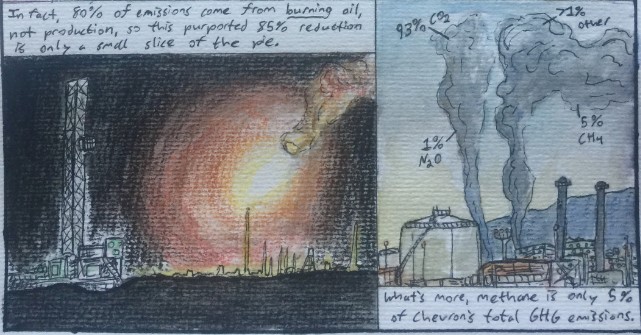
    A text that we read together in class for reflecting on the philosophy of the information literacy project was the introduction to Heather Houser’s book Infowhelm: Environmental Art and Literature in an Age of Data. One of the primary arguments of the book that inspired me to design this assignment and also my students in their work was its focus on how artists and writers utilize scientific data in their environmental art and literature to “speak back to forms of epistemological mastery” and positivism that data could end up reifying (2). The work that students came up with was thoughtful and wide-ranging. For instance, Lauren Posey, who is a first-year student at the University of Pittsburgh focused on greenwashing by corporate companies such as Chevron. She looked at Chevron’s 2019 Sustainability Report, specifically interrogating the truth behind Chevron’s statistics which claimed that “We have reduced methane emissions from Chevron’s US onshore production operations by 85 percent since 2013”. Posey pointed out, through a panel in her visual narrative, the part that remains untold: Methane is only five percent of Chevron’s emissions of greenhouse gases.

    Mary Guildin, another student, focused on the decreasing rate of bee populations in North America and Europe to dig deeper into the possible causes that might be responsible for the alarming decrease of the bee population. Besides the climate emergency, one of the reasons that she pointed out was the fact that the desire for perfectly manicured lawns was responsible for destroying bee habitats. Nate Madden drew the interconnections between the lack of healthcare in several counties of West Virginia, USA, and the high percentage of deaths due to lung cancer with the widespread practice of Mountain Top Removal coal mining in the state, thereby gesturing to the problem that environmental injustice disadvantages the low-income counties disproportionately. What is significant about the narratives that they crafted was the way they utilized information to show how issues about environmental justice at a local level translate to global problems. Their projects demonstrated that approaching justice as a multidimensional issue going beyond legal mechanisms can be generative for the Environmental Humanities as a discipline. 

    The idea behind this assignment was to carefully think through in what ways information is an aesthetic category in itself and in what ways information could be mobilized to tell stories about environmental injustice while being attentive to the nuanced, textured and grounded narratives that emerge from this information. It was an attempt on my part to foreground that the core contribution of literary studies towards environmental justice is to embrace how narratives can make a difference in how we utilize the humanities for social change and action.

  • Αρκαδία, Here We Go Again: A Journey from ‘Pastoral’ to ‘Post-Pastoral’. And Beyond.

    Αρκαδία, Here We Go Again: A Journey from ‘Pastoral’ to ‘Post-Pastoral’. And Beyond.

    Image by Judith Prins on Unsplash

    “Small pleasures must correct great tragedies”

    V. Sackville-West, The Garden, 1946

    It has not been long since I first decided to devote (at least) three years of my life to the study of pastoral poetry. I remember that I was reading The Land (1926), the delightful – and often disregarded – poem by Vita Sackville-West (1892 – 1962) when I started pondering what was so intriguing about the rural world, which she described so elegantly through her verses.

    In my hand was a 1928 reprint of the original, a yellow stained booklet that smelled like a mixture of camphor and tobacco. The perfect condition for a book of pastoral poems, I thought, considering the démodé aura that often accompanies this subject in and out of academia. Barrell and Bull have put it quite clearly in the preface of their seminal pastoral poetry anthology: the pastoral primarily works “to decorate the shelves of tasteful cottages [and] to furnish nostalgia” (Barrell & Bull 1974, 432).

    Often referred to as bucolic and idealized, the pastoral has also usually been associated with the idea of enhancing pleasant feelings, inspiring quietness and ensuring tranquility in its readers. This conviction is so rooted in Western culture that the notion of the pastoral locus amoenus, the pleasant place par excellence, has made the concept of the ‘environment’ overlap with the visual legacy of a golden (c)age pastoral idyll. The result is evident in the fact that thinking of ‘nature’ as a pristine, virgin natural landscape still dominates the contemporary ‘environmental imagination’, as Lawrence Buell would say. Alan Ruff has effectively expressed the sense of innate familiarity of the Western world with the pastoral traditional landscape by saying that it seems as if “we have all dwelt in Arcadia” (Ruff 2015, 1). This awareness not only contributes to highlighting the extent of this idea in our culture, but it should also become, I suggest, a warning about the necessity of approaching such a perpetuating narrative in a more critical way, especially when we live in a time called the Anthropocene.

    Since I delved into the reading phase of my PhD, I soon realized that the pastoral was much more than sheep and shepherds. Likewise, my escapist perspectives towards a peaceful, Edenic universe inhabited by herds grazing in boundless meadows abruptly shifted when I understood how early ecocritics had tackled this topic. By sweeping away the widespread idea of the pastoral as a (mere) nostalgic retreat to an idealized natural setting, the “mature environmental aesthetics” (Buell 1995, 32) that appeared in the 90s promoted a revisionist stance (Clark 2011, xiii) which, hand-in-hand with a critical reconceptualization of ‘nature’ as a complex, intricate net of human and nonhuman entities, has led the pastoral to be regarded along a similar trajectory. Taking a famous line from Rachel Carson’s Silent Spring, I would say that that was the very moment when “everything began to change” (1964, 9) in pastoral theory. Not only have notions such as the human-nonhuman continuum (Massumi 2002), intra-action (Barad 2007), and mesh (Morton 2010) led the pastoral to become a fertile terrain from which to dig up valuable considerations about the human-nonhuman relationship; but the hermeneutical complexity advocated by the Environmental Humanities has also contributed to eroding the equation of the pastoral with “any literature that describes the country with an implicit or explicit contrast to the urban” (Gifford 1999, 2).

    The shift in my perspective about the pastoral naturally allowed for an evolution in the way I approached Sackville-West’s poem. Suddenly, from the seductive verses that had titillated my escapist impulses, an array of surprising narratives started exploding from the text, which transferred my attention from the fashion of pastoral clichés, to the issues of human and nonhuman relationality that they entail. The overlooked classical poem, which caused the writer to be remembered primarily as a traditionalist, conservative author, suddenly became visible as the intersection of multiple discourses populating current ecocritical scholarship: in her verses, there are not only flocks and shepherds, but also the features of their entanglement; not only the sentimental celebration of plants and flowers, but also references to how these entities interact with the human, among many other ‘but also(s)’ that offer to this poem fresh flavor. In alignment with what Gifford described when he introduced the notion of “post-pastoral”, my perspective had departed “beyond the closed circuit of pastoral and antipastoral to achieve a vision of an integrated natural world that includes the human” (1999, 148).

    And then came that moment, a mix of epiphany and frustration, when young scholars realize that their brilliant ideas are, in fact, not that brilliant – or original – considering that an array of critics have already developed similar considerations in the field of pastoral theory. In the last three decades, a number of publications on the pastoral have sealed a point of no return in this scholarship. Neologisms including ‘toxic pastoral’ (Farrier 2014), ‘necropastoral’ (McSweeney 2015), and ‘dark pastoral’ (Sullivan 2017) have transformed the subject into an effective navigation tool for exploring human-nonhuman entanglement in the many pastoral manifestations that Western culture presents. Instead of conceiving widespread interest as a negative aspect, one should reflect on how it represents further proof of the relevance of the topic in today’s world: the time has come to pull our pastoral poetry books off the shelves of our cottages, dust off their covers, and read – and re-read – them again, while shedding light on how they can contribute to tackling the challenges of our epoch. That, I think, is what it is (also) like to study pastoral today.

    The idea that the pastoral represents “a species of cultural equipment that western thought has for more than two millennia been unable to do without” (Buell 1995, 32) helps us understand the extent of this subject over time, as well as the importance of regarding the pastoral as an ongoing cultural narrative in need of ever-renewing critical perspectives. And while its gradual resurfacing in critical theory during the last years has gone hand in hand with its reappearing on the shelves of our stores (Corey and Waldrep 2012), many other new versions of pastoral are visible in a variety of cultural contexts, including advertisements, movies, videogames, and even blogs, as the title Arcadiana reveals.

    Hence, one can conclude that not only “have [we] all dwelt in Arcadia” (Ruff 2015, 1), but also that Arcadia is still here, and together with us it has entered the Anthropocene. Here we go again, after more than two millennia, relying on such ancestral imagery to reflect on our relationship with the environment. Perhaps Vita Sackville-West was aware of this when, during WWII, she first drafted the opening of her celebrated poems in The Garden (1946): “Small pleasures must correct great tragedies”, a line that, in 2020, reveals some unexpected ecocritical, modern vibes that resonate with the urgencies of current ecological – among many others – crises.


    Works Cited

    Barad, Karen. Meeting the Universe Halfway: Quantum Physics and the Entanglement of Matter and Meaning. Durham: Duke University Press, 2007.

    Barrell, John and John Bull. The Penguin Book of English Pastoral Verse. Middlesex, England; New York: Penguin Books, 1982 [1974].

    Bennett, Jane. Vibrant Matter: A Political Ecology of Things, Durham. Duke University Press Books, 2009.

    Buell, Lawrence. The Environmental Imagination: Thoreau, Nature Writing, and the Formation of American Culture. Cambridge, MA: The Belknap Press of Harvard University PressHarvard University Press, 1995.

    —. The Future of Environmental Criticism: Environmental Crisis and Literary Imagination. Malden, MA: Blackwell, 2005.

    Carson, Rachel. Silent Spring, Greenwich, CT: Fawcett Publications, 1964.

    Clark, Timothy. 2011. The Cambridge Introduction to Literature and the Environment, Cambridge: Cambridge University Press.

    Corey, Joshua, and G. C. Waldrep. The Arcadia Project: North American Postmodern Pastoral. Boise, Idaho: Ahsahta Press, 2012.

    Farrier, David. “Toxic Pastoral: Comic Failure and Ironic Nostalgia in Contemporary British Environmental Theater.” Journal of Ecocriticism, 6.2, 2014, pp. 1-15.

    Gifford, Terry. Pastoral, London: Routledge, 1999.

    Massumi, Brian. Parables for the Virtual: Movenment, Affect, Sensation, Durham, NC: Duke University Press, 2002.

    McSweeney, Joyelle. The Necropastoral. Poetry, Media, Occults, Ann Arbor: University of Michigan Press, 2015.

    Ruff, Allan R. Arcadian Visions: Pastoral Influences on Poetry, Painting and the Design of Landscape, Oxford: Windgather Press, 2015.

    Sackville-West, Vita. The Land. London: W. Heinemann, 1926.

    —., The Garden. London: Michael Joseph, 1946.

    Sullivan, Heather I. (2014). “Dirty traffic and the dark pastoral in the Anthropocene: Narrating refugees, deforestation, radiation, and melting ice”. Literatur für Leser, 14, 83-97. Frankfurt, Germany: Peter Lang.


    Author: Stefano Rozzoni is a PhD Candidate in “Transcultural Studies in Humanities” at the University of Bergamo, Italy, in cotutelle with Justus-Liebig-Universität Gießen, Germany, where he is a member of the International PhD Programme “Literary and Cultural Studies”, and an affiliate member of the European doctoral program PhdNet. He is also a member of the Research Group “Oikos. Ecology and the Study of Culture” at the Graduate Center for the Study of Culture (GCSC) in Gießen. His research interests focus on Ecocriticism, Posthuman Studies, English Modernism, Virginia Woolf, and pastoral poetry. His dissertation project proposes an ecocritical reading of English Georgian pastoral poetry (1911-1926) for a critical reevaluation of this trend.

  • The Chernobyl TV Series and the Impossibility of (Narrative) Closure

    The Chernobyl TV Series and the Impossibility of (Narrative) Closure

    Image by Mick De Paola on Unsplash

    The 2019 HBO mini-series Chernobyl has been praised as the best series of all times. Its account of the 1986 nuclear disaster in Ukraine and the fates of those dealing with its aftermath touched millions of viewers – but something about the appraising reviews of the series rubbed me the wrong way. It is true that the series is “as stunning as it is gripping”, as a Guardian review by Rebecca Nicholson revels (2019). Watching the series, I was touched by the terrible suffering and moral conflicts of the protagonists following the worst nuclear accident in history, and I recognized the echoes of Svetlana Alexievich’s 1995 Voices from Chernobyl, from which some of the most heart-wrenching storylines were taken.[1] I followed the critical debates about historical accuracy. How indebted is a TV series to its historical sources? And how American is Chernobyl’s view on the inner workings of the Soviet system? After some pondering and reading, I understood that my concern lies elsewhere, with the question of “narratability” and narrative form – and more precisely with the (im)possibility of narrative closure when talking about nuclear accidents.

    In one of the few critical reviews of the series, Mike Hale observes how resistant the Chernobyl nuclear disaster seems to be to narrativization: “[…] as a story, it’s hard to get your arms around – sprawling and repetitious, dependent on arcane particulars of physics and engineering, marked by failures to act and by large-scale action that accomplishes nothing” (2019). Forcing it into the “cheap theatrics” of a “creaky and conventional, if longer than usual, disaster movie”, Hale argues, does injustice to the complexity of the events and the multitude of actors attempting to live up to the moment. Indeed, the genre of the mini-series comes with clear requirements in terms of storyline and character constellations. It tells the story of only a few protagonists,[2] and it has a clear narrative arc. In many regards, contemporary mainstream storytelling still goes back to the Aristotelean poetics in which a tragedy requires a clear beginning, a middle, and an end, accompanied by suspense and finally catharsis, the sense of relief as all conflict is solved and equilibrium is restored. But how can such a storyline be adequate for a sprawling and unruly nuclear disaster?

    In an essay on “Narrative Closure”, Noël Carroll defines closure as a “phenomenological feeling of finality” (2007) as all questions posed by the narrative are answered satisfactorily for the audience. In the Chernobyl series, the (mostly fictional) showdown trial in which protagonist Valery Legasov recounts in detail how the accident happened, serves exactly this purpose. Loaded with suspense, and then relief, the occasion is used to inform the viewer of the intricacies of the social and technological failures which have led to the explosion of the reactor core, and to install Legasov as the hero that the audience needs him to be. All questions are answered satisfactorily, and the catharsis can resolve any doubts we might have about where the responsibility lies. Chernobyl has an ending in the Aristotelean and in Carroll’s sense. But, as the sociologist Kai Erikson observes in A New Species of Trouble (1995):

    Toxic disasters […] violate all the rules of plot. Some of them have clearly defined beginnings, such as the explosion that signalled the emergency at Chernobyl or the sudden moment of realization that opened the drama of Bhopal; others begin long years before anyone senses something as wrong [….]. But they never end. Invisible contaminants remain a part of the surroundings, absorbed into the grain of the landscape, the tissues of the body, and, worst of all, the genetic material of the survivors. (emphasis mine)

    The Chernobyl nuclear disaster has left 2,600 km2 of marshes, fields and forests uninhabitable for the unforeseeable future both in Ukraine and Belarus. Recent studies hint that reports about undisturbed and flourishing wildlife in the so-called ‘exclusion zone’ might be exaggerated, and that the density of mammals is actually lower than in comparable areas with lower levels of ionizing radiation (cf. Beaugelin-Seiller et al.).[3] And while a WHO report from 2005 sets the number of deaths attributed to radiation exposure at less than 50 (plus around 4000 eventual deaths due to long-term health consequences), recent publications have fuelled discussions about the validity of those earlier accounts (cf. Brown 2019). Irrespective of the exact numbers, anthropological research has shown that the accident still influences and overshadows the lives of thousands of people, and that for them, no sense of closure or ending is in sight (cf. Petryna 2013). The events surrounding the Chernobyl nuclear disaster were not only “sprawling and repetitious” in the 1980s, they continue to reach into the lives of uncountable humans and non-humans, and into the deep and almost unimaginably far future.

    Chernobyl makes an attempt to shine a light on the destiny of victims and survivors with an unusually long 5-minute coda, accompanied by a choir performing the Vichnaya Pamyat (or “Memory Eternal”), a hymn usually sung at eastern orthodox funeral services. The coda shows the fate of some of the protagonists of the series, speculates about its political legacy and also includes some drone footage of the abandoned town of Pripyat and the exclusion zone today. The final frame is of the New Safe Confinement completed in 2017, a large arched structure that covers both the damaged reactor and the make-shift concrete sarcophagus constructed directly after the accident. Hidden in this coda, and in the telling title of the final song, is the uncomfortably open ending of the story of the Chernobyl nuclear disaster. However, this openness remains an afterthought, attached to a carefully constructed and contained narrative arc.

    This is not to say that the series is bad, or that it shouldn’t exits. However, it will hopefully not remain the only way that viewers are confronted with what it means to live in a nuclear world. As frustrated climate scientists will attest to, we need to be aware of the limits of certain types of stories to grapple with the complexity of environmental (and technological) disaster. There are currently 440 nuclear power plants in operation worldwide, and while most of them are unlikely to spill ionized radiation through an accident, they produce highly radioactive waste for which most countries have no feasible storage solution right now. To confront the “everyday nuclearity” of our planet, we don’t need fearmongering and finger-pointing, no sharp distinction between heroes and villains. Most importantly, we should not embrace the “phenomenological feeling of finality” offered by Chernobyl (2019) but accept the impossibility of narrative closure. What we need is a nuanced knowledge and understanding of both the history and the present of nuclear power, nuclear waste and other nuclear infrastructures (such as mines or weapons). For such an endeavor, Chernobyl might even provide a good start.

    Do you want to learn more about the scientific, political and cultural history of ionizing radiation? You might want to have a look at this beautiful website by the Bombshelltoe Collective: https://illuminating-radioactivity.com/

    For in-depth discussions of all things nuclear, visit the website of the Bulletin of the Atomic Scientists: https://thebulletin.org/nuclear-risk/


    [1] The production team had the permission of the Nobel prize-winning author to weave the oral histories of her book into the series, and thus we now have filmed versions of the stories of young lovers Lyudmila and Vasily Ignatenko, who was a first responder and died from acute radiation sickness weeks after the accident, and the soldiers sent in to kill the pets left behind during evacuation of the zone around the exploded reactor.

    [2] This has, for example, led to the creation of the compound character of Ulana Khomyuk standing in for the many Soviet scientists who fought for better access to information and healthcare after the accident.

    [3] This is not to say that a purer, undamaged Nature existed around the reactor. The land was heavily cultivated and many of the marshes drained. Nonetheless, these lands have been taken from humans and non-humans alike and will remain contaminated for up to 20.000 years.


    Author: Hannah Klaubert is a doctoral student based at Stockholm University and the Graduate Center for the Study of Culture (GCSC) at Justus-Liebig-University Giessen, Germany. Hannah holds a BA in Comparative Literature and Philosophy from Freie Universität Berlin and an MA in Cultural Analysis from the University of Amsterdam. Her research focuses on fiction from the last three decades dealing with nuclear accidents and disasters. Through an (eco)narratological analysis of the aesthetic forms and strategies employed in literature and film, she aims to understand how the imperceptible threat of radiation and its impact on the human and non-human world are negotiated.

  • Lehrprojekt: Nature Writing und Übersetzung

    Lehrprojekt: Nature Writing und Übersetzung

    Image by Sarah Brown on Unsplash

    — This post is also available in English, please click here to read the English version —

    Das Sommersemester 2020 war in mehrerlei Hinsicht ein ungewöhnliches. Der zwölfwöchige Bachelor-Kurs, den ich unterrichtete, war mein erster, noch dazu im Online-Format, und ich hatte vor, ihn direkt mit einem kreativen Lehrexperiment zu beginnen. Es ging um die Übersetzung von aktuellem britischen Nature Writing, insbesondere von Auszügen aus Mark Cockers A Claxton Diary: Further Field Notes from a Small Planet (2019). Bevor es an die tatsächlichen Übersetzungen ging, bekamen die Studierenden eine kreative Schreibaufgabe, bei der sie ihr eigenes Stück Nature Writing verfassen sollten. Ursprünglich hatte ich das als Gruppenunternehmung geplant, zu der wir während einer Sitzung alle gemeinsam nach draußen gehen würden. Doch da aufgrund des Lockdowns nur Online-Unterricht möglich war, beauftragte ich die Studierenden, die Aufgabe individuell in ihren jeweiligen Umgebungen auszuführen.

    In diesem Artikel möchte ich die Ergebnisse dieser Aufgabe vorstellen. Zuerst werde ich die Aufgabenstellung erläutern und die Texte der Studierenden skizzieren. Dann werde ich die Ergebnisse einer Umfrage beleuchten, in der es um die Auswirkungen und den positiven Nutzen der Aufgabe ging. Schließlich werden einige Beispiele der studentischen Texte präsentiert.

    Die Aufgabe

    Die Aufgabenstellung lautete wie folgt: „Nehmen Sie sich mindestens eine halbe Stunde Zeit, die Sie mit der Natur verbringen. Das kann im Garten sein, in Wald, Feld oder Wiese, in der Stadt, gar auf dem Balkon oder am geöffneten Fenster. Schreiben Sie dann (oder währenddessen) über Ihre Eindrücke. Schreiben Sie mindestens eine Seite Fließtext (Gedichte sind ebenfalls möglich).“ Die Texte waren auf Deutsch zu verfassen, der Zielsprache der späteren Übersetzungen.

    Die Studierenden verfassten eine Bandbreite ansprechender und reflektierter Texte. Die meisten schrieben Prosa, eine Studentin jedoch komponierte ein nahezu imagistisch anmutendes Gedicht über ihren Weg zur Arbeit. Die Hälfte der Studierenden berichtete über einen Spaziergang, wobei die Umgebungen von Feldwegen über Waldwege bis zu Flussufern changierten. Manche liefen abends, um die Farben des Sonnenuntergangs zu genießen. Andere wurden von ihrem Hund begleitet und waren an tägliche Spaziergänge gewöhnt. Eine Studentin ging im Regen hinaus, ihrem Lieblingswetter. Sie alle erzählten von beruhigenden und belebenden Erfahrungen, und von Details, die ihre Aufmerksamkeit gebannt hatten: ein Kaninchen, eine singende Lerche, süß duftende Holunderblüten, ein Feuersalamander. Nicht nur Spaziergänge boten Verbundenheit mit der Natur. Die beschriebenen Umgebungen changierten von Voralpen-Seen bis zu städtischen Balkonen und Fensteraussichten. Die Studierenden bewiesen ein Auge für Details, Farben und Formen, registrierten Geräusche und Gerüche. Unter ihren Texten waren sowohl atmosphärische und emotionale Stücke als auch philosophische Reflexionen über den Platz der Menschen in der Natur und die Verbundenheit aller Lebewesen. Es war ihnen Nature Writing in all seinen Facetten gelungen und sie zeigten so die vielfältigen Qualitäten dieser Art von Literatur.

    Auswertung der Aufgabe

    Da die Pandemie neue und unerwartete Herausforderungen ins Universitätsleben brachte, war mein Fachbereich an neuen (Online-)Lehrkonzepten interessiert, mit denen Dozierende auf diese reagiert hatten. Im Rahmen ihres ausgeprägten Engagements für qualitative Lehre stellte die Johannes Gutenberg-Universität Mainz Mittel für eine wissenschaftliche Hilfskraft zur Verfügung, die bei der Aufarbeitung der erprobten Konzepte half. Am Ende des Kurses erstellte sie eine anonyme Umfrage mit meinen Fragen, dann sammelte sie die Antworten und fasste sie zusammen (11 von 13 Studierenden hatten geantwortet). Mich interessierten besonders zwei Dinge:

    1. Bezüglich meiner pädagogischen Ziele: Welchen Effekt hatte die kreative Schreibaufgabe auf die Übersetzungserfahrung?

    2. Angesichts der jüngsten Umstände: Hatte die Aufgabe positive Auswirkungen auf die Studierenden während des Lockdowns?

    Die Umfrage startete mit dieser zweiten Frage, welche nun bejaht werden kann. Nahezu alle Studierenden hatten die bewusste Beschäftigung mit der Natur als entspannend, meditativ, gar tröstend empfunden. Die meisten hatten sich entschieden, sich zunächst ganz in die Natur zu vertiefen und erst im Anschluss auf ihren Laptops zu schreiben; manche hatten sich Notizen auf Papier gemacht. Sie hatten die Aufgabe als willkommene Abwechslung empfunden, sowohl zu üblichen Uni-Aufgaben als auch zum Lockdown. Eine Studentin berichtete, sie sei motivierter gewesen, die Aufgabe früher als sonst zu erledigen. 

    Das Online-Format des Kurses hatte nach Eindruck der Studierenden ihre positive Erfahrung des Kurses nicht spürbar beeinträchtigt. Obwohl manche einen Austausch ihrer Eindrücke in der Klasse begrüßt hätten (ein solcher fand nicht statt; ich gab lediglich individuelles Feedback), waren sich alle einig, dass sie das individuelle Erlebnis der ursprünglich geplanten Gruppenunternehmung vorzogen. Dadurch waren sie fähig, sich besser zu konzentrieren, und konnten Ort und Zeit des Exkurses frei wählen.

    Die Aufgabe schien außerdem positiven Einfluss auf das Übersetzungserlebnis der Studierenden gehabt zu haben. Viele berichteten, sie hätten sich dadurch besser in die Nature-Writing-Texte hineinversetzen und sich mit dem Autor besser identifizieren können. Ihr Gespür für Details und Atmosphäre war geschärft worden. Gleichzeitig hatte sich ihr Gefühl für die eigene Sprache verbessert und sie so zu kreativen und freien Übersetzungen befähigt.

    Es war mein Ziel gewesen, eine stimulierende Aufgabe zu stellen, und tatsächlich schien diese die Übersetzungskompetenz der Studierenden gefördert zu haben. Zusätzlich brachte sie ihnen Vergnügen, körperliche Aktivität und Entspannung. Die Einbindung ausgewählter kreativer Schreibaufgaben kann somit ein gewinnbringender Baustein beim Unterrichten von Literaturübersetzung sein.

    Veröffentlichung der studentischen Texte

    Die Nature-Writing-Aufgabe hatte die Studierenden aus dem Klassenraum hinausgeführt. Nun sollten auch ihre Texte den Weg in die Welt finden. Eine Studentin schlug vor, diese für eine breitere Leserschaft zu veröffentlichen, um trotz des Online-Semesters ein Gefühl des gemeinschaftlichen Universitätslebens zu vermitteln. Diese Idee wurde von allen Seiten begrüßt und entsprechend verfolgt. Drei der Texte wurden bereits auf dem Blog des studentischen 06|magazins unseres Fachbereichs veröffentlicht. Eine Online-Sonderausgabe mit allen Texten ist in Planung. Um auch hier einen Eindruck des studentischen Nature Writing zu vermitteln, werden im Folgenden einige Beispiel vorgestellt.

    Nature Writing von Annika Fitsch

    Ich sitze auf einem Steg, fühle das warme Holz der Planken unter meinen Beinen und die Sonne auf dem Gesicht. Ich höre die Wellen; sie gehen schneller als sonst, es ist ein recht windiger Tag. Dennoch rollen sie beständig und regelmäßig ans Ufer, was sehr beruhigend wirkt. Auf dem Wasser tummelt sich eine Gruppe Schwäne, im Blaugrau des Wassers wirken die weißen Tupfen beinahe wie Wolken am Himmel. Es sind viele Schwäne, die meisten von ihnen sind im Wasser, einige liegen an Land. Alle befinden sich in unterschiedlichen Positionen. Manche suchen tauchend nach etwas Essbarem, andere schwimmen erhobenen Hauptes umher, wieder andere scheinen ein Nickerchen zu machen. Die schlafenden Schwäne liegen auf den Steinen am Ufer einer kleinen Halbinsel, die vor einem Dorf ein Stück in den See hineinragt. Hinter ihnen sehe ich einen Teil des Hafens und dahinter erheben sich einige Häuser. Das Dorf wirkt ruhig, von hier aus sehe ich keine Spaziergänger, die an der Promenade entlanglaufen, nur die großen alten Bäume sind zu erkennen. Sie stehen in vollem Grün, jeder in einer leicht anderen Schattierung, alle haben eine etwas andere Form und Größe, flach und grasgrün, hoch, spitz und dunkelgrün, beinahe quadratisch und hellgrün.

    Ich höre das Kreischen einer Möwe und das Zwitschern einiger Vögel, das jedoch beinahe von den an Land rollenden Wellen übertönt wird. Ich lasse meinen Blick weiter nach links schweifen, weg von den Schwänen und dem Dorf und über den See. Über bewaldete Hänge und eine weit entfernte, kaum erkennbare Ortschaft hinweg, meine ich, das Ende des Sees erahnen zu können. Am Ende des Sees, hinter weiteren mit Wald bedeckten Hügeln, sehe ich schemenhaft die Umrisse der Alpen. Graue, hohe Berge, auf deren Spitzen noch Schnee liegt. Den Schnee erkenne ich so gut, dass die Berge gar nicht so weit weg erscheinen.

    Mein Blick schweift weiter über kleine Ortschaften, Waldgebiete und aus Sandstein bestehende Hänge. Mit den Augen folge ich einer Straße, die direkt am See entlangführt, zu einem nahe gelegenen Ort, von dem ich einige Häuser, die Kirchturmspitze und den Hafen erkennen kann. Schließlich gleitet mein Blick über ein kleines Wäldchen zurück zu dem Steg, auf dem ich sitze. Ich schaue noch einmal hinaus auf das Wasser, betrachte den Farbverlauf des Wassers, von dem Braunblau des seichten Wassers am Ufer über ein dunkles Grünblau bis hin zu einem Graublau an den tiefsten Stellen des Sees. In dem grünblauen Wasser sehe ich einen weißen Tupfen, einer der Schwäne hat sich von seiner Gruppe entfernt und schwimmt nun einige Meter vor mir auf dem See. Hinter ihm, etwas weiter draußen, sehe ich einen Mann, der in einem kleinen Schlauchboot sitzt und angelt. Das schwarze Boot wird von den Wellen sanft hin und her geschüttelt.

    Die Sonne scheint auf die unruhige, durch Wellen unterbrochene Wasseroberfläche und lässt das Wasser etwas heller erscheinen. Ich kann jedoch nicht bis auf den Grund sehen. Durch den Wind und die Wellen wird der Sand aufgewirbelt und färbt das Wasser bräunlich. Der Schwan steckt seinen Kopf unter einen seiner Flügel und beginnt, sein Gefieder zu putzen. Auch sein Gefieder ist etwas bräunlich, er scheint noch recht jung zu sein. In einiger Entfernung fliegen drei schnatternde Gänse über die Bäume auf meiner rechten Seite hinweg und landen mit einem lauten Platschen auf dem Wasser. Durch ihre Landung entstehen Kreise im Wasser, die jedoch schnell von den Wellen verschluckt werden. Ganz leise höre ich den Wind durch die Blätter streichen und das Rascheln des Schilfgrases, das sich sanft im Wind wiegt. Doch das lautere Geräusch der Wellen lenkt meine Aufmerksamkeit wieder auf das Wasser. Während ich mich umschaute, verkam das beständige Rollen der Wellen zu einem Hintergrundgeräusch, doch nun drängt sich der Klang des Wellenschlags wieder in den Vordergrund.

    Ich nehme diese rauschende, plätschernde Gleichmäßigkeit in mich auf, atme ein letztes Mal die frische klare Luft, in der ein Hauch von Seetang liegt, und stehe auf.

    “Der Regenspaziergang” von Juliane Lein

    Es ist ein grauer Tag. Ich lege die gut zweihundert Meter von der Haustür bis zum Feldweg rasch zurück. Es tut gut, draußen zu sein und die Häuser Germersheims in einiger Entfernung hinter sich zu lassen. Am anderen Ende des Feldes kann ich die Schnellstraße und dahinter die Gebäudekomplexe der Südpfalz-Kaserne sehen. Gras sprießt am Feldrand und auch die Bäume grünen. Die obersten Triebe lassen bereits die Blätter hängen, so lange hat es schon nicht mehr geregnet. Auch die Felder sehen völlig ausgetrocknet aus. Ich bleibe einen Moment stehen und richte meinen Blick gen Himmel. Grau und schwer ragen die Wolkenberge über mir auf. Von mir aus könnte es einen kräftigen Regenguss geben. Seit Tagen, wenn nicht gar Wochen, gab es nichts außer grauem Himmel. Keinen einzigen Regentropfen. Ich gehe weiter und bemerke nach einigen Schritten, wie der erste Regentropfen einen großen feuchten Fleck auf dem staubigen Boden hinterlässt. Endlich!

    Weitere Tropfen folgen und hinterlassen ein unregelmäßiges Fleckenmuster. Ich richte meinen Blick erneut hinauf zu der dichten Wolkendecke, die schon den ganzen Morgen über der Stadt hängt. Kühle Wassertropfen fallen mir auf die Stirn und die Wangen und ein Lächeln breitet sich auf meinem Gesicht aus. Regen ist das schönste Wetter. Zumindest für mich. Die kühle, frische Luft eines Frühlingsregens, die tropisch-stickige Hitze eines Sommergewitters, das Rascheln der trockenen Blätter im Herbst, während die Regentropfen darauf niederprasseln, und der kalte Schneeregen im Winter, der wie kleine Nadeln im Gesicht sticht. Ich schaue mich um und sehe die Grashalme am Feldrand rhythmisch im Takt der Tropfen wippen. Sie fallen nun in immer kürzeren Abständen und größerer Zahl. Ich setze die Kapuze meiner Jacke auf und setze meinen Weg fort. Das Prasseln des Regens wird dumpfer.

    Die Wege sind bereits völlig durchnässt, genauso wie meine Jacke. An der Weggabelung biege ich nach links ab, um einen größeren Abstand zu den Häusern der Stadt zu gewinnen. Die Luft ist kühl und nicht mehr so stickig wie die letzten Tage und ich stelle mich für einen Moment unter eine Buche, um die frische Luft einzuatmen und dem Prasseln des Regens zuzusehen. In den tiefen Furchen der Felder bilden sich bereits matschbraune Pfützen, da das Wasser nicht schnell genug von dem ausgetrockneten Boden aufgesogen werden kann. Nach ein paar Minuten gehe ich weiter, den Weg entlang, an der Schnellstraße vorbei und hinüber zum Flusslauf der Queich, die auch durch Germersheim fließt, bevor sie in den Rhein mündet. Kleine, ineinanderfließende Kreise zeichnen sich durch die herabfallenden Regentropfen auf der Wasseroberfläche ab. Im Vorübergehen betrachte ich den Tanz der Tropfen, es hat beinahe etwas Meditatives allein durch den Regen zu spazieren. Ich genieße die letzten Sekunden Abgeschiedenheit, bevor ich in die Wohnsiedlung am Rande der Felder einbiege. Bis zu meiner Wohnung sind es noch ein paar Minuten.

    Im Hausflur ziehe ich meine nassen Schuhe aus, um sie zum Trocknen stehen zu lassen. Meine Jacke hänge ich an der nächstgelegenen Tür auf. Einige Tropfen perlen von ihr ab und hinterlassen kleine, feuchte Flecken auf dem Boden. Ein Stück des Regens habe ich also mitgebracht. Ich betrachte die Fensterscheibe, während ich mir Wasser im Wasserkocher erhitze. Die Tropfen rinnen an ihr hinab. Es scheint so, als würden sie ein Wettrennen machen. Der Wasserkocher schaltet sich automatisch ab und auch an seiner Innenseite rinnen die Tropfen hinab wie an der Scheibe. Ich bereite mir einen Tee zu und setze mich noch eine Weile ans Fenster, um den schönen Regenspaziergang in aller Ruhe ausklingen zu lassen.

    Juliane Lein ist Bachelor-Studentin im 4. Fachsemester am FTSK Germersheim. Sie studiert Englisch, Französisch und Arabisch mit den Schwerpunkten Internettechnologie und Medienübersetzen.


    Autor/in: Melina Lieb ist Doktorandin und wissenschaftliche Mitarbeiterin am Fachbereich für Translations-, Sprach- und Kulturwissenschaft der Johannes Gutenberg-Universität Mainz/Germersheim. Ihr Forschungsschwerpunkt liegt auf britischem Nature Writing des 21. Jahrhunderts, Ecocriticism und Ecopoetry. Neben ihrer Doktorarbeit verfasst sie auf Deutsch und Englisch eigene Gedichte und Prosatexte, die von ihrer lebendigen Umwelt inspiriert sind.

  • Teaching Creative Nature Writing and Translation

    Teaching Creative Nature Writing and Translation

    Image by Sarah Brown on Unsplash

    — This post is also available in German, please click here to read the German version —

    The summer term of 2020 was an unusual one in several ways. The undergraduate course I taught was my first one, on top of that in online format, and I started with a creative teaching experiment right away. The twelve-week course was on the translation of current British Nature Writing, looking specifically at excerpts from Mark Cocker’s A Claxton Diary: Further Field Notes from a Small Planet (2019). Prior to the actual translation tasks, I gave my students a creative writing exercise in which they had to produce their own piece of Nature Writing. Originally, I had intended this to be a group exercise in which we would all head out together during one session. Due to the lockdown, however, I could only teach online, and so assigned the task as one that students would complete individually in their respective environments.

    In this article, I would like to illustrate the outcomes of this assignment. First, I will outline the task and what the students made of it. Then I will present the results of a survey conducted after the course, looking at the effects and benefits of the assignment. Finally, a few examples of the students’ texts will be included.

    The Assignment

    The assignment was the following: “Take at least half an hour to spend time with nature. You can do this in your garden, in the forest, the fields or a meadow, in the city, even on your balcony or at an open window. Write about your impressions (afterwards or during the experience). Write at least one page of text (poems are also possible)”. Texts were to be written in German, the target language of the translations on which we would later work.

    The students produced a range of engaging and thoughtful texts. Most of them wrote prose pieces, though one composed an almost imagist poem about her way to work. Half of the students had gone for a walk, through environments ranging from field paths to forest paths to riversides. Some went in the evening to enjoy the colours of the setting sun on the landscape. Others were accompanied by their dog and used to daily walks. One went out in the rain, her favourite kind of weather. They all told of calming and enlivening experiences, and recounted details that had captivated their attention: a rabbit, a singing lark, sweet-scented elderflowers, a fire salamander. Not only did walks offer connection with nature. The environments described ranged from lakes in the Alpine foothills to urban balconies and window views. The students demonstrated an eye for detail, colour and shape, noted sounds and scents. Among their texts were evocative and emotional pieces as well as philosophical reflections about the place of humankind in nature and the interconnectedness of all living beings. They had produced Nature Writing in all its dimensions, and therefore successfully demonstrated the multi-faceted qualities of this field of literature.

    Evaluation of the Assignment

    As the pandemic had brought new and unexpected challenges to university life, my faculty was interested in how lecturers had responded to this with new (online) teaching approaches. Given the Johannes Gutenberg University Mainz’s strong commitment to teaching quality, it provided funding for a research assistant who helped with the evaluation. At the end of the course, she created an anonymous survey with my questions, collected and summarised the answers (11 out of 13 students responded). I was especially interested in two things:

    1. In light of my teaching aims, what effect did the creative writing task have on the translation experience?

    2. In light of recent events, did the task have a positive effect on the students during the lockdown?

    The survey started with this second question, which can now be answered with a “Yes.” Almost all students had perceived the conscious engagement with the natural world as relaxing, meditative, even soothing. Most of them chose to concentrate fully on experiencing the natural world and only write afterwards on their laptop; some made notes on paper. They found the task a welcome change, both from usual university work and the lockdown. One student reported that she had felt more motivated than usual to hand in the assignment early.

    Students also remarked that the online format of the course had not impaired their positive experience too much. Although some would have liked to exchange their impressions afterwards in class (which we did not do; I only gave individual feedback), all agreed that they preferred the individual task over the group experience I had originally planned. In going out alone, they were able to focus more and also had greater choice over place and time of their experience.

    The assignment also appeared to have a positive impact on the translation experience of the students. Many reported that they could better relate to the Nature Writing texts they had to translate, feeling greater identification with the author. Their awareness of details and atmosphere was heightened. At the same time, they gained a greater feeling for their own language which enabled them to produce free and creative translations.

    It had been my aim to offer a stimulating task, and indeed it appears to have promoted the students’ translation competence. In addition, it brought them enjoyment, physical activity and relaxation. Including selected creative writing tasks can therefore be a profitable course component in teaching literary translation.

    Publication of the Students’ Texts

    The Nature Writing exercise took the students out of the classroom. Now, their writings were also to go out into the world. One student suggested publishing them for a wider readership, in order to create a feeling of university life despite the online semester. The idea was welcomed by the course and thus pursued. Three of the texts have already been published on the blog of our faculty’s student magazine, the 06|magazine. A special online issue with all texts is being planned. To give an impression of the students’ Nature Writing, a few examples are also included in this post (originals in German only).

    Nature Writing by Annika Fitsch

    Ich sitze auf einem Steg, fühle das warme Holz der Planken unter meinen Beinen und die Sonne auf dem Gesicht. Ich höre die Wellen; sie gehen schneller als sonst, es ist ein recht windiger Tag. Dennoch rollen sie beständig und regelmäßig ans Ufer, was sehr beruhigend wirkt. Auf dem Wasser tummelt sich eine Gruppe Schwäne, im Blaugrau des Wassers wirken die weißen Tupfen beinahe wie Wolken am Himmel. Es sind viele Schwäne, die meisten von ihnen sind im Wasser, einige liegen an Land. Alle befinden sich in unterschiedlichen Positionen. Manche suchen tauchend nach etwas Essbarem, andere schwimmen erhobenen Hauptes umher, wieder andere scheinen ein Nickerchen zu machen. Die schlafenden Schwäne liegen auf den Steinen am Ufer einer kleinen Halbinsel, die vor einem Dorf ein Stück in den See hineinragt. Hinter ihnen sehe ich einen Teil des Hafens und dahinter erheben sich einige Häuser. Das Dorf wirkt ruhig, von hier aus sehe ich keine Spaziergänger, die an der Promenade entlanglaufen, nur die großen alten Bäume sind zu erkennen. Sie stehen in vollem Grün, jeder in einer leicht anderen Schattierung, alle haben eine etwas andere Form und Größe, flach und grasgrün, hoch, spitz und dunkelgrün, beinahe quadratisch und hellgrün.

    Ich höre das Kreischen einer Möwe und das Zwitschern einiger Vögel, das jedoch beinahe von den an Land rollenden Wellen übertönt wird. Ich lasse meinen Blick weiter nach links schweifen, weg von den Schwänen und dem Dorf und über den See. Über bewaldete Hänge und eine weit entfernte, kaum erkennbare Ortschaft hinweg, meine ich, das Ende des Sees erahnen zu können. Am Ende des Sees, hinter weiteren mit Wald bedeckten Hügeln, sehe ich schemenhaft die Umrisse der Alpen. Graue, hohe Berge, auf deren Spitzen noch Schnee liegt. Den Schnee erkenne ich so gut, dass die Berge gar nicht so weit weg erscheinen.

    Mein Blick schweift weiter über kleine Ortschaften, Waldgebiete und aus Sandstein bestehende Hänge. Mit den Augen folge ich einer Straße, die direkt am See entlangführt, zu einem nahe gelegenen Ort, von dem ich einige Häuser, die Kirchturmspitze und den Hafen erkennen kann. Schließlich gleitet mein Blick über ein kleines Wäldchen zurück zu dem Steg, auf dem ich sitze. Ich schaue noch einmal hinaus auf das Wasser, betrachte den Farbverlauf des Wassers, von dem Braunblau des seichten Wassers am Ufer über ein dunkles Grünblau bis hin zu einem Graublau an den tiefsten Stellen des Sees. In dem grünblauen Wasser sehe ich einen weißen Tupfen, einer der Schwäne hat sich von seiner Gruppe entfernt und schwimmt nun einige Meter vor mir auf dem See. Hinter ihm, etwas weiter draußen, sehe ich einen Mann, der in einem kleinen Schlauchboot sitzt und angelt. Das schwarze Boot wird von den Wellen sanft hin und her geschüttelt.

    Die Sonne scheint auf die unruhige, durch Wellen unterbrochene Wasseroberfläche und lässt das Wasser etwas heller erscheinen. Ich kann jedoch nicht bis auf den Grund sehen. Durch den Wind und die Wellen wird der Sand aufgewirbelt und färbt das Wasser bräunlich. Der Schwan steckt seinen Kopf unter einen seiner Flügel und beginnt, sein Gefieder zu putzen. Auch sein Gefieder ist etwas bräunlich, er scheint noch recht jung zu sein. In einiger Entfernung fliegen drei schnatternde Gänse über die Bäume auf meiner rechten Seite hinweg und landen mit einem lauten Platschen auf dem Wasser. Durch ihre Landung entstehen Kreise im Wasser, die jedoch schnell von den Wellen verschluckt werden. Ganz leise höre ich den Wind durch die Blätter streichen und das Rascheln des Schilfgrases, das sich sanft im Wind wiegt. Doch das lautere Geräusch der Wellen lenkt meine Aufmerksamkeit wieder auf das Wasser. Während ich mich umschaute, verkam das beständige Rollen der Wellen zu einem Hintergrundgeräusch, doch nun drängt sich der Klang des Wellenschlags wieder in den Vordergrund.

    Ich nehme diese rauschende, plätschernde Gleichmäßigkeit in mich auf, atme ein letztes Mal die frische klare Luft, in der ein Hauch von Seetang liegt, und stehe auf.

    “Der Regenspaziergang” by Juliane Lein

    Es ist ein grauer Tag. Ich lege die gut zweihundert Meter von der Haustür bis zum Feldweg rasch zurück. Es tut gut, draußen zu sein und die Häuser Germersheims in einiger Entfernung hinter sich zu lassen. Am anderen Ende des Feldes kann ich die Schnellstraße und dahinter die Gebäudekomplexe der Südpfalz-Kaserne sehen. Gras sprießt am Feldrand und auch die Bäume grünen. Die obersten Triebe lassen bereits die Blätter hängen, so lange hat es schon nicht mehr geregnet. Auch die Felder sehen völlig ausgetrocknet aus. Ich bleibe einen Moment stehen und richte meinen Blick gen Himmel. Grau und schwer ragen die Wolkenberge über mir auf. Von mir aus könnte es einen kräftigen Regenguss geben. Seit Tagen, wenn nicht gar Wochen, gab es nichts außer grauem Himmel. Keinen einzigen Regentropfen. Ich gehe weiter und bemerke nach einigen Schritten, wie der erste Regentropfen einen großen feuchten Fleck auf dem staubigen Boden hinterlässt. Endlich!

    Weitere Tropfen folgen und hinterlassen ein unregelmäßiges Fleckenmuster. Ich richte meinen Blick erneut hinauf zu der dichten Wolkendecke, die schon den ganzen Morgen über der Stadt hängt. Kühle Wassertropfen fallen mir auf die Stirn und die Wangen und ein Lächeln breitet sich auf meinem Gesicht aus. Regen ist das schönste Wetter. Zumindest für mich. Die kühle, frische Luft eines Frühlingsregens, die tropisch-stickige Hitze eines Sommergewitters, das Rascheln der trockenen Blätter im Herbst, während die Regentropfen darauf niederprasseln, und der kalte Schneeregen im Winter, der wie kleine Nadeln im Gesicht sticht. Ich schaue mich um und sehe die Grashalme am Feldrand rhythmisch im Takt der Tropfen wippen. Sie fallen nun in immer kürzeren Abständen und größerer Zahl. Ich setze die Kapuze meiner Jacke auf und setze meinen Weg fort. Das Prasseln des Regens wird dumpfer.

    Die Wege sind bereits völlig durchnässt, genauso wie meine Jacke. An der Weggabelung biege ich nach links ab, um einen größeren Abstand zu den Häusern der Stadt zu gewinnen. Die Luft ist kühl und nicht mehr so stickig wie die letzten Tage und ich stelle mich für einen Moment unter eine Buche, um die frische Luft einzuatmen und dem Prasseln des Regens zuzusehen. In den tiefen Furchen der Felder bilden sich bereits matschbraune Pfützen, da das Wasser nicht schnell genug von dem ausgetrockneten Boden aufgesogen werden kann. Nach ein paar Minuten gehe ich weiter, den Weg entlang, an der Schnellstraße vorbei und hinüber zum Flusslauf der Queich, die auch durch Germersheim fließt, bevor sie in den Rhein mündet. Kleine, ineinanderfließende Kreise zeichnen sich durch die herabfallenden Regentropfen auf der Wasseroberfläche ab. Im Vorübergehen betrachte ich den Tanz der Tropfen, es hat beinahe etwas Meditatives allein durch den Regen zu spazieren. Ich genieße die letzten Sekunden Abgeschiedenheit, bevor ich in die Wohnsiedlung am Rande der Felder einbiege. Bis zu meiner Wohnung sind es noch ein paar Minuten.

    Im Hausflur ziehe ich meine nassen Schuhe aus, um sie zum Trocknen stehen zu lassen. Meine Jacke hänge ich an der nächstgelegenen Tür auf. Einige Tropfen perlen von ihr ab und hinterlassen kleine, feuchte Flecken auf dem Boden. Ein Stück des Regens habe ich also mitgebracht. Ich betrachte die Fensterscheibe, während ich mir Wasser im Wasserkocher erhitze. Die Tropfen rinnen an ihr hinab. Es scheint so, als würden sie ein Wettrennen machen. Der Wasserkocher schaltet sich automatisch ab und auch an seiner Innenseite rinnen die Tropfen hinab wie an der Scheibe. Ich bereite mir einen Tee zu und setze mich noch eine Weile ans Fenster, um den schönen Regenspaziergang in aller Ruhe ausklingen zu lassen.

    Juliane Lein is a fourth-semester undergraduate student. She studies English, French and Arabic, with a focus on internet technologies and media translation.


    Author: Melina Lieb is a PhD candidate and lecturer at the Faculty of Translation Studies, Linguistics and Cultural Studies at the Johannes Gutenberg-Universität Mainz/Germersheim, Germany. Her research focus is on 21st-century British Nature Writing, ecocriticism and ecopoetry. In her dissertation she considers the role of the “common” in this field of literature, including aspects such as the everyday, the ordinary and the familiar as well as the shared and the political. Melina also writes her own prose and poetry inspired by the natural world, both in English and German.

  • Teaching Environmental Literature Online

    Teaching Environmental Literature Online

    Where in the world?! Environmental literature from around the globe, literally and figuratively

    The COVID-19 pandemic has forced teachers and students to reimagine environmental literature classrooms. Spaces where we once discussed environmental literatures at the same time and place have been replaced with online “classrooms” that are scattered across time zones and a wide range of learning conditions, where family or financial responsibilities often compete with curricular deadlines for attention.

    In the face of these abruptly altered circumstances and with students spanning the USA, from Hawaii to Massachusetts, I integrated a series of ArcGIS Online mapping assignments into my introduction to environmental literature course. This course fulfills a humanities requirement for students majoring in a range of fields, from business, journalism, and environmental studies to human physiology and pre-med. In this blog post, I show how digital tools offer unique opportunities to integrate a dispersed classroom community and consider new ways of teaching environmental literature.

    Why use ArcGIS Online if your university has it…and some free online alternatives if they don’t

    As humanities scholars and teachers, we have a lot of digital tools available to us through our institutions. But we often overlook tools that are primarily used in the sciences. ArcGIS Online is generally used for empirical research in fields ranging from sociology to physical geography and biology, where researchers collect and map data sets. The data points this kind of research collates seems an unlikely fit for the interpretive work we do in the humanities. Yet a couple of trainings at my own institution, the University of Oregon, and a workshop led by David Taylor and Maria Brown at the 2019 ASLE biennial ecocriticism conference showed me how mapping tools can be a valuable resource for literature classes.

    There are a lot of free online mapping tools, like QGIS, StoryMapJS, ArcGIS Online public accounts, and Google’s My Maps application. Important projects, like the UN Youth Climate Report, are happening through free online tools.

    So why did I go to the trouble of working with the University of Oregon IT department to use the university’s official ArcGIS Online account? There are three main reasons.

    First, using your university’s online resources usually means that students are guaranteed the same level of privacy they can expect in the classroom. This allows teachers and students to work together to create brave spaces of inquiry where everyone can take risks, test out new ideas, and exchange viewpoints.

    Second, while students can use free online tools at any time, they do not always have the opportunity to work with tools like Esri’s ArcGIS. A wide range of organizations around the world use Esri software, so taking advantage of existing university accounts to access these tools can give students valuable experience for their future career pursuits.

    Finally, ArcGIS has the Survey123 application, which allows teachers to create forms that automatically populate a map with information. Basically, you can create a form (not unlike a Google form) that students can open on their phones or in their browsers. The surveys in my course comprised analysis questions that students submitted to generate an interactive map, similar to the one below (see fig. 1). Click here to see the interactive map and view the texts we read during the course!

    Figure 1: Interactive map for locating ourselves in relationship to the texts we read.
    Portions of this document include intellectual property of Esri and its licensors and are used under license.
    Copyright © 2020. Esri and its licensors, all rights reserved.

    Mapping texts from around the world and across different media

    Although the mapping assignments were initially part of an in-person version of this course, they geographically grounded our virtual classroom. The mapping tool created an online location for our conversations about cultural representations of nature and the environment across an array of socio-historical contexts from around the world. Besides introducing ourselves via a welcome survey (on which students could provide the location from which they were taking the class), students created each point on the map you see below by completing analyses about texts and contexts with which we engaged over the course of the term (see fig. 2). As the points on the map demonstrate, this introduction to environmental literature course surveyed a wide range of texts from around the world…and across several genres and media.

    Figure 2. Collaborative class map created over the course of the term. Each point represents student analyses of texts we read from around the world.
    Portions of this document include intellectual property of Esri and its licensors and are used under license.
    Copyright © 2020. Esri and its licensors, all rights reserved.

    We began with U.S. nature writing with which most students were already generally familiar, reading creative non-fiction excerpts from renowned authors like Henry David Thoreau, Aldo Leopold, and Rachel Carson. Then we moved on to important environmental justice works, like Helena María Viramontes’s novel Under the Feet of Jesus before looking at some postcolonial ecocritical perspectives through reading Wangari Maathai’s Unbowed: A Memoir and Amitav Ghosh’s The Great Derangement: Climate Change and the Unthinkable. We ended with multimedia texts, watching two documentaries from the Irish film maker, Risteard Ó Domhnaill, who held a live question and answer period with students over Zoom. We finished the term by playing the video game, Never Alone (Kisima Ingitchuna), a collaborative project between Iñupiat Elders in northern Alaska and E-Line Media to tell traditional stories in an interactive medium.

    The global scope of this course inevitably raised questions about crises like climate change and how we imagine our planetary relations. The mapping assignments encouraged students to reflect on the texts and contexts we studied through a representation of the planet. The representation of the world through a cartographic online tool allowed us to map connections among our own remote learning locations and the places, both real and imagined, with which we engaged through the texts and contexts we studied. It also drew out connections among the environmental issues that our analyses brought to bear. These connections became more apparent to students over the course of term as we populated the collective course map with the students’ articulate analyses, using both visual and textual language. The maps and analyses the students submitted revealed an array of stories, including our own, that built classroom community and cultivated conversation in radically altered but no less immediate environmental relations.

    Challenges with using a digital mapping tool for an online course

    Geographically locating ourselves in relation to the texts and contexts we studied in this course was initially something I’d planned to do in face-to-face class sessions. The COVID-19 pandemic altered my plan, however, making this online tool yet another form of online engagement for students. Like any new software application, ArcGIS can be challenging for students at first, putting an onus of technical writing and support on the instructor. The wide use of Esri software means that many how-to sites for the mapping tool exist, but I found I had to supplement these online resources for our specific assignments. The initial hiccups worked out, however, as I adapted assignment prompts and instruction pages based on student questions and feedback, providing valuable teaching and learning experiences for us all.

    One downside to the Survey123 application is that text fields are limited to 1000 characters. This means students sometimes had to make challenging choices about what to include and exclude to create concise and clear analyses across multiple categories in the mapping assignments. This can be frustrating to some students, as we are habituated to perceive online forms to just be a fill in and send kind of interaction. But the benefits of specifying analyses to fit within short character limitations helps students to hone their ideas when they’re working individually and to prioritize ideas when working in groups.

    Inspiring results in student work

    From a series of mapping and writing assignments over the course of the term, students created an archive of materials upon which they could draw to create story maps. The story maps were originally planned as the final project for the course, but the national uprisings in the United States altered the course of finals week for our spring term, as many finals were made optional at the University of Oregon. Consequently, many students focused their energies elsewhere as the pandemic and protests created unprecedented learning pressures.

    Yet all students came to be represented in the excellent story maps that were ultimately submitted. One story map, Nature’s Tongue: Social Context and the Environmental Relationship, traced the role language plays in our class’s perceptions and the field of environmental literature. This engagement with language reveals the entanglements of colonial and environmental histories while also attesting to the excellent work all the students in the class did over the course of this very turbulent term.

    Another story, Understanding the Environment: An Exploration through Different Mediums, compared and contrasted film and print media to critically situate student perspectives within the materiality of historical and cultural production. By focusing on media, this story map demonstrates how form and content collaborate to make meaning.

    Finally, Let Us Rebuild: A Reflection on Environmental Degradation and a Push for Renewal (no public link) presents an analysis of the intersections and interconnections within class conversations and the contexts we encountered in the texts we read. This story map heeds complex constellations of power that implicitly and explicitly inform narratives and environmental relations.[1]

    Ultimately, the selection of story maps that were submitted revealed an online classroom environment in which students showed resilience, patience, and positive attitudes as they engaged with each other, new online tools, and a broad spectrum of texts, contexts, and media in the midst of unparalleled challenges to teaching and learning.

    Conclusion: Teaching mapping tools in turbulent times

    The mapping tools offered unique ways of engaging with each other at a unique time in history. This term taught us all some important skills and lessons about how to adapt our teaching and learning in shifting environments under almost any circumstances. Despite the challenges that come with learning an online tool for the first time, I appreciated the opportunities mapping tools offered both myself and the students to incorporate geographic contexts, images, text, and video into analyses of environmental literature in different genres, histories, and media. In contrast to the standard essay form that final papers generally take, the story maps allowed students to critically situate themselves, their ideas, and their collaboration with peers within visual and textual narratives.

    Thinking about our local and planetary relations in cartographic representations established malleable scales and scopes within which we could recognize each other as authorities and amplify voices while we encountered new material and narrative worlds. This malleability of scale and scope opened up our online classroom environment so we could more easily and informally learn from and with each other in new ways. At a time when new perspectives are needed to challenge old habits of mind, the toughest term I’ve ever taught became one in which the students situated thoughtful analyses in textual, visual, and geographic terms through the mapping tools. Their creative and rigorous engagement with text, context, media, and genre presented an array of ideas that integrated each other’s perspectives in inspiring ways. Cumulatively, their work reveals great thoughts and thinkers for more hopeful and enduring futures in which I will find inspiration as a teacher for years to come.


    [1] Thank you to Riley Chan, Maya Gurewitz, Byon Kea, and Sam Perlman for providing permission for me to share and discuss your excellent work!


    Author: Katherine (Kate) Huber is a PhD candidate in the English Department at the University of Oregon (UO). Kate specializes in twentieth-century Irish and British literature and ecocriticism, with interests in transatlantic African and Caribbean anglophone and Dutch literature and postcolonial studies. Kate teaches environmentally themed composition and literature courses. She also co-facilitates the UO’s longstanding ecocritical reading group, Mesa Verde. Read more about Kate’s teaching, research, and public writing at katehuber.org

  • Review: Virtual Opening and Streaming Festival ‘Critical Zones’ (May 2020)

    Review: Virtual Opening and Streaming Festival ‘Critical Zones’ (May 2020)

    Image by USGS on Unsplash

    Virtual Opening and Streaming Festival ‘Critical Zones’, 22 – 24 May 2020, ZKM Karlsruhe (Online)

    The 22nd of May saw the launch of Critical Zones: Observatories for an Earthly Politics, a ‘thought exhibition’ at ZKM Karlsruhe. The exhibition – opening physically on the 24th of July, but currently available online – began with a streaming festival: three days of films, lectures, and panel discussions, mediated and moderated by Bruno Latour, Peter Weibel, Barbara Zoé Kiolbassa, Dominika Szope, and Annett Holzheid. The territory, literally and conceptually, was the Critical Zone – the “thin biofilm” of the earth’s near-surface, “from the tops of the trees to the bottom of the groundwater” – but the festival also raised relevant questions about critical practice, offering insights into academic and intellectual collaboration.

    Most of the festival is still available to watch: particularly provoking, for me, were Jennifer Gabrys’s discussion of the politics and pragmatics of sensory technologies; Eyal Weizman’s thinking around breath, and his proposal of clouds as the limit condition of forensics; Dipesh Chakrabarty’s remarkable reflection on colonial and post-colonial world-making; and the conversation between Donna Haraway, Weibel and Latour that followed the screening of Haraway and Fabrizio Terranova’s Storytelling for Earthly Survival. Those who work around the intersection of ecology and theatre, as I do, would also have been interested by the tensions, similarities and distinctions between Latour’s 2018 Anthropocene Lecture at HKW, and his collaboration with Frédérique Aït-Touati on Moving Earths (recorded at the Théâtre Nanterre-Amandiers in December 2019). The festival’s juxtaposition of the two – very similar in content, but clearly distinct in their performance practices and contexts – offers a sense of what Aït-Touati and Latour believe the theatre makes possible, or some of the things the medium can do.

    During a panel discussion on Saturday the 23rd of May, Latour and Jérôme Gaillardet characterised the Critical Zone as a way of bringing together different disciplines within a common conceptual space, rather than as a unified concept in itself. The festival’s speakers’ approaches were, therefore, heterogeneous, but constellated around a number of preoccupations – most notably assembly, subjectivity, and entanglement. Latour’s desire to re-understand the political subject, for example, was picked up by Haraway in her proposals for intimacy, connectedness, and “response-ability”; Jennifer Gabrys, meanwhile, invoked Alfred North Whitehead, Lyn Margulis and Isabelle Stengers in arguing that the task now is less to sensitise the subject than it is to rethink it as “already entangled with so many other entities and entanglements”.[1] This position – familiar to those working in the field, although perhaps rather less so to those outside it – is at the heart of Latour’s concept of terrestrial subjectivity, as I understand it: an interspecies, multiscalar self-description that addresses the question of ‘where we are’ not in spatial terms, but in relation to the other entities that are making us subsist. It is this sense of terrestrial entanglement that Latour and Haraway argue must be practically enacted in new strategies and technologies of political assembly. To this end, Latour has urged Weibel to republish the catalogue of Making Things Public, a previous collaboration at ZKM.

    It is a different approach to interdependence, however, that is perhaps the festival’s most relevant contribution to a blog that connects graduate students across the environmental humanities. As well as thematising entanglement, the weekend also bore witness to it as a practice: Dipesh Chakrabarty, in particular, offered valuable insight into the long-term mutualism of his intellectual engagement with Latour. As well as admiring Chakrabarty’s exemplary patience, curiosity, and thoughtfulness, I must confess that I found his description of this relationship acutely moving. It spoke to me of a critical practice characterised by sustained and simultaneous challenge and support: research not as a cantilever, but an arch.

    Since I was quite young, I have studied and worked in the kind of context that gets described as ‘competitive’: St Paul’s School (a prominent private school in the UK), the University of Cambridge, the Royal College of Music, and a career as a freelance baritone. I have always nodded along with that description, and repeated it to others – and I have found myself doing so again in recent discussions around job cuts, hiring freezes, and precarious employment.

    In the light of Chakrabarty’s comments, however, I can’t help feeling that this characterisation is inadequate, even ideological. It presents itself as a description of a situation – lots of people, all of them capable, not many jobs – but smuggles with it a prescription of how those people should frame, understand, and feel their response. Even without considering the unfairness of any such competition – particularly in and after a crisis that looks set to sharpen existent inequalities of race, class, and gender – the use of competitiveness as a descriptor naturalises a self-interested, zero-sum idea of academic work as a reaction to the scarcity and precarity of the jobs available. Within this model, co-operation and collaboration are framed as generous, instead of fundamental: an attitude completely at odds with what Chakrabarty is describing, as well as the actual practice of most academics – and the best academics – that I know.

    This is fraught and difficult territory, especially for someone writing from a position of considerable privilege. It is one thing to point out the etymological polyvalence of ‘competition’ – competere, “striving after (something) in company or together” – and the subsequently pluralised sense of what it might mean to compete with someone; it is quite another to begin to address the precarity and inaccessibility of academic employment, and the complex politics implicit in credit and collaboration. But in a profession so committed to radical redescription and lexical precision, and in a field that tends towards a robust suspicion of individualism, there has to be a better way to name our experience; a better word to describe the worlds in which we are proposing to work, that might more thoughtfully represent a process of productive solidarity within structures that are beyond our control.

    With this in mind, it is worth noting in closing that the festival’s speakers were accompanied, questioned, and challenged by a lively and engaging discussion group on Telegram. This group continues as an ongoing space for dialogue, running alongside ZKM’s programme of events (including their excellent Terrestrial University lecture series). It would be wishfully naïve to propose this discussion, and the exhibition more broadly, as a model for academic practice: they are obviously subject to different imperatives and exposed to different pressures. Critical Zones: Observatories for an Earthly Politics remains, however, not just a valuable resource and a fascinating body of work, but also a provocation to reflect on the nature and framing of contemporary professional research.


    [1] Haraway and Latour, of course, are discussing questions raised throughout their work – notably in Down to Earth: Politics in the New Climatic Regime (Cambridge: Polity, 2017), and Staying With the Trouble: Making Kin in the Chthulucene (Durham, NC: Duke UP, 2016).


    Author: Milo Harries is a PhD candidate at the University of Cambridge, writing on theatre and participation in the context of the climate crisis. Current research interests include: community theatre with/after Covid-19; local theatres, terrestriality and the Critical Zone; theatre ethics and aesthetics; theatre as denial; theatre for change; games and play. Milo is also an opera singer, holding an MPerf from the Royal College of Music, and most recently appearing in the role of Domenico in Silent City, part of Matera 2019.